When walking through the alleys of Jakarta at night, locals might whisper this to you:
"Hati-hati, di sini sering ada pocong." (Be careful, there are often pocongs here.)
Wrapped from head to toe in a white shroud, with its feet still bound, hopping toward you—that is Pocong.
Indonesia has a unique and rich culture of ghosts and spirits. A complex blend of Islam, Hinduism, animism, and various ethnic traditions has given birth to "ghosts" unlike any other country. These are not just urban legends; they are deeply rooted in the daily lives, movies, games, and conversations of the Indonesian people.
In this article, we will explain the vocabulary related to Indonesian ghost and spirit culture, along with its background and stories.
*If you are not good with scary things, please turn back here (lol).
First, the basics: Key vocabulary related to ghosts and spirits
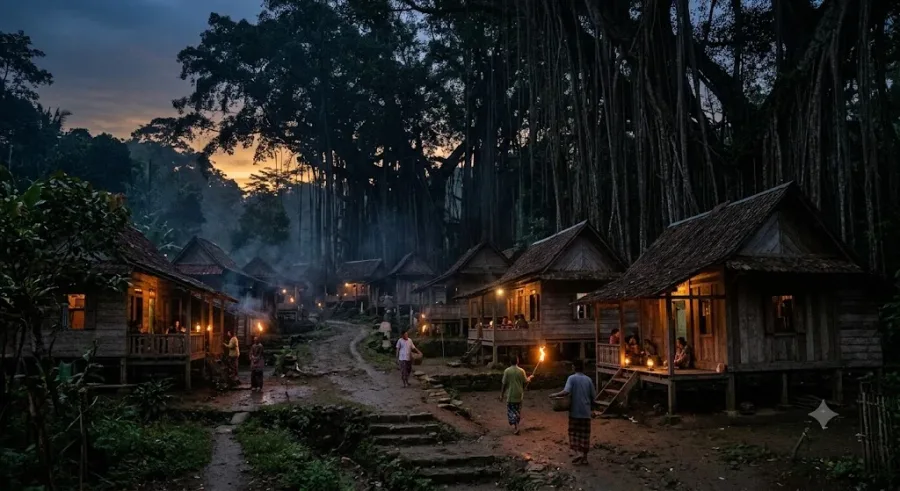
In Indonesia, words related to ghosts, spirits, and supernatural phenomena appear naturally in daily conversation. "A ghost appeared," "I was cursed," "I asked a shaman for help"—these are not fiction, but real, everyday topics for many Indonesians.
Indonesian ghost culture is deeply connected to Islam. Islam acknowledges the existence of spiritual beings called "jin," and it is believed that they can possess or harm humans. This belief has merged with folklore and ghost culture to create Indonesia's unique and rich spiritual worldview.
In Indonesian:
Hantu adalah bagian dari kepercayaan masyarakat Indonesia. (Ghosts are a part of Indonesian society's beliefs.)
Banyak orang Indonesia percaya pada keberadaan makhluk halus. (Many Indonesians believe in the existence of spiritual beings.)
Kepercayaan ini berakar dari Islam, Hindu, dan animisme. (These beliefs are rooted in Islam, Hinduism, and animism.)
Important terms:
・hantu → Ghost/spirit in general
・makhluk halus → Spiritual being/spirit (literal translation: subtle creature)
・jin → Jin. A spiritual being recognized in Islam
・kepercayaan → Belief/faith
・mistis → Mystical/supernatural
Pocong—The Ghost in the White Shroud
The Pocong is the most famous ghost in Indonesia. The reason it feels so real is that the appearance of the Pocong is directly derived from Islamic burial customs.
In Islam, the deceased is wrapped from head to toe in a kain kafan (white burial shroud) and buried with ties at the head, waist, and feet. A Pocong is said to be the spirit of someone whose burial shroud ties were not untied, causing them to emerge from the grave still bound.
Because its feet are bound, it cannot walk and instead moves by hopping—this unique movement is what makes the Pocong "Asia's scariest ghost." It is said that if a Pocong shows you its face, you will die within three days.
It is the character that appears most frequently in Indonesian horror movies, dramas, and games, and the 2006 film "Pocong" was a massive hit.
In Indonesian:
Pocong adalah hantu yang terbungkus kain kafan putih. (A Pocong is a ghost wrapped in a white burial shroud.)
Pocong melompat-lompat karena kakinya masih terikat. (A Pocong hops around because its feet are still tied.)
Jika kamu melihat wajah pocong, kamu bisa mati dalam tiga hari. (It is said that if you see a Pocong's face, you could die within three days.)
Pocong sering muncul di pemakaman dan tempat sepi. (Pocongs often appear in cemeteries and deserted places.)
Key Vocabulary:
・pocong → Indonesia's iconic ghost wrapped in a burial shroud
・kain kafan → Islamic white burial shroud
・terikat → Tied up
・pemakaman → Cemetery/Graveyard
・melompat → To jump/hop
Kuntilanak—The Long-Haired Female Spirit
The Kuntilanak is, alongside the Pocong, one of the scariest ghosts in Indonesia.
The Kuntilanak is believed to be the spirit of a woman who died during or after childbirth. She is depicted wearing a white dress, hiding her face with long black hair, and sitting in trees while letting out laughter. Hearing a high-pitched "kik-kik-kik..." laugh is considered proof that a Kuntilanak is nearby.
The Kuntilanak is said to often dwell in pohon pisang (banana trees) or pohon beringin (banyan trees), and cutting down these trees at night is considered a taboo. It is also said that they like to approach babies and children, so pregnant women and new mothers are advised to be especially careful.
In Malaysia, it is also called "Pontianak," which is the origin of the name of the city of Pontianak in West Kalimantan, Malaysia.
In Indonesian:
Kuntilanak adalah hantu perempuan berambut panjang dan berbaju putih. (A Kuntilanak is a female ghost with long hair and a white dress.)
Dia sering bersemayam di pohon pisang atau beringin. (She often dwells in banana or banyan trees.)
Suara tawanya yang khas menjadi tanda kehadirannya. (Her distinctive laughter is a sign of her presence.)
Kuntilanak dipercaya mengincar bayi dan ibu yang baru melahirkan. (The Kuntilanak is believed to target babies and mothers who have just given birth.)
Key Vocabulary:
・kuntilanak → Spirit of a woman who died in childbirth. White dress, long black hair
・berambut panjang → Long-haired
・bersemayam → To dwell/inhabit
・pohon beringin → Banyan tree
・mengincar → To target/aim for
Genderuwo—The Giant Black Male Spirit
The Genderuwo is a giant male spirit originating from Javanese culture.
It is depicted as a giant entity, 2 to 3 meters tall, entirely black, covered in hair, and possessing red eyes. Contrary to its appearance, the Genderuwo is said to have the "ability to shapeshift," allowing it to transform into a woman to sleep beside a husband or turn into a handsome man to seduce women.
Genderuwo are said to inhabit old houses, abandoned buildings, and the roots of large trees. When one feels that a "Genderuwo is living in the house," it is common to ask a dukun (shaman/medium) to perform an exorcism.
The Genderuwo also has a "sexual ghost" aspect, with folklore suggesting it approaches women at night to make physical contact. This is often told as an "explanation" for the experience of waking up at night and suffering from sleep paralysis.
In Indonesian:
Genderuwo adalah makhluk gaib berukuran raksasa berbulu hitam. (The Genderuwo is a giant, black-haired, supernatural entity.)
Dia bisa berubah wujud menjadi manusia untuk mengelabui korbannya. (It can shapeshift into a human to deceive its victims.)
Genderuwo sering menghuni rumah tua dan pohon besar. (Genderuwo often inhabit old houses and large trees.)
Untuk mengusirnya, biasanya dipanggil dukun. (To exorcise it, a shaman is usually called.)
Key Vocabulary:
・genderuwo → A giant black male spirit. Originating from Javanese culture
・makhluk gaib → Supernatural entity/invisible being
・berubah wujud → To shapeshift/change form
・menghuni → To inhabit/dwell in
・dukun → Shaman/medium/healer
Other Famous Ghosts and Yokai
Beyond the Pocong, Kuntilanak, and Genderuwo, Indonesia is home to a variety of unique ghosts and yokai.
Leak is a yokai unique to Bali, said to be a black magician who has transformed. It is depicted with a grotesque appearance, featuring a severed head flying through the air with its internal organs dangling. Deeply rooted in Balinese Hindu culture, Barong is positioned as the sacred entity that battles the Leak.
Tuyul is a spirit in the form of a small child, a "familiar" that steals money from others for its owner. "Keeping" a Tuyul requires a special ritual, and it demands a strange price in return, such as "raising it like a child and feeding it breast milk."
Wewe Gombel is a spirit in the form of an old woman who is said to kidnap children who are not loved by their parents and raise them as her own. This ghost is often spoken of as a warning against child abuse and neglect.
Jenglot is a small, humanoid, mummy-like creature that is sometimes sold in markets. It is a mysterious entity said to bring good luck to its owner or, conversely, to drink blood.
In Indonesian:
Leak adalah hantu khas Bali yang berbentuk kepala terbang. (Leak is a Balinese ghost in the form of a flying head.)
Tuyul dipercaya bisa mencuri uang untuk tuannya. (Tuyul is believed to be able to steal money for its master.)
Wewe Gombel menculik anak-anak yang tidak disayangi orang tuanya. (Wewe Gombel kidnaps children who are not loved by their parents.)
Jenglot is a mysterious creature that is bought and sold.
Key vocabulary:
・leak → A monster transformed from a Balinese black magician. A severed head that flies through the air
・tuyul → A child spirit that steals money. It is 'kept' as a familiar
・wewe gombel → An old woman spirit that kidnaps children
・jenglot → A mysterious humanoid mummy-like creature
・menculik → To kidnap or abduct
Ghost Culture and Modern Indonesian Society
Indonesian ghost culture remains active today through movies, dramas, games, and social media.
Indonesia is one of the world's leading horror movie nations, and Indonesian horror films boast popularity throughout Southeast Asia. 'Pengabdi Setan' (Satan's Slaves) and 'KKN di Desa Penari' (KKN in the Dancer's Village) are major hits from recent years.
Additionally, there are many project videos on YouTube about 'hunting hantu' (ghost hunting), and late-night explorations of abandoned hospitals, schools, and cemeteries have become popular content.
Belief in ghosts remains widespread in both urban and rural areas, and the custom of performing selamatan (a prayer ceremony for safety) to appease spirits when building new houses or moving continues to this day.
In Indonesian:
Film horor Indonesia sangat populer di Asia Tenggara. (Indonesian horror films are very popular in Southeast Asia.)
Banyak konten YouTube tentang hunting hantu di Indonesia. (There is a lot of ghost hunting content on YouTube in Indonesia.)
Sebelum menempati rumah baru, banyak yang mengadakan selamatan. (Before moving into a new house, many people hold a safety prayer ceremony.)
Kepercayaan pada hantu masih kuat di masyarakat Indonesia. (Belief in ghosts is still strong in Indonesian society.)
Key vocabulary:
・film horor → Horror film
・hunting hantu → Ghost hunting/visiting haunted spots
・selamatan → A ceremony to pray for safety and peace. Sharing a meal to appease spirits
・konten → Content
・kepercayaan → Belief/faith
Summary of Frequently Used Phrases
Here is a summary of phrases that often come up in conversations with Indonesians when discussing ghost culture. The question 'Do you believe in ghosts?' is a very lively topic in Indonesia.
Kamu percaya hantu tidak? (Do you believe in ghosts?)
Katanya di sini sering ada penampakan. (They say there are often sightings here.)
Aku pernah lihat pocong waktu kecil. (I saw a pocong when I was a child.)
Jangan lewat situ malam-malam, angker. (Don't pass by there at night, it's haunted.)
Rumah itu kosong tapi terasa ada yang menghuni. (That house is empty, but it feels like something is living there.)
Key Vocabulary:
・penampakan → Ghost appearance/spiritual sighting
・angker → Haunted/a place where spirits appear (adjective for a location)
・mistik → Mystical/supernatural
・kerasukan → To be possessed by a spirit
・tolak bala → Warding off evil/repelling misfortune
Summary
Vocabulary related to Indonesian ghost and yokai culture:
・pocong → A hopping ghost wrapped in a white burial shroud. Born from Islamic burial customs
・kuntilanak → The spirit of a long-haired woman who died in childbirth. Characterized by banana trees and laughter
・genderuwo → A giant black male spirit. Has the ability to shapeshift and originates from Javanese culture
・leak → A flying severed-head yokai from Bali. An existence transformed from a black magic practitioner
・tuyul → A child familiar that steals money
・selamatan → A safety prayer ritual to appease spirits. Performed for every new home or new business
Points to remember first:
・"Kamu percaya hantu tidak? (Do you believe in ghosts?)" — A classic topic to liven up conversations with Indonesians
・"Angker" — A convenient word to express "haunted/a place where spirits appear"
・"Pocong melompat karena kakinya terikat. (Pocong hops because its feet are tied.)" — Conversations will flourish if you can explain the characteristics of a Pocong
By learning about Indonesian ghost culture, your understanding of the Indonesian spiritual world, faith, and daily life will become deeper, and a little bit scarier 🇮🇩