Shimokita Senrogai is a new 1.7km "town" created by developing the former railway tracks between Odakyu Line's "Higashi-Kitazawa Station" and "Setagaya-Daita Station." Since its full opening in May 2022, this year marks its fifth year already.
While the Senrogai has now completely blended into the daily lives of people coming and going through Shimokitazawa, what kind of changes has it gone through to become a place that can support daily life? Looking back on that journey might lead to discovering new charms of this place that we didn't know before.
Therefore, we gathered three people who have watched over the "Shimokita Senrogai" from the sidelines since its development—Takaaki Mukai and Yuka Jimbo from Odakyu Electric Railway, and Shintaro Uchinuma from Sanposha—and interviewed them in a roundtable format. This is the first part of that article.
※ Scheduled to be delivered in a two-part article (Part 1/Part 2)
Welcoming the 5th year of Shimokita Senrogai
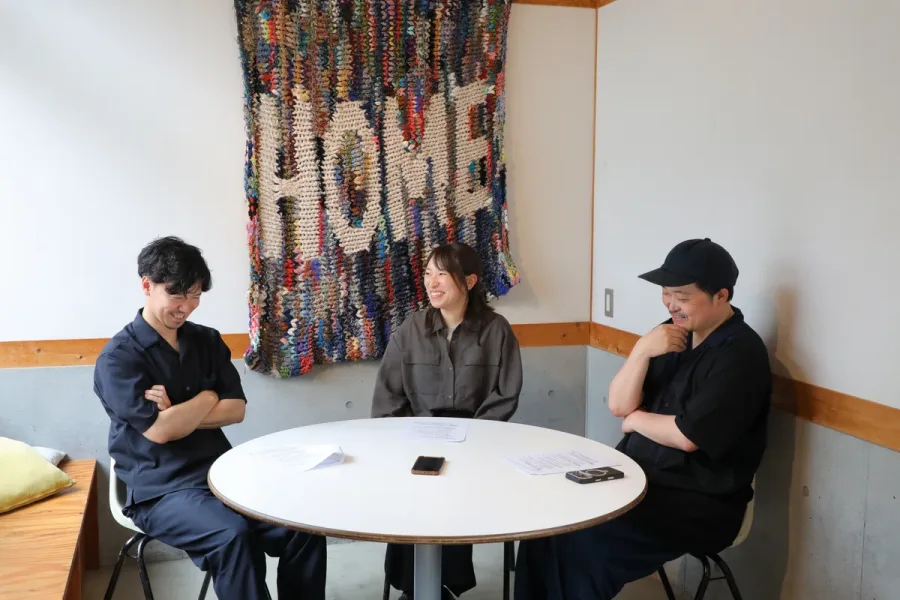
━━First of all, how do you feel looking back on the "Shimokita Senrogai" so far? Especially since you, Mr. Mukai, have been involved since the beginning of the development.
Mukai: I started getting involved in Shimokitazawa around 2015, so it's been about 11 years now.
━━I'd like to hear from the time you started thinking about the development.
Mukai: It started with putting into words what perspective we should use to think about the development. The three perspectives I thought of at that time were a "social perspective," a "regional perspective," and finally, an "Odakyu perspective."
At the time in Shimokitazawa, there were movements against the development, and it was clear that uniform development was not what was wanted. I wanted to create a model case of how we could respond to such social trends and voices by utilizing "individuality" and "diversity" in the development. That was the first "social perspective."
Then, when I actually met various people and walked the streets, I realized that "Daita" and "Higashi-Kitazawa," which I had lumped together under the word "Shimokitazawa," were completely different towns. Once I knew that regionality, I wanted to bring out the good qualities that the town originally possessed, and that was incorporated as the "regional perspective."
And for Odakyu, that time was also a transition period. We were in a flow where we wanted to face what is called "town development"—not just increasing real estate revenue, but "how to create the value of an area or town and make it sustainable"—and think from a broad perspective.
━━Have the three perspectives you just told us about been gradually realized through the Senrogai?
Mukai: Yes, that's right. Of course, there are small issues, and conversely, there are issues that have arisen because we worked from these perspectives, but I feel that what we originally envisioned has been gradually realized.
━━How do you feel about this, Ms. Jimbo, who is also involved in the Senrogai as part of Odakyu Electric Railway?
Jimbo: To start from the premise, I started getting involved in Shimokitazawa around 2020, but I wasn't with Odakyu at the time. I was involved as someone in charge of on-site operations for "reload" within the Senrogai as part of GREENING Inc.
Uchinuma: You were the "reload person," but before I knew it, you had become an "Odakyu person." (Laughs)
Jimbo: That's right. (Laughs) GREENING, which operates <reload>, has the keyword "community development starting from a cup of coffee," and as a company that values creating urban culture through the design of "places" where people gather and relationships are born, I was just doing field-based work at the time, such as interacting with tenants and managing event spaces.
At the beginning of the facility's launch, things were inevitably hectic and my perspective tended to narrow, but as I gradually gained more breathing room, I began to notice the appeal of the entire Senrogai area. I was on the Tohoku-zawa side, but I realized how many interesting things were happening just by walking a little to <BONUS TRACK> in the Daita area.
So, actually, I learned about the development-based story more deeply after joining Odakyu, but the fact that I changed jobs to Odakyu and am working because I felt the appeal and potential of the <Shimokita Senrogai> unit rather than each facility individually feels connected to the three perspectives on development we were talking about earlier.
━━I see. Then, how did you come to be involved with Senrogai, Uchinuma-san?
Uchinuma: When did you come to the <Bookshop B&B>, which was at the previous location, Mukai-san?
Mukai: It was 2017.
Uchinuma: That's right. You came to interview me at the B&B I was running as a "local player." You asked, "What would make you happy about the railway site that is going to be developed?"
That was the trigger, and at first, we decided to think together about how to utilize the place where <(tefu) lounge> is located. After that, I eventually joined the discussion about the place where <BONUS TRACK> is located. It's been 8 or 9 years since I started getting involved with things around Senrogai.
Click here for the detailed secret story behind the launch of <BONUS TRACK> ▼
"Development" and "Tradition": Are they contradictory?
━━Did you go to ask Uchinuma-san for his input with the expectation that he would be deeply involved in Senrogai in the way he is now?
Mukai: No, I wasn't thinking that far ahead; I just felt it would be a plus if I could hear something.
I wanted to hear about the development of Shimokitazawa from people active in various fields like "food" and "culture," so I met with four people, one of whom was Uchinuma-san, and another was Sekiguchi-san (current Director and CEO of GREENING Inc.).
━━That sounds like an amazing twist of fate.
Mukai: But at the time, I think people were thinking, "Isn't this just going to be another uniform development by a big corporation?" and I was keenly aware that I, as someone from Odakyu, was in a completely different layer than the players in the city. It was a start from a distance, like being a bit feared.
Uchinuma: If anything, at B&B, we were even holding events for people involved in anti-development movements. Since I was running a place "in Shimokita" and "independently," to be honest, there was a certain sense of caution at the beginning.
But, it might be a conclusion after the fact, but I think the development of Shimokitazawa is, broadly speaking, a story about "how to protect the tradition of the city of Shimokitazawa." Hiraku Ogura, who owns <Fermentation Department (inside BONUS TRACK)>, also recently wrote a book called "How We Live with Tradition".
━━What is the tradition of Shimokitazawa?
Uchinuma: I think it's a city where young people and "people who aren't quite sure yet" take on new challenges and new things are born.
People often say, "The scenery of Shimokitazawa has changed due to development," and while it's true that the scenery has changed, if you ask why it changed, I think it's to protect tradition. Protecting tradition doesn't mean "doing the same thing as 100 years ago." I think it means updating the place to suit the times so that the core philosophy of the city can be properly passed on to the future.
Thinking about it that way, I feel that Shimokitazawa's tradition has been protected by the development in the sense that there is a place where young people can take on new challenges.
━━Conversely, would it have been difficult to protect that tradition if you hadn't developed it?
Uchinuma:There is a general logic in real estate value that land value increases in places with high foot traffic. The area in front of Shimokitazawa Station also saw land prices skyrocket. Naturally, that means only those who can afford high rent can rent space, so it would have turned into a place for chain stores and "business powerhouses" to operate, let alone young people taking on challenges.
But there was originally an era in Shimokitazawa where it was possible for individual shop-scale people to just try something out. In the past, there were many properties that were easy to challenge in, but as they were repeatedly rebuilt due to aging, the city gradually had less margin for such challenges.
At that time, the area between Shimokitazawa Station and Setagaya-Daita Station, where BONUS TRACK is now, was not the center of the station front, and it wasn't originally a residential area with a lot of foot traffic, but the mission we received from Odakyu was to 'create the Shimokitazawa of the future' in this location. In other words, I think that means 'inheriting the tradition of Shimokitazawa'.
Although BONUS TRACK is a newly built property, it is designed with as much margin as possible, and efforts have been made to keep rent low by minimizing construction costs so that young people can continue to take on challenges. I felt that it was a place where, if new challenges were to arise, the flow of people would eventually follow, thinking, 'Something interesting is happening over there'.
I now feel that this has become a reality.
Both the management and the local people have gained more 'breathing room'
━━I have mainly asked about the development stage so far, but I would like to shift my focus to the subsequent operation.
Are there any initiatives that you feel became important milestones for realizing the 'three perspectives' that Mr. Mukai spoke about or the 'inheritance of tradition' that Mr. Uchinuma mentioned?
Mukai:I think a big reason why Senrogai has been realized in such a good form is that it didn't become a 'consumed tourist destination'.
Senrogai is basically an extension of daily life. I think of it as a place that brings accidental encounters and a bit of edgy fun into daily life, rather than jumping into a different, extraordinary world.
━━So, it is in the midst of daily life that important steps are accumulated.
Mukai:I think events and the like are also quite important, but I think the foundation above all else is that the 1.7km of Senrogai is rich in greenery and safe to walk through.
When stimuli like events are well intertwined with that daily sense of security, vitality is born, making people think, 'Maybe I should try something like this too.' I feel that the energy of small activities is continuously connecting and circulating in that way.
━━The existence of 'energy for small activities' seems to lead to the Shimokitazawa-ness.
Mukai:I feel that the energy itself is something that the city of Shimokitazawa originally possessed, rather than something from Senrogai. I have the feeling that the energy of the city is accelerating because Shimokita Senrogai was created as a stage where individuals can demonstrate the power they possess.
━━Events, in particular, can truly become a 'stage' where that power can be demonstrated. Could you tell us a little more about the events held in Shimokitazawa and Senrogai?
Mukai: As a premise, I think it's amazing that the town's traditional festivals have continued for so long. Bon Odori (this year 7/25, 7/26) and Tengu Matsuri—there is a lot of energy in the fact that local people, separate from Odakyu, have been enthusiastically continuing these unique, long-standing events together.
I think it's even better that, alongside those traditional events, different types of events like the 'Shimokitazawa Curry Festival,' and newer but thematic ones like 'Moon Art Night Shimokitazawa' and 'Shimokita Senro-sai,' have started because of Senrogai and now coexist in the town.
It's not that all the festivals and events are blending into each other, but the state of them each being held and coexisting is something I feel has become stronger over these five years.
*For the latest information on 'Moon Art Night Shimokitazawa,' please check this official Instagram.
Jimbo: Also, what I think is that events like 'Shimokita Senro-sai' and 'Moon Art Night Shimokitazawa,' as well as daily life, have all gained more breathing room over the past five years.
━━By 'everyone,' do you mean the management members?
Jimbo: That's right. The teams involved in event management and the participating shops have gradually developed a desire to 'surpass last year's event.' Exchanges of opinions have become more active, and we've started receiving proactive advice from the shopping districts that join us as co-organizers.
But it's not just about events; in daily life, I feel like everyone in the town has more breathing room. For example, when <reload> first opened, I think customers felt like, 'I don't know how to spend time here,' 'I don't know what kind of shops are here,' or 'I don't even know how to use this place.'
But now, many people come with their dogs, and more people are working or doing what they like on the outdoor chairs; it feels like everyone has gotten used to how to use the space. When that happens, I think a sense of breathing room naturally emerges across the entire Senrogai, allowing us to take the next step of, 'Well then, let's try doing this next.'
The interaction between daily life and events
━━I'd like to ask Mr. Uchinuma about this as well: how do you perceive the connection between events that require gathering people intensively and the daily life where people pass through naturally?
Uchinuma: I think <BONUS TRACK> and Senrogai are really great places, and the first premise is that I feel the amazingness of being able to use these plazas freely.
That's because, when looking from the side of daily life, it's easy to understand that 'it's nice to have an event occasionally,' but in fact, from the perspective of those who want to hold events, there are many cases where 'it's better to do it within daily life.'
There are many types of event spaces that are just plain white square galleries, or just big boxes that can hold a lot of people, where they say, 'There's nothing here, so please go ahead and gather people yourself.' But for most people who aren't professionals at holding events in such places, the hurdle to doing something there is really high. Therefore, there is a strong demand to be grateful if one can show what they are doing in a place where there is already a flow of people.
Thinking about it that way, event spaces like <BONUS TRACK> aren't actually that common in the world. People who have participated in events often tell me, 'I'm happy that people come specifically for it, and I'm also happy that people who just happen to be passing by can see it.'
━━I think this means 'making events a part of daily life' in a sense, but isn't that difficult for the management?
Uchinuma: I also run a shop called <Bookstore B&B>, where I've been 'holding events almost every day' for 14 years. From the perspective of the side managing the events, if you only have an event once a week or once a month, the day of the event certainly becomes a 'difficult day.' Because it's extraordinary, it becomes painful just on that day. But when you do it every day, it becomes like, 'Well, it's night again, shall we prepare?'
That's the same for Sanposha (the operating company of BONUS TRACK); if you create a base where you are basically doing something every Saturday and Sunday, the people who come will shift their thinking to 'I wonder what's on this week,' and those doing it can also shift to the mindset of 'We have that this week.'
It's hard every weekend, but instead of saying, 'It's hard because we have that this week,' we just make it like, 'This is what's on this week.' I think being able to stay in that mindset is very important for management.
━━So the experience at B&B is influencing Senrogai in that way.
Uchinuma: That's right. I don't think any other management company besides Sanposha would have the idea of holding events every weekend. But rather than doing something big and flashy, we were quite conscious from the very beginning about creating a space where we could do something every week, even if it was small. It makes it easier to conduct small experiments that way.
It's special for the people who come, but if it's special for the people running it every single time, they'll get tired and it won't last. So, I don't think I would have been able to imagine how to create a fresh experience while making it a routine in terms of mindset if I hadn't been running B&B.
Jimbo: Things like the fireworks project in the summer or the rice cake pounding at New Year's are common, everyday seasonal events, but I also feel that they take on a special color precisely because we are doing them at BONUS TRACK.
When it comes to fireworks, for example, there's a fireworks buffet from a slightly unusual and cute fireworks shop, or the atmosphere we create where everyone shares the fire. The fact that scenery you can only see in this place is repeated on a daily basis is also a very good stimulus for Odakyu.
Mukai: We are getting a huge amount of stimulation from Sanposha regarding how to perceive a space, the definition of an event, and the way of thinking about things in the first place.
Jimbo: I think so too. I learn something new every time from the surprises, like 'People actually come for this kind of content' or 'This scene can be so emotional and fun.'
Even with the New Year's rice cake pounding, if you just hear the words, you might think, 'Is it a bit plain?' or 'It's just normal, right?', but the excitement and atmosphere that actually happen can only be created here, and the sense of groove that suddenly builds up from the everyday is really great.
We are now having Sanposha help us plan the 'Shimokita Senro-sai' and 'Moon Art Night Shimokitazawa' as well, so I would like to create the atmosphere that is happening at BONUS TRACK in events that involve the entire Senrogai.
Also, I feel that being able to pay attention to this kind of 'atmosphere' is a perspective that was finally born in the last few years as we ran toward the 5th anniversary of Senrogai.
<Continued in Part 2>
Photo / Daiki Tateyama Reporting, Text, and Editing / Alisa