The path of life is like a hike; proceed along a road of ten thousand ups and downs.
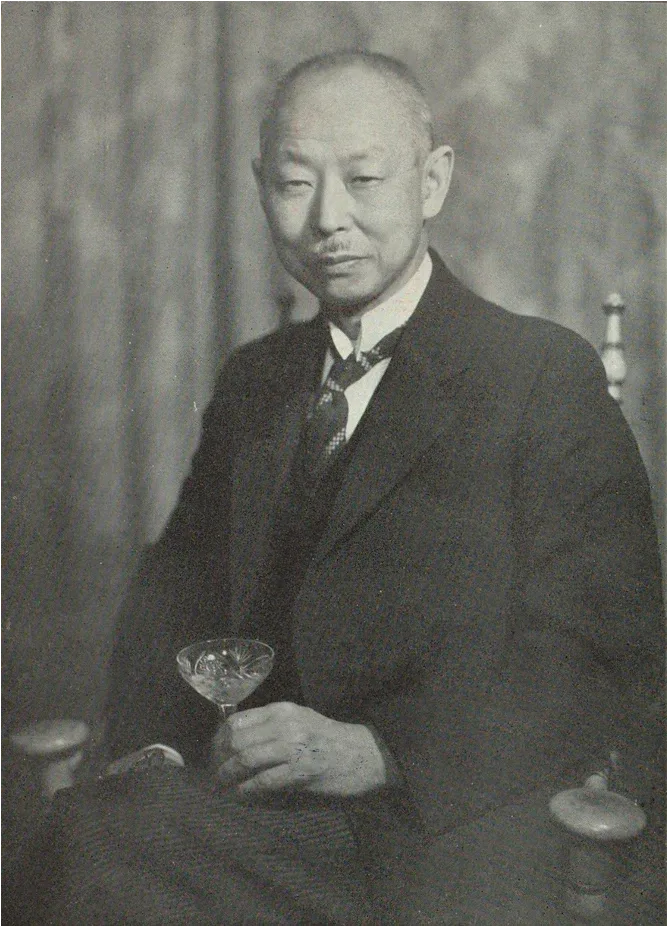
Yoshisuke Aikawa (1880–1967)
Hiding his status to become a factory workerYoshisuke Aikawa, born in Yamaguchi in 1880, was the nephew of Kaoru Inoue, a hero of the Meiji Restoration, through his mother. Thanks to that connection, he attended the Mechanical Engineering Department at Tokyo Imperial University while living as a student at the Inoue residence in Azabu-Uyamada. Inoue recommended that Aikawa join Mitsui after graduation. However, Aikawa, who had decided to follow Yukichi Fukuzawa's philosophy of independence and self-respect, hid not only his educational background but also his social status to take a job as a finishing worker at Shibaura Engineering Works (now Toshiba). Incidentally, at the time, the monthly salary of an engineer was about 45 yen, while the starting salary for a finishing worker was 48 sen per day.
During his time as a worker, Aikawa went on factory tours every Sunday, bringing his own lunch. This continued for two years, and from this experience, he realized that "the companies succeeding in our country are those imitating the West." At the time, Aikawa had become a foundry worker, and there was no one in the country he could look up to as a master in this field. He decided to go to America to train. This was in 1905.
After two years of foundry training in America, Aikawa returned to Japan and spoke to Inoue about the future potential of the foundry industry. With the support of his sister's husband, Fusanosuke Kuhara, and the Fujita family, he established the Tobata Casting Company in Tobata, Fukuoka Prefecture. Although the company's management did not improve for several years after its founding, it rode the wave of the World War I economic boom to become a large organization with over 800 employees.
Forming Japan's largest corporate groupThe war brought another turning point for Aikawa. In 1928, when Fusanosuke Kuhara's Kuhara Mining was on the verge of bankruptcy due to the end of the war, Aikawa was chosen as its savior. Aikawa introduced a holding company system, building a pyramid structure—a concern—with subsidiaries and sub-subsidiaries such as Kuhara Mining and Hitachi, Ltd. under Nippon Sangyo Co., Ltd., or Nissan. He also made Nissan's shares available to the public, restarting it as a so-called public concern. Although the company's stock price was sluggish at first, when the price of gold rose and the shares of its subsidiary, Kuhara Mining, increased in value, Nissan's stock price also surged from 12.50 yen to 150 yen at once.
Using his abundant capital, Aikawa also entered the automobile manufacturing industry and, at the government's request, became the president of the Manchuria Heavy Industry Development Company (Mangyo). Furthermore, he turned Nissan into a Manchurian corporation, and at its peak, he formed the largest corporate group in Japan, with 31 companies in Manchuria and 63 companies in Japan proper, with a total capital exceeding 2.2 billion yen. However, after World War II, he was sent to Sugamo Prison as a Class A war criminal, and he also suffered hardships such as resigning from his seat when he was elected to the House of Councillors for the second time due to his son's election law violation.
In his essay collection "Hyakumi Dansu" (The Hundred-Flavor Chest), Aikawa stated, "The path of life is like a hike. Flat roads and courses with little change have no interest at all," and his 86-year life was like hiking a course with ten thousand ups and downs.
During his time as President of Manchuria Heavy IndustryIllustration drawn by Yoshisuke Aikawa
【A brief word】
Right now, Nissan Motor is facing a major crisis. Since it is one of Japan's leading companies with roots in Yoshisuke Aikawa, I certainly hope for a V-shaped recovery.
Next time, it will be Yataro Iwasaki, who built the massive Mitsubishi zaibatsu. Look forward to it.
※ ※ ※
The content of this article is also introduced in a YouTube video.
You can watch it in detail from the link below.
The content introduced in this article is an excerpt from my book "Footprints of Economic Greats [Revised and Expanded Edition]" (FLoW). If you would like to read more, please see here.