Hello!
In recent years, search engines like Google Search have evolved tremendously, and the number of users searching for information in new ways using generative AI (such as AI Overviews) is rapidly increasing.
Many creators, web managers, and individuals running businesses may be feeling anxious, wondering, "With the AI era in full swing, will traditional SEO measures become meaningless?"
Amidst this, on May 15, 2026 (local time), there was a very important announcement on the official Google Search Central Blog. Google has officially released a new resource (guide) titled "Optimize your website for Google's generative AI features."
In this article, I will explain the contents of this latest official guide in an easy-to-understand manner and unravel the roadmap for web publishing, focusing on what kind of content we should create from now on.
Background behind Google's release of the new optimization guide
According to an announcement by Google's John Mueller, the number of users utilizing generative AI experiences in search is steadily increasing.
Accordingly, this new official guide was created to help website owners, SEO specialists, and developers correctly understand "how to properly display content in Google's generative AI features and improve performance across search as a whole."
This is the first time that specific perspectives for creating "content that is evaluated and chosen by AI" have been presented by Google as a systematic guide.
5 Key Points revealed by the new guide
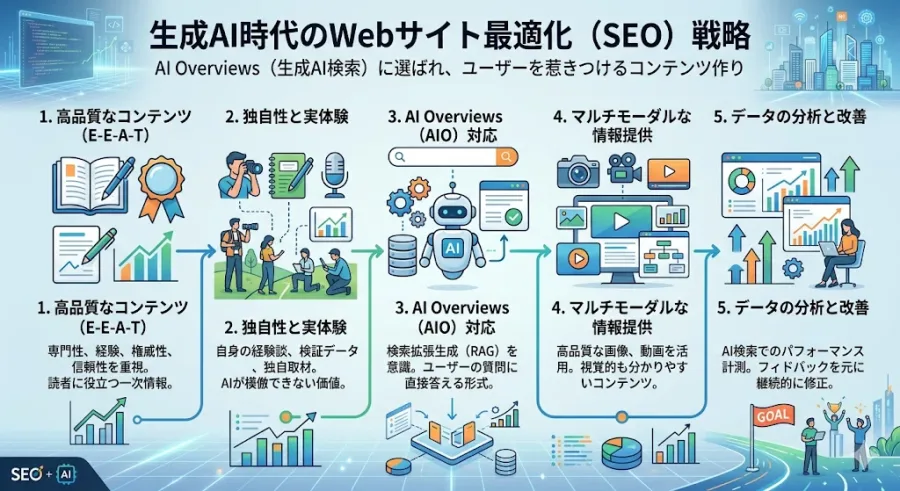
The newly released optimization guide ("Optimize your website for Google's generative AI features") contains important guidance mainly on the following five themes.
1. The importance of valuable "originality"While AI is good at summarizing and combining existing information on the internet, it cannot create primary information, unique perspectives, or content based on gritty, real-world experience on its own. That is why "valuable, original content" created by human creators is more important than ever. Creating content that no one else can imitate, by combining your own expertise and practical experience, will be your greatest weapon.
2. Optimization tips for local, shopping, images, and videosGenerative AI search results go beyond simple text summaries. They are deeply linked to multimodal (diverse format) information, such as local store information (local), product data (shopping), and visual information (images/videos). Tips are provided on how to provide information according to the characteristics of each type of content.
3. Dispelling common misconceptions about "AEO / GEO"In the recent SEO industry, terms like "AEO (Answer Engine Optimization)" and "GEO (Generative Engine Optimization)" are buzzing around as new measures for AI search. In this guide, Google clears up "common misconceptions" about these new concepts and explains the essential approach. It is important not to be swayed by superficial hacks or techniques.
4. Initial guidance on rapidly evolving "AI agents"The evolution of "AI agents" that autonomously perform tasks on behalf of users and crawl the web to gather information is remarkable. The guide outlines the policy on how websites should face these rapidly evolving AI agents and what initial steps should be taken.
5. Traditional SEO best practices are the "greatest foundation"The point most emphasized in this guide is that "traditional SEO best practices remain effective and serve as the foundation for success with Google's generative AI features." Thoroughly mastering the basics—such as creating high-quality content, proper structured data markup, and user-first site design—is ultimately the strongest strategy even in the AI era.
What creators and practitioners should implement right now
The survival strategy for the future that can be deciphered from this official announcement is the combination of "faithful-to-the-basics web design" and "unique expertise and real-world experience."
In the modern era, even without a high-spec PC, anyone can perform advanced information organization and technical verification by utilizing cloud environments and convenient AI tools (such as NotebookLM). By leveraging such environments to actually get hands-on in your own field of expertise (business, technology, or specific industry practices), the "real reports" and "verification data" you produce will become exactly the highest quality primary information that AI cannot imitate.
The important thing is not to fear the rise of AI, but to use AI and IT tools wisely while steadily building up "valuable content that only you can write."
Summary
The new resource released by Google can be taken as a powerful message of encouragement to us creators, stating that "just because it is the AI era, the essence of what we should do does not change. Rather, the value of the uniqueness emitted by humans is increasing."
Let's not be swayed by trendy buzzwords, but instead cherish the basics while pouring the value that only you can provide into your content!