Last time, I wrote about my defeat.
I tried to recreate Touhou: Embodiment of Scarlet Devil in a browser by teaming up with AI, but after two days, I was stuck at an incomplete Stage 1. The remaining workload would take years. I froze the project. I wrote, 'Even with AI, I cannot reach a perfect recreation of a game ZUN made by himself in 2002. The correct answer isn't in the code, but in ZUN's intuition.'
In that article, I talked about a high school student who started porting Touhou: Perfect Cherry Blossom to the PSP during spring break in 2009. Using cygwin, PSPSDK, the Ryujinroku sample, and his own rendering code. In an era without AI, he made it to the Stage 1 mid-boss in a month. I paid my respects to that student and closed the article.
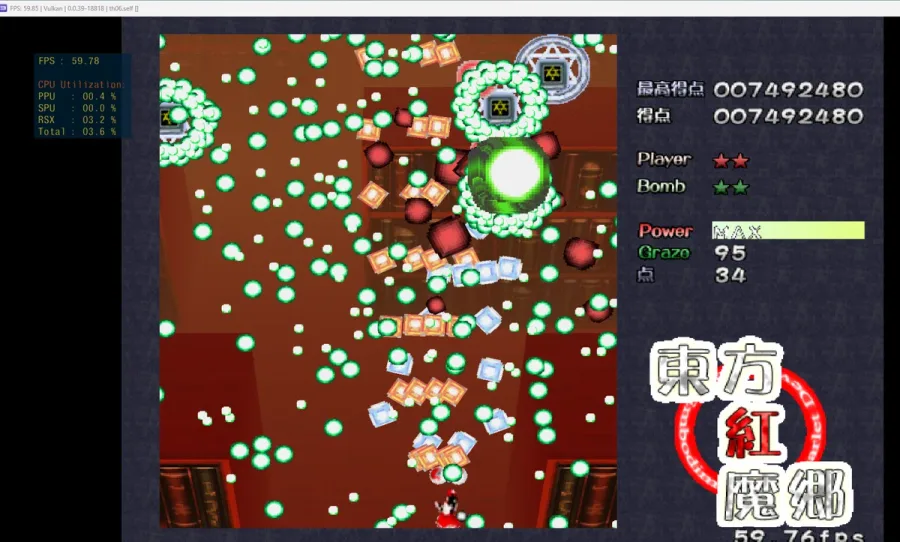
Six months have passed since then. Now, on the PSP in my hands, Embodiment of Scarlet Devil, Perfect Cherry Blossom, and Imperishable Night are running. All stages, on real hardware, at 60fps.
My conclusion from last time was wrong by only one word.
The true nature of the March defeat
I had read the cause of my previous defeat as 'not enough AI.' I was wrong. The method was wrong.
What I did in March was rewrite the virtual machine running inside Touhou: Embodiment of Scarlet Devil in JavaScript. I had the GensokyoClub decompile (a volunteer project that decompiled the original executable back to C language level) on hand. But I read it as 'analysis material,' told the AI its specifications, and tried to rebuild it in a different language.
In short, this was manual copying. Placing the real code to the side and creating something similar from scratch. No matter how carefully you read it, a human cannot convey every single numerical value dissolved between the lines to an AI. The wall I wrote about last time—'I can't convey the correct answer to the AI'—was right there.
I should have just run it instead of trying to rebuild it.
The decompile is not analysis material. It is source code that runs if you build it. It took me four months to realize that.
Bridgehead
What made me realize it was an existing Switch port.
https://gbatemp.net/threads/touhou-6-switch-port.682936/
The GensokyoClub decompile has a portable version that replaces parts dependent on DirectX 8 with SDL. The consistency rate with the original is 97.65%. And someone had run it on the Nintendo Switch. The decompile can be built. Moreover, it runs on other hardware. The fact that I didn't notice in March was right there.
Using the Switch port as a bridgehead, I turned toward the PS3.
The reason is simple: the PS3 is the hardware I have spent the longest time with. The quirks of each Cell core, direct control of the RSX, and the path to send programs to the real hardware had already become my own tools.
Recreating DirectX 8 with RSX
The most difficult part of the PS3 port was reproducing the rendering of Embodiment of Scarlet Devil on the PS3's GPU (RSX).
Embodiment of Scarlet Devil was written in DirectX 8. It is rendering from the era of the fixed-function pipeline. Texture composition modes, alpha blending, and render target switching. I had to replace these one by one using the RSX low-level API. Up to this point, it was within the scope of my expectations.
What I didn't expect was two days of the measuring instruments lying to me.
From a certain point on, all semi-transparent composition was wiped out. The outlines of bullets disappeared, effects became opaque squares, and bomb light effects became solid fills. There appeared to be six symptoms. They each took the form of bugs common in ports from DirectX 8: incorrect texture color order, misaligned UV coordinates, or missing composition mode specifications. I chased all six, and all six were dead ends.
There was only one root cause. After switching render targets, the RSX does not maintain the blend state. It must be re-issued every time you switch. Because I wasn't doing that, SRC_ALPHA composition had been disabled ever since the first switch. A single state management error was mimicking six different types of bugs.
It wasn't me who identified this bug, but another AI I was using. I was chasing the six symptoms, and the AI said, 'Don't look at the symptoms, question the common premise.'
On July 28, 2026, Embodiment of Scarlet Devil was fully cleared on actual PS3 hardware, running all the way to the ending. 60fps, with a processing drop rate of 0.7%. I made it so that it only launches when the original CD is inserted, and not a single byte of the original data is included. This is the line I drew to avoid interfering with ZUN's sales.
In my previous article, I wrote, 'Even the author himself can no longer build Embodiment of Scarlet Devil in the same environment as back then.' That Embodiment of Scarlet Devil ran on a 2026 PS3.
The person who was making the same thing in the same week
A few days after I released it, I found my port being introduced in a Touhou decompilation community (Discord).
And that was when I found out. In the same week as me, someone else had been making the same PS3 port. Looking at the commit history, they were two days ahead of me.
Two people in different places, from the same decompilation, to the same console, in the same week. This wasn't so much a disappointment as it was a story of my bad timing. If I had looked just one week earlier, I wouldn't have had to reinvent the wheel twice.
The other author ran my version on actual hardware and wrote a comparison for each item: resolution, CD requirement, sound effect overlapping, and lack of keyboard support. I replied with thanks and an introduction. It was English through a translation tool, but it got across just fine. In the end, the person I communicated with most effectively in that community was this person.
And at this time, I encountered a certain word for the first time.
slop
'Slop' is slang for low-quality content generated by AI. My port was called that, with the addition of 'ZERO human work'.
At first, I took it straight as an insult. Now I see it a bit differently. In that community, the word 'slop' is almost like a greeting. Members call themselves 'I am slop' and refer to each other by adding 'slop' to their names. The vigilance against whether something is AI-made is real, but the word itself is light. I also wrote later, regarding my next port, 'Please look forward to the birth of new slop.' That changed the atmosphere.
However, there is one thing I thought about at that time. That port, which was called slop, was something that no one had been able to complete in the world of the PSP for 17 years.
'It's impossible with HTML'.
I talked about the browser porting project from March in the community.
I don't remember the exact reactions, but they boiled down to two points: "That method won't work," and "Someone else is doing it using a different method." There was already an attempt to run decompiled code directly in the browser via WebAssembly.
Don't rebuild it, just run it. The reason for my failure in March was summarized from the outside in one sentence.
So, shall I port Embodiment of Scarlet Devil to the PSP?
The high school student from my previous article had been on my mind the whole time.
If it worked on the PS3, it should work on the PSP. The foundation of decompilation is the same; the only difference is the hardware constraints. A handheld from 2004, with a 333MHz CPU, 32MB of main memory (64MB in later models), and a 480x272 screen. It's a different league from the PS3. But in 2009, a high school student managed to get to the stage 1 mid-boss on this device.
August 4, 2026. I started working on the PSP from the morning.
At first, I tried software rendering. 5fps. The colors were glitched to blue. When I switched the rendering to the PSP's GPU (GE), it was full of bugs but hit nearly 60fps. I reached the demo play in the emulator (PPSSPP). When I sent it to the actual hardware, it terminated normally because I hadn't placed the original game data. Once I placed the data, it stopped because the initial camera direction was a zero vector, causing normalization to fail. After fixing that, the demo ran on the actual hardware.
That night, I completed Embodiment of Scarlet Devil on the actual PSP from stage 1 to stage 6, all the way to the ending.
It only took a few days. The foundation I had built on the PS3 (how to read decompiled code, how to replace rendering, the procedure for finding traps on actual hardware) worked perfectly on the PSP.
I released it. In the PSP homebrew community, it was read as technical content in a channel where the author of ME (mentioned later) is present.
In the decompilation community, the initial reaction was "slop" again. But a few hours later, they told me, "There is no precedent for a PSP port" and "The fact that you aren't distributing the original assets is commendable," and the discussion settled down.
I learned from their own mouths that I had become the first person to run Embodiment of Scarlet Devil on a PSP.
Perfect Cherry Blossom ─ A sequel 17 years in the making
If Embodiment of Scarlet Devil could run, the next one is Perfect Cherry Blossom. That is exactly the place where the high school student from before stopped.
Here, I want to write about what happened after that high school student.
During spring break in 2009, the high school student got as far as the stage 1 mid-boss of Perfect Cherry Blossom. For the boss, Letty, he had her fire danmaku from the Ryujinroku sample and displayed "Letty's danmaku not made yet" on the screen. In the video's comment section, there remains a nonsensical post: "Just open Notepad and match the PSP format lol, I did this in middle school lol." (Yeah, right, as if...) In 2011, someone else started a PSP port of Embodiment of Scarlet Devil, but it stopped after 2 days, 31 commits, and 991 lines. In 2012, yet another person challenged Perfect Cherry Blossom, but since DX Library lacks 3D rendering, they faked the stage 1 background with pseudo-2D and stopped at the character selection screen.
All three of them stopped at the wall of stage 1.
Why? Because all three of them were written on top of wrappers. Once you're riding on top of things like the Ryujinroku sample or the DX Library—those 'layers for drawing easily on the PSP'—you can't touch the performance the PSP actually possesses. And there's another thing: none of the three were using the PSP's second CPU.
What Sony kept locked away
In addition to the main CPU that was disclosed to game developers, the PSP has another CPU core with the same structure. It's called the ME (Media Engine), and Sony only ever publicly stated it was for 'media processing.' That was the extent of the explanation: it was used for video playback. It was only through the analysis of the homebrew community in later years that it was discovered to be a MIPS core identical to the main CPU, capable of general calculations. A library (MECC) that made it usable by anyone was released after 2024, and finally, 'using the second core for bullet calculations' became a reality.
The same thing applies to memory. Later PSP models have twice the officially stated memory for the GPU. It makes sense if you consider it an area increased for the TV output function, but it was hidden so that games couldn't see it. The means to unlock that have also been found through community analysis.
The clock speed is the same. The PSP's CPU is capped at 333MHz, but the internal clock generator can go faster. It was known that it could be raised to 443MHz with custom firmware.
I don't think Sony locked these away because it was technically impossible. As long as millions of early PSP models were being sold, unlocking performance that could only be used on later models would break game compatibility. The memory bandwidth wouldn't keep up, so just making the core faster wouldn't be as effective as expected. And if you allowed full power at all times on a handheld, the battery wouldn't last. Compatibility, bandwidth, power. Sony had three reasons to 'not do it'.
I didn't have those three reasons. With homebrew software where I didn't need to worry about compatibility, and because I'd be using it plugged in so the battery didn't matter, I could just measure the bandwidth limits in logs and avoid them. The conditions for an individual 20 years later to do what Sony didn't just happened to all be there.
Perfect Cherry Blossom, cleared on real hardware
For the foundation of Perfect Cherry Blossom, I was allowed to use the th07 decompile by Some100. It was something I confirmed with GensokyoClub as a 'decompile guaranteed by the community'.
I combined the ME with the rendering foundation I built for the Embodiment of Scarlet Devil PSP port. The main CPU handles game progression and rendering, while the ME handles bullet updates, hit detection culling, and sound effect synthesis. It's an asymmetric design where the two cores share the load. I write the display list directly to the GPU without going through a wrapper. I placed the conversation character portraits in the hidden memory of the later models.
To write the result first: I cleared Perfect Cherry Blossom from Stage 1 to Stage 6 on real PSP hardware on Lunatic. Since it doesn't stick to 60fps in the heaviest scenes of the final stage at the native 333MHz, I also included a constant-speed mode that drops the rendering to 30fps while keeping the game progression speed the same (the same philosophy as the frame rate setting in the original game). With the clock raised, the final spell 'Reflection of Youth' runs at 59fps while blooming hundreds of bullets across the screen.
17 years since the screen where a high school student in 2009 made Letty fire Ryujinroku bullet patterns. On the same machine, the same game now runs in its entirety.
I hadn't planned on supporting the early PSP models (32MB of memory). The trigger was one tester.
After I released Perfect Cherry Blossom, I received a friend request from one of the GensokyoClub members. They were someone who could speak Japanese even while using translation, and they ended up testing it on an early PSP model. When asked, 'Is it true that Touhou 7 doesn't work on the 1000?', I replied, 'I tried it just now and it didn't even boot; the power cut out. But I'm working on support for it now.' A few days later, I got a message from them saying, 'I made it to Stage 3, it was wonderful.' Support for the early model is a feature I added for this person.
I also received a reply on X (formerly Twitter) from someone else saying, 'I'm enjoying it without irony, I've been playing TH7 for two days, this is the first time I've properly touched the Touhou Project.' The fact that the PSP version became someone's first Touhou might be the thing I'm happiest about with this port.
When I uploaded the video, it was viewed about 4,000 times. It's not a large number, but it was a video that no one had been able to upload for 17 years.
Imperishable Night ─ Even if you can't reproduce the feeling, you can match the calculations
The third one is Imperishable Night.
There is something I must write here first. The decompile I used as the foundation for Imperishable Night is not an official GensokyoClub decompile. It is a decompile generated by AI by a volunteer, which is outside the community's guarantee. When I released it, I received advice from the community: 'Since it's not guaranteed, we can't help if it breaks; you should wait for the official version and polish Embodiment of Scarlet Devil and Perfect Cherry Blossom instead.' I decided to proceed at my own risk, and instead, I clearly stated in the README that 'this port is based on an AI-generated decompile unrelated to GensokyoClub, and GensokyoClub does not support this port.' The community requested that 'if you used AI, please disclose it very clearly,' and I complied with that.
With that said, what I want to write about most regarding Imperishable Night is the answer to the conclusion of my previous article.
Last time, I wrote that "ZUN's intuition cannot be reproduced." That still holds true. I cannot recreate the way the danmaku spreads, the timing of enemy appearances, or that specific tactile feel on my own.
However, it is ZUN's code that is running it. If that is the case, the calculations should be able to be matched.
For the Imperishable Night port, I created a system that runs the original PC version as-is, records the state of the random numbers, coordinates, and score for every frame, and compares them against the PSP version. I play back the original replay on the PSP and verify frame by frame whether it is drawing the same random numbers at the same frames as the original.
At first, the player character died at 55 seconds into Stage 1. There were two causes. One was a misinterpretation of the conditions for item collection. The other was that in the processing when a boss is defeated, the timing for freeing the effect area was off by one block compared to the original. In the original, the generation that should have failed because the effect frame (512 slots) was full succeeded in the port, and the random number consumption shifted by one there. That single shift killed the player character dozens of seconds later.
After fixing those two things, the random number states matched the original perfectly for 10,118 frames in Stage 1, 13,068 frames in Stage 2, and 7,808 frames in Stage 3 (within the range where records could be taken).
ZUN's intuition cannot be reproduced. But I was able to make ZUN's calculations match bit by bit. This is my answer to the "unreachable" conclusion from last time.
I'll also mention one thing about performance. Imperishable Night is the heaviest of the three. In addition to the same ME allocation as Perfect Cherry Blossom, I stripped out the OpenGL-style wrapper (PSPGL) that was sitting at the entrance of the rendering process and changed it to feed display lists directly to the GPU. Through the wrapper, there was a fixed cost of 40 microseconds per draw call, which accumulated for every bullet on the screen. Once I stripped it out, that fixed cost disappeared. The video showing it reaching 60fps on actual hardware was viewed about 19,000 times.
I am currently working on getting it to run on an original model PSP (32MB). It boots up to the title screen. I need a few more MB to enter the stages. Packing a 2004 game into 2004 hardware, whether AI is involved or not, ultimately comes down to manual work, one byte at a time.
How many people were there?
I want to answer the phrase "ZERO human work" here. Not with a rebuttal, but by counting.
The people who spent six years creating the decompile of Embodiment of Scarlet Devil. The person who ported it to the Switch. The person who created the decompile of Perfect Cherry Blossom. The person who generated the decompile of Imperishable Night using AI. The person who analyzed the PSP's second core and turned it into a library (I asked this person questions directly and received answers). The people who left notes on bulletin boards about the quirks of the actual PSP hardware. The person who verified my port on actual hardware from the decompile side. And, the high school student from 2009.
AI was a tool for me to bundle the achievements of these people. Behind what looked like the work of one person, there are this many people, even just listing their roles. The number of humans is actually higher than the three people in the past who took on the challenge by hand alone.
And many of these people didn't even know it at the time I was using their work. They participated asynchronously in the form of published code and logs. So the only thing I had to do was write down that I used what I used. I wrote that the foundation of Perfect Cherry Blossom was Some100's decompile, that the foundation of Imperishable Night was an unsupported AI-generated decompile, and I wrote that I was using AI in the very first line. Just by doing that, the atmosphere in the place called "slop" changed. At least to the extent that it could be received with goodwill.
The Era of Restoration
In the week I am writing this article, the official remake of Touhou Embodiment of Scarlet Devil (New Classic) was released. A reproduction version from 2002 is also included. Footage of Embodiment of Scarlet Devil played on the big screen at the Shibuya Scramble Crossing.
In the same week, the official side was running Embodiment of Scarlet Devil on modern machines, and I was running Embodiment of Scarlet Devil, Perfect Cherry Blossom, and Imperishable Night on a PSP. The methods are exact opposites. They remade it, and I ran what was unearthed.
In my previous article, I wrote, "Even the author himself can no longer build it." I will correct that. It could be built. ZUN's 2002 code was restored by volunteers and is running on 2026 PS3s and PSPs.
What cannot be reproduced is the intuition. That is still something no one can do.
However, there are things you only understand once you try running it. That inside the code ZUN wrote alone, including the behavior when the effect frame is full, there was a determinism from the very beginning that allows it to be played back on a handheld device 24 years later without a single frame of deviation. Last time, I wrote that there are things that can only be told by a story of failure. This time is a story of success, but what needed to be said was the same. ZUN's unfathomable depth is something you only understand once you try running it.
Next, I intend to start from the ground up on a work that no one has decompiled yet.
This article is published for free. Given the nature of the subject matter, I will not be charging for it. If you find it interesting, I would appreciate it if you could leave a tip.
The source code for the trilogy is available on GitHub. It does not include the original game data. To play, you absolutely must provide the original PC version yourself.
Embodiment of Scarlet Devil: https://github.com/kan8223-dotcom/th06-psp-native
Perfect Cherry Blossom: https://github.com/kan8223-dotcom/th07-psp-native
Imperishable Night: https://github.com/kan8223-dotcom/th08-psp-native
Video from a high school student in 2009The reaction when I informed the creator