Autumn 2025.
Across social media, the tone surrounding “generative AI music” is shifting.
A few months ago, the discourse was dominated by fear and rejection.
Now, more voices are beginning to acknowledge reality:
AI as an inevitable part of creation — something to adapt to rather than fight.
And yet, resistance remains.
One particular group stands out for its persistent opposition: Vocaloid producers, or Vocalo-Ps.
Ironically, they were once the very symbol of human creativity merged with technology.
So why have they become the most vocal critics of generative AI?
To understand that, we need to look not only at music,
but at the entire cultural ecosystem surrounding Vocaloid —
a world shaped by otaku aesthetics, doujin (independent) production, and illustration-driven storytelling.
1. From Controlling the Machine to Being Replaced by It
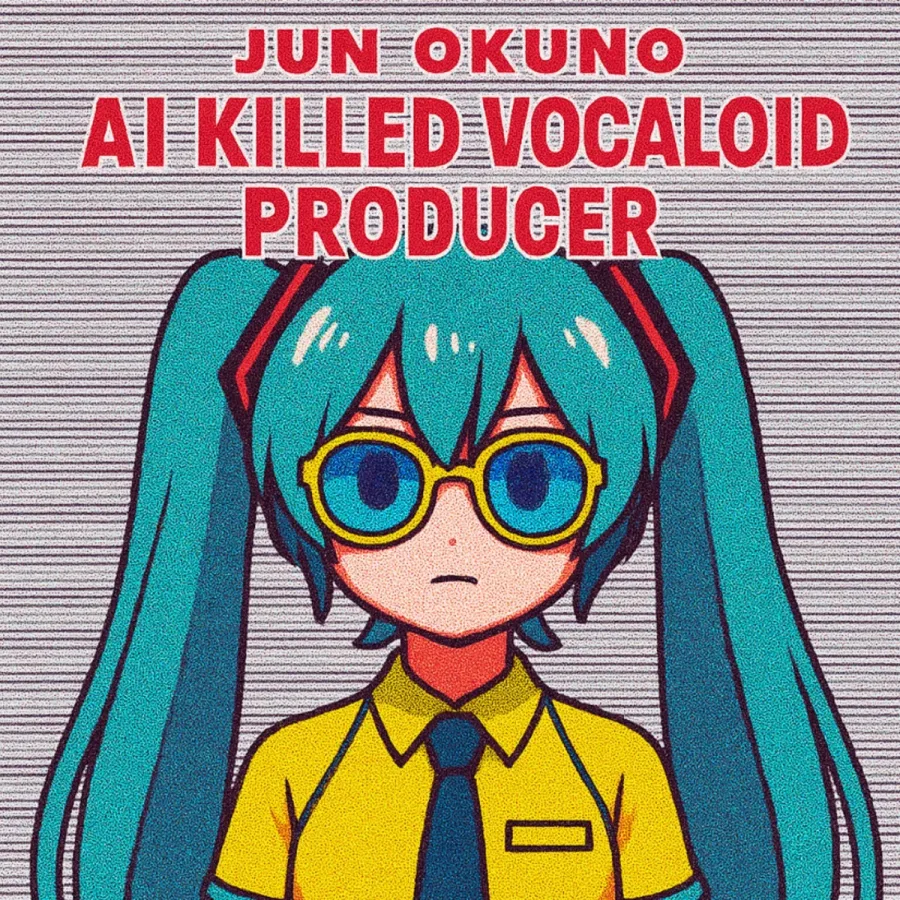
The Vocaloid movement began as an artistic experiment:
recreating the human voice through software.
Producers were pioneers — the ones who controlled the machine, giving it emotion, narrative, and song.
Generative AI reverses that relationship.
Now, the machine writes the melodies, arranges the harmonies, even generates the vocals itself.
Those who once commanded the technology are now the ones being automated.
This reversal is not just technological.
It’s existential.
It erases the very space where Vocaloid producers once stood —
the place between human intention and digital expression.
2. The Aesthetic of Effort
Vocaloid culture grew from the world of DTM — desktop music —
a space defined by solitary, painstaking craft.
Every sound, every EQ, every nuance of Vocaloid tuning was hand-shaped.
That slow, deliberate labor became a form of devotion.
In this world, effort equals value.
The beauty lies not only in the final track, but in the process of creating it.
Generative AI collapses that structure.
It can produce a song in seconds — flawless, finished, emotionless.
The “story of effort” that once gave these works meaning suddenly disappears.
What is lost is not technique, but the reason for making art by hand.
3. The Poetry of the Artificial Voice
There is also a deeper poetic layer to Vocaloid music.
Its emotional force comes from a paradox:
a non-human voice singing of deeply human feelings.
The slight mechanical tremble, the synthetic breath, the unreachable distance between voice and soul —
those imperfections became the aesthetic heart of the genre.
But as AI voices evolve toward hyper-realism,
that fragile poetry begins to vanish.
The more human the sound becomes, the less room there is for the beauty of artificiality.
Vocaloid’s charm was born of its inhuman limits — and AI erases them completely.
4. Vocaloid as a Composite Culture, Not Just a Genre
To see why AI poses such a deep challenge, we must remember:
Vocaloid is not only music.
It’s a composite otaku subculture, a collaborative world built from many creative layers:
The producer (composer/arranger)
The Vocaloid character (the “singer”)
The illustrator (the visual identity)
The video creator (for the MV or animation)
The fans and secondary creators (MMD, fan art, MAD edits)
Each song is a miniature ecosystem —
a fusion of sound, character, and visual storytelling.
Its lifeblood is not “authentic performance,” but shared creation.
The culture thrives not on realism, but on personification:
the belief that a voice, even if digital, can carry identity and emotion.
5. Illustration and the Second Front of Disruption
At nearly the same time generative AI began composing music,
AI also began generating art — and this hit the Vocaloid world even harder.
Vocaloid depends visually on illustrators:
the “character art” that defines a song’s identity,
the thumbnail that determines its reach,
the world-building that turns a track into a story.
Without illustration, a Vocaloid song struggles to travel.
The art is the gateway.
But now, AI image generators can produce professional-looking character visuals instantly.
Thus, not only the music but the visual foundation of Vocaloid culture
faces the same existential replacement.
It’s a dual pressure — sound and image, both overtaken by algorithms.
6. The Social Web of Agreement
Vocaloid culture was born on the internet,
and the internet rewards shared emotion over balanced argument.
Within that ecosystem, saying “AI has no soul” spreads faster than any nuanced view.
Publicly supporting AI can quickly mark someone as a traitor to the community’s values.
Even those curious about it often stay silent.
What emerges is a feedback loop:
the rejection of AI becomes a kind of moral identity.
AI skepticism isn’t just common; it’s socially reinforced,
woven into the idea of what it means to be a “real” Vocaloid producer.
7. The Realization: Understanding, But Not Solving
At this point, one thing becomes clear:
there is no easy way out.
AI represents an existential threat that cannot be reasoned away.
Rejecting it won’t stop the progress of time;
accepting it feels like self-erasure.
This isn’t a technical issue but a meaning crisis.
To embrace generative AI is to question the value of years spent mastering craft by hand.
It’s to ask whether the human struggle itself still matters in a world of instant creation.
The conflict is not about efficiency.
It’s about identity.
And that kind of loss has no simple cure.
8. Two Kinds of Love for Creation
Perhaps, then, this isn’t a battle between progress and tradition,
but between two ways of loving creation.
Vocaloid culture loves the act of making — the tactile, stubborn intimacy of crafting sound by hand.
AI culture loves the structure itself — the system, the generative logic, the potential of infinite variation.
Both are sincere.
Both are creative.
They simply believe in different gods.
9. The Unresolved Present
Generative AI is, for Vocaloid culture, an unmovable threat.
And Vocaloid producers’ resistance is not ignorance — it’s instinct.
For those who built their identity through painstaking human craft,
AI feels less like a tool and more like a mirror reflecting their own obsolescence.
Understanding that doesn’t solve it.
There is no reconciliation, no “solution.”
Some contradictions are not meant to be resolved.
They simply exist.
Maybe Vocaloid and AI music are just two parallel truths —
two different answers to the same desire to create.
They don’t have to agree.
They only have to coexist, uneasily, within the same era.
10. Conclusion — Living in the Tension
The clash between Vocaloid and AI music isn’t about right or wrong,
but about how different cultures defend what they hold sacred.
Vocaloid preserves the beauty of human effort.
AI embodies the inevitability of automation.
Neither can truly replace the other,
and neither can claim moral superiority.
Perhaps there is no resolution — and maybe that’s fine.
Art has always evolved through friction, not harmony.
What matters is not which side wins,
but that both existed long enough to make us ask what creation really means.
There is no answer.
Only the sound of two cultures,
playing in dissonance —
and, in that dissonance,
something profoundly human remains.
Thank you for reading to the end. If you like, please follow me. I would be happy to receive your comments.
If you're interested in Jun Okuno's music, please give it a listen!