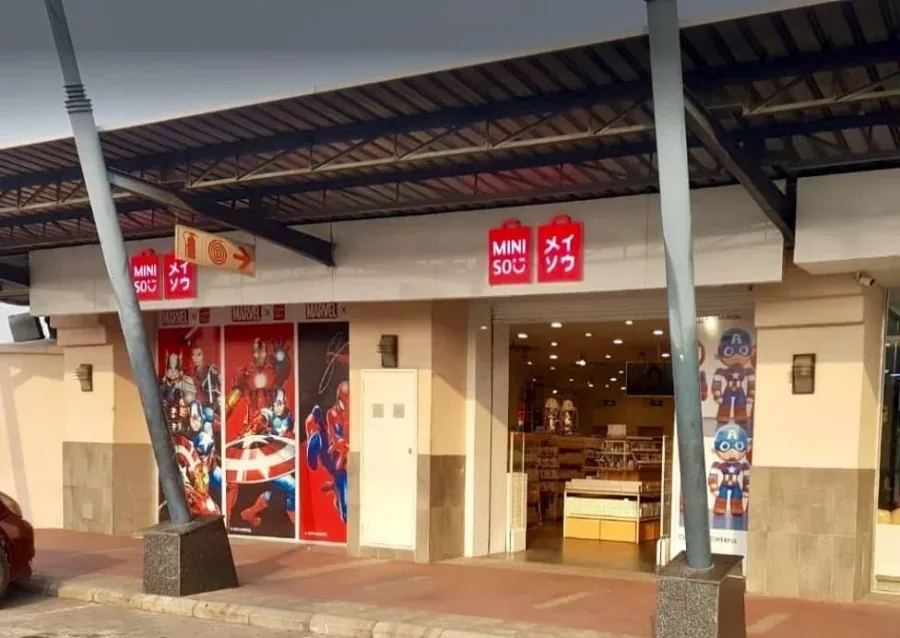
For many Japanese people, the MINISO stores seen in emerging countries like those in Africa might give the impression of being 'a store like DAISO that I've seen somewhere before.' In fact, the company once entered the Japanese market, but struggled to build a brand and compete in the 100-yen shop industry, eventually withdrawing in 2019.
Because of this, many people likely still hold the impression that 'MINISO is a cheap, Japanese-style copycat brand.'
However, the current MINISO has evolved significantly from its original form, and understanding its reality provides a clue to understanding new business models originating from Asia.
From 'Imitation' to 'Creation': The Shift to a Retailtainment CompanyIt is true that when MINISO was founded, it imitated the store design and product concepts of DAISO and MUJI. However, its evolution since then has been remarkable.
Today, it has developed new business formats such as TOP TOY and MINISO IP LAND, creating a new retail model that fuses retail and entertainment (retailtainment). Stores have transformed from mere places to sell products into 'stages' that provide experiences, establishing a unique path often described as 'Instagram + content' or 'MUJI + UNIQLO + Disney Store.'
What is particularly noteworthy is that it balances an 'exciting worldview' with profitability through a dual approach of popular licensed IP and self-developed IP. For example, while it increases the motivation for Millennials and Gen Z to visit through licensing partnerships with global characters such as Barbie, Marvel, Harry Potter, Disney, and Sanrio, it strengthens profit margins and brand uniqueness through self-developed characters (such as PandaAroma and MINI Family) and TOP TOY's original IP. The flagship stores of MINISO IP LAND and TOP TOY pursue a level of production and design comparable to the Pokémon Center, Sanrio shops, or the Disney Store, highlighting their appeal as experiential retail (retailtainment) by creating 'Instagrammable' spaces that people want to post about. Through these efforts, MINISO has achieved listings on the NYSE (New York Stock Exchange) and HKEX (Hong Kong Stock Exchange), and its reputation in the global market is rising. This has allowed it to succeed in building sensory and emotional connections with consumers while increasing profit margins.
Below are photos of MINISO IP LAND and TOP TOY stores:
In this way, MINISO, which started as an imitator, has built a unique business model by combining its own creativity and management skills while using its learning as a foundation. This can be called a success story of the process from 'imitation to creation.'
Global Strategy: The Role and Positioning of the African MarketMINISO's global strategy is not uniform; it is characterized by an approach tailored to the market characteristics of each country and region.
In the African market in particular, it adopts a low-risk model centered on franchises, where head office-led control over quality management and store design is limited. As a result, stores in places like Nigeria face challenges such as inconsistent interior design and product displays, or weak IP experiences.
I also found 'We Bare Bears' merchandise slumped on a shelf in a Nigerian store as if it were unsold stock, and I ended up buying it. The question also arose: 'Why are these outdated characters, which are by no means popular, being sold on the front lines in Africa?'
This is a prime example of a part of Miniso's global inventory optimization strategy. Specifically,
Seasonal products and IP merchandise (e.g., We Bare Bears, Marvel, Minions, etc.) that did not sell in mainland China, the Middle East, or urban areas in Asia are transferred to the African market, where demand and competition are relatively moderate.
Even higher-priced merchandise is resold at promotional prices in Africa, minimizing the risk of unsold inventory.
At the same time, there is a high possibility that these items will be accepted by local consumers as 'global trends,' providing a certain level of brand experience.
In this way, it can be said that the African market plays a role as 'an important hub for recirculating inventory within the global supply chain.'
On the other hand, in markets with a growing middle class such as mainland China, the Middle East, and Southeast Asia, the company is establishing brand premium by opening flagship stores and deploying IP-led product strategies.
In this way, Miniso employs a sophisticated strategy of using different models for different markets—an 'experiential/brand-strengthening model' and a 'price-oriented/emerging market development model'—and even in markets like Africa, this functions as part of what supports the company's growth.
Comparison of business performance: Miniso and DaisoThis difference in strategy is also reflected in earnings. In 2024, Miniso's sales exceeded approximately $2.3 billion (about 320 billion yen), and its gross profit margin is around 45%, significantly higher than Daiso's estimated 30%. The high ratio of IP products and in-house developed products is seen as contributing to higher unit sales prices and increased brand value.
A shift in perspective: Miniso as a hint for learningMiniso's evolution can be called a typical case of 'from imitation to creation.'
Learning 'store aesthetics' from Japan's Muji and Daiso,
Building an 'efficient supply chain' like Uniqlo,
Adding 'IP-based storytelling and experience' like the Disney Store.
Such integrated thinking should be noted as a new strength of Chinese companies.
Of course, the IP, worldview, and quality standards held by Japanese companies remain major strengths and are highly regarded around the world. The Ministry of Economy, Trade and Industry and JETRO have also set the strengthening of overseas expansion for Japanese IP businesses as a policy goal.
In that context, Miniso's global IP-based experiential strategy and flexible market adaptation stance may serve as one reference case. There is no need to perceive it as 'being caught up with' or 'being imitated,' and looking at it as a hint for new ideas is also a valid perspective.
Conclusion: Beyond stereotypesMINISO is no longer just a 'Japanese-style shop'; it has grown into a global brand operating in over 100 countries by integrating IP strategy with retail experience.
By looking at the big picture rather than just its presence in Africa, we can gain insights into new business trends and the diversity of corporate strategies.