After getting used to altitude sickness in Cusco and being overwhelmed by Machu Picchu, descending to Lima gives you the feeling that both your altitude and your emotions are suddenly returning to the ground. Zero meters above sea level. One of the largest cities in South America. A population of about 11 million. And a place that has carved out over 400 years of history as the capital of Spanish colonial rule.
Lima is often spoken of as a "dangerous city." That aspect certainly exists. But when you actually walk around, you can see that such an assessment is quite crude. Where is it dangerous, where is it safe, and what logic draws those boundaries—I felt that the essence of the city of Lima emerges there.
First, from the airport
Jorge Chávez International Airport is located in an area called Callao. It is a 30 to 40-minute drive from the city center or Miraflores. The moment you step out of the arrival lobby, Lima begins.
Uber works just as the app says. If you call one from the designated Uber area a short walk from the arrival lobby, the wait time is about 5 to 10 minutes. Always verify the license plate and the driver's face photo before getting in—this is a habit you should practice throughout South America, not just in Lima.
Do not use street taxis. If you follow just this rule, moving around the airport is almost problem-free.
Around the airport: The "true face" of Lima
The scenery that unfolds from the car window after leaving the airport becomes your first impression of a Lima not found in tourist guidebooks.
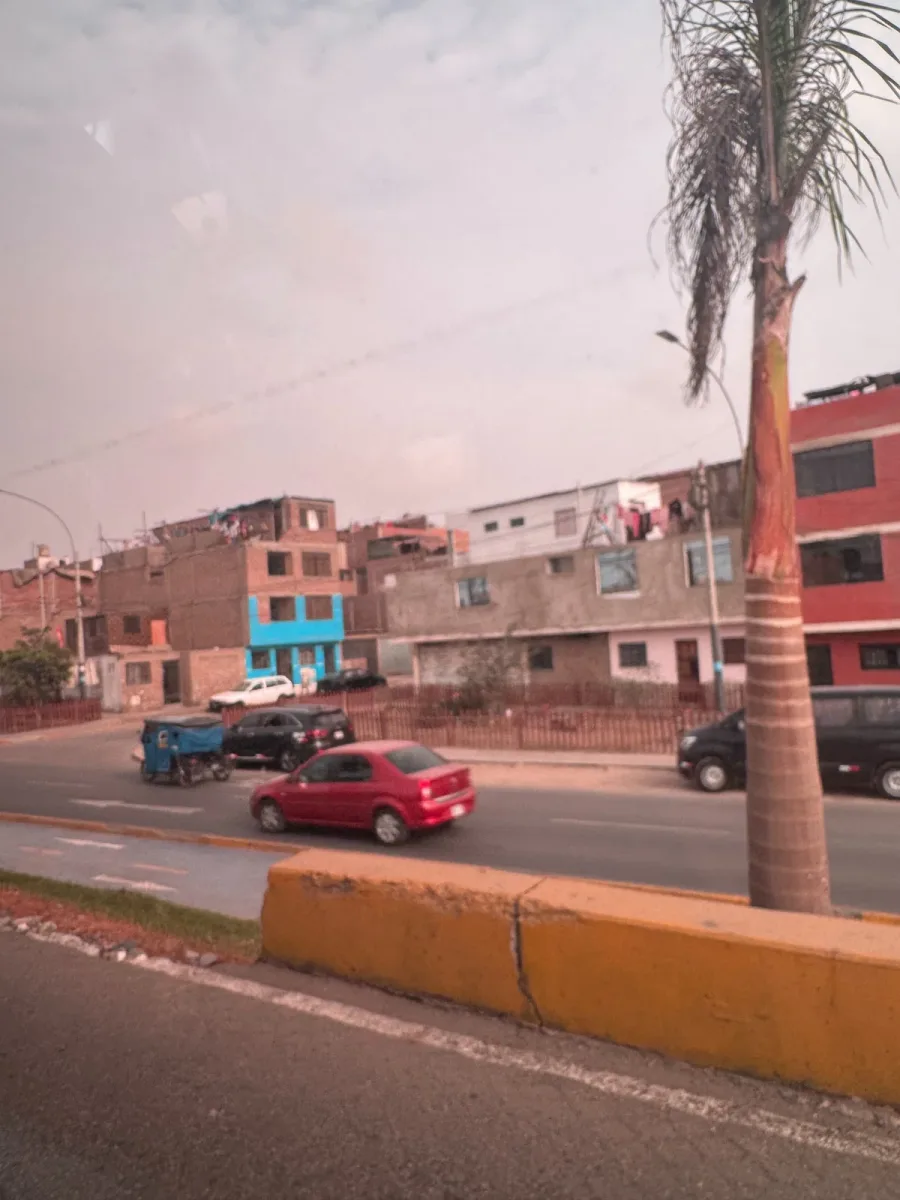
Rows of unfinished brick buildings line the streets, with laundry hanging on the roofs. Moto-taxis (three-wheeled vehicles with a roofed cargo bed attached to a motorcycle) weave between cars. The median strips are made of yellow-painted concrete, cracked in places.
This is the area from the Callao district to the surroundings of the airport. It is considered a high-security risk area even within Lima, and sightseeing on foot is not recommended. You need to be especially careful on the streets at night, and you should avoid hailing street taxis.
However, I feel it is a bit wrong to dismiss this scenery with the single word "dangerous." The unfinished buildings are traces of a culture of continuous expansion: "build the second floor once the first is finished, and the third once the second is finished." I think the fact that the city is always under construction is the default state of "life" here.
Compared to the calmness of Cusco and Machu Picchu, the area around Lima airport certainly has a sense of tension. However, that is an issue of the area, not the city as a whole—that was my final impression.
Lima Historic Center (Centro Histórico)—A city carved by Spain
The UNESCO World Heritage district of Lima's old town is an urban space that has been built up over more than 400 years since its construction by the Spanish in 1535. Centered on the Plaza Mayor (Plaza de Armas), the Cathedral, the Archbishop's Palace, the Government Palace, and the Palace of Justice are arranged to surround it on all four sides.
Looking down from above, the intent of its spatial composition is clear at a glance. This is a "city for show." A declaration of power and faith issued by the conquerors to the colony. A massive political text written in stone and plaster.
Palacio de Justicia (Supreme Court)Standing out even within the historic district is this building, which is currently used as the Supreme Court. The heavy, neoclassical colonnade, the triangular pediment, and the aura that permeates the entire building saying, "This is a temple." Looking down from above, under the grayish sky of Lima's old town, the Peruvian flag flutters quietly all alone.
Plaza San MartínWalking two blocks south from the Plaza Mayor, you will find another square. At its center stands an equestrian statue of General José de San Martín. The pedestal is inscribed with 'LA NACIÓN AL GENERAL SAN MARTÍN'—'The Nation to General San Martín'.
Surrounding this square, which honors the hero of the South American independence movement, are Belle Époque-style buildings constructed when Lima flourished during the rubber and cotton booms of the early 20th century. Mansard roofs, curved dormer windows, and rounded corner towers—this style, influenced by the French Third Republic, proves how strong Lima's longing for Europe was at the time.
Let us pause here and address the question: 'How does this differ from European architecture?'
The 'Hybrid' Architecture of Lima—How It Differs from Europe
When comparing Lima's architecture to that of Europe, there are two differences that stand out most.
Balcón Limeño (Lima Balcony)Protruding from the outer walls of the Archbishop's Palace of Lima are lattice-style wooden overhanging balconies. These are known as 'Balcón Limeño,' a unique architectural element of Lima.
The structure was heavily influenced by Moorish (Islamic) architecture via Andalusia in Spain. It is designed so that the interior cannot be seen from the outside, while the outside can be clearly seen from within. Unlike Venetian Gothic windows, this is a spatial device that incorporates the asymmetry of vision into its design. It is said that they were created so that women from wealthy colonial families could observe the street without having to go out.
This element does not exist in the architecture of mainland Europe. It is a unique variant born in Lima through the process of transplantation from the Iberian Peninsula to South America, combined with the arid desert climate and the social structure of the colony.
Mestizo Baroque (Barroco Mestizo)Even more interesting is the interior decoration of the church architecture.
The Baroque style was brought from Spain. However, it was the local indigenous craftsmen who actually carved the sculptures. While they superficially followed European motifs of saints and angels, they quietly hid Amazonian tropical plants in the vine patterns of the columns, indigenous features in the faces of the angels, and the cosmology of Quechua culture in the corners of the retablos (altarpieces).
This is called 'Mestizo Baroque' (Hybrid Baroque). Using the style of the conquerors while carving indigenous memories into the interior—it is a dual structure of visual resistance and acceptance.
Lima Cathedral—400 Years of Faith and Power
The Lima Cathedral (Catedral de Lima), standing facing the Plaza Mayor, is a building that has been repeatedly destroyed and rebuilt due to earthquakes since its founding in 1535. Its current appearance is the result of reconstructions in the 18th and 19th centuries, with its twin towers and a facade featuring Baroque ornamentation rising toward the square.
Once you step inside, the logic of the space changes.
The rib-vaulted ceiling is painted in blue and gold, with a massive main altar placed at the far center. The wooden choir stalls (sillería) lining both sides are carved with such precision that they look as if they were transplanted directly from a Spanish Gothic cathedral. The verticality of the space is so dominant that the backs of people standing before the altar look small.
The Cathedral features 14 chapels, each functioning as an independent space for worship. In contrast to the vertical serenity of the main hall, the interiors of the chapels are excessive worlds overflowing with gold and color. I believe this contrast in density is one of the layers that define the Lima Cathedral.
This verticality of Catholic architecture is based on theological intent. The structure reaching toward the heavens is an expression of 'upward-looking faith' and also a device to make visitors feel their own smallness. This is a fundamentally different sensation from how Japanese shrines and temples express sacred space through a 'horizontal axis leading into the depths'.
The San Francisco Monastery and Catacombs: Living with the Dead
A five-minute walk from the Plaza Mayor, the Basilica of San Francisco is one of the most impressive buildings in Lima's old town.
The exterior differs from the highly decorative Jesuit-style Baroque; it is the sturdy, robust Baroque style of the Franciscans—heavy masonry with the solar emblem (IHS monogram) floating in the center of the facade. At the time of my visit, the square side was under construction, and UNESCO support plaques were lined up.
Inside the monastery, there is a chapel housing a luxurious blue and gold retablo. This is a classic example of the aforementioned Mestizo Baroque. The excessive brilliance, overflowing with botanical motifs and somehow evoking an affinity with Inca gold culture, is of a different quality from the 'heaviness' of European Baroque. It is closer to a more fundamental 'vitality'.
And then, to the catacombs underground.
Photography is prohibited inside. ( Official Website / Wikipedia: Catacombs of Lima ) As you proceed through the dimly lit passageways, you emerge into a space where bones are neatly stacked. The remains of an estimated 70,000 or more people are meticulously arranged in circular or grid patterns, sorted by skulls and femurs.
This is not a grotesque display. It is the order of a Catholic 'sanctuary of the dead'.
In Catholicism, there is a history of viewing the body as a 'vessel' to which the soul must return at the Last Judgment. That is why cremation was forbidden for many years, and bones were carefully preserved and laid to rest beneath the cathedral. The dead are not treated as 'people of the past,' but as beings who still belong to the community of faith.
In Inca civilization, there was also a custom of having the mummified remains of ancestors (mallqui) participate in feasts as members of the family. While the forms of expressing their view of life and death differ, the two cultures resonate deeply in the sense that 'the dead and the living are continuous'—though when the Spaniards built churches on this land, that resonance was likely something they did not anticipate.
Cerro San Cristobal: The Hill You Should Not Go To
Looking up from the historic district, you can see a conical hill to the north. A cross stands at the summit, and colorful houses are densely packed, clinging to the slope from the middle upwards—this is Cerro San Cristóbal (San Cristóbal Hill).
This is also a landmark that visually marks Lima's 'security boundary.' The area from the foot to the middle of the hill is a high-risk zone for travelers. Access to the summit is also not recommended on foot without a local guide.
You should avoid getting close just because it looks good in photos. Viewed from the Old Town, this hill serves as a beautiful landscape that symbolizes the topographical and social complexity of Lima.
Miraflores—A Safe Zone Above the Cliffs
About a 20-minute taxi ride south from the Old Town, the air changes as you enter the Miraflores district.
Well-maintained street trees, sophisticated cafes, and young people riding Grab-style e-scooters. And its most distinctive feature is the 'cliffs.'
Miraflores faces the Pacific Ocean, but you cannot go directly down to the beach. The city spreads out atop 70- to 80-meter-high sheer cliffs, with a narrow coastline and wave-eroded rock shelves below. The promenade (Malecón) continues for several kilometers along the edge of the cliffs, and in the evening, locals jog or sit on benches to watch the sunset.
Parque del Amor (Park of Love) is a park where colorful mosaic tile benches, reminiscent of Gaudí's Park Güell, line the cliffs. At dusk, the sight of the orange and purple sky melting into the surface of the Pacific Ocean was a rich, South American-style display of color.
Why the promenade was safe after 11:00 PMThis was the most unexpected experience I had in Lima this time.
After finishing my meal at Kjølle past 10:00 PM, I walked toward the Miraflores-Barranco direction. Even late at night, couples and families were walking normally on the Malecón promenade. There were no suspicious figures, and no one approached me. Even after 11:00 PM, that feeling remained unchanged.
On the way, I crossed a transparent pedestrian bridge built into the cliffs. Through the glass floor, you could see the road and coastline below the cliff. People were coming and going even at night.
Why is this area alone safe?
Miraflores is physically separated from the low-lying areas by a 'natural moat' of cliffs. The residents have a high income level, and there are many private security guards. There is a liveliness where people are always watching, even at night. It is more accurate to think of it as a different city from the area around the airport, even though it is in the same Lima.
Larcomar is a semi-open-air shopping mall embedded into the face of a cliff. It houses Häagen-Dazs, Nespresso, and several seafood restaurants, with people coming and going until late at night. The view of the Pacific Ocean at night from the edge of the cliff was a mysterious scene where the hustle and bustle of the city and absolute silence existed simultaneously.
Barranco—Lima's Bohemian Quarter
Walking further south from Miraflores, you enter the Barranco district.
This is a hub for Lima's gastronomy, home to restaurants like Kjølle and Central, but more than that, it is a place where "art, old buildings, and nighttime music" overlap.
Invictus Taproom is a craft beer bar that makes use of a late 19th-century mansion. With mosaic tile floors, cast-iron gates, and stone colonnades, the exterior remains true to its colonial architecture, while the interior has been transformed into a semi-outdoor space with string lights, vines climbing to the ceiling, and brick flooring. The music is loud, the place is crowded, and it gets livelier the later the night gets.
Opposite it is a cultural center called "Casa Parra del Riego." The white neoclassical mansion has been carefully preserved and is used as an exhibition space for art and events. The combination of the building and the green garden symbolizes the stance of the Barranco district to "make the most of the old as it is."
If Cusco is a "layering of Inca and colonial," then Barranco is a "layering of colonial and modern." And flowing over those layers is the music of the night.
Safety in Lima—In Conclusion
Finally, I will summarize my actual impressions of safety.
Areas to avoid
Callao district (around the airport)
Around Cerro San Cristobal
The old town at night (after hours when foot traffic decreases)
Areas that are relatively fine during the day
Lima Historic Center (old town)
Areas where I felt safe walking even late at night
The Malecon (promenade) in Miraflores
Central Barranco (around Invictus Taproom)
My overall impression is that 'as long as you choose the right area, you can move around with a sense of security comparable to Cusco.' It is a different kind of security from the tourist-friendly atmosphere of Cusco; it is the 'safety of a high-income area functioning as a city,' but I felt that was genuine in its own right.
Uber was consistently available throughout the day. Airport pickups were also problem-free. I never felt suspicious at any point.
Lima is often treated as a mere 'transit point' for trips to Peru. A one-night stay before heading to Cusco and Machu Picchu, or a flight connection. However, this city has a depth that makes such treatment a waste.
The stone city built by the Spanish 400 years ago, the ruins that have slept beneath the ground for 3,000 years, and the modern Limeños drinking wine on the cliffs—they all exist on the same strata.
I think it is worth staying an extra day in Lima just to confirm that.
Locations featured this time
Jorge Chávez International Airport
Palacio de Justicia
Plaza San Martín
Cathedral of Lima
Archbishop's Palace of Lima
Basílica y Convento de San Francisco de Asís
️ Cerro San Cristóbal — Recommended only for distant views from the Old Town. No pedestrian access.
Parque del Amor — Miraflores
Larcomar — Miraflores
Invictus Taproom — Barranco
Casa Parra del Riego (Cultural Center) — Barranco