Vercel Labs has released 'fx,' a small coding agent written in Zig, as open source.
When I first saw the news, I thought, 'Vercel made a coding agent too?'
However, after reading the official information, it's a bit different.
The interesting thing about fx is not that there is one more new coding tool like Claude Code or Codex.
It is that they have made it possible to embed the AI agent itself as a small component into apps and systems.
Here, we can see the direction of the AI infrastructure that Vercel has been thinking about recently.
What is fx?
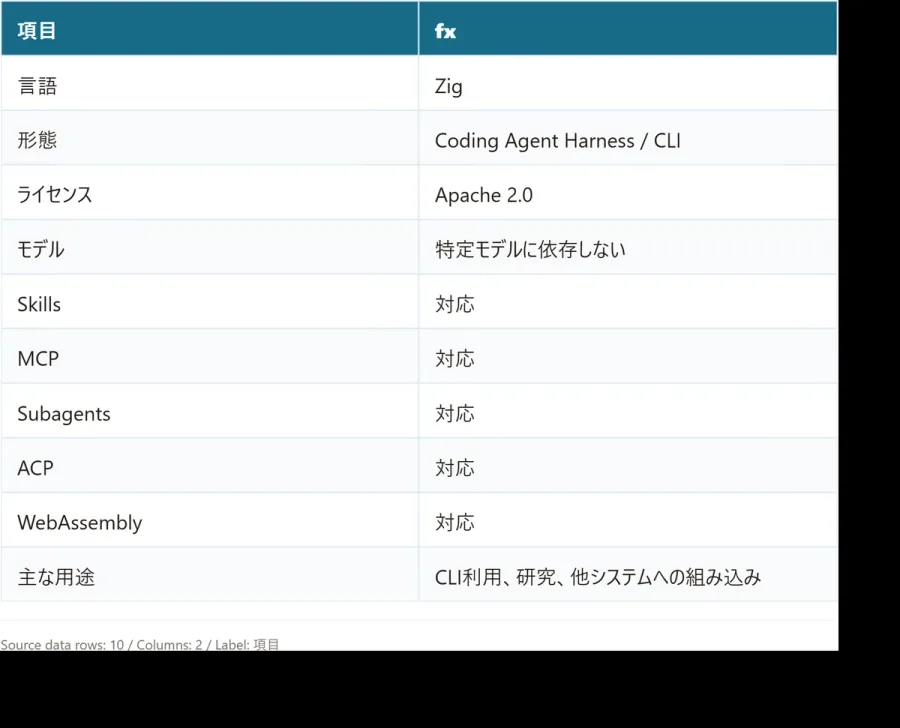
fx is an open-source coding agent released by Vercel Labs.
It is built in Zig and runs as a native binary, and it also supports WebAssembly.
Vercel Labs describes fx not just as a CLI, but as:
a 'Coding Agent Harness designed to be integrated as part of a larger system'
as it explains it.
To summarize its main features, they are as follows.
The current official fx demo shows it at about 6.39MiB. On the other hand, the GitHub README also mentions 7.8MiB for updated builds, as it is in a stage where it is frequently changed as an experimental version.
What is important is not the difference of a few MB.
It is that it is built to be extremely small as an AI agent.
The meaning of creating a 'small AI agent'
When people hear 'AI agent,' it is easy to imagine a standalone application.
Launch Claude Code.
Launch Codex.
Use a dedicated Agent app.
Until now, the structure has centered on 'humans using Agents'.
fx is a little different.
The official documentation clearly provides a way to embed fx into applications.
In other words,
instead of 'using the fx app', you can 'make fx work within your own app'
.
I think this is the most interesting part of this release.
AI agents are going from 'apps' to 'components'
For example, suppose you are building a business web app.
Until now,
User
↓
Web App
↓
AI API
↓
GPT / Claude / Gemini
was the common configuration.
Using a mechanism like fx allows you to place an Agent in between.
User
↓
Web App
↓
fx Agent
↓
Skills / MCP / Subagents
↓
AI Model
↓
External Services
The app side no longer needs to give detailed instructions directly to the AI model.
You just need to pass it to the Agent side,
'Handle this task.'
and that's it.
That Agent reads the Skills, uses external tools via MCP if necessary, and passes the work to another Subagent.
The structure of AI applications is going to change significantly.
fx has Skills, MCP, and Subagents.
If fx were just a lightweight CLI, it wouldn't be this interesting.
Despite its small size, fx possesses the core mechanisms that make up an Agent.
SkillsYou can add repetitive procedures and specialized capabilities.
MCPYou can connect to external tools and services.
SubagentsYou can delegate independent tasks to other Agents.
ACPYou can operate fx from other Agent Clients, such as an editor.
In other words, while fx is compact, it
possesses the essential structures required for an Agent, such as 'adding capabilities,' 'connecting to the outside world,' 'delegating tasks,' and 'being operated from other applications.'
It has quite a lot of these.
What is Vercel trying to build?
If you look only at fx here, it ends as an 'interesting small Agent.'
However, when placed alongside Vercel's recent moves, the meaning changes.
Looking at it this way, it doesn't seem like Vercel is trying to become a 'company that provides AI models.'
Rather,
A foundation for operating by combining AI models, agents, skills, and external services
It looks like they are trying to build.
It is not a rival to Claude Code
When you look at fx,
"A rival to Claude Code?" "A rival to Codex?"
is what you might want to think.
However, based on its current positioning, it is more than just that.
The official fx documentation also states that regarding the UI, they are aiming for a design closer to a Unix Shell rather than a large 'in-terminal IDE'.
In other words, they are not trying to build a massive, all-in-one AI development environment.
They are building the bare minimum Agent Core,
and adding necessary capabilities later.
It is a Unix-like philosophy.
This is very Vercel-like.
Instead of making everything into one giant product, they combine small components.
It might no longer be about 'how many AI agents you hire'
Recently,
"I hired 5 AI agents"
"I created 10 AI employees"
expressions like these have increased.
However, if agents like fx become widespread, this way of thinking might also change.
Instead of counting agents one by one like human employees,
you launch an agent only when a necessary process occurs.
Once the process is finished, it terminates.
For another process, you launch an agent with a different skill.
In other words,
the agent becomes a 'processing unit' rather than an 'employee'.
fx assumes a memory baseline of a few MBs and lists the ability to run many instances on a single machine as part of its design philosophy.
I think this is a quite important way of thinking.
It can also be used behind a Personal AI Workspace
What's even more interesting is its compatibility with systems like a Personal Workspace.
You only need one screen that a human operates on a daily basis.
Behind the scenes,
a research agent,
an analysis agent,
a coding agent,
a writing agent,
a verification agent
and so on, are launched only when needed.
They don't need to be separate AI applications.
The front end is a single workspace.
Small agents run in the background.
As embeddable agents like fx increase,
there is a possibility that you won't even need to 'open an AI app to use AI'.
This is because the agents will do the work automatically inside the systems you use every day.
Vercel has truly begun to build the 'Lego' of the AI era
When you've been watching Vercel for a while, it starts to feel like the 'foundation for the Lego of the AI era.'
Connect models with AI Gateway.
Connect services with Connect.
Connect capabilities with Skills and MCP.
And with fx,
they have even turned the Agent itself into a small component.
At this point, it's not just a 'Lego foundation.'
There are connection standards.
There are components.
They've even released a motor.
Users no longer need to build everything from scratch.
You just need to choose the necessary parts and assemble the system you want to create.
The real interest of fx is not the '6MB'
Regarding fx,
'It's only 6MB'
'It starts in 10 microseconds'
These numbers are certainly eye-catching.
However, if you only look at that, you lose sight of the essence.
What's important is,
Making AI agents small enough to be embedded into other systems.
And,
the fact that it provides Skills, MCP, Subagents, ACP, and even WebAssembly.
The current fx is still experimental, and Vercel Labs itself assumes frequent changes.
Even so, the direction is quite interesting.
Until now, AI agents have been 'apps used by humans.'
From now on,
they might become 'components that work inside apps.'
Looking at fx, it seems Vercel is already starting to test that future.
#Vercel #fx #AIAgent #GenerativeAI #AIDevelopment