As I asked in the latter half of the text, like in the title, I have now been able to verify the answer. Please proceed to the article I wrote on October 8th, 'Hole in the piping of Fukushima Daiichi Unit 2. The situation is different from the 'flow-accelerated corrosion' pipe rupture mechanism at Mihama Nuclear Power Plant' (added on October 8th).
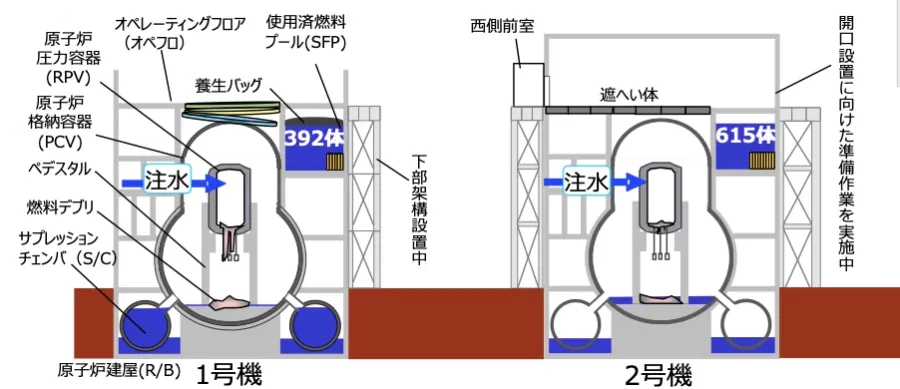
At the Fukushima Daiichi Nuclear Power Plant, there are many places where water must be circulated to continue cooling. These are the fuel debris and spent fuel. Regarding spent fuel, removal from the pools has been completed for Units 3 (566 assemblies) and 4 (1535 assemblies), but not yet for Units 1 and 2. As time passes, things are wearing out all over 1F. Today's story is one example of that.
At Unit 2, on August 9, it was confirmed that the water level in the 'skimmer surge tank,' which catches water overflowing from the spent fuel pool, had dropped, and on August 13, it was announced that the leak was from the pump room/heat exchanger room below the skimmer surge tank. The pool water temperature was 34.5 degrees. Calculations suggested it should only have reached a maximum of about 46 degrees (it must not exceed 65 degrees).
On August 19, it was explained that because there is a high-radiation area (maximum 120 mSv/h in 2019), it would be investigated using a remote-controlled robot. I found out about the investigation method of 'filling the skimmer surge tank with water to identify the actual location where water is leaking' and that 'the equipment or piping has a hole, or a connection is leaking.' (previously reported)
Regarding the fact that I asked the Chairman of the Nuclear Regulation Authority about this on August 21, I will mention it later.
October 3, announcement of a 2-centimeter hole in the pipingAnd then, on October 3, the results of the investigation conducted on October 1 were finally released, and photos were made public showing that 'piping inside the heat exchanger room' was damaged. When asked by a reporter, they answered that the hole was about 2 centimeters.
In the future, they will repair the leakage point, but at the same time, they say they will also build an alternative cooling method. This is because even if they fix the leakage point, a leak might occur somewhere else again.
Alternative cooling methods were considered in three plans, and they say they will adopt Plan ①, which is to isolate the leakage point and bypass it with steel pipes. This means that in just two days since the investigation, they thought of three plans and have already narrowed it down to one.
During this time, the water temperature rose from 34.5 degrees to 50 degrees (daily report P2), and is currently 48 degrees (daily report P2).
Chairman Yamanaka: 'The issue of aging degradation of the entire 1F'As I mentioned earlier, I asked the Chairman of the Nuclear Regulation Authority on August 21, and I will excerpt the exchange from that time. What I sought in my question was Chairman Yamanaka's view on the degradation of nuclear power plants that have been damaged by earthquakes, tsunamis, and nuclear accidents 13 years after the accident.
At this time, I also asked about the cause of the high-voltage line fire at Unit 6 (which I have already written about here) as a deterioration issue. Although I could not elicit a view beyond "I would like to provide guidance so that aging degradation of the entire site does not affect safety," I was able to confirm that he recognizes that deterioration will naturally progress in various parts.
That's it! "Flow-accelerated corrosion" that occurs in pipingOn this day, after my question, there was an interesting question from a reporter for a specialized journal. The reason I thought it was interesting is that since TEPCO stated on August 19 that there was a hole in the piping or a leak at a connection as the cause, I had been thinking, " If there is a hole in the piping, that's that," but I couldn't remember the name of the phenomenon I was thinking of as " that thing," and that reporter drew the name of the phenomenon out of Chairman Yamanaka's mouth at the perfect angle. I will excerpt it.
Unfortunately, when the cause of the leak at Unit 2 was revealed at the TEPCO press conference on October 3, I thought, "That thing, that thing. What day was that press conference?" but I didn't have time to go back through the press conference records, and I couldn't recall the name, so I couldn't ask a question.
Furthermore, when I searched for "flow-accelerated corrosion", many research results appeared, including a paper regarding the pipe rupture (fatal) accident at the Mihama Nuclear Power Plant, a paper stating that it is "one of the important issues that must be considered in aging management measures for nuclear power plants," and a paper regarding the construction of prediction models. I will ask at the next opportunity whether what happened at Unit 2 was "flow-accelerated corrosion".
And, since I did ask, as mentioned at the beginning, please jump to "Hole in the piping of Fukushima Daiichi Unit 2. The situation is different from the pipe rupture mechanism "flow-accelerated corrosion" at the Mihama Nuclear Power Plant".
[Title Image]October 3, 2024 TEPCO "Regarding the results of the investigation to identify the leak location associated with the drop in water level of the Unit 2 spent fuel pool skimmer surge tank"