Groq is the name of both an American startup company that boasts world-class performance in AI 'inference' and the specialized processor developed by that company.
Because its design philosophy is fundamentally different from that of typical CPUs and GPUs, it is attracting significant attention in the AI industry.
1. The company Groq
Groq was founded in 2016 by Jonathan Ross (the key figure who developed the 'TPU', an AI-dedicated chip, at Google).
Headquarters: Silicon Valley, USA
Vision: Realizing 'real-time AI'. The goal is to eliminate AI response wait times.
Recent developments: In late 2025, NVIDIA agreed to acquire Groq's major assets for approximately $20 billion, and efforts are underway to integrate its technology into NVIDIA's next-generation platforms (such as Vera Rubin).
2. Groq's processor (LPU)
The chip developed by Groq is not strictly a CPU or GPU, but is called an LPU (Language Processing Unit).
The greatest feature of the LPU lies in its 'Deterministic architecture'.
Utilization of SRAM:
While GPUs read and write data from heavy external memory (HBM), the LPU places data directly into ultra-fast SRAM (static memory) on the chip. This eliminates latency associated with data movement to the absolute limit.Predictability of instructions:
General processors operate while predicting 'what processing to do next', but with the LPU, the compiler (software side) perfectly controls the chip's movements on a cycle-by-cycle basis. It is like driving on a dedicated road without traffic jams.Maximum utilization of arithmetic units:
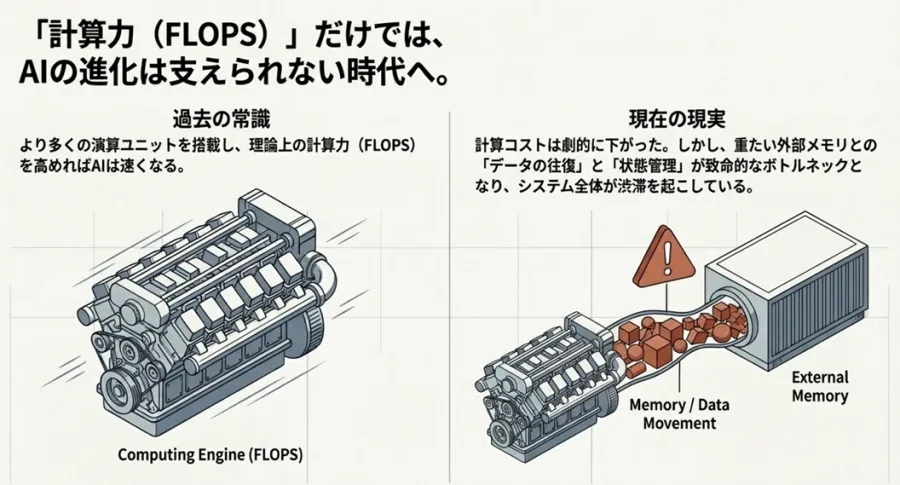
Although GPUs have very high theoretical arithmetic performance (FLOPS), it is not uncommon for arithmetic units to temporarily sit idle due to memory waiting or processing variations in actual operation. The LPU is designed to
minimize such 'idle time'. The goal is to concentrate every possible cycle on useful computation, and that is precisely the real key. By pre-arranging the flow of processing through precise state management by the compiler, it is
able to stably maintain a state close to peak performance
.A 'scheduling race' rather than a FLOPS race:
Modern GPUs have evolved by incorporating more arithmetic units and competing for higher theoretical performance (FLOPS). However, in the field of AI inference, it is important not only 'how fast it can calculate', but also 'whether it can continue to execute that calculation without interruption'. Groq's approach focuses more on pre-designing the order of processing and the flow of data to operate the entire chip without waste, rather than simply expanding arithmetic capacity. In other words, if GPUs are a world
competing for FLOPS (theoretical performance)
, it can be said that Groq is aiming for a world competing for the precision of scheduling to keep calculations from stopping.Overwhelming token generation speed:
For example, when running a large language model (LLM) like Llama 3, it can generate hundreds of tokens (units close to characters) per second, enabling 'blazing fast' dialogue that far exceeds human reading speed.
3. The essence of AI chips: Comparison of design philosophies of the 4 major architectures (as of 2026)
The competition for AI chips is no longer just about 'how high the FLOPS are'. The essence is the reality that 'computation has become cheap, but data movement and state management are expensive'. In response to this, each company is providing completely different answers.
Here is a super simple breakdown of the four major design philosophies for AI chips.
-
GPU Type (Representative: NVIDIA, AMD)
"Increase computing power at all costs"Pack in tens to hundreds of thousands of parallel processing units to maximize theoretical FLOPS.
Supply massive data via HBM.
Highly versatile, handling both training and inference.
Weakness: In real-world AI processing, memory wait times, branching, and scheduler jitter can cause effective performance to drop to 30-60% of theoretical peaks.
→ A world of "huge peaks, but effective performance depends on the situation."
-
TPU Type (Representative: Google TPU)
"Build a dedicated computing factory for AI"Accelerate matrix operations (tensor calculations) with dedicated hardware.
More optimized for AI than GPUs → higher efficiency and power efficiency.
However, the processing flow is relatively dynamic, and the core approach is still "increasing computing power."
→ Positioned as an improved version of the GPU.
-
LPU type(Representative: Groq → NVIDIA integration)
"Never stop computing" = Extreme scheduling designCompiler determines movement completely at the 1-cycle level (deterministic).
SRAM-centric to minimize data movement.
Strict control of state management → Keeps compute units from "idling," operating at nearly 100%.
Image: If a GPU is "loading up on high-speed engines," Groq is "designing a dedicated road with zero traffic."
Result: Latency is abnormally low, and inference is lightning fast (hundreds to thousands of tokens/second).
→ A world of scheduling competition, not FLOPS competition.
-
Wafer-scale type(Representative: Cerebras Systems)
"Making the chip massive"One entire wafer as one chip (one of the world's largest).
Massive SRAM makes memory movement physically almost zero.
Pros: Fundamentally solves the data movement bottleneck → Strong for huge models and long context.
Cons: High manufacturing difficulty and cost.
→ Solves the data movement problem by "eliminating distance."
The industry is currently fighting over how to solve the following three issues.
FLOPS (pure computing power) → GPUs/TPUs are strong
Memory bandwidth / Data movement → Cerebras solves this physically, GPUs respond by increasing HBM
Latency / State management → Groq (LPU) dominates with deterministic scheduling
The reason NVIDIA is still overwhelming is that
Ecosystem (CUDA) lock-in
Both training and inference
Because they are integrating Groq's technology here (fully incorporating LPU elements into the Rubin platform at GTC 2026), covering almost all three bottlenecks in the process.
Once you understand this structure,
'why NVIDIA is still the king' and 'who has the potential to overtake them next' should become clearly visible.