When I make notes on the movies I watch, I gradually find myself becoming obsessed with writing the "synopsis" itself.
In the case of old Japanese films, the "synopses" posted on movie databases are often quoted from the press sheets released at the time. Since press sheets are produced and distributed during filming before the release, the content sometimes differs from the actual finished film. There are quite a few patterns where the ending is completely different. Therefore, when it comes to a "real synopsis" based on the finished work, there is no choice but to confirm and record it yourself.
If you write down and compile a "synopsis," you sometimes notice things when you rewatch the movie after some time has passed. You can realize changes in your perspective, such as "Oh, I thought that was important at the time!" or "No, no, isn't this part more important?" Even though the movie itself hasn't changed at all, the "synopsis" you perceive changes slightly depending on your own situation when you watched it. I think this might be one of the joys of continuing to watch movies for many years, or watching the same movie over and over again.
Recently, I've been obsessed with reading reviews of stage plays and theater performances on note.
When I do that, I realize that many people use quotes from the official website for their "synopsis."
That method is accurate for saving time and for being "safe." But honestly, I feel that what kind of "synopsis" that person felt—in other words, what they understood as the main points—is also important. I thought that if you're going to take the trouble to write a review note, summarizing it yourself makes it more of a "record." Personally, that's what I want to read.
(Licking my lips like a stage review fanatic)
I wrote that rather pompously, but since my articles have started to get long once I get obsessed with the synopsis, I'm changing to a four-film summary starting this time.
1. Director Kokichi Uchide, "Yagyu Bugeicho: One-Eyed Jubei," Toei / 1963 (Showa 38)
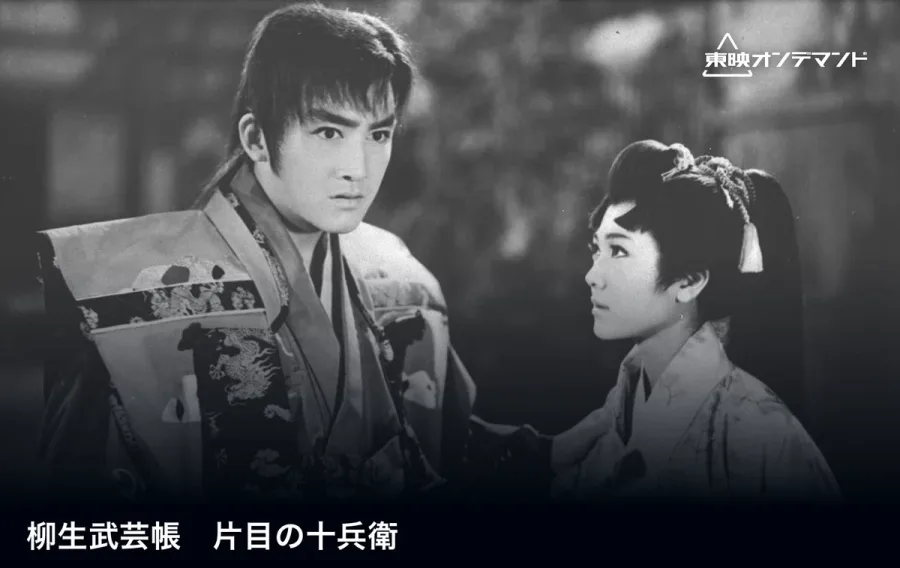
The Junior Councilor, Mino-no-kami Inaba (Kei Sato), in order to bring down the Shogun and the Yagyu family, pressures the Yagyu clan to make the Yagyu Bugeicho public in front of the Shogun (Chiyonosuke Azuma). On the surface, it was said that the Yagyu Bugeicho contained the secret techniques of the Yagyu Shinkage-ryu, but in reality, it was a league scroll signed in blood by the daimyo who had plotted rebellion at the time of the opening of the shogunate. Now that the rebellion never actually happened, it was a dangerous document that could cause chaos in the shogunate's administration if it were exposed.
The head of the Yagyu family, Munenori, entrusts Jubei (Jushiro Konoe) with the task of summoning the signatories as witnesses to avoid making the Bugeicho public. Now that Tadayoshi Satomi of Utsunomiya, the only survivor of the league scroll and a witness who could testify to the intent of the signatures, has been assassinated, Jubei must search for the mysterious person who had only left a blood seal without a signature at the end of the scroll.
Is it a parallel story again!? I'm amazed they can keep dragging this out with the plot of whether or not the current Shogun knows the contents of the Bugeicho. In this case, given that the Yagyu Bugeicho is truly a league scroll of rebellion and Kei Sato has a copy of it, I didn't quite understand why the person who left the seal could prove that the Bugeicho was not a league scroll of rebellion, or that the Yagyu family was not involved in the rebellion (despite the head of the Yagyu family having his seal on it).
Although it's a bit flat, the dark screen with frequent night scenes and the somewhat fantastical costumes of the martial artists are interesting and enhance the atmosphere.
However, it would have been better to more clearly establish the worldview that "if it's to protect the clan, the lives of the disciples are trash, and we will be as heartless as necessary."
In the beginning, there is a scene where Jubei suddenly cuts down his disciple to confuse the enemy. It feels half-baked to have such severe scenes side-by-side with scenes that are clearly theatrical, like the enemy ninjas lining up neatly like Kabuki actors, or Jubei's younger sister pretending to be a blind pilgrim. Unless you show the harshness of the world Jubei lives in, the persuasiveness of him being the "fierce tiger of Oshu that even the Shogun's family cannot touch" feels inconsistent. Perhaps this was a film from a time when they were unsure about setting the reality line for period dramas.
Date Masamune (Isao Yamagata), who appears from the middle of the film as a survivor of the league scroll, gave an incredibly good performance, and this time his tone matched Jushiro Konoe's very well. Both of these actors have a realistic acting style, but it's a good balance that isn't "natural" in the sense of today's sensibilities.
Date Masamune did not wear an eyepatch so as not to clash with Jubei. His flashy tea room attire, while being loungewear, is also good (his outfit for sneaking out is even flashier).
But what is with the part where the Yagyu mansion becomes full of homemade traps like Home Alone? Sometimes in Chushingura movies, the Kira mansion is also a trick house, but what kind of taste is that???
2. Director Kinnosuke Fukada, "The Ghost Cat's Mechanical Ceiling," Toei / 1958 (Showa 38)
The Go instructor employed by the Nabeshima clan, who loves cats so much that he even brings his beloved cat Tamasudare to the castle, gets into a dispute during a lesson with the lord, Hizen-no-kami, because he was insulted for being blind, and is cut down by the enraged lord. His mother, the widow, cannot accept her son's death and commits suicide, entrusting her curse to the cat. In fact, the whole series of disturbances was a conspiracy by the chief retainer, Masao Mishima, who was aiming for the Nabeshima family's succession. However, the mother's grudge entrusted to the cat is deep, and a ghost cat begins to appear around the lord and those present at the Go match. Masao Mishima was pleased that the lord had fallen into madness from fear of the ghost cat, but the senior retainer, Ryunosuke Tsukigata, who sensed Mishima's conspiracy, sets out to calm the family dispute.
Since it was made during the ghost cat movie boom, I thought it would be cheap, but I was very wrong. The movements of the ghost cat are amazing. The wire action of flying from the floor to the lintel and ceiling, and the sharp movements like a dance performance are too impressive to watch.
The scene where the ghost cat manipulates people (people are drawn in when the ghost cat makes a beckoning gesture) is a classic gimmick in ghost cat movies, but I was surprised that the timing and music were completely Kabuki (or rather, "old theater"). The agile ghost cat takes on dance-like movements with plenty of timing, accompanied by the mellow tone of the shamisen. At the same time, the movements of the people attacked by the ghost cat are unrealistic and acrobatic, incorporating handstands and backflips, like the movements of Hanashiten. The movements are quite beautiful, and I thought it was a performance that could only be done by people who had undergone considerable training, both for the ghost cat role and the victim role.
By the way, the cat that becomes the ghost cat was quite cute. It was a white cat with black patches, maybe 2 years old? In ghost cat movies, sometimes the cat is already killed and comes back as a ghost to attack, but the cat in this film is alive. Therefore, it sometimes acts in its cat form, but when it becomes a human-shaped ghost cat, it looks like the demon woman in the Kabuki play "Momijigari." It has messy black hair, and the kimono has black fur spots on the white fabric... Could it be that it's utilizing the pattern of the original cat...? Also, the fact that the left and right sides of its messy hair are pointed like cat ears is also too good.
The blind Go instructor, the former lover who is now the lord's concubine, the strong-willed mother, and the mysterious ascetic—the elaborate setup that could have become a legend-style story if handled well catches the eye, but perhaps because the running time is too short at 70 minutes, the human relationships and their respective intentions don't seem to be fully digested. I thought it was more of a "there's too much lack of explanation" state than "leaving room for imagination."
However, what is a "mechanical ceiling"? There was no particular mechanism on the ceiling. (There was a rule that the ghost cat would always break through the ceiling to retreat.)
3. Director Junya Sato's "Aiyoku" (Desire) Toei / 1966 (Showa 41)
Rentaro Mikuni, acting as the deputy manager of the public relations department at a major food company, meets Ryoko Sakuma, who runs a waiting house in Kyoto, following a traffic accident he had during a business trip to Osaka. Despite having Yoshiko Mita, a club mama in Ginza, as his lover, Mikuni becomes deeply involved with Sakuma. Infatuated with Sakuma, Mikuni neglects not only Mita but also his work, drawing the attention of Tetsuro Tamba, his friend since student days and his superior (managing director), but...
Hmm, I'd like to call it a "bizarre masterpiece," but I get the impression that there are significant issues with the script, direction, and acting... all of it.
I can see they were aiming for a path similar to Daiei films starring Ayako Wakao, but I truly realized the sophistication, dignity, and the robust technical skill that supports the "abnormality" that Daiei possesses.
There is a considerable amount of awkwardness in the direction, including the casting balance, script, and shot composition; to put it bluntly, it feels sloppy. There are too many rough points to overlook, such as the heavy-handed dialogue that seems to think adding "dosu" to the end of a sentence makes one a Kyoto woman, a script that is overly explanatory and lacks necessity and organization, and direction (including the actors' performances) that presents every scene in a uniform way.
Even though it's a messy office romance, the hardest part is that I don't know how old Rentaro Mikuni's character is supposed to be. His childish behavior, the poverty-stricken look of the room he lives in, and the setting of dating a club madam (for four years) make him seem like he's in his mid-20s, but his appearance and position at the company are those of someone in his 40s. Nothing but a sense of incongruity enters my mind.
Also, Rentaro Mikuni is an actor whose self-display sometimes ignores the study of his role, which is off-putting, and in this film, that comes out in a very bad way. I think he should have focused entirely on supporting Ryoko Sakuma.
How should I put it? It's rare for everything to be this "bad." I thought, "Is this what those mass-produced novels look like, the ones where a senior citizen after retirement thinks their first work is a masterpiece and sends it to a literary prize, and the preliminary reader just wants to say, 'Please, spare me'"...
4. Director Yasushi Sasaki's "Hatamoto Taikutsu Otoko: Nazo no Fukumaden" (The Bored Hatamoto: The Mysterious Demon's Den) Toei / 1955 (Showa 30)
A story where the bored Hatamoto (Utaemon Ichikawa), visiting Kyoto, gets involved in a strange incident related to a raid on a Namban (foreign) ship.
While strolling through Kyoto, the bored Hatamoto helps a woman who suddenly runs up to him, but as soon as she leaves him, she is shot to death by someone. From the story of the yoriki (police official) who was chasing the woman, the bored Hatamoto learns of the mysterious death of a man thought to be involved in the Namban ship raid. It seems the woman was that man's lover and apparently knew the secret of the incident. The yoriki was in charge of the investigation into the Namban ship raid. Afterward, he was suddenly told by the Kyoto Shoshidai (Kyoto Deputy) to stop the investigation, but the yoriki resigned and continued the investigation on his own. As murder cases that look like attempts to silence people occur one after another, the bored Hatamoto and the yoriki notice the behind-the-scenes maneuvers of Eitaro Shindo, a hobbyist with connections to the shogunate, and a doctor.
As you can guess from reading the synopsis above, the plot is unnecessarily complicated and the storyline is hard to follow.
It is very difficult to understand that the Namban ship raid and the mysterious man of taste Eitaro Shindo (and two other villains added) are related. As it goes into the second half, it becomes more heavy-handed, and the development becomes like something four puppets gathered at a local Doutor coffee shop and connected together on a whim, but it is actually surprising that the film's production is by no means half-hearted. It's heavy-handed, but there's no cutting corners.
Although it is a template series film of the "well-known" and "standard" variety, I felt it was strange that the catchphrases "The scar that the Shogun permits" and "Hatamoto Taikutsu Otoko" were repeated so many times. Was it because they weren't well-established yet at the time, or was it a deliberate service?
Eitaro Shindo is set up as a man of taste who loves Noh, and because of that, he is summoned by the shogunate. He has built a Noh theater in his own residence, and the climax of the film is the scene of the Noh performance of "Aoi no Ue" for the opening of that stage. Although it is short, the powerful part just before the intermission is captured, so you can enjoy the atmosphere of Noh. I wonder if it's one of those service scenes common in old movies like "You can watch a stage performance in a movie!"
The Noh instruction is credited to "Iwao Kongo," so I think this scene is performed by the head of the Kongo school. The part up to running off to the hashigakari (bridge) carrying the robe during the intermission is the head of the school, and it changes to Utaemon from the cut where he returns to the main stage and throws off the robe he was carrying. It's a development where it turns out the Noh actor was Utaemon, but the precision of the movements is so different that it's obvious it was a substitute, which is part of the charm.
But why "Aoi no Ue"? Since the story starts with a Namban ship raid, if you can choose the program as you like, something like "Kumasaka" would have been more appropriate.