Introduction
When you're churning out 20 SEO articles a month, there's a tedious, headache-inducing task: 'keyword selection.'
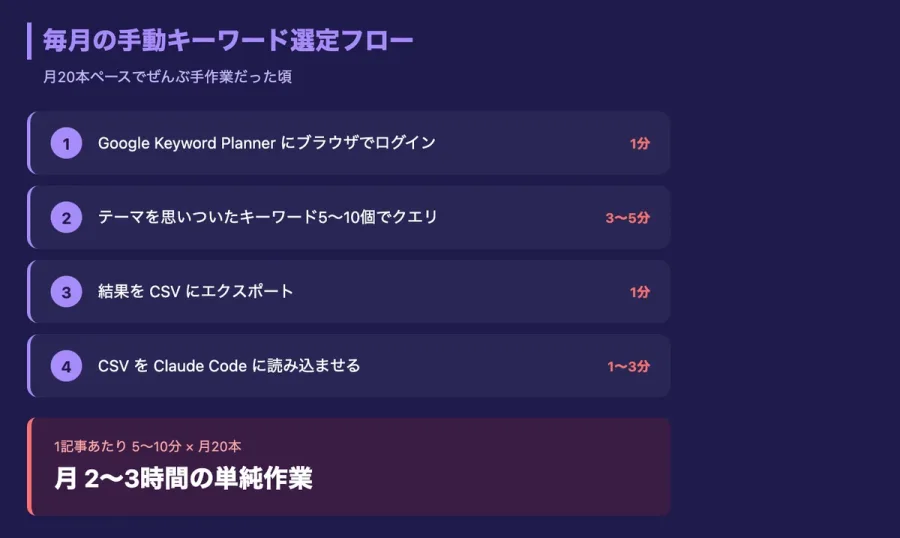
Opening Google Keyword Planner in a browser, querying with keywords I've brainstormed, organizing the results into a CSV, and passing that to Claude Code (a CLI-based AI coding tool)—this back-and-forth takes 5–10 minutes each time, totaling 2–3 hours a month. I've thought many times, 'Can't I just dump this on the AI?'
One day, I looked into it seriously, and the moment I decided that 'DataForSEO' was the top recommendation, I had to question myself. Today, I'll write about that 30-minute thought process in chronological order.
2–3 hours of simple tasks were piling up
I've built my SEO article generation skills within Claude Code, so the actual writing is almost entirely automated. However, the material gathering that comes before it—'which keywords to write about,' 'is the search volume reasonable,' 'what's the competitive landscape'—has always been manual.
Specifically, the process looks like this:
Log in to Google Keyword Planner in a browser
Input 5–10 keyword candidates and run a query
Export the results as a CSV
Load that CSV into Claude Code
It sounds simple when written out, but a 5–10 minute task balloons to 2–3 hours when you're doing 20 articles a month. What's even more problematic is that the comprehensiveness of the 'keywords I brainstormed' depends on what's in my own head. I can never pick up niche related terms that I, the writer, don't know.
'Can't I delegate this to AI?'—that was the starting point of my investigation.
The idea of 'Can I make this an MCP?'
What came to mind here was MCP (Model Context Protocol). It's a common standard for calling external services from Claude Code, and in my case, I've already connected MicroCMS (blog posting) and Google Search Console (retrieving search performance) via MCP.
In other words, if there were a keyword research service that could connect via MCP, I could create a state where 'the AI automatically grabs keyword candidates and search volumes from the Claude Code session and proceeds all the way to article writing.'
Investigation started. My initial hypothesis was simple: 'Isn't it logical to connect Google Keyword Planner via MCP?' Since the primary source of the data is Google, connecting to it should be the cheapest and most accurate method. Thinking that, I started moving.
I organized the options into 5 categories
As I proceeded with the investigation, it became clear that the methods for keyword research that can be called directly from AI can be roughly divided into 5 categories.
Google Ads API (Keyword Planner) — The primary data source for search volume. API usage fees are free
DataForSEO — A reseller service wrapping the Google Ads API. Pay-as-you-go with a $50 prepayment.
Semrush / Ahrefs API — Minimum $449–$499.95/month. Completely over-spec for small and medium-sized businesses.
SerpAPI / Rakko Keywords — Strong in SERPs or specialized for Japan. Unsuitable for search volume alone, or lacks MCP support.
Free tools like Google Trends / Suggest — Cannot obtain absolute search volume values.
Looking at the price range, Semrush and Ahrefs are immediately excluded. It's not a scale where I'd pay nearly ¥70,000 a month. SerpAPI and Rakko have different use cases or lack the crucial MCP implementation. Google Trends only provides relative trend values, so it's not a substitute for volume figures.
In other words, the only realistic options were connecting directly to the Google Ads API or going through DataForSEO.
The 3 traps behind Google's "free" service
The first thing I researched in detail was the Google Ads API (Keyword Planner), which I had considered the frontrunner. "API usage is free," "It's the official data source"—so far, so good.
However, when I dug a little deeper, I found three prerequisites stacked up.
First, creating a Manager Account (MCC) is mandatory. A developer token cannot be issued for a standard ad account. An MCC is an account format for agencies, so if you aren't planning to run ads yourself, you have to create a new one.
Second, the Developer Token review takes 24–48 hours. You need to apply for Basic access, and it seems there are cases where it gets rejected if you don't have agency credentials. It's not a service you can use immediately.
Third, and this was the biggest catch: without a history of ad spending, search volume returns only range displays like "1K-10K" or "10K-100K". If you want high-precision numbers, you need to maintain at least ¥1,000–¥2,000 per month in ad spend.
The claim that "API usage is free" is only half the truth; in reality, a monthly ad maintenance cost of ¥1,000–¥2,000 is a de facto prerequisite for accuracy. Adding in the setup for OAuth refresh tokens and the like, the initial effort takes 1–2 hours.
Feeling that it was "more troublesome than I thought," my focus began to shift toward DataForSEO.
The moment I concluded, "DataForSEO is the one"
As I researched DataForSEO, I saw Google's traps elegantly disappear.
No ad account required. You can use it immediately after signing up and charging $50.
An official MCP server (dataforseo/mcp-server-typescript) already exists, and DataForSEO maintains it themselves.
You can get data for the Japanese market by passing language_code:"ja" and location_code:2392 (Japan).
Installation is completed with a one-line command.
I also did a rough calculation. 20 articles/month × 5 keywords/article × 50 related keyword candidates = 5,000 keywords/month at that query volume, the monthly cost would stay between ¥80 and ¥150. A $50 charge is calculated to last for 2 to 3 years.
I was on the verge of entering 'conclusion mode,' thinking, 'This is the one.' I could already imagine my hands typing the command 'claude mcp add dfs-mcp ...' into Claude Code.
However, the moment I tried to put my conclusion into words, another voice arose in my head.
This was the biggest sense of unease I felt 30 minutes into my research.
The obvious question: 'Isn't this just cutting out the middleman?'
As someone who has lived as a business owner for 12 years, the intuition that 'if you're paying a margin to a middleman, it's cheaper to get it directly from the source' is a rule I trust quite a bit.
In fact, regarding search volume, I found that this intuition was partially correct. DataForSEO is just wrapping the original Google Ads API, and their profit is the fee for taking on the burden of Google's screening and maintaining ad billing. In theory, there is no doubt that 'if you get it directly from Google, you can save on the agency fee.'
'See, I should definitely build this with a direct Google connection,' I thought, having almost overturned my conclusion, but when I recalculated the costs by scale here, I saw a conclusion that was the opposite of my intuition.
When I calculated it, my intuition was reversed
Let's compare the two in terms of monthly cost.
Google Ads API Direct: API usage fee ¥0 + ad maintenance ¥1,000–¥2,000/month + initial labor 1–2 hours
DataForSEO: ¥150–¥500/month + initial charge $50 (= ¥7,800, prepaid for 2 years) + 5 minutes setup
What I notice here is that if the monthly query volume is 3,000 to 5,000 keywords or less, DataForSEO is actually cheaper financially. Google's 'free' is offset by ad maintenance costs, and the setup labor is more than 10 times higher.
Conversely, once you reach a scale exceeding 10,000 keywords per month (= a scale where you automate mass production of dozens of articles every month + competitor analysis + bolstering existing pages), going directly through Google becomes cheaper.
In other words, the intuition that 'it's cheaper to get it directly from Google' only holds true above a certain scale. At a small scale, the middleman is cheaper, which is a seemingly contradictory conclusion.
Why are middleman services cheaper at a small scale?
Thinking about it a little, this was a rational structure.
Google's 'free API' is a bonus service for advertisers. From Google's perspective, Keyword Planner is a tool to promote ad placement, and they don't want to give high-precision data for free to people who don't run ads. That's why they gate the precision based on ad billing history.
On the other hand, DataForSEO collects small amounts from many users, maintains ad billing history on their end, and provides the wrapped API. It's a structure where the ad maintenance cost incurred for each individual is split among all subscribers.
From the perspective of a small-scale user, buying two years' worth of 'wrapped access' for a $50 charge is ultimately cheaper than maintaining a ¥2,000 monthly ad spend on my own. This was a perfectly sound economic structure where '<u>an intermediary acts on behalf of economies of scale</u>'.
'Cutting out the middleman' isn't always better. As long as your scale is below the intermediary's break-even point, it is more rational to use the intermediary. I felt this was a perspective that could also be applied to business decisions.
The final conclusion was a 'two-stage approach'
As the final output of my research, this is the conclusion I reached.
Immediate: Implement DataForSEO MCP. Prepay $50 to enable keyword volume lookups directly from Claude Code
Future: Transition to a direct Google Ads API connection once our company's scale reaches over 10,000 queries per month, or once we start running ads ourselves
There are three reasons why I chose this two-stage strategy.
The first is that I can take action immediately. While waiting 24–48 hours for Google's review plus 1–2 hours for setup, my keyword selection would remain manual. With DataForSEO, I can get it running in 5 minutes.
The second is that the sunk cost (non-refundable prepayment) is small. If I pay $50 and decide three months later that 'direct Google is better after all,' the loss is only a few thousand yen. On the other hand, if I build a direct Google connection from the start and then stop because it's 'too much hassle,' the 1–2 hours of setup time will have been completely wasted.
The third is that I can defer the decision until I have a clearer outlook on scaling. The idea that we will 'exceed 10,000 words in the future' is hypothetical; currently, we are at about 5,000 words per month. I will not over-invest based on hypothetical scenarios.
A lesson one level more abstract, gained from this experience
Looking back after finishing the research, the lesson I learned was that 'the habit of always asking what the original data source of a service is' has become one level more important when selecting tools in the AI era.
Ahrefs and Semrush do not operate their own Google crawlers; their SERP acquisition relies on their own scraping infrastructure. When you ask, 'What is the original data source for this service?,' you can always see a structure where there is an original supplier somewhere, with several layers of intermediaries in between.
The moment you think, 'It would be cheaper if I cut out the middleman,' don't forget that there is a counter-truth: 'depending on the scale, the middleman might be cheaper.' Weighing both sides to make a decision—this was the framework I reaffirmed for decision-making regarding AI-related tools.
Summary
Keyword selection for 20 SEO articles per month was taking 2–3 hours/month
Started research with the idea, 'Can't I leave this to AI via MCP?'
The options were effectively limited to either direct Google Ads API or DataForSEO
Google's 'free' tier effectively required a monthly ad spend of ¥1,000–2,000
Immediately after concluding on DataForSEO, I felt a sense of unease about whether it was just a 'middleman'
When I did the math, it turned out that for 3,000 to 5,000 words or less per month, using an intermediary is actually cheaper—a paradox emerged
Final conclusion: A two-stage approach—start with DataForSEO for now, and switch directly to Google once volume exceeds 10,000 words per month
Lesson: The habit of asking 'What is the primary data source for this service?' is effective for tool selection in the AI era
From starting the research to reaching this conclusion, it took a total of just over 30 minutes. This was the result of asking Claude Code to 'compare DataForSEO MCP selection and alternatives, assuming a pace of 20 articles per month,' and spinning our thoughts around together. In an era where AI takes over the burden of research, what humans need to do is 'the moment intuition feels off, verbalize it and flip the hypothesis'—I realized that once again.