*This article uses affiliate advertising (Rakuten Affiliate).
I have been carrying cameras on broadcast sets for 15 years.
From news, documentaries, and corporate VPs to drone aerial photography, I write this honestly from the perspective of someone who has been through all kinds of shoots.
"Is it too late to buy a SONY FX3 in 2026?"
——
I get this question all the time.
I understand the feeling. It was released several years ago.
If you open the internet, rumors that "the FX3 II is coming out" circulate almost every week.
So, thinking "wouldn't it be more profitable to wait," people freeze with their wallets clutched tight before they ever press the shutter.
To give you the conclusion first, the FX3 is still the go-to for shooting in 2026.
Moreover, what is currently on store shelves is strictly not the original "ILME-FX3," but the successor minor-change model, the "ILME-FX3A."
Every year, people chase used or clearance stock without knowing this fact, only to realize later, "Wait, the model number is different from mine."
In this article, I have organized the current standing of the FX3 from a professional perspective and compiled 10 recommended peripherals to pair with the body, categorized by use case.
I have made this a practical guide to ensure you don't take any detours in choosing your equipment.
[Check prices and stock for SONY FX3A (current model) on Rakuten Ichiba]
Why can I still call a camera from several years ago the go-to?
The reason is simple: the FX3 has yet to be surpassed in the balance between
"the quality of the image you can capture" and "the reliability to keep shooting."
Full-frame Exmor R CMOS sensor, 4K up to 120fps, S-Cinetone and S-Log3, and long-duration recording thanks to the built-in cooling fan.
This combination packs the peace of mind of a professional video camera into a 715g (including battery and card) body that you can hold with one hand.
From the perspective of a broadcast set, the correct answer to choosing equipment is not "chasing the latest specs" but
"not stopping on set."
Not overheating during an interview, not crying over noise in low light, and matching colors with other Cinema Line cameras—
The FX3 satisfies these "dull but critical parts" at a high level.
That is why, rather than letting your gear sit idle while waiting for a rumored successor, you are better off shooting now to build up your work and portfolio.
This is a philosophy I have consistently written about in
[Don't be swayed by the rumored specs of the
FX3 II (past article)].
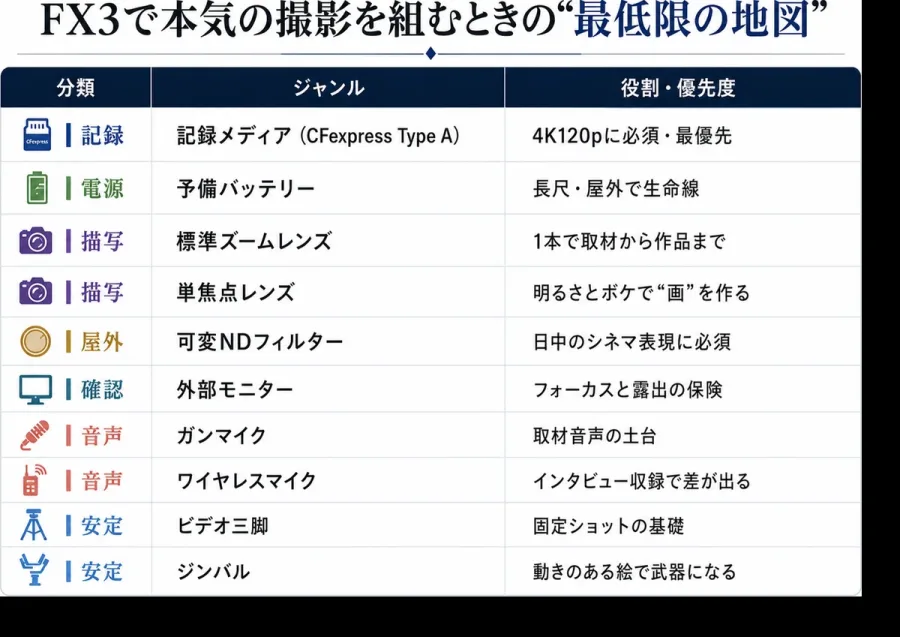
First, get an overview with the quick guide to recommended configurations. The 10 categories below are the "minimum map" for setting up serious shooting with the FX3.
[See the lineup of ILME-FX3A available for purchase now]
Many people misunderstand this, so I will first clarify the model number situation.
As of 2026,
there are
“three versions” of the FX3.
The first is the original “ILME-FX3” released in 2021.
This has already been discontinued,
and is now only available as remaining stock or on the used market.
The second is the
“ILME-FX3A,” which Sony is promoting as its successor.
It is a minor update model released on June 6, 2025,
with a manufacturer's suggested retail price of 581,900 yen including tax.
It is priced almost the same as the original.
And the third is the
“FX3 II (FX3 Mark II)” that is buzzing on the internet. As of June 2026, this has not been officially announced and remains strictly at the rumor stage. You should also know what changed from the FX3 to the FX3A
before buying. The internal video performance (sensor and 4K120p) is basically the same; what changed are the peripheral specifications.
The rear monitor resolution has been improved from approximately 1.44 million dots to
approximately 2.36 million dots,
and the included battery charger has been changed from the BC-QZ1 to the BC-ZD1, which can charge two batteries simultaneously.
On the other hand, the infrared remote sensor and NFC have been removed, bringing these specs in line with the FX30.
Since Bluetooth and Wi-Fi are the mainstream for remote control and smartphone connectivity, there is almost no practical disadvantage.
In short, the FX3A is
“the current model with the same image quality but fine-tuned usability.” If you are buying a new one now,
this is the FX3A you should choose. So,
“should you wait for the FX3 II?” Rumors suggest the inclusion of a global shutter, a dual processor,
and a new sensor,
with some information even leaking a price in the 400,000 yen range.
It looks attractive,
but neither the announcement date nor the content is confirmed.
Treating it as confirmed information is dangerous.
In professional practice, you cannot schedule work based on unconfirmed equipment.
If you have projects to shoot now,
the correct approach is to solidify your foundation with the current FX3A.
If a successor really does come out,
and you are convinced it has the evolution you need for your shooting
(for example, multi-cam synchronization or audio reliability),
you can reconsider it then.
This is the way to make a decision without taking a detour.
Also,
there is a sibling model released in August 2025 called the
“FX2 (ILME-FX2B).”
It is a model oriented toward a hybrid of stills and video,
featuring approximately 33 megapixels and a tilt-type EVF,
with a suggested retail price of 416,900 yen including tax.
If you are serious about taking photos, choose the FX2;
if you are focused on video, choose the FX3A;
it should be easy to choose if you think of it in terms of this division.
[Find CFexpress Type A cards that support 4K120p and are VPG200 or higher]
The first thing you should invest in for the FX3,
before lenses, is “recording media and power.”
If you skimp here,
you won't be able to use the best shooting modes,
or you will be left crying when your battery dies on set.
It's unglamorous, but this is the foundation.
For 4K120p shooting on the FX3, the required media differs depending on the recording format used.
For XAVC S 4K and XAVC HS 4K, you can also use SDXC cards that meet the conditions.
On the other hand, for XAVC S-I 4K S&Q slow-motion shooting, a CFexpress Type A (VPG200 or higher) is required.
Detailed compatibility conditions and recommended cards are explained in the following article.
For those unsure about choosing recording media for the FX3
Even when shooting 4K120p with the FX3,
the required media differs depending on the recording format.
“Is CFexpress Type A really necessary?”
“Which should I choose between VPG200, 400, and 800?”
We explain these questions in detail in a separate article, covering compatible recording formats and 5 recommended products.
Check here if you want to confirm before purchasing.
▶ CFexpress Type ARecommended5Choices | FX3's4K120p requirements?
The power source for the FX3 is the Rechargeable Battery Pack NP-FZ100. It lasts about 135 minutes (a little over 2 hours) in continuous video recording according to CIPA standards, but
this is just a figure under ideal conditions.
In cold outdoor environments, with the monitor always on,
and frequent recording start/stops,
the actual battery life feels much shorter.
That is why you should have at least 2 to 3 spare [NP-FZ100] batteries. Since it supports power supply and charging via USB Type-C, if you combine it with a mobile battery or AC power, you won't have to worry about power even for half-day shoots.
The fact that the FX3A now comes with the BC-ZD1 dual-battery charger is a subtly welcome improvement for long-term operation.
[FX3 compatible Sony genuine FE G Master lenses]
Even with the same body, the lens changes the "look" entirely. Since the FX3 uses the E-mount, the options are vast, but for your first two lenses, I recommend a "versatile standard zoom" and a "bright prime lens."
The go-to choice when you're unsure is the
FE 24-70mm F2.8 GM II, model number [SEL2470GM2]
.
Covering everything from wide-angle to medium telephoto with a constant F2.8 aperture, this single lens handles most tasks, including interviews, discussions, product shoots, and snapshot-style creative work. In broadcast environments, the standard range is something you can "just attach and never go wrong with," making a huge difference in efficiency. It also reduces the risk of dust getting on the sensor every time you change lenses. The GM II offers a great balance between image quality and weight, making it practical to handle even when mounted on a gimbal. It is a lens you can use for a long time as your first choice.
If zoom lenses are for "utility," prime lenses are for "expression."
Among them, the
FE 35mm F1.4 GM (SEL35F14GMSEL35F14GM) allows you to create a "cinematic" look with a heavily blurred background, thanks to the shallow depth of field of full-frame plus F1.4.
35mm is neither too wide nor too tight, making it a versatile focal length for both people and landscapes.
Combined with the low-light capable FX3, it truly shines in night shoots or indoor interviews.
You don't need to buy it right away, but when you want to capture that "signature shot" for your project, having this lens will change everything.
[Check out variable ND filters for outdoor shooting]NDfilters]
Many people who can't capture a "cinematic" look outdoors aren't using an ND filter, regardless of their gear.
This isn't a matter of taste, but a matter of knowing how.
To achieve smooth, cinematic motion, it is standard practice to keep your shutter speed at approximately double your frame rate (around 1/48 second for 24p).
However, if you do this outdoors during the day, you will get overexposed highlights because too much light enters even when you want to open the aperture.
That is where a
[variableNDfilter] comes in.
By reducing the amount of light in front of the lens, you can maintain the proper shutter speed while keeping the aperture open at F2.8, even in bright outdoor conditions.
With a variable type, you can quickly adapt to changing light caused by moving clouds just by rotating the ring.
Products that are too cheap tend to cause color casts or unevenness (cross-hatch patterns), so choose based on the balance between diameter and image quality.
This one item will improve the success rate of your outdoor shoots by a significant margin.
The FX3's rear monitor was upgraded to a high-definition 2.36 million dots in the FX3A, but it can still be difficult to check focus under direct sunlight or at low angles.
[Shooting monitor] added to your setup allows you to shoot while checking waveforms and focus assist even in bright environments, significantly reducing accidents like "soft focus" or "missed exposure" later on.
Since the FX3 has an HDMI Type-A (full-size) terminal, you can output video stably with a secure cable, which is ideal for professional work.
An external monitor is also effective when you are filming yourself for solo shoots.
[XLR Finding Professional Shotgun Mics You Can Use with the Handle]
It is often said that "90% of video is sound." It might sound like an exaggeration, but
from experience in the field, it is true.
If the video is a bit grainy but the sound is clear, it is watchable.
The reverse is tough.
The FX3 comes with an XLR handle unit as standard, allowing you to use professional microphones directly via XLR/TRS inputs. There is no reason not to take advantage of this asset.
The first item is a highly directional [shotgun microphone].
It picks up sound clearly from the targeted direction
and suppresses ambient noise,
making the "base sound" of outdoor reporting and interviews
stable.
If you connect it via the XLR handle,
you can also operate professional shotgun mics
that support phantom power (+48V).
You can also adjust levels with the dial at your fingertips,
allowing you to record high-quality audio
directly to the camera without adding a separate recorder.
The standard approach is to solidify the foundation of your sound here first.
Having a [wireless microphone]
that you can clip onto the speaker allows you to record clear voices even at a distance.
It truly shines in situations where the subject and camera are far apart, such as discussions, street interviews, or your own on-camera commentary.
If you mount the receiver on the handle or shoe
and send it to the XLR/3.5mm input,
you can neatly integrate it into the FX3's audio system.
Recently, more models have appeared with memory recording and automatic level adjustment in small transmitters, reducing the stress of level matching. If you are doing side work in reporting, this is one of the categories with the highest return on investment.
[Comparing aluminum tripods with video heads]
Stable footage is the foundation of trust. While there are times when the realistic shake of handheld shooting is a weapon,
as a basic requirement, you should have "tools to lock it down" and "tools to move it smoothly."
It is a golden rule of video
[to choose a video tripod (with head)] rather than a ball head for photography.
With a fluid head (a smooth hydraulic head), pans and tilts move at a constant speed,
and fixed shots stop perfectly still.
Please choose based on a load capacity
that can firmly support the weight of the FX3 plus a standard zoom lens.
The "peace of mind of not moving" in interviews and discussions is directly linked to the quality of the tripod.
Aluminum legs are affordable and sturdy,
while carbon fiber is light and easy to carry,
so it is best to choose according to your intended use.
Walking, chasing, circling—
those kinds of "moving shots" are the specialty of a gimbal.
[Mirrorless-compatible gimbal] The most important point when choosing is load capacity.
When you add the 715g FX3 body, lens, ND filter,
and in some cases a microphone or small monitor,
the total weight increases quickly.
If you do not choose a model with extra payload capacity,
the motors will struggle and cause jitter,
ruining the smoothness you worked so hard for.
Lenses pair well with lightweight standard zooms or prime lenses, and please remember that if you want to mount a heavy professional zoom lens,
you will need a higher-end gimbal.
View the set where you can get all the accessories for the FX3 at once]
Budgets are limited.
That is precisely why the order of investment is important.
The FX3A body has a manufacturer's suggested retail price of around
581,900 yen including tax.
You will be adding peripherals to this,
and here is the priority list from a broadcast production perspective.
The top priority is "recording media and power."
Since this directly affects whether you can "shoot or not shoot,"
you should start here.
Next is the "lens."
If you have one standard zoom lens,
most jobs can be handled.
Third are "ND filters" and a "tripod."
These improve the quality of outdoor and fixed shots.
Audio (shotgun mics/wireless) and gimbals,
as well as external monitors, are in a zone where priority changes depending on the projects you take or the work you want to create.
If it's interview-based, prioritize the microphone;
if it's a video project with movement, prioritize the gimbal,
and so on.
[Rakuten Ichiba] sometimes offers discounts on bundled accessories during sale periods, so it is a smart move to target those times for consumables and general-purpose items.
One thing often overlooked in terms of cost-performance is
"resale value."
Equipment like the FX3/FX3A,
which has stable professional demand,
does not see its used market value collapse easily,
and as a result, "it may look like an expensive purchase,
but the actual expenditure is moderate."
Rather than repeatedly buying and replacing cheap, unknown equipment,
investing in a standard model and using it for a long time
is often cheaper in total.
[Find a CFexpress compatible card reader to speed up transfers]
Finally, I will share some
"wasteful mistakes" that I have actually seen on set.
Just by avoiding these,
you can prevent a percentage of your equipment costs from going to waste.
The first is
the case where you intend to shoot 4K120p but
only have an SD card prepared.
As mentioned above, high frame rates
require a CFexpress Type A (VPG200 or higher).
Realizing you "cannot shoot" after buying it
is the biggest waste.
The second is the mistake of not having an ND filter outdoors, causing you to increase the shutter speed and resulting in jerky, "video-like" footage.
The third is accidents where the shoot stops due to cheap cables or cards. Since 4K recording puts a high load on the entire system, you should choose data pathways (cards, cables, readers) based on reliability.
One more tip from the broadcast field.
The FX3 is designed with a built-in cooling fan and is robust for long-duration 4K60 recording, but heat will still build up if you leave it in direct sunlight under the scorching sun.
Take it out of the bag and place it in the shade,
let it air out between takes—
this level of "care"
will clearly reduce the trouble rate.
Since data transfer speed also matters after shooting,
if you consider editing efficiency,
setting up a high-speed transfer environment
will pay off when you run it as a side business.
[View a list of professional shooting equipment that can be used on set]
Q: Is it too late to buy an FX3 in 2026?
A: It is not too late.
The current model is the ILME-FX3A after minor changes,
and its image quality and video performance are fully current.
Since the rumored FX3 II has not been announced,
it is more rational to shoot now and build your track record
rather than waiting for it and letting your equipment sit idle.
Q: Should I choose between the FX3 and FX3A?
A: If you are buying new, the choice is basically the FX3A.
The original FX3 is discontinued and focuses on stock and used items.
While there are times when you might find a used FX3 at a good price
considering the price difference and warranty,
the current FX3A is the safer bet if you plan to use it for a long time.
Q: Is an SD card not enough?A: You can operate with an SD card for normal 4K30/60, but you need a CFexpress Type A (VPG200 or higher) for 4K120p slow motion, which is the appeal of the FX3.
If you are aiming for slow motion, have it ready from the start.
Q: Does the lens have to be a genuine one?
A: That is not the case.
However, for your first lens,
I recommend a genuine standard zoom
for compatibility and peace of mind in operation.
When you want to expand your range of expression,
adding a bright prime lens is the standard path.
Q: I also want to take good photos?
A: If your photo ratio is high, the sibling model FX2 with approximately 33 million pixels and an EVF is also a candidate.
If video is your main focus, it is better to commit to the FX3A,
as it can be operated more lightly.
The time spent waiting for a rumored successor is time you aren't shooting.
The FX3 (currently the ILME-FX3A) maintains a level of perfection
that can still be called the "mainstay of shooting" even in 2026.
The important thing is not to be satisfied with just the camera body.
Solidify your foundation with recording media and power,
determine your image with the lens, and increase your on-site yield with ND filters, tripods, audio, and gimbals.
If you acquire gear in this order, you won't be overwhelmed by it and can
focus on the act of shooting itself.
Gear is not magic; it is a tool to
eliminate wasted time and stress.
Good tools, in the right order.
That alone will
definitely take your footage to the next level.
[SONY FX3 Check out the gear to get started with shooting]