The Odakyu Line possesses various aspects, such as demand as a commuting route and tourist demand along the line. To meet these demands, the Odakyu Line has various train types. In this article, we will examine what kind of demand each train type exists for, focusing on Express, Commuter Express, Rapid Express, and Limited Express.
Click here for the previous article ⇓
Express
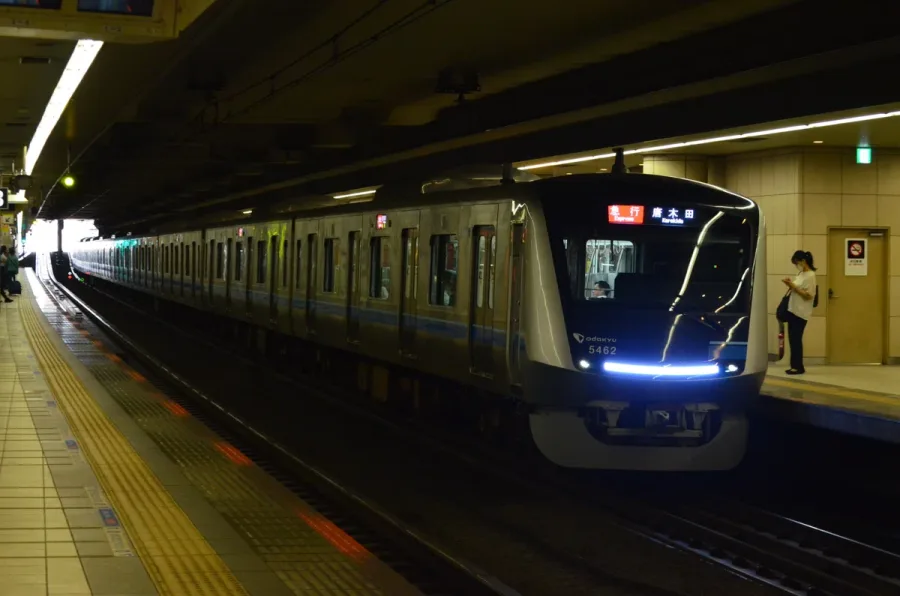
Even among the Express trains that still run in large numbers, there are trains that cannot be lumped together.
1: Shinjuku - Odawara/KarakidaMany Express trains departing from and arriving at Shinjuku Station have these destinations, and during the daytime, almost all Express trains go to Karakida. This is because, with the exception of a few morning trains, Rapid Express trains go to Odawara, Fujisawa, and Shin-Matsuda, so it has an aspect as a rapid service for Tama Line users. Also, since Rapid Express trains stop at Seijogakuen-mae, Kyodo, and Mukogaoka-yuen, which the Rapid Express passes, it also targets people who cannot take the Rapid Express due to the station stops. Since it is for Tama Line users, you can also see scenes of passengers heading for Odawara/Fujisawa transferring to the Rapid Express at Shin-Yurigaoka.
Odawara-bound trains are operated for similar reasons and are mainly operated in the morning.
As introduced in the previous article, this train operates as a local train until Shin-Matsuda, where it changes its type to Express. It fulfills the role of a local train from Odawara to Hon-Atsugi, but it also serves as a rapid service beyond Hon-Atsugi, passing through Atsugi, Zama, and Sobudai-mae. Since this train is operated with a 6-car formation, it is often impossible to get a seat beyond Hadano or Isehara, and the congestion is quite severe.
At night, a few 10-car Express trains bound for Sagami-Ono are operated, but these are operated with 10-car formations and pass through the 4 stations between Odawara and Kaisei. There is also no type change at Shin-Matsuda.
This is a train that was changed in the 2025 timetable revision. Since Satsukidai, Kurokawa, and Haruhino became Express stops, it effectively functions as a local train within the Tama Line. In fact, the timetable at Karakida Station shows that all trains are Express from 10:00 to 16:30.
On the other hand, it functions as a rapid service beyond Shin-Yurigaoka, and in addition to the role of the Express in (1), it is a quite interesting train that also has an aspect as a train for people who travel through to the Chiyoda Line. The train from the Tama Line to the Chiyoda Line is a train that was revived in the 2025 timetable revision, and it was the first revival in 7 years since the Tama Express, which was abolished in 2018.
All Express trains on the Enoshima Line are operated with 10-car formations, and all trains are bound for Shinjuku. A feature of the Enoshima Line Express is that it only runs in the morning and late at night, and during the daytime, Rapid Express trains are operated. The stops are the same as the Rapid Express stops with the addition of Chogo and Minami-Rinkan, which is intended for commuting and school demand. Beyond Sagami-Ono, it is treated the same as other Express trains.
5: Starting within the Odawara Line - Yoyogi-UeharaThese are trains that depart from and arrive at stations such as Hon-Atsugi, Ebina, Sagami-Ono, and Shin-Yurigaoka, and they fulfill the role of a rapid service within the Odawara Line and a through service to the Chiyoda Line. They are operated during the daytime and are also often seen on weekends and holidays. Demand is expected from passengers traveling through to the subway line, and there is demand for outings to the city center and commuting.
Commuter Express
These trains are only set for weekday inbound trains, and all trains are bound for Shinjuku.
Karakida - ShinjukuThis is a train set in 2018 that passes through Kurokawa, Haruhino, and Satsukidai, where Express trains stop, and it plays the role of a rapid service within the Tama Line.
Within the Odawara Line, it also plays a major role as a rapid service second only to the Rapid Express because it passes through Noborito and Kyodo, where Express trains stop. However, it only runs 3 times in the morning, and since weekend and holiday services are replaced by Rapid Express, it is a train limited to commuting and school demand.
At Shin-Yurigaoka, it connects with the Commuter Semi-Express, and you can see passengers transferring from each train.
Rapid Express
The Rapid Express is the fastest train type on the Odakyu Line that does not require a surcharge. It is a train that passes through the 10 stations between Noborito and Shimokitazawa, and 6 trains per hour are operated at Shinjuku Station. Overall, there are many passengers, and it is rare to be able to sit beyond Sagami-Ono, Shin-Yurigaoka, and Hadano, and it is not uncommon for it to be packed at Noborito, Shimokitazawa, and Yoyogi-Uehara.
1: Shinjuku - Odawara/Shin-MatsudaThis is a destination as major as Fujisawa, and it starts to appear sporadically from around 9:00 AM. It connects Shinjuku to Odawara in about 58 minutes, making it comparable in time to the Limited Express. Until the 2025 timetable revision, the service type was changed to Express at Shin-Matsuda, but this change was discontinued following Kaisei's promotion to a Rapid Express stop.
②: Shinjuku - FujisawaOriginally operated as the Shonan Express, this train became the Rapid Express in 2004. It is the same as other Rapid Express trains up to Sagami-Ono, but this train shows its true power on the Enoshima Line, where it only stops at four stations: Chuo-Rinkan, Yamato, Shonandai, and Fujisawa. It passes through all other nine stations. Until 2022, it ran through to Katase-Enoshima beyond Fujisawa, but due to system segmentation, it now terminates at Fujisawa, except for three night trains.
There is demand for transfers to the Tokyu Den-en-toshi Line, Sotetsu Izumino Line, Yokohama Municipal Subway Blue Line, and the Tokaido Line, catering to both commuting and return-home needs.
There are not many Rapid Express trains on the Tama Line, with only 5 trains total (upbound and downbound) on weekdays, and only 2 on weekends and holidays. Because it passes through Haruhino, Kurokawa, and Satsukidai, there is high demand during commuting hours, and it is replaced by Express trains during the daytime.
~Break Line~
Let's rest our eyes
(=ω=`)
Limited Express
This is a service type operated by the Romancecar, the face of Odakyu Electric Railway, connecting Shinjuku to many tourist destinations such as Hakone, Enoshima, and Gotemba.
①: Super Hakone (Shinjuku - Hakone-Yumoto)This train is scheduled to have its frequency increased in the 2026 timetable revision, and its feature is that it runs non-stop from Shinjuku to Odawara. It passes through all major stations such as Noborito, Sagami-Ono, and Ebina. The demand is greater from passengers along other lines than from passengers along the Odakyu line, and it is intended for people who want to go to Hakone in a hurry, as well as for day-trippers. Because it is strongly positioned as a tourist limited express, it only operates on weekends and holidays, with no weekday service.
The Super Hakone is served by the GSE (70000 series), EXE, and EXEα (30000 series). In the case of the GSE, you can enjoy a large front view, while the EXE and EXEα allow for comfortable travel with wide, plush seats. For the EXE and EXEα,the rear 4 cars terminate at Odawara, so that is a point to be aware of.
This train connects Shinjuku to Hakone-Yumoto, and unlike the Super Hakone, it stops at several intermediate stations. It varies by train, with some stopping at Mukogaoka-Yuen, Ebina, or Hadano, and it always stops at about three intermediate stations. It targets Odakyu Line users, and there is a lot of boarding and alighting at intermediate stations, with a diverse passenger base including those in a hurry and those sightseeing at intermediate stations. It operates not only on weekends and holidays but also on weekdays, and is served by the GSE, EXE, EXEα, and MSE (60000 series). Especially for the GSE,the front and rear observation seats sell out immediately, so for those who want to enjoy the view,booking earlyis recommended.
Some trains may have a Katase-Enoshima bound train attached to the rear, so be careful not to board the wrong train. For 10-car trains,they are split at Odawara, so this is also something to watch out for.
The Sagami serves as a supplementary role to the Hakone, stopping at about 4 to 6 intermediate stations. It stops at Shin-Yurigaoka, Machida, Hon-Atsugi, Isehara, Hadano, etc. Like the Hakone, it is served by four types of Romancecars, and here too,the observation seats are popular and sell out immediately.
As a point of caution, all trains terminate at Odawara or Hon-Atsugi, so one should be careful not to confuse them with the Hakone.
The Enoshima is a flagship Odakyu limited express alongside the Hakone, stopping at intermediate stations Shin-Yurigaoka, Sagami-Ono, Yamato, and Fujisawa, with a switchback performed at Fujisawa. The Enoshima is also served by four types of Romancecars, and for the EXE, EXEα, and MSE, the front 6 cars are detached at Sagami-Ono. This is not done for the GSE. The GSE'sobservation seats sell out immediately, so that is a point to be aware of.
5: Fuji-san (Shinjuku - Gotemba)The Fuji-san is a limited express train connecting to Gotemba in Shizuoka Prefecture, and it runs directly onto the Gotemba Line from Matsuda Station along the way. Until 2018, the Fuji-san was known as the Asagiri, and in the past, trains equipped with double-decker Green Cars also operated. On the Odakyu Line, it stops at Shin-Yurigaoka, Sagami-Ono, Hon-Atsugi, and Hadano, and on the Gotemba Line, it stops at Matsuda and Suruga-Oyama (some trains only). Regarding the passenger demographic, many passengers are seen using it as far as Matsuda Station, and seats are noticeably empty beyond Matsuda Station. It gives the impression of a commuter or return-home limited express rather than a sightseeing limited express for outings.
Only the MSE is used for the Fuji-san, and it operates as a 6-car train.
As a point of caution, you can travel to Matsuda Station using the Odakyu Line limited express fare and ticket, but from Matsuda Station, it becomes the JR Line limited express fare and ticket and the fare jumps up. Please be careful.
This train departs from and arrives at Kita-Senju Station on the Tokyo Metro Chiyoda Line, and you can access Hakone and Enoshima directly from the Chiyoda Line. Intermediate stops on the Chiyoda Line are Otemachi, Kasumigaseki, and Omotesando, while on the Odakyu Line, the Hakone stops at Seijogakuen-mae and Hon-Atsugi, and the Enoshima stops at Fujisawa.
The MSE is used for this train, and it is split at Sagami-Ono along the way. The front 6 cars go to Hakone-Yumoto, and the rear 4 cars go to Katase-Enoshima.
As points of caution,
1. You cannot get off the outbound train within the Chiyoda Line, and you cannot get on the inbound train within the Chiyoda Line. 2. The doors that open differ between the Odakyu Line and the Chiyoda Line. 3. Although it stops at Yoyogi-Uehara, you cannot get on or off there.
Please be aware of these three things.
7: Morningway & Metro Morningway (Odawara & Hon-Atsugi & Sagami-Ono - Shinjuku & Kita-Senju)The Morningway is a train operated on weekday mornings, serving as a commuter limited express.
The Morningway departs from Odawara, Fujisawa, and Sagami-Ono, and stops at several stations along the way such as Hon-Atsugi, Yamato, and Shin-Yurigaoka.
All Metro Morningway trains depart from Hon-Atsugi, stop at Machida, Shin-Yurigaoka (some only), and Seijogakuen-mae (some only), and stop at Omotesando, Kasumigaseki, and Otemachi on the Chiyoda Line.
Four types of Romancecars are used for the Morningway, and the MSE is used for the Metro Morningway.
There is high demand for commuting to work and school, and you can see people sleeping until their arrival station, as well as people working or studying.
As a point of caution, you cannot use it only within the Chiyoda Line like the Metro Hakone. Please be careful.
This is a limited express that pairs with the Morningway and is operated during return-home hours.
The Homeway has trains bound for Hon-Atsugi, Katase-Enoshima, and Hakone-Yumoto, and stops at Shin-Yurigaoka, Yamato, and Fujisawa.
The Metro Homeway only goes to Hon-Atsugi, and stops at Otemachi, Kasumigaseki, and Omotesando on the Chiyoda Line.
Four types of Romancecars are used for the Homeway, and the MSE is used for the Metro Homeway.
There is high demand for returning home, and you can see people sleeping until their arrival station, as well as people working or studying.
As a point of caution, you cannot use it only within the Chiyoda Line like the Metro Hakone. Please be careful.
The New Year is a special Romancecar operated in the early hours of New Year's Day, with trains bound for Odawara and Katase-Enoshima, and four types of Romancecars are used.
There is also the Metro New Year that runs directly from the subway line; only the MSE is used for this, and the destination is only Katase-Enoshima.
The stops can vary by year, and it has even stopped at Sangubashi Station, where only local trains stop. It is a very popular train and can sell out immediately after reserved seat ticket sales begin.
How was it? This time it ended up being long, but I hope you found it interesting. What kind of characteristics did the trains you usually ride have?
If you found this article interesting, please like and follow!
I also run YouTube and RailLab, so please take a look if you'd like!
Click here for related articles ⇓
*All photos in this article were taken by the author. Secondary use is permitted. I would appreciate it if you could credit the source.