The Tarumi Railway is a third-sector railway connecting Ogaki to Tarumi. During the Japanese National Railways era, the line only went as far as Kōmi Station; it was abolished in 1984 and converted to a third-sector railway, and the current terminus at Tarumi was opened in 1989, meaning it was extended after the conversion. Also, near the terminus, you can observe the Neodani Fault, which moved during the 1891 Nobi earthquake.
I rode the Tarumi Railway to see the fault.
Ogaki Station
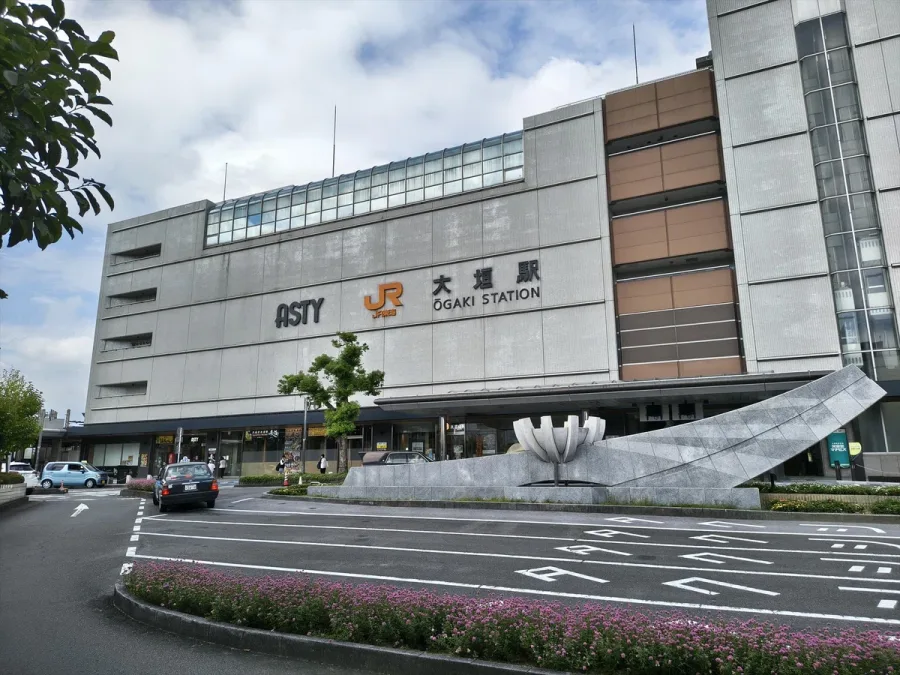
The starting point of the Tarumi Railway is Ogaki Station. Because it was originally a Japanese National Railways line, the Tarumi Railway uses a portion of the JR platforms.
I purchased a one-day free pass. If you are making a round trip to the terminus at Tarumi, the free pass is cheaper. The free pass is purchased at the Tarumi Railway ticket window, which is located inside the Ogaki Station premises (on the platform). I arrived at Ogaki by JR from the Nagoya direction and stopped by the window without leaving the station, so it was no problem, but I think it might be a hassle to buy a free pass from outside Ogaki Station, as you would have to ask at the JR ticket gate to enter the premises.
I boarded the train bound for Tarumi just after 1:00 PM, and it was crowded with many high school students. I think it is a convenient time for those leaving school at noon.
As is common with local lines, high school students got off at every station, and by the time we reached Motosu, the train was empty.
The train was bound for the terminus at Tarumi, but there was a vehicle change at Motosu, and I transferred from the one on the left to the one on the right in the photo below. From here on, the number of passengers could be counted on both hands.
Getting off at Midori Station
To go to the Fault Observation Museum, I got off at the nearest station, Midori Station. Since this area opened relatively recently, the roadbed is modern.
Neodani Fault
The Neodani Fault is an earthquake fault created by the 1891 Nobi earthquake. The fault is just a few minutes' walk from Midori Station. It is now overgrown with grass and difficult to recognize at first glance, but the several-meter-high step is the fault.
Earthquake Fault Observation Museum
Near the fault is the Earthquake Fault Observation Museum, where you can learn about the history of the Nobi earthquake and view the fault itself. So, let's go in! (500 yen).
The museum building (my own name for it) displays photos, historical accounts, and equipment from that time, while the observation building (also my own name) allows you to observe the actual fault surface.
To Tarumi Station by Motosu City Bus
I originally intended to head to Tarumi Station by train, but I noticed there was a bus available, so I took the Motosu City Bus to Tarumi Station instead. Surprisingly, the bus is free. Even travelers can ride it for free without any issues.
Tarumi Station and its surroundings
The area around Tarumi Station is mountainous, with villages strung out along the river. It feels truly peaceful, but I imagine living there is quite challenging in its own way.
From Tarumi Station to Ogaki
As mentioned earlier, since the line to Tarumi Station opened relatively recently, the station is not located within the village, but rather on the outskirts on a concrete roadbed.
This is my first time riding the Tarumi Railway. It runs through the plains up to Motosu, and from Motosu to Tarumi, it travels through mountainous valleys, allowing me to enjoy the scenery and a relaxed atmosphere.
I heard that you can see a strike-slip fault a few kilometers past Tarumi Station. It seems difficult to visit without a car, but I would like to go if I have the chance.
//