There are generally three types of reactions from Seiya fans when they hear about 'Saintia Sho'.
'Gender-bent?' 'What about the mask rule?' 'Silent Knight'?
Although this work has successfully concluded after an eight-year run, I suspect there are quite a few 'Saint Seiya' fans who haven't read it because the premise of 'female Saints fighting with their faces exposed' is a sticking point.
However, I think Saintia Sho is a work that is a bit too good to dismiss out of prejudice.
So, what is the setting for the existence of a Saintia (this is what female Saints who fight with their faces exposed are called in the work; hereafter, I will refer to them as 'Saintia' in this text, except for the work's title, to match the terminology used in the story), and where did that idea come from?
In this note, I will introduce and examine that.
Work Introduction
This work is a spin-off of Masami Kurumada's battle manga 'Saint Seiya'.
The author is Chimaki Kuori, who has a track record with manga adaptations of Gundam SEED DESTINY and Sengoku BASARA. Chimaki Kuori.
It is serialized in 'Champion RED', published by Akita Shoten.
Long-time readers might wonder, 'Isn't it Shueisha?', but all recent Saint Seiya manga works have been published by Akita Shoten.
There are various types of Saint Seiya spin-offs, but Saintia Sho falls into the category of a side story that maintains as much consistency as possible with the original manga.
Stress regarding the worldview, such as 'The power balance between Saints and gods is different from the original...' or 'Gold Saints aren't this weak and obsessed with talking about themselves...', is relatively unlikely to occur (or so it should be).
In fact, Kuori-sensei herself is a fairly hardcore Saint Seiya fanatic, so sometimes there are little Easter eggs included that 'only long-time fans would notice...'.
The story of this work takes the form of another battle that unfolded behind the scenes of Seiya and his friends' fight.
The enemy is the 'Goddess of Strife, Eris' who appeared in the first animated film, 'Evil Goddess Eris'.
Eris also appeared in the 'SUPER MUSICAL' stage play 10 years ago.
Perhaps because the divinity of the Goddess of Strife is easy to work with, this is her third appearance.
While the SUPER MUSICAL had a strong remake feel of Evil Goddess Eris, Saintia Sho is written as a long-form manga, so it uses the film as a reference while expanding with new interpretations and settings.
Since the opponent is a god, naturally, Athena fights. (Saori-san is super busy both behind the scenes and in public.)
The timeline is roughly from before the start of the Galaxian Wars to before the start of the Poseidon arc in the original work.
At just the right time when their schedules are open, original characters, centered on the Gold Saints, also appear quite frequently.
In this behind-the-scenes battle, which could be called the Eris arc, the Saints who take on the role of protecting Athena are the Saintia.
(So it is not gender-bending.)
First, regarding the definition of a Saintia.
In Volume 1 of 'Saintia Sho', there is first an explanation of the rules for female Saints as a preamble.
Building on that, the explanation about the Saintia continues.
That is the definition of a Saintia.
In other words, it's the logic that 'It wasn't depicted in the original, but of course women would take care of Athena's personal needs. They also train in Saint combat techniques in preparation for emergencies, and in fact, they are even granted Cloths'.
Next, regarding the issue of whether Saintia do not have to follow the mask rule.
The reason why female Saints wear masks is explained in the original work as follows.
The reason for wearing a mask (the expression 'made to wear' is slightly concerning...) is explicitly stated as "to cast aside her womanhood."
Therefore, a mask to cast aside womanhood is unnecessary for Saintias, who are required to be completely female, that is.
In fact, if they were to wear a mask clumsily, it would be as good as a useless object that would make them no longer a "complete woman," which would be a problem for a Saintia.
Now, with the explanation so far, some people might be wondering, "So, are Saintias Saints who don't belong to any of the |Bronze|, |Silver|, or |Gold| ranks?"
Regarding this point, all the Cloths worn by Saintias that appear in the disassembly diagrams are considered |Bronze Cloths|.
In other words, if we classify them by Cloth, their rank would be |Bronze Saint|. However, they are not referred to by titles like "Bronze Saintia."
Also, since Saintia Cloths without disassembly diagrams appear in the work, it cannot be definitively stated that |Silver Saint| or |Gold Saint| Saintias do not exist.
The origin of the idea of |Saintia|
Examining from Saintia Sho related interviewsIn the previous chapter, I explained that Saintias are a setting that follows the original work.
So, who did the idea of Saintias come from in the first place? Kuori-sensei? Kurumada-sensei? A third party?
Who the originator is became clear around 2018-2019 when Saintia Sho was adapted into an anime.
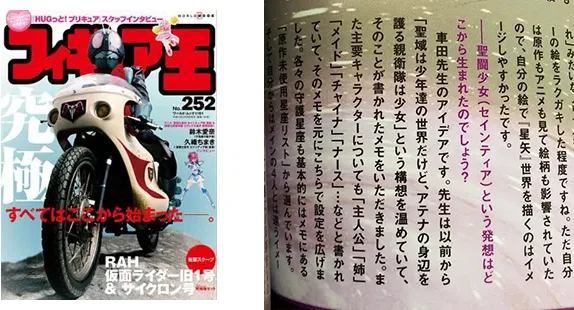
First, an interview with Kuori-sensei that appeared in the hobby magazine 'Figure King No. 252'.
Also, the anime official website has a message from Kurumada-sensei with the same intent posted.
There is no doubt that the originator of the Saintias is the original author, Kurumada-sensei.
Then, what I am curious about next is, when exactly was the time that Kurumada-sensei is referring to when he says "for a long time," "from quite a long time ago"...?
In my personal opinion, I believe that around 2011, Mr. Kurumada already had the idea for the Saintia, or its predecessor.
The key to this line of thinking is the TV anime 'Saint Seiya Omega', which began airing in 2012.
In the mook 'Saint Seiya Pia', published prior to the broadcast, there is an interview with Yoshihiko Umakoshi, who served as the character designer for the first season of Saint Seiya Omega.
The same interview also includes the images Mr. Umakoshi presented for the themes, and for the 'female warrior', slightly more detailed task content is appended.
Although there is a difference between a handmaiden and a 'warrior priestess', the 'general framework of a female warrior who serves close to Athena and protects her, distinct from a regular female Saint' is consistent with the Saintia.
When I first read Saintia Sho, this interview was the first thing that came to mind.
From this short text alone, one cannot deny the possibility that the idea for the 'warrior priestess' task might have coincidentally come from the anime staff rather than Mr. Kurumada.
'Saint Seiya Pia' contains no further information.
However, 'Figure King No. 170', which was published around the same time, also featured a Saint Seiya Omega special, and the female warrior is mentioned in an interview with producer Go Wakabayashi.
With this, we now know that at the time the Saint Seiya Omega project began, Mr. Kurumada had the idea for a female warrior in some form.
I would also like to know if he included elements such as priestesses or handmaidens who serve close to Athena in his idea at that time.
As for the unmasked face, I think there was an understanding that if a female warrior were to be a regular member, it would be easier to handle if she were unmasked, so I don't think it needs to be emphasized that much.
Furthermore, as I continued reading producer Go Wakabayashi's interview, another section mentioning the female warrior appeared.
"Initially, I set her up as a female warrior who was not a Saint"
...That's a subtle phrasing.
Mr. Kurumada is not the type to give detailed orders when providing ideas or initial settings for anime adaptations or other spin-offs.
That is also discussed in this interview.
By the way, in the broadcast episodes, the female Saint Yuna who appears in this interview simply feels that wearing a mask is "suffocating," and she takes it off immediately without dragging it out for many episodes after her appearance.
I will not question the merits of this character design here.
What should be noted is the challenge the anime staff faced in introducing a bare-faced female warrior as one of the main members.
And in another spin-off work, a bare-faced female Saint also appears in a somewhat difficult way.
It is "Saint Seiya: The Lost Canvas - Hades Myth," which was serialized in Weekly Shonen Champion from 2006 to 2011.
I remember that in this work, there was a vague statement like "Only in front of you all" regarding the reason for taking off the mask.
(I don't own all the volumes of this work, so this is vague.)
Even if Mr. Kurumada did not have a concrete concept for female warriors at the time he provided the ideas for Saint Seiya Omega, I think he recognized the problem that "choosing a bare-faced female Saint as the easiest form to move around results in a very unnatural character" through these works.
Since there has been a lot of talk about possibilities, I will summarize it here as a hypothesis.
Do these three cover most of the patterns?
—To the further source—
Taking a bird's-eye view of all Kurumada worksUp to this point, I have examined the setting of the |Saintia| within the framework of |Saint Seiya|.
However, it is difficult to read anything more from the materials I have on hand.
So, I will replace the perspective from "Saint Seiya" to "Kurumada Manga". This is a very effective method for exploring Mr. Kurumada's ideas.
This is because in Kurumada's works, ideas used in past works are sometimes reused in different forms, and sometimes in the same form.
If you are of the Seiya generation, there must be many people besides me who read "Ring ni Kakero" and "Fuma no Kojiro" and thought, "Oh, this is what appeared in Seiya!!" (The actual flow is the opposite, but the subjective reaction is like this.)
So, how has the idea of a female warrior been used in Kurumada's works?
Actually, this is quite clear.
However, before explaining, I would like to call them "female fighters" from here on, as "female warrior" doesn't sound very Kurumada-manga-like.
The definition is "a girl who masters the same kind of martial arts as the protagonist, belongs to the same combat class as the protagonist, and actually stands on the stage of battle".
For example, Kiku Takane, who has mastered boxing and sometimes fights outside the ring, does not stand in the ring as a boxer, so she does not fall under the category of a female fighter.
Now, let's list representative Kurumada manga in order and check if there are any combat girls among the main members. (There are some minor spoilers.)
For each work, 1 lists the main members, and 2 lists characters who seem to fall under the category of female fighters other than the main members.
-
"Ring ni Kakero" (1977–1981)
There are no female fighters among the main members.
Nene of the Kage-do clan wears the same clothes as the boys, but she does not participate in matches.
-
"Fuma no Kojiro" (1982–1983)
There are no female fighters among the main members.
A girl named Komomo appears in the Fuma village, but it is unclear if she is a kunoichi.
There are no women among the other ninjas or warriors either.
-
'Otoko Zaka' (1984–1985)
There are no female fighters among the main members.
In the sequel, Oryu of Tosa and her subordinates control Shikoku despite being women.
-
'Saint Seiya' (1986–1990)
It goes without saying by now.
There are no female fighters among the main members.As female Saints, Eagle Marin, Ophiuchus Shaina, and Chameleon June appear, and as for the enemy side, Mermaid Thetis appears among the Mariners.
-
'SILENT KNIGHT Sho' (1992)
There is a female fighter among the main members.
She is Shirin, a Fairy (lower-class Knight) who is the first to appear before the protagonist, Sho.On the enemy side, Neta, a Lamia (middle-class Knight), also appears.
-
'B'T-X' (1994-2000)
There is a female fighter among the main members.
She is Karen, the master of the protagonist Teppei and one of the Four Spirit Generals.Karen.The cross-dressing beauty Major Aramis and the Seven Demon Generals' Salome appear on the enemy side.
-
'Ring ni Kakero 2' (2001-2008)
There are no female fighters among the main members.
Olivier, one of the Three Musketeers of the new generation French Jr., is a cross-dressing beauty who also participates in matches as a boxer.
-
'Saint Seiya: Next Dimension - Myth of Hades' (2006-)
There are no female fighters among the main members.
The Satellites who protect Artemis are all female.
The results are quite clear, aren't they?
It is evident that female fighters began to appear in Kurumada's works from a certain period onwards.
When is that certain period? Naturally, it is 'Saint Seiya'.
I will present the confirmation results from the previous chapter in a table, using Saint Seiya as the threshold to classify them into Pre-Seiya and Post-Seiya.
In pre-Seiya works, even with a subject that seems easy to handle like ninjas (Fuma no Kojiro), no female fighters appear, whereas in post-Seiya works, even in men's boxing (Ring ni Kakero 2), female fighters appear.
It is also characteristic that the two works following Saint Seiya feature female fighters playing a major role as members of the main cast.
Those familiar with Kurumada's works might think, "Aren't female fighters like Shilin and Karen completely different types?"
Indeed, compared to Karen, who is in the lineage of female mentor characters and is one of the strongest Four Spirit Generals, Shilin has a somewhat weaker warrior presence, serving as the sex appeal character before transforming (or more accurately, revolutionizing) and mainly as a mascot role cleaning up lower-ranked pawns (soldiers) after transforming.
This is likely due to Shilin being the first female fighter and the uniqueness of the work SILENT KNIGHT Sho as a Kurumada manga.
(I will omit the details of this uniqueness as it is enough content to write a separate note about.)
Also, if you break the two down into several elements, you can see that while they appear to be different types, they have many points in common.
They use weapons such as rods (batons).
They are the first to encounter the protagonist, who was an ordinary person, and teach them about enemy forces and fighting techniques.
They are the most friendly toward the protagonist among the main members of post-Seiya works.
I will add a supplement because some people might not grasp the third point, "main members of post-Seiya works."
In works up to Saint Seiya, the protagonist and their allies, once they had shown their fighting prowess, would then fight as one unit (as the Golden Japan Jr./Fuma Clan or the Cosmo Warriors/Athena's Saints).
(Though often pointed out,) facts known by one are perfectly shared with other allies before you know it, and barriers broken by one are treated as having been broken by other allies as well, allowing them to pass through.
In contrast, in post-Seiya works, the main members basically act individually. They fight together only because their interests temporarily align, and once they achieve their goal, they go their separate ways.
Even if one character is acknowledged and allowed through a barrier, other characters are not acknowledged and cannot pass through.
Characters who were initially aiming for the protagonist's head often end up in a relationship where they are not really allies even after they put down their weapons. (The image is that if you treat them as allies, they will blow you away with a 'BOOM!!' on the next page.)
Even in SILENT KNIGHT Sho, which was canceled after 13 weeks, as the first post-Seiya work, you can see the main members having different principles and clashing.
In such post-Seiya works, Shilin and Karen are positioned as characters friendly to the protagonist from the start.
Perhaps these narrative positions and battle styles were the fixed elements of female fighters in Kurumada-sensei's mind, and since Shilin, who was given sex appeal and mascot-like flavorings, didn't quite click, he went with the female mentor character he was used to drawing for the next one, Karen.
I don't know the reason why Kurumada-sensei started drawing female fighters in post-Seiya works.
However, it is not hard to imagine that he had enough material to judge that he should include women in the main cast as a pathway for female audiences, given that Saint Seiya was quite popular with girls at the time and the huge hit of 'Sailor Moon,' which was also produced by Toei as a program following the TV series.
Conclusion
I have traced back as far as I could.
With this, my analysis is complete.
If you previously viewed Saintia Sho as a soft title, I would be happy if you now have a little interest, thinking, "Could this actually be the fruition of an idea that has been nurtured for over 20 years since the end of the Saint Seiya serialization...?" What do you think?
The actual Saintia Sho is content where you can enjoy not only the battles of the "Saintias as completed warriors" but also the activities of the "Gold Saints as completed warriors," so it is recommended for those who like the original characters.
Please give it a read.
Afterword
Miscellaneous notesI had been thinking about writing this analysis for several years and had been working on it little by little, but with the conclusion of Saintia Sho, I was finally able to give it shape.
I touched on Yuna's evaluation in a note I started writing earlier, but I decided not to include it because the conversation went off on a tangent, and I felt that my criteria for evaluation had changed from what they were a short while ago to what they are now. In this day and age, it is a bit difficult for a warrior of justice to remove a mask that also serves as protective gear based on personal feelings.
While it is off-topic, there is also a trend of cross-dressing beauties appearing in post-Seiya works featuring female warriors, such as Major Aramis in B'T-X and Olivier in Ring ni Kakero 2.
Regarding this, I wonder if there is an influence from Charlotte, the female swordswoman who appeared in 'Shin Samurai Spirits,' which was planned to be adapted into a manga but ended up only having illustrations published.
(Chronologically, the sequence is: Shin Samurai Spirits manga adaptation project →invited as a pillar for the launch of Shonen Ace→ publication of Shin Samurai Spirits illustrations → B'T-X serialization?) As for a straightforward cross-dressing beauty, perhaps 'The Rose of Versailles,' where Shingo Araki served as character designer and animation director?
I would also like to summarize my thoughts on SILENT KNIGHT Sho, which I omitted, in a note sometime. (Even if I analyze it, it is not really interesting, so the structure is tricky...) ■
Supplementary NotesPunctuation has been added as appropriate to dialogue quoted from the manga.
Shaina's lines are quoted from the Kindle version (the one that is not the Final Edition). They should not have been corrected from the Jump Comics version, and there are no changes in the Final Edition other than an increase in the use of kanji.
Regarding the notation for Ophiuchus, I have used 'Ophiuchus' (Snake Bearer Constellation) to align with the Final Edition and recent NEXT DIMENSION works, rather than the traditional 'Ophiuchus' (Snake User Constellation).
(In the early stages of ND, the constellations from the beginning of the previous work were still written as 'Pegasus' (Pegasus Star Constellation) as before,“Star”Constellation, but they are now unified as 'Pegasus' (Pegasus Constellation).)Regarding the article title of the interview published in Figure King No. 252, since it did not match between the table of contents and the corresponding page, I have listed the one from the corresponding page, which was more cohesive.