Have you started studying AWS and find yourself wondering, "What exactly does an ALB (Application Load Balancer) do?"
In a nutshell, an ALB is an "excellent host (traffic controller)" that evenly distributes access to a website across multiple servers.
In this article, for AWS beginners, I will explain the basic roles and benefits of an ALB, as well as common technical terms (listeners and target groups), using everyday analogies.
It's a quick read that will take about 5 minutes, so please stick with me until the end!
1. What is an ALB (Application Load Balancer)?
In short,
it is a "traffic controller (load balancer)" thatsmartly distributes website access (traffic) across multiple servers.
Example (Restaurant Host)
When many customers (users) arrive, the host at the entrance (ALB) guides them to "available tables (servers like EC2)" in order, preventing the load from concentrating on just one specific table.
2. Three Major Benefits and Main Functions of an ALB
① Load Balancing Even if access is concentrated, it distributes the processing across multiple servers to prevent site
downtime or latency.
You can change the destination based on the URL path or domain.
Access to [example.com/blog/](https://example.com/blog/)*
→ To the blog server
Access to [example.com/api/](https://example.com/api/)*
→ To the API server
It periodically checks if the servers are running normally. If it finds a faulty server,
it automatically stops distributing traffic to it and only guides traffic to healthy servers.
By setting an SSL certificate (AWS Certificate Manager) on the ALB, the
encryption processing can be handled centrally by the ALB (reducing the burden on the servers).
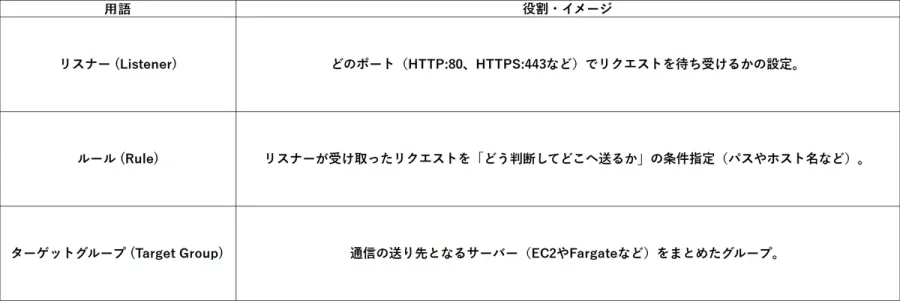
3. Key Terms You Must Know for ALB!
4. Summary
The ALB isa very important service that smartly distributes web application (HTTP/HTTPS) traffic.
It is an essential item for building systems that are resilient to failure and easy to scale.
Thank you for reading until the end! I hope this article has been helpful. I will continue to share knowledge about AWS in an easy-to-understand way, so please check back again!