Six months ago, I introduced Venice AI, an "uncensored, privacy-focused AI," in an article.
Honestly, I just left it alone after that. I didn't do any additional promotion.
However, when I opened the dashboard the other day for the first time in a while, I found that registrations via my referral link had been trickling in over the past six months. Even while I was doing nothing.
I was actually surprised, thinking, "So this is a tool that people are still finding even though I left it alone."
When I went back in to take a look, I found that Venice AI was no longer the same tool I had introduced.
This article is a summary of this "transformed Venice AI" as an updated version of my article from six months ago. Whether you read the previous one or are here for the first time, this single piece is designed to give you the latest overall picture.
The previous article is here↓
Venice AI has evolved from a "chat" to a "production hub"
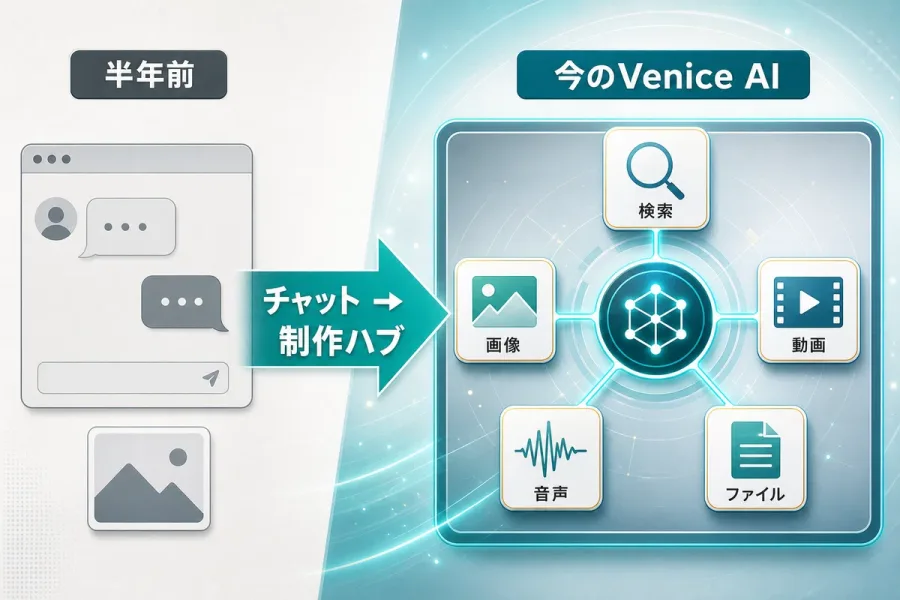
This is the biggest change in the last six months.
The previous Venice AI was, roughly speaking, an "uncensored chat AI + image generator."
The current Venice AI has become an agent-based AI production hub that automatically connects search, images, video, audio, and file analysis within a chat.
My honest impression after using it for the first time in six months is that "it is no longer just a chat AI."
Let's look at what has been added, one by one.
Venice's core of being "loosely regulated" is still alive and well
While features have continued to increase, Venice's starting point remains unchanged.
Compared to other major AIs, the restrictions on expression are looser. This is Venice's origin and its biggest selling point. Many people who read the previous article were likely drawn to this.
Image generation is particularly strong. You can choose open-source image models with fewer restrictions yourself to suit your needs. In addition to general-purpose models like Z-Image Turbo, Chroma, and the Flux series, there are even models that support NSFW (adult content) (such as Lustify) available. Even expressions that would be blocked at the entrance by major tools can pass through on Venice depending on the model. For those who come with the goal of "loosely regulated image generation," this is likely the biggest reason.
However, there are three points I don't want you to misunderstand.
It is not "anything goes": Illegal content (such as depictions involving real minors) is naturally prohibited by the terms of service. It remains strictly within the scope of laws and the terms of use.
It depends on the model: Not all models are uncensored; you need to choose a model with loose regulations yourself.
Video is still in a transitional phase: Video generation itself exists (Sora 2, Veo 3, Kling, Wan, etc.). However, "uncensored video" cannot yet be created stably, and it is at a stage where we are waiting for future support. If you have the same expectations for video as you do for images, you will likely be disappointed.
Roughly speaking, images have loose regulations / video is still to come. If you understand this point correctly, you are less likely to feel that it is "not what I expected" after registering.
Change 1: Chat has become an "Agent" (Agentic Chat)
This is the biggest change.
In May 2026, Venice's default chat switched to "Agentic Chat."
What is the difference?
Before, if you wanted an image, you would "switch to image mode," or if you wanted to search, you would "turn on search," with you manually choosing how to use it.
Now, when you send a complex request, Venice automatically breaks it down into steps and chooses the necessary tools to use itself.
If it determines that a web search is necessary, it will search.
If an image is needed, it will generate an image.
If a video is needed, it will create a video.
If you provide a file, it will analyze the contents.
It does all of this within a single conversation.
In short, it feels like it has moved from being a "partner to give instructions to" to a "partner to delegate work to."
I will write this fairly.
Just because it has become agentic does not mean the previous chat has disappeared.
The conventional "Classic Chat" is still properly available, and it includes over 200 models, video generation (Reference-to-Video), custom characters, image editing, and music/audio generation.
If you want to leave it to the AI roughly → Agentic Chat
If you want to specify models and settings in detail yourself → Classic Chat
This distinction is all you need.
Change 2: The pricing and credit system have changed
Since this is about money, I will explain it carefully.
There are currently these four plans (as of June 2026).
Free ($0): 10 texts/day, 15 images/day, API access also available
Pro ($18): Unlimited text, 1,000 images/day, 100 credits/month
Pro+ ($68): 7,500 credits/month, 2 months of credit rollover
Max ($200): 22,500 credits/month, 3 months of credit rollover
The credit conversion is 100 credits = $1.
You can try it out normally even with the free plan, and the fact that you can even use the API is a subtly nice point.
Note: "1,000 images/day" and the "credit consumption model" are different thingsI'll write this first because it's a point of dissatisfaction in external reviews as well.
When you hear "Pro gets 1,000 images/day," it sounds like it's unlimited, but advanced models (such as the latest image and video models) consume credits separately.
It is easier to understand if you think of it as: image count quota = basic models, and credits = advanced models.
The reason some people feel that "I can take 1,000 images, but my credits disappear quickly" is because this two-tiered system is difficult to understand.
This confusing credit system is honestly a weakness of Venice. I will touch on it again in the "Points to Note" section later.
Change 3: The referral program functions as a lead for articles
I wrote at the beginning that "registrations continued even though I had left it alone," and this is the mechanism behind that.
Venice has a referral program, and it works like this.
If someone who registers via my referral link upgrades to Pro, the referrer receives $10 in API credits
The person referred also receives $10 in credits
You can check your referral link in your profile settings
It is open to all users, including anonymous visitors
In other words, it is designed to benefit both the person who registers and me.
Note: Not everyone who registers results in a rewardI will be honest about this.
You only receive reward credits when the person you referred converts to Pro. People who continue to use it for free or who just register are not eligible.
Therefore, it is not a sweet deal where you get money for every registration just by posting a link, and I will not write about it that way either. Please think of it as a mechanism where, if someone likes it and continues to use it, both parties benefit just a little bit.
Change 4: Privacy has been organized into '4 levels'
Source: Venice official privacy explanation
Privacy-first was a selling point last time too, but now the content is neatly organized.
Anonymous: Venice anonymizes and relays to external models. However, you should assume that storage on the external provider's side is a possibility
Private: Processed on Venice-managed GPUs or on partners with contracts that do not retain data
TEE: Processed within an isolated execution environment (Trusted Execution Environment)
E2EE (End-to-End Encryption): Encrypted on the device and decrypted only within a verified TEE. It is the strongest, but in exchange, web search and memory functions cannot be used
One important note here.
Venice is not 'completely anonymous magic'.
If you read the privacy policy, IP, device information, usage data, and purchase information are collected. However, it is designed not to store the content of prompts or outputs and is organized around offering verifiable protections like TEE/E2EE.
'Account and payment information is handled, but conversation content is not retained.' If you understand this correctly, you can use it without excessive expectations or excessive anxiety.
Change 5: Aiming to become a foundation for AI agents and APIs
This is for intermediate to advanced users, but I am including it because it clearly shows Venice's direction.
Venice provides an OpenAI-compatible API, and you can handle chat, images, audio, and video with a single API key. It also supports web search, file input, MCP tools, and wallet payments.
Furthermore,
Integration with development tools like Claude Code / Cursor / Codex CLI
Venice MCP Server, Venice Skills
Agents such as OpenClaw, Hermes Agent, and NanoClaw
A mechanism where AI agents issue their own API keys via wallet (Autonomous API Key)
These are all available.
In short, it is trying to become an 'inference infrastructure used by AI agents' while simultaneously being an 'AI app used by humans'.
Change 6: Trying a 'different design for AI usage fees' with VVV / DIEM
This is a point of contention, so I will write it carefully.
Venice has a token called 'VVV' and a mechanism called 'DIEM'.
VVV: A token on Base. If you deposit (stake) 100 VVV, you can use Venice Pro
DIEM: A design where 1 DIEM can be used as '1 dollar worth of API credit per day'. DIEM can only be issued by VVV holders
Roughly speaking, it is an attempt to handle AI usage fees in a form other than subscriptions.
However, I will state this clearly: this is not investment advice.
Token prices fluctuate, and there are also risks related to liquidity and regulation. It is safer to view this with a sense of distance, thinking, 'So there is another design for AI usage fees.' Only those who are interested should check the official information themselves.
Honest points of caution (for those who have read this far)
I won't be trusted if I just end with a promotion, so I will properly write about the weaknesses as well.
The credit system is confusing: The two-tiered structure where '1,000 images/day' and the 'credit consumption model' are separate is a stumbling block.
External reviews are mixed: Ratings on Trustpilot are on the lower side (in the 2-point range), with complaints about the credit system, image limits, support, and censorship. On the other hand, it is highly rated in app stores for the ability to 'use multiple models anonymously'.
The new Agentic Chat is not without issues: While the uptime itself is high (99.99% over the last 90 days), Agentic Chat was temporarily suspended on June 9, 2026, due to an external partner.
Consider the smartphone app as a 'supplement': Agentic Chat has come to mobile, but there are also reports of app errors. It is recommended to try it on a PC browser first.
If you have excessive expectations like 'a dream AI that is uncensored and completely private,' you will likely be disappointed.
'I want to cross between multiple AI models,' 'I don't want the content of my conversations to be saved,' 'I want to handle images, videos, and agents all at once' — for people like this, the current Venice is a quite interesting option.
Summary
Venice AI, which I had left alone for half a year, had become this.
Chat → evolved into an agent-based production hub (automatically connecting search, images, videos, and file analysis)
Pricing is in 4 tiers: Free / Pro / Pro+ / Max, with 100 credits = 1 dollar.
Privacy is organized into 4 levels: Anonymous / Private / TEE / E2EE.
It has also started to have a face as an API/agent platform.
However, the confusion of the credit system and the mixed reviews are facts.
For those who want to bring photorealistic images closer to the scenes they want to create
I want to change expressions and backgrounds and try making images myself. For those people, I have prepared
a paid article (1,980 yen) on prompts that use rearranged words.
It summarizes base templates, words for replacement, 10 completed prompts, common failure patterns, and practical steps in Venice. The free section also includes words for changing expressions and examples.
Before purchasing, there is something I would like you to check.
Since generation results vary depending on the model and instructions used, I cannot guarantee the same images as the examples.
If you are still choosing your tools, please take a look at this free article.
I created the same scene using ChatGPT and Venice's image models to compare the differences in composition, expressions, and instructions.