※Postscript.
After writing this review, I attended the 'Prism Rondo' special screening and staff talk show held at Machi Asobi vol. 30.
Having watched the first episode again on a movie theater screen and heard from the production staff, I would like to write down a little bit of what I felt through that event.
Introduction
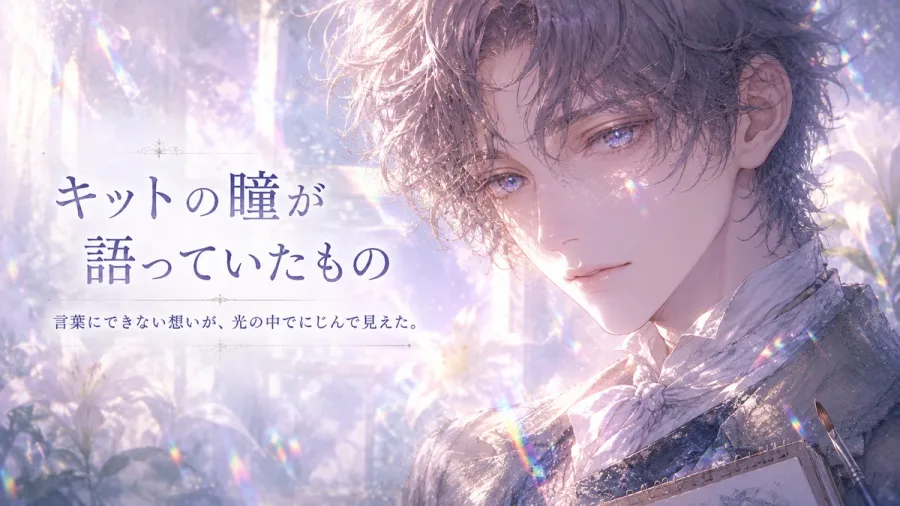
After finishing all 20 episodes of 'Prism Rondo,' the first thing I felt was that this is a work that deserves to be talked about more.
Although it is a work that focuses on the relationship between Riri Ichijoin and Kit Church, I feel that calling it just a romance anime is a bit insufficient.
What was impressive about this work was that Riri and Kit never once said 'I like you' or 'I love you' to each other's faces until the very end.
Instead, there were gazes.
There was silence.
There were paintings.
There were colors.
And in the end, the very landscape the two arrived at remained as a single painting.
That is why I interpreted this work in this way.
Perhaps 'Prism Rondo' was a work that depicted love not as a confession, but as art.
Looking back on all 20 episodes with my own themes
While watching all 20 episodes, I tried assigning my own themes to each one.
Episode 1:Encounters and Reasons
Episode 2:The First Prism
Episode 3:The Beginning of the Two
Episode 4:Neighbors and the Critique
Episode 5:Kit and Christopher
Episode 6:The White Horse and the Ball
Episode 7:Cloudy Prism
Episode 8:Catherine
Episode 9:Where the Heart Lies
Episode 10:Thaw
Episode 11:Heading Toward Spring
Episode 12:The Power of Friends
Episode 13:A Ticket to the Future
Episode 14:The Weight of Resolve
Episode 15:Resonance and Dark Clouds
Episode 16:Gray Tears
Episode 17:Unspoken Feelings
Episode 18:A World Without Prisms
Episode 19:Reunion and Lingering Regret
Episode 20:Dreams are Prisms
When lined up like this, the flow of this work becomes visible.
The story begins with the meeting of Riri and Kit.
At an art academy in a foreign land, Riri faces her first assignments and new human relationships, touching upon a world as complex and beautiful as a prism.
However, that light does not remain clear forever.
In episode 7, the prism clouds over, and in episode 16, the tears turn gray.
And in episode 18, the story finally sinks into a 'world without prisms.'
Even so, in the end, beyond the reunion and lingering regret, the light of dreams returns once more.
That is why I wanted to set the theme of the final episode as 'Dreams are Prisms'.
I believe that dreams are not just bright things.
Encounters, talent, jealousy, friendship, pain, parting, lingering regret, resolve.
There are colors that only become visible after all those things have refracted and overlapped.
Perhaps that was the prism in this work.
Riri and Kit do not say 'I like you'
What left the strongest impression on me in "Prism Rondo" was that Lily and Kit never once said "I like you" or "I love you" to each other's faces until the very end.
In a typical romance, it wouldn't be strange to have a confession scene somewhere.
There could have been a scene where they put their feelings into words and clarified their relationship.
However, this work chose not to do that.
Instead, their emotions gradually seeped into the screen.
The way they look at each other.
A sudden silence.
The time spent trying to see the same scenery.
The gaze directed at the other's painting.
The choice of how to accept the other person chasing their dream.
Beyond that accumulation of moments was the kiss scene near the end.
I feel that kiss wasn't just a romantic trope placed there suddenly, but the moment when the emotions that had gone unspoken over the course of 20 episodes finally took shape.
Lily and Kit's love was not something confirmed by a confession.
It was something that deepened little by little through shared time, shared scenery, and through their art.
That is precisely why the romantic depiction in this work had such a quiet, persuasive power.
What Kit's eyes were saying
There is a part of this work where I strongly felt the staff's dedication.
That is Kit's eyes.
Kit is not the type of person who puts his true feelings into words.
In fact, I think he was the type of person who often swallowed his emotions or held onto them without speaking them aloud.
That is why his eyes were so important.
The way light enters them.
The wavering of his gaze.
His eyes when looking at Lily.
The expression of someone about to say something, only to swallow it back.
I feel that emotions that could not be conveyed through dialogue alone resided there.
In the work "Prism Rondo," the eyes are not just character design.
They were like small prisms, receiving light, reflecting colors, and showing the swaying of the heart.
In particular, weren't Kit's eyes quietly telling the story of the feelings he couldn't put into words?
The friends at the Art Academy gave dimension to Lily's dream
"Prism Rondo" was not just a story about Lily and Kit.
Because of the friends she met at the Art Academy, I think Lily's dream became something three-dimensional rather than just her own.
Dorothy is Lily's confidante and best friend.
She comforts her when she's down, encourages her when she's lost, and sometimes dares to push her forward.
The theme of "the power of friends" that I attached to episode 12 is something that becomes visible precisely because of Dorothy's presence.
Geoffrey is the son of a minor noble, a heavy drinker and a bit of a clown.
However, he is more than just comic relief.
He was an essential mood-maker who softened the atmosphere of the academy, which was often shaken by talent and evaluation.
Peter is a brilliant student from Delhi, India, and a friend of Kit's.
However, in the middle of the story, he struggles with his inability to paint well.
At that moment, Kit's words cut deep, and the two end up having a falling out.
Peter's suffering showed that even talented people can get lost.
At the same time, it depicted how Kit's words could sometimes hurt people.
Although Kit is a beautiful genius, he is not a perfect prince.
I think he was also a young man carrying his own immaturity.
Shinnosuke Kobayakawa is a young Japanese man who came to England dreaming of becoming a sculptor.
He was upright, kind-hearted, and well-liked by everyone.
In the second half, he returns to Japan and comes close to marrying Riri.
But in the end, he too follows his own dream and heads back to Italy.
Shinnosuke is not a loser in love.
I think he was just another young man who chose his dream in a different way than Riri.
Sakura Kobayakawa is a girl who lost the ability to speak due to a certain shock.
However, through her life in England and her interactions with Riri and the others, she gradually opens her heart.
And after returning to Japan, she becomes able to speak normally.
Riri and Kit depict love by not putting it into words.
Sakura depicts the recovery of her heart by regaining her words.
This contrast was also very impressive.
And then there is Catherine.
At first, Catherine appears as someone who is jealous of Riri and makes mean, unreasonable demands.
But she was neither just a villain nor a simple love rival.
Through her interactions with Riri, Catherine realizes that there is a path for her other than the life decided for her as a noble.
She then breaks off her engagement with Kit and becomes friends with Riri.
I think Catherine's change well demonstrated that this work was not about winning or losing in love, but about how to choose one's own life.
Dreams are not singular.
The futures of the friends were also very good.
Dorothy naturally lets go of her future with Geoffrey and chooses a normal family life with her fiancé.
However, I don't think that means she gave up on her dreams.
A glamorous path in art is not the only way to live.
Choosing a peaceful happiness for oneself is also a valid future.
Peter's future as a potential art dealer is hinted at when he visits Shinnosuke in Italy.
If he, who struggled with painting, ultimately moved from being on the 'creating side' to the 'connecting side of art,' that is also a good landing point.
Geoffrey runs the pub he had always dreamed of.
For someone who loves to drink and is a bit of a clown, a pub where people gather, laugh, and talk is a very fitting place.
It was a future that suited Geoffrey, who had been softening the atmosphere of the room since his academy days.
Catherine uses her strength of loving fashion to open her own shop.
Furthermore, she begins to handle kimonos from Riri's family's kimono shop.
Having stepped out of the life decided for her as a noble, she turns her 'likes' into a job and connects her bond with Riri to the future.
I think it was a very good ending.
Looking at it this way, the dream this work depicted was not just about succeeding as a painter.
Choosing a family.
Turning to the side that supports art.
Creating a place where people gather.
Turning what you love into a job.
Each choice has its own color.
That is why I believe the final episode's line, "Dreams are prisms," was directed not only at Lily and Kit, but at all of their friends as well.
Was the "field of lilies blooming in the cave" an unconscious confession?
When discussing this work, one simply cannot overlook the "field of lilies blooming in the cave."
When they first met, Kit invited Lily to search for that field of flowers.
At that point, Kit himself may not have even realized that it was a romantic feeling.
However, looking back after watching the final episode, that invitation seems to have had a very significant meaning.
Kit never says, "I love you."
But he invites Lily to the scenery he wants to see.
Isn't that the same as saying the following?
There is a view I want to see with you.
There is something I want to search for with you.
I want to invite you into my dreams.
Thinking about it that way, that invitation might have been Kit's unconscious confession of love.
For Kit, a confession was not "I love you," but perhaps
"Let's go see those flowers together."
was it not?
This is a very fitting expression of love for this work.
Instead of putting love into words, he offers it as a landscape he wants to share.
Instead of explaining his emotions, he invites the other person to a place that would make a painting.
Because this work centers on art, I believe the expression of love was also, in some way, artistic.
The white horse Aphrodite, an indirect compliment
In the early stages, the scene where Kit says Lily resembles his white horse, Aphrodite, at his home was also impressive.
Normally, telling a woman she "looks like a horse" is a rather strange expression.
However, considering that the white horse's name is Aphrodite, the meaning changes.
Aphrodite is a name associated with beauty.
And if that white horse was a particularly beautiful existence to Kit, comparing Lily to it might have been his ultimate compliment.
Kit is not the type of person to say "You are beautiful" to someone's face.
However, by comparing Lily to something he finds beautiful, it seems he was letting his feelings out just a little bit.
The white horse was not just a romantic prop, but perhaps an existence that reflected Kit's aesthetic sense and his unconscious affection for Lily.
Riri, who brings color back to a monochrome Japan
A scene that left a particularly strong impression in the second half was when Riri returned to Japan.
From the time Riri returned to Japan until she reunited with Kit and remembered the joy of painting, the screen was depicted in monochrome.
I believe this was a directorial choice to show that color had been lost from Riri's world, not through dialogue, but through the screen itself.
There is a peaceful life.
A future of marriage is just ahead.
However, within Riri, the joy of painting and the light toward her dreams had not yet returned.
Through her reunion with Kit, Riri remembers the feeling of 'wanting to draw' once again.
The return of color was not only a rekindling of love, but perhaps also the moment Riri reclaimed herself as an artist.
This work was one that spoke through the colors on the screen rather than explaining emotions through dialogue.
The prism in the first half is polarization; the prism at the end is a rainbow
The word 'prism' in the title of this work takes on a different meaning once you watch it to the end.
I feel that the prism in the first half functioned somewhat like polarization.
Light does not reach straight.
Relationships are distorted.
Emotions are seen from different angles.
The relationship between Riri and Kit, Catherine's jealousy, Peter's suffering, and the other possibility of Shinnosuke—none of it is seen straight.
However, watching until the final episode, you realize that the prism was not merely something to distort light, but something to create a rainbow.
The prism in the first half is something that distorts light.
The prism at the end is something that turns light into a rainbow.
Encounters, friendship, jealousy, lingering attachment, tears, dreams.
I think it is only after all those colors overlap that the answer 'Dreams are prisms' finally comes into view.
The boldness of not putting the misery of war at the forefront
Considering the historical background of this work, I think they could have put the war and the instability of the era more at the forefront.
However, 'Prism Rondo' did not overly depict that.
Rather than inducing tears by strongly showing the misery of war, it focuses strictly on Riri and the others' dreams, art, human relationships, and their respective choices.
I believe this was not a lack of substance, but rather a form of boldness.
Of course, I am not ignoring the shadows of war or the era.
However, I feel that this work did not place that misery at the center of the story, but rather focused entirely on depicting how the characters dreamed, how they loved, and how they chose their own lives.
Instead of making the audience cry by directly depicting misery, it shows them still painting and seeing the same scenery as someone else, even in an era where everything might be lost.
I think that quiet strength was what made this work unique.
In the end, the two become a single painting.
And then, the final episode.
Lili and Kit find the "field of lilies blooming in a cave" that they searched for when they first met in China.
It is not just spoken of as a memory.
They truly go to that place together.
And there, they paint.
As lily petals dance in the air, the sight of Lili standing there and the scenery itself end by becoming a painting.
I think this ending is so beautiful because it does not state the fulfillment of their love in words.
They do not become a couple because they said "I like you."
It does not conclude because they said "I love you."
The two stand in the same place, see the same scenery, and turn that moment into a painting.
In other words, their relationship itself finally crystallizes as art.
The flower field they were supposed to go searching for at the beginning becomes the place they truly reach in the end.
And Lili's figure, along with the lily petals, becomes a single painting.
Here, I felt that this work layered love, dreams, and art onto a single canvas.
Lili and Kit did not confirm their love with words.
But in the end, they were in the same scenery.
And that scenery became a painting.
Isn't that the most beautiful answer in "Prism Rondo"?
Precisely because it might be a work that hasn't seen the light of day
"Prism Rondo" might not be a work that has gained widespread recognition.
But that is exactly why I wanted to put it into words like this.
The emotions dwelling in Kit's eyes.
The fact that Lili and Kit never say "I like you" until the very end.
The lily field in the cave connecting their meeting to the finale.
The word "prism" changing its meaning from polarization to a rainbow.
And the fact that Dorothy, Geoffrey, Peter, Shinnosuke, Sakura, and Catherine each gave their own color to Lili's dream.
This work possessed that kind of care.
Even works that hide in the shadows of major hits have their own light.
In fact, I think it is meaningful that for such works, there are writings left behind by those who watched them later, showing that 'there was someone who loved this work.'
I would be happy if this article could become something like a small lighthouse for such works.
Postscript: Bringing the atmosphere of shojo manga to anime lines. How 'Prism Rondo' was made, as seen at the Machi Asobi screening.
I attended the 'Prism Rondo' special screening and staff talk show held at Machi Asobi vol. 30.
The event consisted of a screening of the first episode, followed by a talk session with the staff members who took the stage. The guests were animation producer Keita Yoshinobu, chief animation director and character designer Yasuko Takahashi, and chief animation director and sub-character designer Aiko Minowa.
Producer Yoshinobu served as the moderator, while Takahashi and Minowa shared episodes from the production process.
After watching the entire series, re-watching the first episode on a movie theater screen makes me realize once again that the expressions, gazes, costumes, and lighting—which I initially saw just as an introduction—were crafted with great care.
I felt that this work is not one that explains emotions with big words, but rather one that places emotions within the drawings themselves.
A longing for shojo manga was the gateway to this workWhat was impressive was that Producer Yoshinobu mentioned, 'I had wanted to be involved in works based on shojo manga since I joined the company.'
However, he said he rarely encountered such opportunities. Amidst that, the work he was assigned one day was this 'Prism Rondo'.
Also, Takahashi and Minowa mentioned that they were of the generation that grew up reading the works of Yoko Kamio, who handled the original character designs. Because of that, while they were very happy to be involved in this project, they also seemed to struggle quite a bit with how to express the atmosphere of Kamio's drawings in animation.
It wasn't just about making them look similar; it was about how to refine the lines to make them move as animation.
How could they keep the glamour of shojo manga while making it look natural on screen?
The difficulty of that 'translation' came across during this talk.
Eyes, stylization, and sub-characters. Adjustments to imbue drawings with emotionWhat left a particular impression from Takahashi's talk was the point that the 'stylization' and 'eye treatment' for the animation were difficult.
To keep the atmosphere of Yoko Kamio's original character designs while making them move as animation, how much should the expressions be simplified, and how much of the character's essence should be preserved? I think that balance was very delicate.
Hearing this, I felt a bit more convinced about the impression I had long held regarding Kit's eyes.
'Prism Rondo' is not a work that over-explains the characters' feelings through dialogue. That is precisely why the way the eyes are drawn and where the gaze is placed must have played a major role in conveying the characters' inner emotions.
I felt that the reason Kit's eyes seemed to hold emotion was because of the accumulation of such detailed efforts.
On the other hand, in Minowa-san's story, the difficulty of creating sub-characters was also impressive.
While ensuring they don't stray too far from the main character's art style, they also need to have an 'exquisite mob-like quality.' If sub-characters stand out too much, they get in the way of the main characters. However, if their presence is too thin, the atmosphere of the art academy and the city doesn't come to life.
They mentioned that finding that balance was difficult.
'Prism Rondo' is a story about Lily and Kit, but it is also a work where the world gains depth through the academy friends and the people around them. Perhaps it was because of such detailed design that the sub-characters didn't overshadow the leads, yet still made one feel the life and relationships within the screen.
Costumes were another language that reflected the era and relationshipsThe talk about costumes was also very interesting.
Takahashi-san mentioned that they focused on ensuring the design materials and historical research were accurate. Since 'Prism Rondo' is set in early 20th-century London, even a slight deviation in the costumes would change the atmosphere of the entire work.
I think it was important not just to make them look glamorous, but to establish them as people living in that era.
Among them, the 'Silver Lily' costume that Lily wears in episode 6 was said to be a difficult one to get right.
While it is an impressive and beautiful costume that highlights Lily's specialness, if it were too flashy, it would feel out of place for the era of the work. Perhaps it is because of the process of searching for that balance that the costume appears not just as a 'pretty dress,' but as the radiance of the person Lily is at that moment.
On the other hand, Minowa-san mentioned that they were conscious of the texture of fabrics like the suits of that time.
It's not just about making them the 'shape of old clothes,' but thinking about the thickness, stiffness, and weight of those clothes. By considering such textures, I think the characters start to look like they are truly standing in the atmosphere of that era.
Furthermore, Minowa-san cited the scene in episode 10 where Catherine has Lily try on various clothes as an impressive costume scene.
That scene is not just a glamorous sequence with many costumes appearing. I think it was a scene where you could see through the clothes how Catherine views Lily, how she is trying to bring out Lily's charm, and how the distance between the two has changed.
I felt that the costumes in 'Prism Rondo' were not just decorations to make the characters look beautiful, but another language that reflected the atmosphere of the era, the characters' positions, and even changes in their relationships.
Director Nakazawa's lines and the rhythm of disciplined workThere were also many interesting stories about the impression of Director Kazuto Nakazawa.
Takahashi-san mentioned that they once worked at a desk near Director Nakazawa. What left a strong impression at that time was that Director Nakazawa almost never used an eraser.
In the work of drawing, one would expect to naturally hear the sounds of drawing lines, erasing, and drawing again. However, from Director Nakazawa's desk, the sound of that eraser was almost never heard. They said they were very surprised by that.
Minowa-san spoke about their impression of Director Nakazawa from yet another perspective.
While many in the anime industry start their work around noon, Director Nakazawa would arrive at the office first thing in the morning and leave in the evening. It was striking to hear people say that because they rarely saw him actually working, he felt more like a concept than a person.
Producer Yoshinobu mentioned that he spent more time with Director Nakazawa than with his own family. He also noted that when the director draws, his posture is incredibly upright and perfect.
Lines that rarely require an eraser.
A work rhythm of arriving in the morning and leaving in the evening.
The posture of drawing with a straight back.
Listening to these stories, the impression of Director Nakazawa that emerges is one of lines drawn without hesitation and a disciplined work rhythm.
The quiet, refined quality of 'Prism Rondo' may well be a reflection of this creator's attitude.
The images of movies and voices behind the charactersThe discussion about character design was also fascinating.
It seems the character of Kit was based on the image of Leonardo DiCaprio from 'Titanic.' Hearing that, the slightly free-spirited yet somehow fragile atmosphere Kit possesses makes perfect sense.
A young man who seems unbound by status or place, yet is drawn to beauty more than anyone else. The scent of romance in his character was indeed reminiscent of both Western films and shojo manga.
Additionally, the image for Shin was based on Ryo Yoshizawa.
While Shin possesses a different kind of beauty than Kit, in terms of refinement and a quiet presence, it feels as though that image is reflected in the character's silhouette.
Regarding the voices, it was mentioned that Kouki Uchiyama was Takahashi-san's wish, while Yuki Kaji was recommended by Yoko Kamio. Apparently, Kamio-sensei doesn't have a TV at home, but she does enjoy Western films.
Producer Yoshinobu also remarked that he was amazed that such a cast could be assembled.
It wasn't just the art; the creators' individual desires to 'hear it from this person' were layered into the voices as well. Thinking about it, 'Prism Rondo' is not only a work that speaks through art, costumes, and gazes, but also one that brings the contours of emotion to the surface through the quiet performance of the voices.
Peter and Lily shedding tears. What lay beyond the difficulty of drawing themWhen asked about characters that were difficult to draw, Takahashi-san named Peter.
He felt pressure because the Peter that Director Nakazawa drew was so good. On the other hand, it was also memorable that Minowa-san mentioned he liked Peter.
Producer Yoshinobu noted that he was surprised by how the art evolved as the story progressed during production. Even if characters seem complete as settings from the start, I felt that in reality, they gradually become the 'face of the work' during the production process.
Takahashi-san also mentioned that it was difficult to draw Lily shedding tears in episodes 16 and 17, which occur in the latter half of the series.
Rather than explaining emotions through grand dialogue, 'Prism Rondo' is a work that entrusts them to expressions and gazes. That is precisely why the tearful scenes weren't just about making the audience cry; it was necessary to pour everything Lily had carried up to that point into the angle of her face and the lines around her eyes.
It is said that the painting was so popular that the company staff even used it as their PC wallpaper. Since such things are truly rare, I felt that it was a piece that left a strong impression even among the creators themselves.
A work that the creators themselves still watch todayWhat was even more impressive was that Mr. Minowa mentioned he still watches "Prism Rondo" on Netflix every day.
Someone involved in the production continues to rewatch the work almost every day even after its completion. That alone conveyed how much this work is cherished even among the staff.
Also, according to Mr. Takahashi, the winter clothes worn by Peter, Jeffrey, and Kit in the key visual were not originally part of the character settings. Therefore, they created new winter clothing designs just for the key visual.
Furthermore, they had merchandise like acrylic stands made based on those visuals, which are scheduled to be released at the end of July.
Creating new costume designs for a single key visual, which then expands into merchandise. I felt that the effort put into creating the art is also accumulated in the developments outside of the work itself.
It was a work that depicted love through pictures, not wordsWhen I binged it, I felt that "Prism Rondo" was a work that depicted emotions that aren't put into words through pictures. After hearing the staff talk at this Machi Asobi, that impression became even stronger.
The treatment of the eyes.
The texture of the costumes.
The positioning of the supporting characters.
The expression on Lily's face as she sheds tears.
And the affection of the staff who continue to watch the work even after it is finished.
There was meticulous work there to make the atmosphere of a shojo manga function as an anime.
"Prism Rondo" was a work that depicted love through pictures, not words.
My impression that I felt that way has, through this event, moved a little closer to certainty.
Conclusion
"Prism Rondo" was a work that, while depicting romance, did not confine romance only to words.
It doesn't say "I like you."
It doesn't say "I love you."
But the gazes speak.
The pictures speak.
The silence speaks.
And the lily field at the end says it all.
The relationship between Lily and Kit was not completed by a confession.
Over the course of 20 episodes, it gradually took on color, became murky, shed tears, was lost, reunited, and finally became a single painting.
For me, "Prism Rondo" was a work where dreams, love, and art finally fit onto the same canvas.
And, after watching that finale, I thought to myself.
Dreams are prisms.
Perhaps love was a prism, too.
However, what I have touched upon in this article is still only a part of the work.
'Prism Rondo' is not a work that explains everything in a flashy way, but the more you pay attention to the gazes, the silences, the changes in color, and the choices made by the characters, the more you will see little by little.
What kind of scenery did Riri and Kit see at the very end?
I definitely want you to see it for yourself in the main story.
Also, this work can be taken as a story that chronologically leads to 'Etoile Blooming in Paris'.
How will the light of the dreams and art depicted in 'Prism Rondo' bloom in the story that follows?
Next time, in my review of 'Etoile Blooming in Paris', I would like to look back on that connection as well.
Until next time, with the next work.