In a corner of Narita Airport, there is a forgotten station building.
The tunnel to this otherworldly space opens quietly near the ticket gate of the "Terminal 2 Station." In a Narita Airport overflowing with travelers in a hurry, no one pays it any mind.
I visited this place on a whim when I arrived at the airport early once before, and I was captivated by its eerie atmosphere.
This time, I visited "Higashi-Narita Station" again with a film camera, so I would like to introduce the strange story of this place along with my film photos.
A Forgotten Station Building
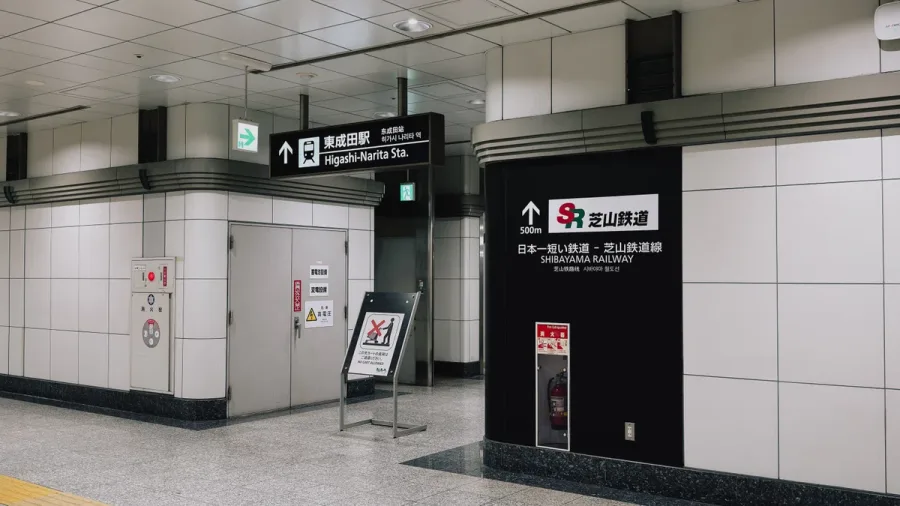
You walk down a long, long corridor to get to "Higashi-Narita Station." The airport was crowded, but the moment I entered this corridor, all signs of people completely vanished.
Other than passing a pair of police officers just before arriving at the station, I didn't see a soul. The sight of the officers walking through the inorganic space reminded me of a 70s dystopian film.
The strange space you arrive at in this way is "Higashi-Narita Station."
You might wonder why a station building that looks like a ruin is hidden in the corner of such a modern facility. But there is a proper reason for the strangeness of this place.
The Dream of Narita International Airport
The original idea for "Narita Airport" was to build a massive airport in the suburbs where noise issues wouldn't occur, and connect it to the city center via the Shinkansen.
In the 1960s, the government secured the land in "Narita" and began construction, but local residents opposed the plan. Involving student movements and the far-left, the riot police and protesters clashed so violently that there were deaths on both sides.
Opening in 1978 in a significantly delayed and scaled-down form from the original plan is the "Narita Airport" we know well. The heavy-handed warnings and checkpoints at the surface entrance of Higashi-Narita Station are remnants of this heavy history.
However, the "Narita Shinkansen," which was supposed to be built in parallel, had a plan that was so broken there was no prospect of it ever being completed. The cause, like the Narita Airport issue, was opposition movements by residents and others.
As an alternative, a method was adopted to extend the existing Keisei Line close to Narita Airport and connect from there to the airport itself by bus. This is how the former Narita Airport Station, the current "Higashi-Narita Station," was born.
Remnants of a dream
I would like to take a look at Higashi-Narita Station.
Like many buildings from the 70s and 80s remaining in Japan, I felt that the design style was significantly different from those of today.
The same can be said for Hotel New Akao, which I wrote about on note previously; there is a sense of cultural playfulness and vanity that is absent in modern spaces designed solely for practicality.
What particularly catches the eye are the massive ceramic reliefs. The idea of placing works of art in public spaces feels quintessentially Showa-era.
Also, the current station interior is partitioned off by fences, with more than half of it hidden from view.
It is not exactly good manners, but if you lift your camera up to the gap at the top of the fence, you can see what it looks like inside.
The interior is quite spacious, and you can see the ticket gates for the Skyliner and a coffee shop.
As if time has not moved at all since the bubble era, the coffee shop is left exactly as it was back then.
Nissin advertisements from the late 80s also remain on the walls, never having been removed.
The station that lost its name
Why has time stopped at Higashi-Narita Station, keeping it in the 80s?
From its opening in 1978 until 1991, when the bubble era—which saw a boom in overseas travel—came to an end, the former Narita Airport Station was used as the main route from the city center to Narita Airport. At its peak, it was reportedly bustling with an average of 26,000 users per day.
However, in 1991, the current "Narita Airport Station," which is directly connected to the terminal, opened.
It was realized by reusing facilities that had already been built for the Narita Shinkansen, a project that had stalled in the 70s. In other words, a transportation method close to the original plan was finally realized just as the country had passed through the period of high economic growth and the end of the bubble era was beginning to come into view.
Originally prepared as a temporary alternative, the old Narita Airport Station saw its usage plummet the moment the new station opened. Having had the name "Narita Airport Station" taken by the new station, it has been left in a state where time seems to have stood still since that day.
Of the people who used this station for overseas travel during those prosperous times, how many still keep a corner of their memory reserved for this place?
A dried-up well
I buy a 220-yen ticket for the "Shibayama Railway" and enter through the ticket gate. IC cards and the like cannot be used.
The biggest reason this old station building continues to operate quietly is the "Shibayama Railway," the shortest railway line in Japan, which runs into this station.
Even after the opening of Narita Airport in 1978, opposition movements by local residents continued. And it was this "Shibayama Railway" that was provided as compensation for the significant deterioration in transportation convenience caused by the airport construction.
There was one staff member at the ticket gate window, but otherwise, there was no one else. The space, illuminated by strangely designed fluorescent lights, felt strangely dark, as if the weight of accumulated time was absorbing the light.
I go down the stairs to the platform.
Perhaps because it is an underground space, I feel a strangely damp and murky air. It felt like I had descended to the bottom of a dried-up well.
There is, as expected, no one on the platform either. An escalator continues to move all by itself.
What exacerbates the eeriness of this space is the old Skyliner platform visible on the other side across the tracks. The dark part on the left side of this photo.
It was abandoned when access was switched to the current 'Narita Airport Station' and has been left untouched for 35 years since. As a result, the station sign for the 'Narita Airport Station' of that time remains, and the advertisements are also just as they were back then.
While walking around, the Shibayama Railway train I was going to ride arrived.
There were a few passengers on the train. Most of them seemed to be tourists or rail enthusiasts who had gathered for its rarity, and I don't think there were any local residents.
After passing through the dystopian darkness and running for a few minutes facing the runway, you arrive at 'Shibayama-Chiyoda Station'.
The station is relatively new, and there is nothing particularly noteworthy, just a street with a few airport-related facilities scattered about. I walked for a few minutes and then took a shuttle bus straight back to the airport.
'Higashi-Narita Station' was born as a byproduct of the chaos of Narita Airport's construction and Japan's period of rapid economic growth.
Right behind our daily lives, this kind of surreal world quietly exists.
Please take a look at this as well.