[Free Newsletter] Are you struggling with structures for the First-Class Architect exam? ⇒Go from struggling with structures to "understanding"! Get easy explanations of Q&A and calculation problems delivered for free
Hi, I'm Director Zero!
Today, let's organize our thoughts on the "yield point". In structural design, it is very important to know at what stressplasticityoccurs. That is the yield point (yield stress).
Understanding the stress-straincurve will give you a clear image all at once.
Furthermore, I will summarize how to determine it, its units, representative values for different steel materials, and the differences from tensile strength.
If you read this article, you will clearly understand the meaning of the yield point and its relationship to design!
Recommended Study Materials
[Recommended by the Manager!] Save 50% with this set! All 90 calculation problems from the past 15 exams explained ⇒Understand the flow of calculations and how to solve them! First-Class Architect [Structure] Calculation Problem Explanation Collection
What is the Yield Point?
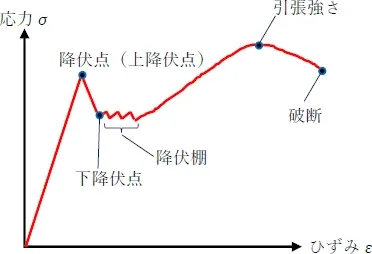
The yield point is the stress at the moment the steel material transitions from the elastic region to the plastic region. It is also called "yield stress".
When you pull on steel, it is initially in the elastic region.
This is a state where it returns to its original shape if the force is removed.
However, when it reaches a certain stress, it suddenly begins to stretch significantly.
The stress at this time is the yield point.
In steel materials, once the yield point is reached, the stress drops once.
First peak → Upper yield point
Slightly lower value → Lower yield point
After that, the strain continues for a while at a constant stress.
This is called the yield plateau.
Eventually, the stress rises again and reaches a maximum value. That is the tensile strength.
Difference between Elasticity and PlasticityElastic range: Returns to original state when force is removed
Plastic range: Permanent deformation remains
The yield point is this boundary.
Read from 100 yen! No internet required! Click here for a PDF article that is easy to read even when printed Read anytime, anywhere! No ads! A PDF version of a structural mechanics learning article for architecture students
How to determine the yield point
To find the yield point, you just need to determine the "stress at yielding".
Stress can be calculated using a basic formula.
σ=PA\sigma=\fracPA
σ: Stress
P: Tensile force
A: Cross-sectional area
If you know the P at yielding, you can calculate the yield stress.
Determining from Hooke's LawIn the elastic range, Hooke's Law holds true.
σ=Eε\sigma=E\varepsilon
E: Young's modulus
ε: Strain
If you know the strain, you can also find the stress. Because E for steel is constant.
Units of the yield point
Since the yield point is a stress, its unit is the same as stress.
N/mm²
Pa
MPa
Both are "Load ÷ Cross-sectional Area". In structural design, we often use MPa.
List of Yield Points for Steel Materials
Let's organize the yield points of typical steel materials.
SN400, SS400, SSC400 → 245 or more
SS490, SN490 → 325 to 445 or less
SR235 → 235 or more
SD295A → 295 or more
SD345 → 345 or more to 440
SD390 → 390 to 510
SD490 → 490 to 625
* All units are in N/mm² (MPa)
You can see that the strength varies significantly depending on the steel grade.
We are selling a set of all PDF teaching materials related to structural design (3550 yen ⇒ 2480 yen)
[Value Set] Structural Design Teaching Materials (Total 12 files)
Difference between Yield Point and Tensile Strength
This is a point that is easy to confuse.
Yield Point → Stress at which plasticization begins
Tensile Strength → Maximum stress exhibited by the material
Looking at the stress-strain curve, the yield point is in the middle, and the tensile strength is the highest point.
Thinking based on yielding first is the basic approach in design.
Summary
The yield point is the stress at the boundary where the material transitions from elastic to plastic.
Stress is calculated as σ=PA\sigma=\fracPA or σ=Eε.
Tensile strength is the maximum stress and is different from the yield point.
Being able to draw the stress-strain curve will deepen your understanding.
FAQ
Q1: Does it break immediately after exceeding the yield point?
The conclusion is "it does not break immediately."
Even after yielding, the material retains some strength, but plastic deformation progresses. In design, it is basic to use the material within a range that does not exceed the yield point.
Director Zero's closing words
Try drawing the stress-strain curve yourself once. All the hints are there!
[Information on our free email newsletter]
Apart from the note articles, I distribute a free email newsletter called "Easy to understand for beginners! Architect Examination (Structure) and Easy Talks on Architectural Structure."
・Explanation of 1st-class architect structural text problems one by one with true/false answers
・The flow of how to solve calculation problems
will be delivered to your email twice a week.
Recommended for people like this:
・People aiming to obtain 1st-class or 2nd-class architect qualifications
・Students studying in the department of architecture
・People with these concerns:
"I cannot understand calculation problems (structural mechanics)..."
"I am self-studying, so I don't know how to study"
"I have been bad at structural mechanics since I was a student"
"The explanations in commercially available problem books are too short to understand"
You can register just by entering your email address in the form below and sending it. Registration is free, and of course, you can unsubscribe at any time.
Recommended teaching materials
[Manager's recommendation!] Save 50% with the set! All 90 calculation problems from the past 15 exams explained⇒Understand the flow of calculations and how to solve them! 1st-class Architect [Structure] Calculation Problem Explanation Collection
Reference
#1stClassArchitectExam
#1stClassArchitectSubjectExam
#2ndClassArchitectExam
#1stClassArchitectExamSelfStudy
#1stClassArchitectExamPastQuestions
#2ndClassArchitectSubjectExam