After the death of Emperor Chuai, Empress Jingu headed toward Yamato with her prince.
This prince was the future Emperor Ojin.
However, Emperor Chuai already had other princes.
They were Prince Kagosaka and Prince Oshikuma.
Their father was Emperor Chuai.
Their mother was Oonakatsuhime.
In other words, Prince Oshikuma and Emperor Ojin were half-brothers who shared the same father.
In the Kojiki and Nihon Shoki, the side of Empress Jingu and Ojin is depicted as the ultimate victor, while Prince Kagosaka and Prince Oshikuma are the losers.
However, a question arises here.
After the death of Emperor Chuai, why did Prince Oshikuma try to prevent Ojin's accession?
Was he merely a rebel?
Or did Prince Oshikuma himself have a reason to claim the throne?
2. The Mystery of Prince Oshikuma's Mother, 'Oonakatsuhime'Here, I would like to focus on Prince Oshikuma's mother.
Oonakatsuhime.
Tracing the genealogy in the Kojiki reveals something interesting about Oonakatsuhime.
Oonakatsuhime's father, Prince Ooe, was a son of Emperor Keiko. And the Kojiki records that Prince Ooe married his 'half-sister, Princess Shirogane,' and fathered Oonakatsuhime.
In other words, if one follows the genealogy of the Kojiki, not only Oonakatsuhime's father's side but also her mother, Princess Shirogane, is positioned within the same royal lineage as Prince Ooe.
This means that according to the genealogy in the Kojiki, Oonakatsuhime was connected to Emperor Keiko through both her father's and mother's sides.
Furthermore, Prince Oshikuma's father, Emperor Chuai, also connects to Emperor Keiko through Yamato Takeru.
Prince Oshikuma is repeatedly connected to the royal lineage of Emperor Keiko through both his father's and mother's sides.
Thinking about it this way, can the resistance of Prince Kosaka and Prince Oshikuma to Ojin's accession really be dismissed as a mere 'rebellion'?
The possibility emerges that the side of Prince Oshikuma also had a genealogical basis for claiming the throne.
3. Did Prince Oshikuma really die?In the 'Nihon Shoki', Prince Oshikuma is defeated by the army of Empress Jingu and meets his end near Seta.
However, a completely different tradition remains in Echizen.
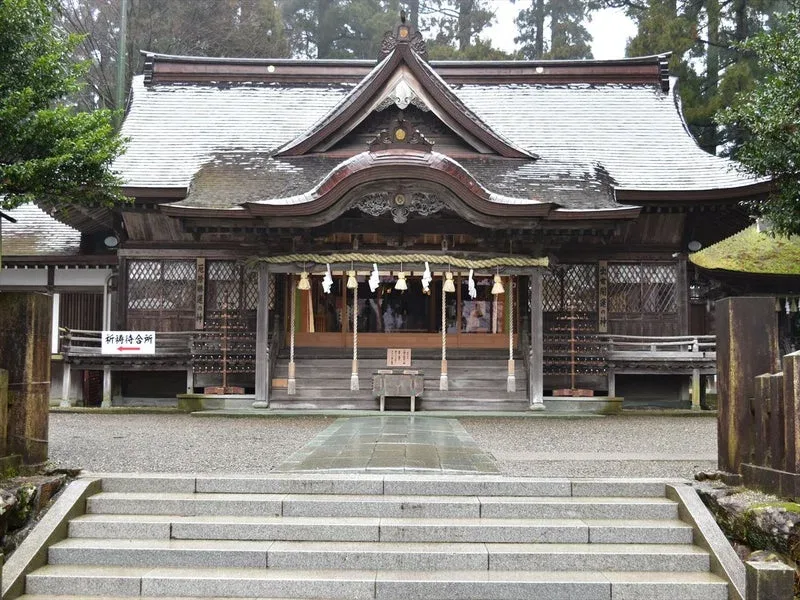
The setting is Tsurugi Shrine in Echizen Town, Fukui Prefecture.
Here, Prince Oshikuma is enshrined as an important deity.
And according to the shrine's records, when Prince Oshikuma was struggling in Echizen, the Great Deity Susanoo appeared in his dream and granted him a divine sword.
It is said that Prince Oshikuma pacified his enemies with that divine sword.
Furthermore, what is noteworthy is the tradition that Prince Oshikuma was revered as the 'reincarnation of the god Susanoo'.
Prince Oshikuma, who disappears as a loser in the Kojiki and Nihon Shoki, shows a completely different figure in Echizen.
4. 'Tsurugi Daimyojin' who enshrined Prince OshikumaFollowing the traditions of Tsurugi Shrine further, the relationship between Prince Oshikuma and the shrine is quite deep.
In the medieval 'Tsurugi Daimyojin Engi', one can see traditions that have Prince Oshikuma as the enshrined deity.
At the current Tsurugi Shrine,
the Great Deity Susanoo, the Great Deity Kehi, and Prince Oshikuma
are enshrined.
This is an interesting combination.
Prince Oshikuma, who was granted a divine sword by Susanoo.
And, the Great Deity Kehi is right next to him.
In the previous article, I examined the possibility that Amenohiboko = Kehi no Okami = Susanoo might be the same entity.
If this hypothesis holds, the three deities enshrined at Tsurugi Shrine are not completely unrelated gods.
5. He was the clan deity of Oda NobunagaFurthermore, an unexpected figure appears at this Tsurugi Shrine.
It is Oda Nobunaga.
The Oda clan of Echizen held traditions that this region was their place of origin, and they revered Tsurugi Shrine as their clan deity.
Records from the Sengoku period also remain that identify Tsurugi Shrine as Nobunaga's 'clan deity'.
In other words, Prince Oshikuma was enshrined alongside Susanoo at a shrine that would later become known as the clan deity of Oda Nobunaga.
Of course, this does not mean we can assume a blood relationship between the Oda clan and Prince Oshikuma.
What is important is the fact that the worship of Prince Oshikuma, who became a loser in the Kojiki and Nihon Shoki, was preserved for a long time in Echizen.
6. However, Ojin also comes to EchizenSomething even stranger happens.
The prince on the side that defeated Prince Oshikuma, the future Emperor Ojin, also heads to Echizen.
In the 'Kojiki', Takenouchi no Sukune accompanies the Crown Prince, traveling through Omi and Wakasa to Tsuruga.
There, the deity that appeared in the Crown Prince's dream was Izasawake no Okami, also known as Kehi no Okami.
And the god told the Crown Prince, 'I wish to exchange my name for yours.'
This is the famous 'name exchange' between Kehi no Okami and Ojin.
Why would Ojin, who should have won the struggle for the throne, need to go to Tsuruga and exchange 'names' with Kehi no Okami?
7. Was Ojin 'Legitimate' from the Beginning?Here, let us compare Prince Oshikuma and Ojin.
Prince Oshikuma was the son of Emperor Chuai and O-Nakatsuhime.
Ojin was the son of Emperor Chuai and Empress Jingu.
The two were half-brothers.
And then,
Prince Oshikuma
↓
considered a reincarnation of Susanoo
↓
defeat
After that,
Ojin
↓
heads to Tsuruga
↓
exchanges names with Kehi no Okami
is the sequence.
If Ojin had been an unquestionable, legitimate successor to the throne from the start, what would this 'exchange of names' signify?
Conversely, if we consider that Prince Oshikuma's side possessed some form of legitimacy inheriting the previous royal lineage and rituals, and that Ojin's side was a new force that won the succession struggle, a different interpretation becomes possible.
Perhaps Ojin needed not only to obtain the throne but also to inherit the ritual authority held by the old royal power.
Is it not possible that this memory became the story of the 'exchange of names' with Kehi no Okami?
8. What Was the 'Name' That Ojin Inherited?Prince Oshikuma is said to be the 'reincarnation of the god Susanoo' in Echizen.
And Ojin, who defeated Prince Oshikuma, subsequently headed to Tsuruga in the same Echizen and exchanged 'names' with Kehi no Okami.
In the previous article, I examined the possibility that the same ancestral genealogy exists between Amenohiboko, Kehi no Okami, and Susanoo.
If Kehi no Okami was a god who overlapped with Susanoo, this 'exchange of names' looks completely different.
Could it be that what Ojin inherited was the 'name of Susanoo' that Prince Oshikuma possessed?
Ojin gained the throne by defeating Prince Oshikuma. However, the ritual legitimacy held by the old royal lineage could not be obtained through war alone.
Therefore, Ojin headed to Echizen and, by receiving a 'name' from Kehi no Okami, who overlaps with Susanoo, inherited the royal authority of Prince Oshikuma's side.
Of course, this is one hypothesis.
However, when viewed in this light, two seemingly unrelated traditions—'Prince Oshikuma as the reincarnation of Susanoo' and 'Ojin exchanging names with the Kehi Great Deity'—become connected.
9. So, from where did Prince Oshikuma inherit Susanoo?Here, the greatest mystery remains.
Why was Prince Oshikuma considered the 'reincarnation of Susanoo' in Echizen?
There are two possibilities. One is that he inherited it from the lineage of his father, Emperor Chuai. The other is that he inherited it from the lineage of his mother, O-Nakatsuhime.
In the case of Empress Jingu, it is relatively easy to understand. In the genealogy of the 'Kojiki', tracing back her maternal line leads to Amenohiboko.
However, in the case of Prince Oshikuma, even if we can confirm a genealogy leading to the Keiko royal line, it is unclear why that led to the tradition of him being the 'reincarnation of Susanoo'.
Did the authority of 'Susanoo' that Prince Oshikuma was said to have inherited lie on the side of his father, Chuai?
Or was there a ritualistic background in the lineage of his mother, O-Nakatsuhime, that became invisible from the Kojiki and Nihon Shoki?
This remains unknown.
10. The 'Legitimacy' Held by Prince OshikumaIn the genealogy of the 'Kojiki', Prince Oshikuma was connected to the royal line of Emperor Keiko through both his father's and mother's sides.
That Prince Oshikuma was defeated by the Ojin side and remembered in Echizen as the 'reincarnation of Susanoo'.
And Ojin, who became the victor, headed to that Echizen and exchanged 'names' with the Kehi Great Deity.
If 'name' meant not just a label, but the qualification to inherit the royal line and rituals, then another meaning emerges from this tale of name exchange.
After Ojin defeated Prince Oshikuma and gained the throne, was it not necessary for him to inherit the authority of the royal line that the Prince Oshikuma side held?
And could it be that this authority was linked to 'Susanoo' in Echizen?
11. The 'Child of Prince Oshikuma' Who Disappeared from the Kojiki and Nihon ShokiHere, there is another strange tradition. The 'Kojiki' and 'Nihon Shoki' do not record anything about the children of Prince Oshikuma. However, in Echizen, a tradition remains that not only did Prince Oshikuma survive, but he also fathered a child named 'Tsuruhiko'. What is even more complex is that there is also a tradition that 'Tsuruhiko' is not the child of Prince Oshikuma, but another name for Prince Oshikuma himself. And in another tradition surrounding Tsurugi Shrine, there even exists one that identifies 'Tsuruhiko-no-Mikoto' as the child of Susanoo-no-Mikoto. Prince Oshikuma. Tsuruhiko. Susanoo. Why did these three overlap in the same land of Echizen? In the Kojiki and Nihon Shoki, Prince Oshikuma dies in defeat, and his lineage disappears there. But in Echizen, the story of Prince Oshikuma had not ended.
Here, in closing, I would like to record one more strange fact.
About a century after the era of Prince Oshikuma and Ojin, a major shift occurred in the succession to the throne.
When Emperor Buretsu had no heir, the person welcomed as the new Great King was Odo no Okimi—Emperor Keitai, who is considered a fifth-generation descendant of Emperor Ojin.
And Odo no Okimi was also a figure with deep ties to Echizen.
Prince Oshikuma—leaves behind survival legends and Tsurugihiko legends in Echizen.
Ojin—exchanges 'names' with the Kehi Great Deity at Tsunuga.
Keitai—appears from Echizen at a turning point in the royal lineage.
Why does Echizen repeatedly appear at major turning points in the succession to the throne?
I had intended to start by investigating Prince Oshikuma, but what remained in the end was an even greater question.
What exactly was Echizen to the ancient royal authority?
And why is it that when the royal lineage is broken, a 'king' appears from Echizen?