On April 15, 1989, the co-operator visited Genoa, a port city in northwestern Italy facing the Ligurian Sea.
When people hear of Italian maritime cities, many first think of Venice. However, in the medieval Mediterranean, there existed a city that stood shoulder to shoulder with Venice, and at times built a maritime network that even surpassed it. That city is Genoa.
To understand the history of Genoa, one must first look at a map. In this city, mountains press right up against the coastline, and there is surprisingly little flat land for the city to expand freely. It is a city that feels as if it were squeezed between the sea and the mountains, and it was precisely those geographical constraints that drove its people toward the sea.
Agriculture alone could not provide sufficient wealth. But the Mediterranean lay right before them.
Genoa is a city that transformed this geographical disadvantage into a massive strength through maritime expansion.
A city where mountains fall into the sea
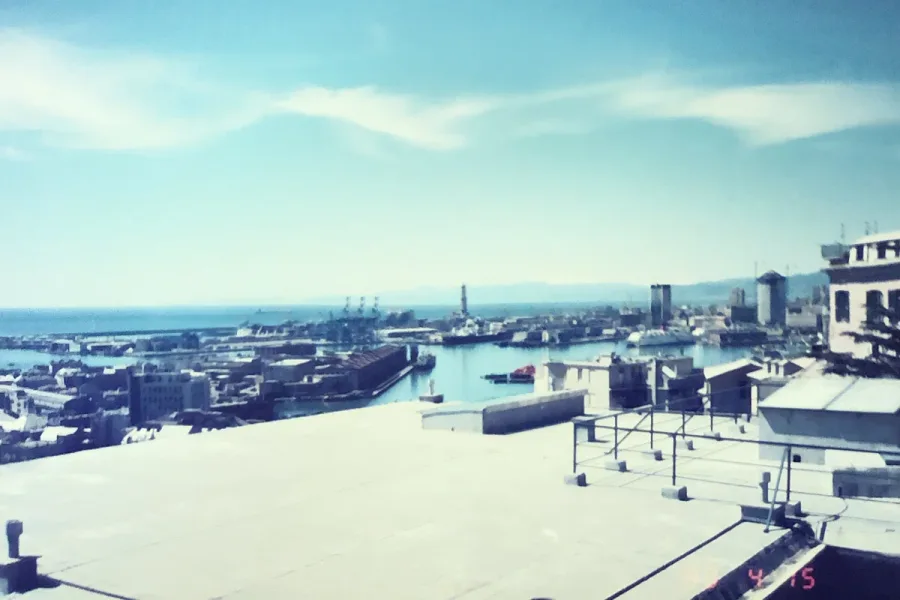
Genoa is the capital of the Liguria region and stretches narrowly along the Ligurian Sea. The Ligurian Apennine mountains loom behind it, and the urban area spreads three-dimensionally from the coast up the slopes.
This topography can be felt physically when walking through the streets of Genoa. There are many slopes and stairs, narrow alleys intersect in complex ways, and suddenly, the sea appears at the end of them. The roads begin to climb just a short distance inland from the port.
Even today, Genoa is closer to a vertical city piled up from the sea toward the mountains rather than a 'city that spreads horizontally'.
The old town covers approximately 113 hectares, with a maze of narrow alleys called 'caruggi' running in all directions. There, people, goods, languages, and food cultures brought from the sea have been mixing for centuries.
The urban structure of Genoa itself preserves its history as a port city.
A port that existed since ancient times
Settlements existed around Genoa since before the Roman era, and it has been archaeologically confirmed that there was contact with Mediterranean trade as early as the 5th to 4th centuries BC. The Ligurians interacted with Greeks, Etruscans, and people of Phoenician-Carthaginian descent.
In other words, Genoa did not suddenly become a maritime city in the Middle Ages.
This location was originally a natural gateway connecting Northern Italy and the Mediterranean.
After the fall of the Roman Empire, it was influenced by powers such as the Ostrogoths, the Eastern Roman Empire, the Lombards, and the Franks, but as central authority weakened, merchants and influential families based in the port began to accumulate power.
And from around the 11th century, Genoa rapidly emerged as an independent urban commune.
The Maritime Republic of Genoa
In medieval Italy, there existed several 'Maritime Republics' that prospered through maritime trade.
They are Venice, Genoa, Pisa, and Amalfi.
As I organize the photos from my past travels, I find that I have captured all four of the major maritime republics that once competed on the Italian seas—Venice, Genoa, Pisa, and Amalfi—along with their respective photographs.
From the 11th century onward, Genoa came to possess not only merchant ships but also a powerful navy, and it even participated in the Crusades. Its sphere of activity expanded throughout the Mediterranean, and it established trading outposts as far as the eastern Mediterranean and the Black Sea.
The goods handled by Genoese merchants were diverse, including spices, silk, grain, wine, metals, dyes, and slaves.
The city itself is small.
However, its economic sphere was unimaginably vast compared to the size of the city.
The War with Pisa: Over the Hegemony of the Mediterranean
The most distinctive feature of Genoa was that trade and war were almost two sides of the same coin.
Pisa was a particularly fierce rival.
The two cities clashed for a long time over hegemony in the western Mediterranean, with Sardinia and Corsica serving as the stages for their conflict. Then, in 1284, the Battle of Meloria, which would greatly alter the fates of both, took place.
The Genoese fleet dealt a devastating blow to the Pisan fleet.
Following this defeat, Pisa's power as a maritime state declined rapidly, and Genoa became one of the most influential maritime powers in the western Mediterranean.
If I had visited Pisa the day before and traveled to Genoa the next day, then my journey from April 14 to 15, 1989, would have coincidentally been an itinerary that consecutively visited two maritime republics that had fiercely competed for hegemony in the Middle Ages.
Porta Soprana: The City Walls that Protected the Republic
While Genoa grew as a maritime state, it also needed to protect the city from the land side.
In the 12th century, as tensions with the Holy Roman Emperor Frederick I Barbarossa rose, Genoa rapidly strengthened its city walls. The defensive line was expanded in 1162, and one of the city gates that remains to this day is the Porta Soprana.
The gate, flanked by two massive circular towers, is also a structure that symbolizes the independent spirit of medieval Genoa.
"La Superba": The Proud Genoa
Genoa has long been known by the name La Superba.
It means 'The Proud City' or 'The Magnificent City'.
True to its name, Genoa maintained a strong sense of independence against outside rule.
However, the Republic of Genoa was not a simple democracy. Politics were driven by powerful merchants, bankers, and noble families, with clans such as the Doria, Spinola, Grimaldi, and Lomellini wielding immense influence.
In 1339, Simone Boccanegra was elected as the first Doge.
And in the 16th century, one of the most famous figures in Genoese history, Andrea Doria, appeared.
From the sea to finance—the 'Genoese Century'
What is interesting about Genoa is that the city's prosperity did not end even when its naval power declined.
Rather, from the 16th century onward, Genoese merchants transformed from 'merchants of the sea' into 'bankers of Europe'.
In particular, their financial relationship with the Spanish Habsburg Empire was deep, and Genoese bankers provided massive amounts of capital to the Spanish royal family. The silver flowing from the Americas to Spain became linked with Genoa's financial network.
Genoese financiers were so deeply embedded in the heart of the European economy that the historian Fernand Braudel called the late 16th and early 17th centuries the 'Age of the Genoese'.
The maritime state had converted its trade network into a financial network.
A city lined with noble palaces
That wealth was also reflected in the urban landscape.
From the 16th century onward, powerful Genoese nobles competed to build luxurious residences. Magnificent palaces line the 'Strade Nuove,' centered around the current Via Garibaldi, and some of these were registered as a World Heritage site in 2006 as 'Le Strade Nuove and the system of the Palazzi dei Rolli'.
The 'Rolli' was an official list of noble residences created to accommodate state guests visiting the Republic.
Rather than the Republic itself owning a massive royal palace, it utilized the private residences of wealthy merchants and nobles as state guest houses.
This was a system truly characteristic of the merchant republic of Genoa.
San Matteo Church—The church of the Doria family
After passing through the narrow alleys of the old town, a church with white and black stripes suddenly appears in a small square.
It is the Church of San Matteo.
This church is deeply connected to the Doria family, one of the most powerful clans in Genoa. The facade uses alternating white and black stone, combining a large circular window with Gothic arches. The official guide for the city of Genoa also highlights the black-and-white striped pattern, the large circular window, and the inscriptions recording the achievements of the Doria family as its key features.
Unlike a cathedral standing in isolation in a vast square, this church is integrated into the narrow urban space, surrounded by other buildings, which is also typical of Genoa.
The city that gave birth to Christopher Columbus
The most famous person from Genoa in the world is, of course, Christopher Columbus.
At the end of the 15th century, when Columbus was active, the Mediterranean world was at a major turning point.
While the trading environment in the eastern Mediterranean was changing with the expansion of the Ottoman Empire, Portugal and Spain were beginning to advance into the Atlantic.
The fact that Columbus, a Genoese, sought to reach Asia by sailing west with the support of the Spanish royal family symbolizes an era in which the economic center of gravity was shifting from the Mediterranean commercial world to the Atlantic world.
Near the Porta Soprana, there remains a building now known as the 'House of Columbus'.
The food culture of a port town—Why was pesto born in Genoa?
Food is indispensable when talking about Genoese culture.
The most famous is likely Pesto alla Genovese.
It is a green sauce made by grinding basil, pine nuts, garlic, cheese, and olive oil.
At first glance, it is a simple dish, but it reflects the very geography of Liguria.
In Liguria, where mountains press right up against the sea, it is difficult to create vast farmland, so people have turned slopes into terraced fields to grow olives and herbs. Seafood is obtained from the sea.
Genoese cuisine has a culture of 'extracting the maximum flavor from limited land,' which is different from luxurious court cuisine.
Focaccia Genovese, farinata made from chickpea flour, stuffed vegetables, and fish dishes are also extensions of this. The current city of Genoa also introduces basil, pesto, focaccia, fish, and vegetables as the city's representative food culture.
Caruggi—The labyrinth of a port town
Another element that characterizes Genoa is the caruggi of the old town.
These narrow alleys, which weave between buildings, are sometimes so narrow that you can barely see the sky.
Medieval merchants, sailors, artisans, pilgrims, and foreigners all passed through these alleys.
There, luxurious palaces and common dwellings, churches, shops, and warehouses are intricately intertwined.
In Genoa, wealth and poverty, the sacred and the profane, and the sea and the land are not clearly separated.
They are layered upon one another within the narrow urban space.
It is this density that gives Genoa's old town its unique charm.
Modern Genoa: Port and Industrial City
As Italian unification progressed in the 19th century, Genoa took on a new role.
It transformed from a medieval merchant republic into a leading port and industrial city of modern Italy.
Shipbuilding, steel, and mechanical industries developed, and the Port of Genoa became a massive logistics hub connecting the industrial zones of northern Italy to the world.
This city is not merely a 'historic city' that preserves the maritime republic of the past.
It is a city that continues to live by the sea to this day.
The old port district, 'Porto Antico,' was redeveloped by Genoa-born architect Renzo Piano, reborn as a modern urban space.
A Maritime City Different from Venice
Genoa and Venice are often compared.
Both were representative maritime republics of the medieval Mediterranean, but their urban landscapes are surprisingly different.
Venice was built on the islands of a lagoon, with waterways running through the city.
Genoa was formed with its back to the mountains, as if pushed out toward the sea.
If Venice is a 'city floating on water,' Genoa is a 'city falling from the mountains to the sea'.
That difference is somewhat reflected in the character of both cities.
Genoa is not a city that displays its splendor head-on.
Even the magnificent palaces are hidden deep within narrow alleys.
Despite possessing immense wealth, they have kept it tucked away inside the labyrinthine city.
From between the mountains and the sea to the world
Looking back at the history of Genoa, one paradox emerges.
This city had no land.
That is why it went out to the sea.
Because it went out to the sea, trade was born; from trade, naval power was born; and from naval power, a network spanning the Mediterranean was formed. And after its maritime hegemony declined, that network was converted into finance, and the Genoese became bankers providing funds to the monarchs of Europe.
In other words, the history of Genoa is a history of continuously transforming geographical constraints into connections with the world.
The Porta Soprana, captured in a photograph from April 15, 1989, conveys the image of the medieval republic that protected the city from the land, while the Church of San Matteo preserves the memory of the prestigious Genoese families who gained immense wealth and power through the sea and finance.
From the land that opened only slightly between the sea and the mountains, the Genoese expanded their gaze to the Mediterranean, the Black Sea, and further to the Atlantic Ocean.
'La Superba—The Proud City'.
That name is not merely a tribute to past glory. It represents the very character of a city that continuously turned from its narrow land toward the outside world.