Wine is an alcoholic beverage made from grapes.
Therefore, wine can be made from any type of grape.
However, strictly speaking, the grapes used for wine are "wine grapes," and they differ in characteristics from "table grapes," which are eaten as they are.
Here, let's learn about the differences between wine grapes and table grapes.
Are there different types of grapes for wine and eating?
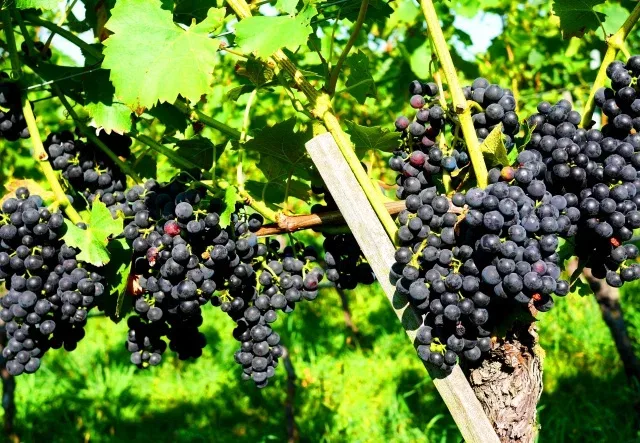
Most of the wine produced in wine regions around the world, especially in Europe, is made from wine grapes.
On the other hand, when we think of grapes familiar to us in Japan, we think of varieties like "Shine Muscat," "Kyoho," and "Pione," which are meant for eating, aren't they?
Those grapes, which are lined up in the fruit sections of supermarkets and department stores, are called table grapes and are produced for eating, not for wine. (As will be explained in detail later, a lot of wine is also made from table grapes.)
Scientifically, wine grapes are called "Vitis vinifera" and refer to grape varieties native to Europe.
On the other hand, table grapes are called "Vitis labrusca" and are grape varieties native to America.
As the name suggests, wine grapes have characteristics that combine the important elements for making wine, and they possess many of the essential components for wine.
Table grapes possess the elements that make them delicious to eat, and they are used for fresh consumption, sweets, and grape juice.
Let's explain in detail below exactly where the differences between wine grapes and table grapes lie.
Differences between wine grapes and table grapes
To understand the differences between wine grapes and table grapes, let's first check the representative grape varieties for each.
Representative wine grapesCabernet Sauvignon
Merlot
Cabernet Franc
Pinot Noir
Syrah
Gamay
Tempranillo
Nebbiolo
Sangiovese
Chardonnay
Sauvignon Blanc
Riesling
Albariño
Pinot Gris
Trebbiano
Airén
Kerner
Koshu (also used as a table grape)
Ryugan (also used as a table grape)
Muscat Bailey A
Niagara
Delaware
Campbell Early
Concord
Muscat of Alexandria
Steuben, etc.
There are other varieties such as wild grapes and hybrid varieties, but I have listed the above as representative examples for this article.
When you imagine wine made from the aforementioned wine grapes versus table grapes, you can probably imagine that there is a difference in aroma and taste.
So, let's learn about the differences in the grapes themselves below.
Characteristics of Wine Grapes
I have summarized the characteristics of wine grapes.
Small berries
High sugar content
Many have thick skins
Seeds are large relative to the berry size
Strong acidity
Most wine grapes are characterized by being small, having slightly less water content, and having a larger proportion of skins and seeds that contain polyphenols such as tannins.
Also, although it depends on the cultivation method, strong acidity is another characteristic.
And the biggest characteristic of wine grapes is their high sugar content.
The raw material for wine is grapes, and alcoholic fermentation is carried out using only the grapes.
If the sugar content is not high, alcohol will not be produced sufficiently, and it will not result in high-quality wine.
In addition, the skin contains many aroma components, including polyphenols related to color, which are important elements for red wines that extract these components thoroughly, as well as for some white wines.
Tannins are also an important point related to the aging potential and structure of wine, and when well-balanced acidity is added to that, it results in a high-quality wine.
While there are many sweet, fresh, and fruity types of wine in the world, the reason there are so many dry wines globally that are excellent as table wines is because they are made from wine grapes.
Characteristics of Table Grapes
Here are the characteristics of table grapes.
Large berries
Less skin and seeds relative to the berry, or seedless
High water content
Lower sugar content than wine grapes
Not strongly acidic
As the name suggests, table grapes are grapes grown to be eaten as they are.
Therefore, high-quality ones are considered to be those with thin skins, large berries, and a juicy texture.
Also, as many seedless grapes are on the market, the reality is that after many years of research, there is a growing popularity for seedless table grapes that are easier to eat.
Many people have the image that table grapes are sweet and sour, but compared to wine grapes, their sugar content and acidity are lower, resulting in a well-balanced flavor when eaten.
Wine grapes are thought to be small and very sour, but in terms of sweetness alone, they are actually sweeter than table grapes, so if you have the chance, why not try eating them?
Many wines are made using table grapes as a raw material, mainly in Japan.
Generally, because table grapes have a lower ratio of skin and seeds, they tend to result in light-bodied wines, as they lack the tannins important for red wine.
Furthermore, due to reasons such as fewer aromatic elements, less sugar, and higher water content, there is a disadvantage that they can become light and watery wines.
Also, it is said that the fact that table grapes impart a flavor to the wine known as 'foxy flavor,' which resembles candy or grape juice, is a cause for concern.
However, in recent years, due to improvements in cultivation and winemaking techniques, many excellent wines are being made from table grapes as well.
We are entering an era where we can enjoy the charm of wines made from table grapes, which are different from wines made from wine grapes.
Understanding the difference between wine grapes and table grapes
It is said that approximately 80% of the grapes grown worldwide are wine grapes.
Since grapes grown in Europe, in particular, are almost exclusively for wine, some may think there is no need to learn about table grapes.
On the other hand, many table grapes are grown in Japan, and they are utilized as ingredients for many Japanese wines.
Because Japanese wine is an unavoidable element when learning about wine in Japan, it is necessary to also acquire solid knowledge about table grapes.
Please use this article as a reference to re-understand the differences between wine grapes and table grapes.