Commonly practiced tilling has both advantages and disadvantages.
Let's rethink the meaning of "tilling" and devise ways to cultivate that enhance soil fertility and allow for sustainable farming while nurturing the organisms that improve the soil.
The "culture" in the English word "agriculture" is derived from a Latin word meaning "to till." Thus, in agriculture, "tilling the soil" has been considered an essential management practice.
Tilling breaks up soil clumps to make them loose and soft, incorporates surface weeds and crop residues, and levels the ground surface, which improves soil aeration and water permeability. Additionally, it promotes the availability of nutrients, which has the benefit of ensuring uniform crop germination and promoting growth.
On the other hand, there are also disadvantages to tilling.
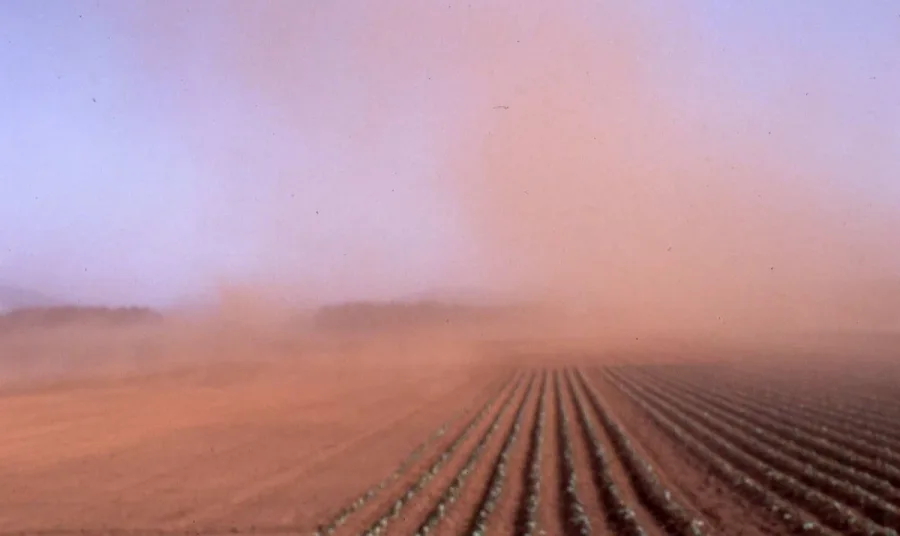
These include the high energy required for tilling, the vicious cycle of creating a plow pan (a hard layer that impairs drainage) due to tractor weight, which then necessitates the use of even larger tractors to break it up, the killing of many living organisms, and the fact that tilled fields become completely bare, making topsoil susceptible to loss by wind and water (Figure 1).
Even without tilling the soil, the large and small holes created by the roots of previous crops and soil animals like earthworms are maintained, so the soil's drainage and aeration remain good. Therefore, you can enter the field immediately even after long rains.
Furthermore, covering the untilled soil with organic matter such as dead grass or crop residues moderates ground surface temperature fluctuations and increases water retention, creating a favorable environment for plant roots, soil animals, and microorganisms. In particular, because a stable habitat is secured, large soil animals like earthworms are more likely to settle, which leads to the promotion of soil aggregation and the suppression of nutrient runoff.
There are also disadvantages to not tilling.
It takes time for the increase in living organisms, the improvement in drainage, and the nutrients in the soil to become easily available to the cultivated crops. Also, compared to after tilling, crop germination is less uniform, and there are challenges such as weeds germinating sporadically and perennial weeds becoming more likely to increase.
Therefore, if you do not manage these disadvantages in poor soil conditions, it may lead to poor crop growth.
What is important is to re-examine the meaning of "tilling" and devise ways to maximize the benefits while minimizing the disadvantages.
To do this, you should consider conditions such as soil physical properties, developmental stages, and crop types, and till only when necessary and only as much as necessary, such as by tilling partially or reducing the number of tilling operations. Please try to devise a tilling method that suits your own field so that you can nurture the organisms that improve the soil and continue sustainable cultivation while increasing soil fertility.
Masao Fujita (2016) Ways to Till, "Let's Start Organic Farming! Soil Building Edition," Organic Agriculture Entry Promotion Council, page 24.