*This article is a deep-dive version. If you want to grasp the main points in 3 minutes, please see the breaking news version: "Top 5 AI News of the Day | April 29, 2026 | The End of the AGI Clause."
In the 24 hours leading up to yesterday, April 28, the global AI industry moved quietly but irreversibly. Microsoft and OpenAI have restructured their seven-year partnership agreement, finally abolishing the "AGI clause," which had long been a symbolic point of contention in the industry. China's DeepSeek released its new-generation 1.6 trillion parameter model, V4, under an MIT license with support for Huawei Ascend chips, keeping the price at 1/50th of US closed models. David Silver, the father of AlphaGo, raised $1.1 billion for reinforcement learning AI that does not rely on human data, and Meta reserved 1 gigawatt of solar power from space for its AI data centers. The China National Development and Reform Commission blocked Meta's acquisition of Manus at the $2 billion stage, and the US-China AI cold war is becoming structured across all layers of law, procurement, and talent. While these may look like individual news items, they actually indicate that the four pillars of "contract structure, model supply, power supply, and geopolitics" have been rearranged simultaneously. In this article, we will organize each point one by one and finally present five perspectives that investors and business professionals should adopt.
1. Why April 27–28 was a "Triple Turning Point for Contracts, Power, and Geopolitics"
Looking back at the AI industry over the past few years, events have had major themes for each period. From late 2022 to 2023, it was "the emergence of ChatGPT and the practical application of large language models"; 2024 was "multimodality and agentification"; 2025 was "reasoning models and the impact of AI design on semiconductors"; and 2026 was initially expected to focus on "power constraints and the resurgence of open source." The news cluster from April 27–28 shows that the latter two predictions have finally spread to the realms of "contracts, regulation, and geopolitics."
The restructuring of the Microsoft-OpenAI agreement set a major precedent for AI legislation and contract practice by abolishing the AGI clause, which was "indefinable but legally binding." DeepSeek V4 represents the moment the open-source camp achieved "1/50th the price of US closed models," potentially rewriting the common sense of corporate AI procurement costs. Meta's space-based solar power symbolizes that the bottleneck for AI infrastructure has shifted from "semiconductors" to "power," and the Chinese NDRC's blocking of the Manus acquisition shows that foreign investment screening and export controls have become the "standard for cross-border AI acquisitions."
These are independent events, but their common denominator is a structural change where "AI evolution has moved away from linear model performance and begun to reorganize the foundations of society, economy, and geopolitics." This article will carefully unravel each one and paint the overall picture.
2. The Core of the Microsoft-OpenAI Contract Revision—What Happened to the 7-Year Partnership?
On April 27, Microsoft announced the contract revision in an official blog post titled "The next phase of the Microsoft and OpenAI partnership." The relationship between the two companies had been operated on four pillars: a $1 billion investment in 2019, an expanded $13 billion investment in 2023, exclusive Azure hosting, exclusive IP licensing, revenue sharing, and the AGI clause. This revision touches all four of these pillars.
First, the dissolution of cloud exclusivity. OpenAI can now provide its products on any cloud provider, including Amazon Web Services, Google Cloud, Oracle Cloud, and CoreWeave, in addition to Azure. However, the status of "Microsoft as the primary cloud partner" is maintained, and new products will be launched on Azure first if Azure can support them. This is a downgrade from "exclusive" to "primary," which is a very significant change in commercial reality.
Second, the non-exclusivity of IP licensing. Previously, Microsoft was in a position to exclusively license OpenAI's IP, but the revision switched this to a non-exclusive license until 2032. It is a form of conceding exclusivity in exchange for a contract extension. This gives OpenAI room to open its core IP to other strategic partners in the future.
Third, the bidirectionality of revenue sharing. Previously, Microsoft paid a portion of the revenue earned through the Azure OpenAI Service to OpenAI as revenue sharing. With the revision, this "Microsoft to OpenAI" payment has been abolished. At the same time, while revenue sharing from OpenAI to Microsoft will continue until 2030, a clear cap has been introduced. This is a transition from a structure where both companies "depend on each other" to one where they "build independent economies."
Fourth, the abolition of the AGI clause. Previous contracts included a clause stating that "some of Microsoft's rights would terminate once OpenAI achieved AGI." The definition of AGI was left to the judgment of the OpenAI board of directors, and Microsoft had long faced practical risks regarding this clause. With the revision, the AGI clause has been replaced with a fixed timeline (a deadline such as 2030 or 2032), making the rights relationship predictable regardless of whether AGI is achieved.
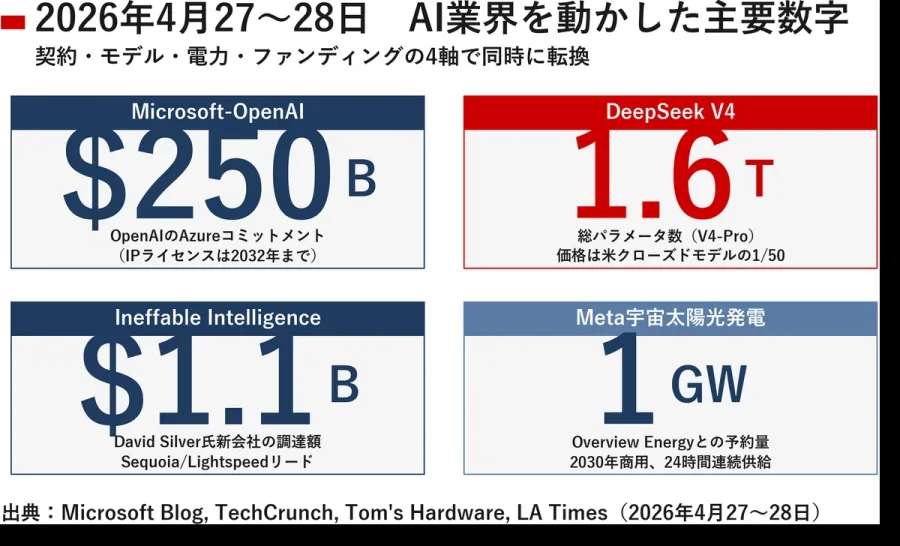
Fifth, OpenAI's corporate structure conversion. OpenAI has effectively completed its structural conversion from an LP structure under the control of a non-profit foundation to a Public Benefit Corporation (PBC). In parallel with this, OpenAI has announced a long-term computing resource commitment of $250 billion to Microsoft Azure.
3. What the End of the AGI Clause Means—From "Indefinable" to "Fixed Timeline"
The most symbolic aspect of this revision is the abolition of the AGI clause. AGI (Artificial General Intelligence) is a symbolic term in the AI industry, but there is no clear definition, either technically or legally. OpenAI's old articles of incorporation defined AGI as "a system that outperforms humans at most economically valuable work," but this judgment was to be made by the OpenAI board of directors.
In other words, the previous Microsoft-OpenAI contract imposed an extremely asymmetric risk on Microsoft, where Microsoft's exclusive access rights would disappear the moment the counterparty (the OpenAI board) declared, "This is AGI." The existence of this clause is considered a major reason why Microsoft engaged in intense governance negotiations over the composition of OpenAI's board between 2024 and 2025.
By replacing the AGI clause with a "fixed timeline" this time, the two companies have switched the contract reset period from an "undefined concept called AGI" to a "clear date of 2030–2032." This is an extremely sound revision in terms of contract practice and should serve as a precedent for future AI inter-company contracts. Some in the legal industry are even saying that the "AGI clause is effectively dead."
However, this does not mean that the discussion of AGI has disappeared from the industry as a whole. In the context of safety, regulation, and social implementation, discussions regarding the "social impact of reaching AGI" will continue. It is important to note that what disappeared this time was merely the "AGI as a trigger in commercial contracts," and interest in AGI itself has not waned.
4. OpenAI's Multi-Cloud Strategy and the Door to a $50B Amazon Contract
The dissolution of cloud exclusivity has a direct and significant meaning for OpenAI. It has already been reported in the industry that a long-term computing resource contract worth $50 billion is underway between OpenAI and Amazon Web Services, and TechCrunch positioned the contract revision as removing the obstacle to the Amazon contract with the headline, "OpenAI ends Microsoft legal peril over its $50B Amazon deal."
With this, OpenAI is moving toward a massive multi-cloud configuration consisting of "$250 billion in Microsoft Azure + $50 billion in Amazon AWS + additional capacity from Google Cloud/Oracle/CoreWeave." By eliminating reliance on a single cloud, they can simultaneously advance three objectives: (1) diversifying the risk of power constraints in specific regions, (2) eliminating dependence on a specific chip supplier (primarily NVIDIA via Microsoft), and (3) optimizing for diverse AI accelerators such as AWS Trainium, Google TPU, and their own custom chips.
Conversely, from Microsoft's perspective, it can be organized that they have regained the following three points in exchange for losing their monopoly. First, predictability of business operations due to the abolition of the AGI clause. Second, the freedom to deploy other companies' models, such as Anthropic's, on a large scale on Azure (expanding the room to support others for high-demand use cases like Claude Code). Third, the ability to clarify the strategic positioning of their own internal models, such as MAI-1 Preview. The background of Microsoft increasing investment in proprietary model development since 2025 appears to be preparation for a strategy that anticipated this revision.
In terms of cloud industry dynamics, this is a healthy move toward diversification where "OpenAI gains bargaining power among hyperscalers, and hyperscalers avoid excessive dependence on a specific model vendor." On the other hand, the breakdown of incentive coordination among hyperscalers could lead to intensified price competition for computing resources.
5. How to Interpret OpenAI's New Corporate Form (PBC) and the $250B Azure Commitment
OpenAI's corporate structure transformation is also inseparable from this set of revisions. OpenAI was founded as a non-profit foundation in 2015, and in 2019, it created an LP under its umbrella with a capped-profit structure called "OpenAI LP" to conduct commercial activities. With this revision, OpenAI has effectively completed its transition to a Public Benefit Corporation, paving the way for traditional stock issuance and listing.
A PBC is a for-profit corporation based on Delaware law, but it is required to explicitly state a "public benefit purpose" in its articles of incorporation, and directors have a duty to balance shareholder interests with the public interest. OpenAI's conversion to a PBC has three design intentions: (1) to open a path for future IPOs and large-scale capital procurement, (2) to allow directors to consider public interests such as AI safety without being bound by fiduciary duties to maximize shareholder value, and (3) to achieve a balance between governance and commerciality through a two-tier structure of a non-profit foundation and a PBC.
The simultaneously announced $250 billion Azure commitment indicates the scale of computing resources OpenAI will consume over the next few years. This is equivalent to $50 billion per year, and even compared to OpenAI's revenue forecasts ($40-50 billion in 2026, $80-100 billion in 2027), it is a scale where computing resource costs account for 50-100% of revenue. The reality that AI is becoming a "capital-intensive industry" is once again highlighted.
From an investor's perspective, an IPO for OpenAI in 2027-2028 is now within a realistic horizon. The valuation could advance from the current level of around $500 billion to a rumored $700 billion to $1 trillion at the time of listing. This is a scale comparable to Apple, Microsoft, and NVIDIA, and will be an event that redefines the valuation of the entire AI infrastructure.
6. The Full Picture of DeepSeek V4—1.6 Trillion Parameter MoE, Prices at 1/50th of Competitors
China's DeepSeek released a preview version of its latest model, DeepSeek V4, on April 25. The flagship V4-Pro has 1.6 trillion parameters, and the budget version V4-Flash has 284-285 billion parameters, both supporting a long context of 1 million tokens. The architecture inherits MoE (Mixture of Experts), but the number of expert networks and activation strategies have been significantly improved, keeping active parameters during inference to the tens of billions scale.
In terms of performance, it is the top among open-source models, surpassing the previous generation V3.2, Qwen 3.0, and Llama 4 in benchmarks for coding, mathematics, and agent execution. However, as DeepSeek itself admits, it is 3-6 months behind US closed models like GPT-5.4 and Claude Opus 4.6. This is a continuation of the "lagging chase" pattern that DeepSeek established with V2 and V3, where they "update the cutting edge of open source six months behind the closed-source cutting edge."
The pricing is shocking. V4-Pro is $3.48-$12 per 1M input/output tokens, and V4-Flash is $0.28-$1, which is about 1/50th compared to GPT-5.4 or Claude Opus 4.6 (generally $60-$90/M tokens). This is a level that fundamentally overturns API procurement costs and has the destructive power to rewrite corporate AI implementation plans at once. For example, a large-scale API workload that previously cost $1 million per month is estimated to drop to $20,000 per month with V4-Flash.
7. Geopolitical Impact of Huawei Ascend Support
Another shock from DeepSeek V4 is that it is the first frontier-class model optimized for Huawei Ascend NPUs. On April 24, Huawei confirmed that V4 can perform stable inference on Ascend super-node clusters, and parallel verification with NVIDIA GPUs has also been completed. This has caused a structural change where (1) a path to operate cutting-edge AI models on domestic Chinese chips has been established even under US semiconductor export restrictions, (2) Chinese companies can build their own AI infrastructure without relying on US-made GPUs, and (3) Huawei is breaking into the AI inference market, which was globally dominated by NVIDIA, as a full-fledged alternative.
Since 2022, the US has gradually restricted the export of A100, H100, and H200 to China, and in 2025, it effectively banned the export of B200/GB200. Chinese companies had no choice but to choose between NVIDIA's downgraded versions (H800, H20) or their own chips (Huawei Ascend, Cambricon, etc.), and frontier models remained dependent on NVIDIA. DeepSeek V4 is historic in that it provides a clear alternative to this dependency structure.
The world's AI infrastructure is splitting into a bipolar structure: (1) the "NVIDIA/TSMC" ecosystem of the US and its allies, and (2) the "Huawei/SMIC" ecosystem of China. As a third pole, the Middle East (UAE's G42, Saudi's Humain), Southeast Asia, and India are exploring their own paths, but they are still dependent on one of the two poles. DeepSeek V4 accelerates this polarization.
8. Strategic Significance of Open Source AI and the MIT License
DeepSeek V4 was released under the MIT license. MIT is among the most permissive of open-source licenses, allowing for commercial use, modification, and redistribution, with the only obligation being the retention of the copyright notice. Unlike Llama's Acceptable Use Policy (prohibition of specific uses) or Mistral's partially conditional licensing, it adopts a stance of purely "you are free to use it."
This is a strategic choice for DeepSeek. First, by minimizing license friction, it becomes easier to attract the global developer community. Second, it simplifies corporate legal reviews and lowers the hurdle for enterprise adoption. Third, against regulations from a US national security perspective (pressure to include clauses prohibiting specific uses), it creates an inverted composition where "Chinese models are freer than US models."
In the world of open-source AI, Meta's Llama, France's Mistral, UAE's Falcon, China's Qwen (Alibaba), DeepSeek, and Yi are competing. This V4 is an existence that has raised the bar for previous open models by one level in all four axes: performance, license freedom, inference cost, and geopolitical substitutability, and it has the potential to rewrite the standard model choices for enterprise AI.
9. Ineffable Intelligence and the AlphaGo-style 'No Human Data Needed' Approach
David Silver, a principal scientist at DeepMind who led the development of AlphaGo, has founded a new company in the UK called Ineffable Intelligence and raised $1.1 billion (approximately 170 billion yen) in a Series A round on April 27. The valuation is $5.1 billion, with Sequoia Capital and Lightspeed Venture Partners leading the round, and participation from Google, NVIDIA, Index Ventures, the British Business Bank, and the UK government's Sovereign AI Fund.
Silver's career has been at the forefront of reinforcement learning (RL) and game AI. AlphaGo defeated world-class Go player Lee Sedol in 2016, AlphaGo Zero reached a level of strength exceeding previous generations in 2017 using only self-play without any human game records, and AlphaZero surpassed all top human players in Go, Shogi, and Chess. This series of achievements demonstrated the superiority of the RL paradigm—'learning by creating data through interaction with the environment'—over the AI paradigm of 'learning from human-created data'.
The goal set by Ineffable Intelligence is to build a 'Superlearner' that extends this RL approach to general-purpose AI. Specifically, it aims for a mechanism where agents acquire knowledge and skills themselves through interaction with simulation environments or the real world, without relying on human-prepared datasets (text, images, video). If LLMs are 'statistical compression of human language data,' then the Superlearner can be called a generalized form of AlphaGo.
10. The Trend of Reinforcement Learning (RL) Regression—From LLMs to 'Superlearner'
The emergence of Ineffable Intelligence symbolizes a turning point in industry-wide research trends. From 2022 to 2024, 'LLM scaling' was the protagonist, and the Scaling Law—which posits that performance improves by increasing parameter counts and data volume—was widely believed. Entering 2025, reasoning models (OpenAI o1, Claude Thinking, DeepSeek R1) appeared, and the importance of 'inference-time computation' was recognized. Now, in 2026, 'human data exhaustion' and 'self-generated data/RL' have emerged as central themes.
Almost all high-quality text data on the web has already been used for training, and there are only three paths to obtain new training data: (1) synthetic data (data generated by AI itself), (2) reinforcement learning (interaction with the environment), and (3) multimodal (video/sensor data). Silver's Superlearner is a prime example of the return to reinforcement learning (2), and it is said that moves to invest in this direction are also underway at OpenAI, Google DeepMind, and Anthropic.
From an investor's perspective, the fact that $1.1 billion was raised for Ineffable Intelligence is evidence that the realization that 'LLM scaling alone will not reach the next generation of AI' is shared by all strategically diverse investors: Sequoia, Lightspeed, Google, and NVIDIA. Over the next 2–3 years, investment in hybrids of LLMs and RL, as well as World Models, is expected to accelerate further.
11. Meta's 1GW Space Solar Power—Who is Overview Energy?
On April 27, Meta announced that it had reserved up to 1 gigawatt of space-based solar power capacity from Overview Energy. Overview Energy is a California-based startup founded in 2023 by engineers from SpaceX and Tesla. The technical method involves solar cells on satellites receiving sunlight in space, converting it into infrared lasers or microwaves, sending them to ground receiving stations, and converting them back into electricity on the ground.
The advantages of space-based solar power are decisive. First, there is no atmospheric attenuation in space, allowing for about 8–10 times the solar intensity available on the ground. Second, it is unaffected by night, cloudy weather, or seasons, and can generate power 24/7/365 if the satellite orbit is chosen correctly. Third, it does not consume land on the ground and requires minimal new power grids. Receiving stations only need a small site of a few hundred square meters.
The roadmap is for orbital demonstration in 2028 and commercial availability in 2030. Meta has reserved 1GW of capacity, which is expected to become a firm contract after a successful demonstration. 1GW is equivalent to the power of several large data centers or the total power of a large city. Overview Energy's previous funding was $500 million in a 2025 Series B round, with an estimated valuation of $3 billion.
Technical hurdles remain significant, and the project is in the demonstration stage regarding four points: (1) construction and operation costs of orbital power satellites, (2) infrared/microwave transmission efficiency, (3) safety of ground receiving systems, and (4) regulations (frequency allocation by FCC, ITU, etc.). If the technology matures as planned, the power problem for AI data centers could be fundamentally resolved. Conversely, if the technology is delayed, this reservation by Meta will function as a power risk hedge for the early 2030s.
12. Structural Limits of the AI Data Center Power Problem
The power demand of AI data centers is increasing at an accelerating rate along with the evolution of AI. As of 2020, global data center power consumption was around 2,000 terawatt-hours (TWh), but the IEA and others estimate it will reach 3,500 TWh in 2025 and 6,000–8,000 TWh by 2030. In the United States alone, data centers could account for 8–12% of total power consumption in the 2030s.
The problem lies in three points: (1) absolute volume of power sources, (2) continuity of power sources, and (3) geographical placement of power sources. First, although renewable energy is progressing, solar power only generates electricity during the day and wind power only when there is wind, making them unsuitable for the 24-hour continuous operation required by AI data centers. Storage batteries have capacity and lifespan limits. Second, nuclear power is excellent for continuity, but new construction takes over 10 years, and SMRs (Small Modular Reactors) will not be commercialized until after 2030. Third, if the location where the data center is built and the location of the power source are far apart, additional investment in long-distance power grids is required.
As a solution to this, the industry is comparing and considering five options: (1) continued use of natural gas thermal power (environmental issues), (2) nuclear power (time-consuming), (3) large-scale storage batteries (high cost), (4) nuclear fusion (practical application undecided), and (5) space-based solar power (Meta's choice this time). The fact that Meta has invested capital in space-based solar power may pressure other hyperscalers (Microsoft, Google, Amazon, Oracle) to follow suit and accelerate the commercialization of space-based solar power.
13. China's NDRC Blocks Manus Acquisition and the US-China AI Cold War
On April 27–28, China's National Development and Reform Commission (NDRC) blocked Meta's $2 billion acquisition of the AI startup Manus. Manus was founded in 2022 and is headquartered in Singapore, but its founders and core technologies are Chinese, and the technology had already been integrated into Meta's advertising management platform (Ads Manager). The NDRC's decision is a formal conclusion to the preliminary investigation started in January, based on foreign investment and export control regulations.
Manus is a startup that garnered attention in 2025 as the 'world's first general-purpose AI agent,' and its agent technology, which autonomously performs browser operations, code execution, and data analysis in remote environments, was highly evaluated. The blocking of the acquisition after Meta announced the $2 billion deal at the end of 2025 and had already begun integration work has sent a major shockwave through the industry.
The White House issued a statement almost simultaneously condemning "China's theft of U.S. AI technology," signaling that the decoupling of U.S. and Chinese AI technology is now structured across all layers: (1) legal (export controls), (2) procurement (exclusion of specific companies), (3) human resources (researcher visa restrictions), and (4) capital (M&A review). For Japanese companies, this means facing three risks: (1) procurement risks for Chinese AI technology, (2) technology transfer risks from Chinese subsidiaries, and (3) risks of prolonged cross-border M&A reviews.
The logic from the Chinese side is one of reciprocity: "As long as the U.S. unilaterally imposes export controls on China, China will also restrict U.S. acquisition of Chinese AI technology." This is a trend of extending the export control tit-for-tat seen since 2022 into the realm of foreign investment screening, and it is expected that the EU, Japan, and South Korea will also strengthen similar review systems in the future.
14. Other Developments—AMD, Google TPU, Colorado AI Act, SoftBank-MODE
Between April 27 and 28, there were several important news items in addition to the five mentioned above. First, AMD officially announced on April 28 that its annual AI event, "Advancing AI 2026," will be held in San Francisco on July 23. It is expected to be a major industry event alongside NVIDIA's GTC, Intel's Intel Vision, and Anthropic Devs, where details on the MI400 series and next-generation Instinct accelerators are expected to be announced.
Second, Google disclosed the configuration of its new generation of AI TPUs (Tensor Processing Units), and the stock price of related company Broadcom reached a market capitalization of $2 trillion. Broadcom has long been Google's co-development partner for custom silicon, and the revenue growth from the TPU v6 generation and beyond has been suddenly recognized. In the semiconductor industry, Broadcom's position as the second-largest AI chip beneficiary after NVIDIA (market cap over $4 trillion) has become clear.
Third, the U.S. Department of Justice (DOJ) intervened on April 24 in the lawsuit filed by xAI against the state of Colorado (filed April 9). The Colorado AI Act (scheduled to take effect on June 30, 2026) is one of the strictest state laws in the U.S., mandating anti-discrimination, transparency reporting, and consumer protection for AI systems. The DOJ is attempting to invalidate the Colorado law through federal law, citing Executive Order 14365 (an order to invalidate state laws that hinder innovation). This is a case where the Trump administration's policy of "centralizing AI regulation at the federal level and effectively overriding state laws" has entered the judicial process, and state laws in Florida, Texas, California, and others may follow the same fate.
Fourth, in Japan, SoftBank Corp. announced a capital and business alliance with IoT startup MODE on April 28. MODE provides solutions that feed sensor data into generative AI to enhance decision-making at construction and manufacturing sites, and by combining this with SoftBank's corporate customer base, the goal is to accelerate the adoption of Industrial AI. AI implementation by Japanese companies is becoming a battlefield for hybrids of "sensor data x LLM" that combine the versatility of generative AI with the uniqueness of the field, and this partnership is a good example of that trend.
Fifth, major semiconductor EDA company Cadence revised its full-year revenue guidance upward against the backdrop of a surge in AI chip demand. Demand for AI semiconductor design is spreading not only to chipmakers' sales but also to upstream EDA tools (Synopsys, Cadence, Siemens EDA), indicating that the ripple effect of AI infrastructure investment is expanding step by step.
15. Five Implications for Investors and Business Professionals
Looking at these movements across the board, investors and business professionals need to be aware of the following five points.
First, "AI stocks" should not be viewed as a single category but divided into five layers: (1) models (OpenAI, Anthropic, xAI), (2) cloud (Microsoft, Amazon, Google, Oracle), (3) semiconductors (NVIDIA, AMD, Broadcom, TSMC), (4) power (renewable energy, nuclear, space solar), and (5) EDA/design tools (Synopsys, Cadence). The revision of the Microsoft-OpenAI agreement is an event that shuffles the boundaries of the layer structure, and from now on, it is necessary to re-evaluate stocks along two axes: "OpenAI's revenue will flow not only to Azure but also to AWS" and "Microsoft's profits will break away from dependence on OpenAI."
Second, AI procurement costs could drop dramatically. With the advent of DeepSeek V4, the option of API unit prices being 1/50th of the conventional price has become a reality. Corporate AI budgets are shifting from a "how much to spend" problem to a portfolio problem of "which model to use for which purpose." A division of labor is progressing where cost-sensitive use cases (batch processing, internal document summarization, code assistance) use open source + local inference, while use cases where latency and quality are decisive (customer support, research, complex agents) use closed models.
Third, the bottleneck for AI infrastructure has shifted from "semiconductors to power." Meta's reservation of space solar power is symbolic, but more realistically, "continuous power supply" will be the top priority in selecting data center locations. As investment targets, (1) regional power companies, (2) nuclear power (especially SMR-related), (3) battery storage, and (4) long-distance transmission infrastructure are emerging as new AI-related stocks.
Fourth, the U.S.-China AI decoupling is irreversible. The Chinese NDRC's blocking of the Manus acquisition and the U.S. DOJ's intervention in the Colorado AI Act, while appearing to move in opposite directions, are actually the same movement. It is the strengthening of sovereignism: "prioritizing one's own AI regulations and procurement rules and excluding foreign interference." Japanese companies need to clarify three points as management issues: (1) risk management for AI exports to China, (2) compliance with U.S. regulations (especially Executive Order 14365), and (3) response to the EU AI Act (full enforcement in August 2026).
Fifth, research investment looking "beyond LLMs" has begun to move. Ineffable Intelligence's $1.1 billion funding is the starting gun for full-scale investment in post-LLM paradigms such as reinforcement learning, self-generated data, and world models. Corporate AI strategies also need to broaden their horizons from the level of "how to utilize current LLMs" to "how to prepare for the next-generation AI paradigm." Specifically, having a structure that can continuously accumulate internal data and utilize it for future RL/self-generated data learning, and having the ability to build simulation environments, will be directly linked to medium- to long-term competitiveness.
16. Summary
April 27-28, 2026, was a highly significant two-day period in which the AI industry simultaneously restructured along four pillars: "contract structure, model supply, power supply, and geopolitics." The Microsoft-OpenAI contract revision removed the indefinable concept of AGI from the contract, becoming the starting point for both companies to build independent economies. DeepSeek V4 presented a full-scale alternative to U.S. models from the open-source x Chinese chip camp in terms of "price, performance, and geopolitical substitutability." David Silver's Ineffable Intelligence signaled the dawn of research investment into next-generation AI that does not rely on human data, and Meta's space solar power symbolized that the bottleneck of AI infrastructure has shifted from semiconductors to power. The Chinese NDRC's blocking of the Manus acquisition confirmed that the U.S.-China AI Cold War has become structured across all layers of law, procurement, human resources, and capital.
While these may be seen as individual news items, they are just one day's movements, but when looking back at AI history in 5 or 10 years, these two days may be remembered as a "triple turning point of contracts, power, and geopolitics." What investors and business professionals need is not a focus on a single stock or a single technology, but the literacy to look across the five-layer structure (models, cloud, semiconductors, power, regulation) and a long-term investment stance that keeps an eye on "what comes after LLMs."
References
Microsoft Blog "The next phase of the Microsoft and OpenAI partnership" April 27, 2026 https://blogs.microsoft.com/blog/2026/04/27/the-next-phase-of-the-microsoft-openai-partnership/
TechCrunch "OpenAI ends Microsoft legal peril over its $50B Amazon deal" April 27, 2026 https://techcrunch.com/2026/04/27/openai-ends-microsoft-legal-peril-over-its-50b-amazon-deal/
Sullivan & Cromwell "OpenAI and Microsoft Announce Next Phase of Partnership" April 2026 https://www.sullcrom.com/About/News-and-Events/Highlights/2026/April/OpenAI-Microsoft-Announce-Next-Phase-Partnership
Directions on Microsoft "Microsoft and OpenAI amend their agreement again" April 2026 https://www.directionsonmicrosoft.com/microsoft-openai-amend-their-agreement-again/
Simon Willison's Weblog "Now-deceased AGI clause" April 27, 2026 https://simonwillison.net/2026/Apr/27/now-deceased-agi-clause/
Tom's Hardware "DeepSeek launches 1.6 trillion parameter V4 on Huawei chips" April 2026 https://www.tomshardware.com/tech-industry/artificial-intelligence/deepseek-launches-1-6-trillion-parameter-v4-on-huawei-chips-as-us-escalates-ai-theft-accusations
ChinaTalk Media "DeepSeek V4" April 2026 https://www.chinatalk.media/p/deepseek-v4
36kr Global "DeepSeek V4 release coverage" April 2026 https://eu.36kr.com/en/p/3780728378776838
TechCrunch "DeepMind's David Silver just raised $1.1B to build an AI that learns without human data" April 27, 2026 https://techcrunch.com/2026/04/27/deepminds-david-silver-just-raised-1-1b-to-build-an-ai-that-learns-without-human-data/
TechCrunch "Meta inks deal for solar power at night, beamed from space" April 27, 2026 https://techcrunch.com/2026/04/27/meta-inks-deal-for-solar-power-at-night-beamed-from-space/
Los Angeles Times "Meta seeks to power data centers with energy beamed from space" April 27, 2026 https://www.latimes.com/business/story/2026-04-27/meta-seeks-to-power-data-centers-with-energy-beamed-from-space
Meta "Powering AI: strengthening the grid, space solar energy, and long-duration storage" April 2026 https://about.fb.com/news/2026/04/powering-ai-strengthening-the-grid-space-solar-energy-and-long-duration-storage/
Mediapost "Meta's Manus acquisition blocked by China" April 28, 2026 https://www.mediapost.com/publications/article/414633/metas-manus-acquisition-blocked-by-china-after-ad.html
AMD "AMD Announces Advancing AI 2026" April 28, 2026 https://www.amd.com/en/newsroom/press-releases/2026-4-28-amd-announces-advancing-ai-2026-.html
MarketBeat "Broadcom hits $2 trillion market cap as Google reveals new AI chips" April 28, 2026 https://www.marketbeat.com/originals/broadcom-hits-2-trillion-market-cap-as-google-reveals-new-ai-chips/
Government Contractor Compliance Update "Federal government intervenes in case seeking to invalidate Colorado AI law" April 28, 2026 https://www.governmentcontractorcomplianceupdate.com/2026/04/28/federal-government-intervenes-in-case-seeking-to-invalidate-colorado-ai-law/
SoftBank Corp. Press Release "Regarding the Capital and Business Alliance between SoftBank and MODE" April 28, 2026 https://www.softbank.jp/corp/news/press/sbkk/2026/20260428_01/
Electronics For You "Cadence bets on AI chip wave, lifts full-year revenue guidance" April 2026 https://www.electronicsforyou.biz/industry-buzz/cadence-bets-on-ai-chip-wave-lifts-full-year-revenue-guidance/
Fortune "Musk v. Altman jury, Google employees, AI autonomous weapons, Microsoft-OpenAI deal terms" April 28, 2026 https://fortune.com/2026/04/28/musk-v-altman-jury-google-employees-ai-autonomous-weapons-microsoft-openai-deal-terms/