This series introduces the 100-year history of C-POP—a term for pop music primarily produced in China, Hong Kong, and Taiwan (including Cantonese, etc.), essentially the C-POP equivalent to J-POP and K-POP—from the 1920s to the latest music, broken down by era.
I have decided to write down what I have researched over the past few years regarding C-POP, including not just the music, but also its history and historical background. While it includes some research-oriented content, I will try to make the articles as easy to read as possible, incorporating YouTube and Spotify links, as well as AI-generated illustrations!
Definition of C-POP in this series
C-POP refers to all pop music sung in Chinese. At its core are Mandarin, the standard Chinese language, and Cantonese, which is primarily used in Hong Kong. In this series, I will mainly introduce songs sung in these two languages.
Just as Japanese kayokyoku eventually came to be called J-POP, C-POP is a term that only became common around the 2000s at the earliest. Before that, pop music sung in Mandarin was called Mandopop, and Cantonese pop was called Cantopop. These two are still used today as the main genres of C-POP.
In this series, I will not limit myself to the narrow definition of C-POP from the 2000s onwards, but will treat all pop music produced in Chinese-speaking regions such as mainland China, Hong Kong, and Taiwan as C-POP in a broad sense.
Note that artist names and song titles from mainland China will generally be written in Simplified Chinese, while those from Hong Kong and Taiwan will be in Traditional Chinese.
Where did C-POP come from?
Now, where was Chinese pop music, or C-POP, born, and where did it start? If we define pop music as music where the composer and lyricist can be identified, written for a specific singer, and intended to be widely heard by the public through media such as records and radio, then the origin of Chinese pop music lies in 1920s Shanghai.
In Shanghai at that time, music that would later be called 'Shidaiqu' (era songs) was born, reaching its golden age from the late 1920s to the 1940s. So, what kind of place did this Shidaiqu music emerge from?
Let's turn the clock back 100 years and fly to 1920s Shanghai.
In Shanghai at that time, there were foreign settlements called concessions. Foreigners and Chinese people mingled, and parties were held every night in social clubs and dance halls.
The catalyst for Shanghai's transformation into an international city dates back about 80 years further. When Shanghai opened as a port following the Treaty of Nanjing in 1842, trade with Western countries, including the UK, began. The Treaty of Nanjing stipulated the cession of Hong Kong Island and the opening of Guangzhou, Xiamen, Fuzhou, Ningbo, and Shanghai. Among these, Shanghai developed into China's premier trading port because it was located near the densely populated Yangtze River basin and at the mouth of the Yangtze, China's largest river.
The foreign settlements in Shanghai at the time became an international city where people of various races lived, including British, French, American, and later Japanese people engaged in trade. The concessions were extraterritorial areas where the laws of the Qing Dynasty did not apply, and many businessmen from the great powers of the time came to this land to make their fortune in a free place with its own independent city council. They gained enormous wealth through trade.
As people who had gained wealth gathered, hotels, social clubs, dance halls, theaters, and cinemas were built one after another in the concessions. It grew into a city where not only foreigners but also many Chinese people worked, did business, and enjoyed entertainment. By the 1920s, the Shanghai concessions were home to 1 million people (100,000 foreigners and 900,000 Chinese) and came to be called the Paris of the East.
Reference: Shanghai: A Century of a Multinational City
Now, the music born in such a place was a type of pop that incorporated traditional Chinese singing with jazz melodies popular in the West and film music. This music was known at the time as Shidaiqu. Let's listen to 'Mao Mao Yu' (1927), which is considered the oldest C-POP.
The oldest Shidaiqu 'Mao Mao Yu' and composer Li Jinhui
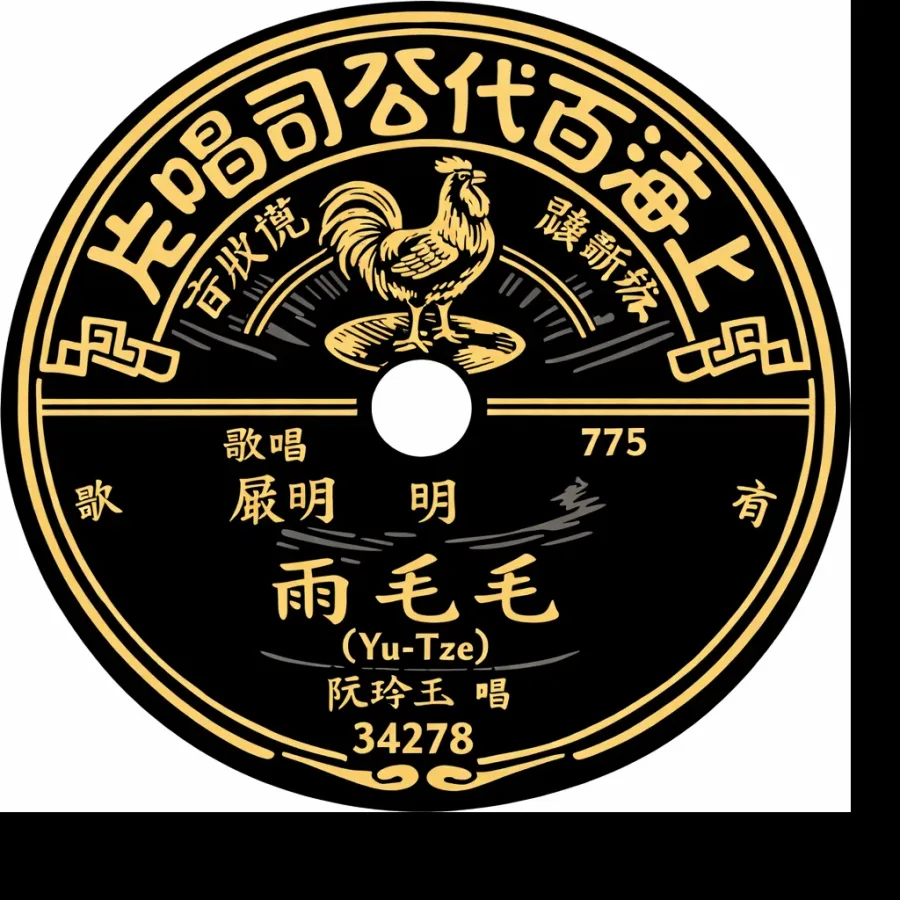
Mao Mao Yu / Li Minghui (1927)'Mao Mao Yu' is the earliest Shidaiqu in China and the most important song that serves as the origin of C-POP. Written and composed by Li Jinhui and sung by his daughter Li Minghui, this song was released in 1927 and is also called China's first pop song. The version often heard today is in the style of big band jazz that incorporates Western trends, bringing to mind the magnificent and gorgeous Shanghai concessions of that time.
'Mao Mao Yu' means 'drizzle' in Japanese. The song depicts the feelings of a woman waiting for her loved one in the drizzle. By modern standards, it might seem like a common love song, but at the time, when Confucian values were deeply rooted, depicting free love between men and women so directly was fresh.
This is a song to listen to while imagining the excitement of parties, dance halls, the record industry, and radio broadcasts. How did people 100 years ago, who had not yet known what pop music was, feel when they heard this modern song?
'Mao Mao Yu' was sung on stage in the late 1920s and later recorded on a record. There are multiple recordings left that changed arrangements over time. The jazz-style recording with wind instruments that you are listening to now is the version recorded in 1934.
Here, let's touch upon Li Jinhui, who handled the lyrics and composition.
Born in Xiangtan, Hunan Province, Li Jinhui was familiar with folk songs from all over China from a young age, and after graduating from the National Higher Normal School, he worked in education and the promotion of the national language. In 1916, he joined the Peking University Orchestra. At Peking University at the time, the New Culture Movement, which sought to rethink Confucian traditions and create a new Chinese culture, was flourishing, and he was greatly influenced by that atmosphere.
Li Jinhui thought about using music for children's education and the promotion of the national language, and produced many songs and musical plays for children. In 1922, he launched the children's magazine 'Xiao Peng You' and served as its first editor-in-chief. Furthermore, he organized a song and dance troupe made up of children and performed all over China.
The central singer of that troupe was his daughter, Li Minghui. For a woman to stand on stage and sing love songs was still bold for the time, but Li Jinhui did not flinch from criticism and raised his daughter to be a star.
'Mao Mao Yu', which was born in such circumstances, was a song created by combining the ideas, folk songs, national language education, children's song and dance plays that Li Jinhui had cultivated, and the popularity of Li Minghui.
In other words, Shidaiqu, and by extension C-POP, was music born from the place where the tradition of Chinese folk music and the modernism of the modern city intersected.
The Golden Age of Shidaiqu (1940s) and the 'Seven Great Singing Stars'
Radio broadcasting began in Shanghai in the 1920s, and commercial broadcasting became popular in the 1930s. As more people enjoyed music through records and radio, the techniques of composition and arrangement, as well as the singing methods of the singers, gradually became more sophisticated.
EMI, a major company representing the Chinese record industry at the time, also invested funds generously in the production of Shidaiqu. Shanghai Shidaiqu, which continued to develop in this way, reached its peak in the 1940s.
The women who were in charge of vocals at the time were called 'Ge Xing' (music stars) and were extremely popular. Among them, the seven most popular female singers came to be called the 'Seven Great Singing Stars'. They were the 'God Seven' of that time.
Seven Great Singing Stars
・Bai Hong Debuted in 1931
Representative songs: 'Intoxicating Lipstick', 'He is the Spring Breeze'
・Chow Hsuan Debuted in 1932
Representative songs: 'When Will You Return', 'Singing Girl at the End of the World'
・Gong Qiuxia Debuted in 1933
Representative songs: 'Dream Lover', 'Autumn Water, My Beloved'
・Yao Lee Debuted in 1935 Representative songs: '
Rose, Rose, I Love You', 'Gong Xi Gong Xi'
・Lei Heunglan Debuted in 1938 Representative songs: '
Suzhou Nocturne', 'Night Fragrance'
・Bai Guang Debuted in 1943
Representative songs: "Waiting for You to Return," "If Not for You"
・Wu Yingyin Debuted in 1945
Representative songs: "Spring Returns to the Earth", "Sending My Love Across a Thousand Miles with the Bright Moon"
※Songs in bold will be introduced later.
Wikipedia Chinese version: Seven Great Singing Stars of the 1940s Shanghai music scene
Listing only their names might make them sound like figures from the classics, but they were undeniable stars in their time (the image at the beginning was created by AI to represent the Seven Great Singing Stars).
Bai Hong was one of the singers who was active from an especially early stage among the Seven Great Singing Stars. She was a talented woman who studied vocal music, was proficient in playing musical instruments, and also composed music.
Li Xianglan is known in Japan as Ri Koran or Yoshiko Yamaguchi. Although she was a Japanese person born in Manchuria, she was active as an actress and singer under her Chinese name and eventually advanced into Shanghai. Later, she came to be counted as one of the Seven Great Singing Stars. After the war, she returned to Japan and continued her career as Yoshiko Yamaguchi.
Among the seven, the one who was particularly popular was Zhou Xuan. Her singing voice was called the "Golden Voice" and was widely loved. Zhou Xuan was also known as one of the representative beauties of the time, and combined with her approachable and down-to-earth image, she boasted immense popularity.
On the other hand, Yao Li was called the "Silver Voice." Although she did not reach Zhou Xuan's level of popularity at the time, I suspect many people today would find Yao Li's voice easier to relate to when listening with modern ears.
If I were to reveal my personal favorite among the seven, it would be Yao Li. Please use the disc guide I will introduce later as a reference and try listening to and comparing their singing voices. Seeing the gap between their popularity at the time and modern sensibilities is one of the joys of listening to music from this era.
Reference: All About Chinese Pops
From here on, I will introduce about eight masterpieces from that time, focusing on songs by the Seven Great Singing Stars, as well as major hits and classics that are still supported today.
When Will You Return? / Zhou Xuan (1937, year of film release)This is truly the soul music of the Chinese people!
"When Will You Return?" (He Ri Jun Zai Lai) is a song created for the film "Three Stars Accompanied by the Moon" (→ Baidu Baike "Three Stars Accompanied by the Moon"), composed by Liu Xue'an. It was sung by the great star of the time, Zhou Xuan, and became one of the earliest major hits in China.
The highlight to listen for is the accordion that continues to accompany Zhou Xuan's singing from the opening solo. It gives sorrow and depth to the young Zhou Xuan's singing voice. What is being sung is a moment at a banquet before a parting. It asks about the day of reunion, saying, "After we part tonight, when will I see you again?" It is heartbreaking, isn't it?
In the middle of the song, a man's voice interjects, saying, "Come on, let's finish this drink before we talk," and "Have another drink." It sounds as if he is trying to prolong the final moments by offering alcohol to the woman who is reluctant to part.
I wonder if the composer ever imagined that a song created for a film 90 years ago would become such a long-lasting classic.
Today, this song is perhaps more famous as a song later covered by Teresa Teng. The Teresa Teng version was released in 1978 with slightly changed lyrics. It garnered attention again nearly 40 years after the original release and continues to be sung as a C-POP classic today. Compared to the Zhou Xuan version, both the singing voice and the accompaniment are more modern, but even so, it is already a recording from nearly half a century ago.
The fact that a song born in Shanghai became a huge hit again thanks to a singer from Taiwan speaks for itself; it shows that this song transcended a single city or era to become a classic loved throughout the Chinese-speaking world.
Tianya Genü / Zhou Xuan (1937, year of film release)One of the songs from the film 'Street Angel'. The sorrowful accompaniment incorporating the erhu sounds as if it is gently guiding Zhou Xuan's innocent singing voice.
The lyrics convey the thought that even if one is separated from a loved one, their hearts remain as one. 'Tianya' refers to the ends of the earth, and by extension, distant lands or foreign places. Although this song was initially called 'Tianya Ge' (Song of the Ends of the Earth), for some reason the character for 'woman' was added along the way, and it came to be called 'Tianya Genü' (Singing Girl at the Ends of the Earth). In terms of the meaning of the lyrics, I think it makes more sense without the 'woman'. Well, this is also a mystery of history.
The film's title, 'Street Angel' (Malu Tianshi), has a poetic ring to it on the surface, but it also carries the weight of a slang term for streetwalkers selling their bodies on the road. Zhou Xuan played the role of Xiao Hong, the younger of two poor sisters. The older sister works as a prostitute, while Xiao Hong makes a living singing in a teahouse.
In the film, Xiao Hong sings 'Tianya Genü' to Xiao Chen, who lives in the building across the street. Xiao Chen responds with his erhu, and through the song, their hearts connect. It is a super, super, super famous scene in film history, so I highly recommend watching it along with the song.
Rose, Rose, I Love You / Yao Lee (1940)Continuing with a national classic.
'Rose, Rose, I Love You' is a representative Shanghai Shidaiqu song, with lyrics by Wu Cun, music by Chen Gexin, and vocals by Yao Lee. It was written as an insert song for the film 'Street Angel', but it has such a catchy melody that you can't help but hum along, and it became a massive hit that was loved long after the film left theaters.
For those who were a bit taken aback by the vocal styles of 'Mao Mao Yu' or 'He Ri Jun Zai Lai' mentioned earlier, you might find this song more comfortable to listen to. Yao Lee's singing voice has clear inflection, a style that carries over to modern pop music.
Yao Lee is one of the singers who had a particularly long career among the Seven Great Singing Stars. She moved her base of operations from pre-war Shanghai to post-war Hong Kong, and was a figure who connected the lifeblood of Shanghai Shidaiqu to Hong Kong.
Also, 'Rose, Rose, I Love You' is one of the Shidaiqu songs with the most covers. Later, it became a hit in the United States as 'Rose, Rose, I Love You' with English lyrics, showing an international reach that was unusual for Chinese pop music.
Rose, Rose, I Love You / Frankie Laine (1951)The English version of 'Rose, Rose, I Love You' climbed to number 3 on the American Billboard charts. It can be called the first global hit in C-POP history for a song born in China.
In an era when the distance between East and West was much greater than it is now, the person who introduced this song to the West was Wilfrid Thomas, a radio host from Australia. After finding Yao Lee's record in Hong Kong, he brought it back to the UK, introduced it on his BBC program, and wrote new English lyrics. Eventually, Frankie Laine sang it, and it became a huge hit in the United States as well.
In the original song, the beauty and strength of the rose are layered onto a woman, but in the English version, it is rewritten into a story about a Western man lamenting his parting from an Oriental woman. Interestingly, while the original song starts with 'méigui méigui', meaning 'rose, rose', the first verse of the English version translates it as 'Rose, Rose I Love you~', but the second verse starts with 'Make way, oh make way', trying to match the sound of the original song. I feel a modest respect for the original in this ingenuity.
When you listen to it as an English song, don't you notice that it wouldn't feel out of place at all if someone told you it was a popular American song from that time? Just by changing the lyrics and arrangement, it blended naturally into the Western hit charts. From this, one can also sense the high level of musical quality in the Shanghai music scene at the time.
Suzhou Nocturne / Bai Hong (1943)A masterpiece created by the famous duo of Yaso Saijo and Ryoichi Hattori, who dreamed of a night in Suzhou. It was originally written for the 1940 Japanese film 'China Night', and in the film, it was sung in Japanese by Ri Koran. The record version was sung by Hamako Watanabe and Noboru Kirishima.
Three years later, in 1943, Di Ya added Chinese lyrics, and a Chinese version sung by Bai Hong was released. Although the Chinese version was not as widely successful as the Japanese version, it has been passed down and sung by many singers to this day.
Suzhou is a water town located west of Shanghai. Large and small waterways and canals run through the city, and boats have been transporting people and goods since ancient times. Because of its waterside scenery, it is also called the 'Venice of the East.' A masterpiece filled with exotic charm.
Bai Hong, who is said to have studied under a Russian vocal coach and mastered the bel canto technique, has a gentle and leisurely singing voice. It is a performance that evokes the slow flow of water in a distant, foreign land. Please listen and compare Li Xianglan's Japanese version and Bai Hong's Chinese version.
A song created in Japan was given Chinese lyrics in Shanghai and recorded by a local popular singer. It is a song that shows how Japanese and Chinese musical cultures were intricately intertwined even in the midst of war.
Both are wonderful songs, but if we are talking about the song alone, I feel that the Chinese version sung by Bai Hong takes the prize, don't you think?
Ye Lai Xiang / Li Xianglan (1944)A masterpiece among the Shidaiqu of Shanghai at the time, or rather, one of the greatest masterpieces in the 100-year history of C-POP.
Ye Lai Xiang (Night-Blooming Jasmine) is the name of a plant in the Apocynaceae family that releases a sweet fragrance at night. The universal lyrics about thinking of a loved one amidst that scent touch the heart. While 'Rose, Rose, I Love You' was covered in English and became a hit in the United States, this song was covered many times in the Chinese-speaking world and was also covered in Japan, Korea, Thailand, and elsewhere. It can truly be called a pan-Asian masterpiece.
Li Xianglan's (Li Xianglan in traditional characters) singing voice is a well-controlled, soprano-style vocalization, and I think her refined singing style fits the adult and bewitching mood of this song perfectly.
Actually, this song was written by composer Li Jinguang and tried out by Zhou Xuan, Gong Qiuxia, Yao Li, and others, but because it had a wide vocal range and was difficult to master, it was not recorded for a long time. Then Li Xianglan appeared, and by singing this difficult song brilliantly, it was officially released to the world. It is surprising that such a great masterpiece might have never been released to the world!
The life of Li Xianglan (Li Xianglan in traditional characters, Japanese name Yoshiko Yamaguchi) is the very history of China and Japan before and after the war. Fluent in both Chinese and Japanese, she was a Japanese born in Manchuria to Japanese parents and began singing on Manchurian radio broadcasts from around the age of 13. Eventually, her Chinese language ability, singing talent, and beauty were recognized, and she debuted as an actress for the Manchurian Film Association in 1938. Although she was Japanese, she was marketed as a Chinese actress, 'Li Xianglan,' and her singing voice became famous in Manchuria, Japan, and various parts of China. In this way, beyond her own will, she became a star across all of East Asia. Because she was misunderstood as being Chinese, after the war, she was suspected of having collaborated with Japan despite being Chinese. Because it was proven that she was Japanese, she returned to Japan. After that, she continued to be active in the Japanese entertainment industry as Yoshiko Yamaguchi. Because she became so famous as a Chinese actress, there are still many people today who think Li Xianglan was a Chinese singer.
The fact that a song representing China was sung by a singer with roots in Japan and Manchuria makes one feel the mysterious connection between Japan and China.
I will introduce some famous covers.
This is 'Ye Lai Xiang' sung in the 1960s by Hong Kong singer Mona Fong. It evokes the nights of Hong Kong, which had ended the era of war and was heading toward prosperity.
It is a moody performance sung in a lower key than the original, leaving space between the words. The mix of Chinese and English suits the exotic atmosphere of Hong Kong, which inherited the international mood of Shanghai after the war.
This is a cover by the great Hong Kong star Sandy Lam, released in 1991. Her bold arrangement and whisper voice match well, to the point where one might think it was written for her from the beginning.
It has the fleeting mood of Shanghai, which existed for only a short period before the war. It has become a song wrapped in a mysterious sex appeal, as if mourning the Shanghai that once prospered as one of the world's leading international cities.
The arrangement for this song is by Singaporean Chinese Dick Lee. Dick Lee himself also sings quite interesting songs, and I will introduce them somewhere in this series!
What is even more interesting is that in 2000, it was covered by a Thai idol—or rather, the melody was boldly quoted.
An ambitious song in which Thai R&B singer-songwriter Boyd Kosiyabong quotes the melody of 'Ye Lai Xiang' and revives it for the modern day through the singing of a female duo.
I dare to introduce this song because it proves that even a melody from the 1940s can be perfectly relevant today if the arrangement is changed. Far from just being relevant, the 56 years that have passed have added a vintage feel, making it endlessly exotic!
Night Shanghai / Zhou Xuan (1946)The definitive Shanghai local song, which was surprisingly rare.
"Night Shanghai" was created as an insert song for the film "Long Xiang Si," produced in Hong Kong by Shanghai filmmakers. The film was released in 1947 and depicts the relationship between a couple buffeted by war and their close friend. While it could be said to be a song made in Hong Kong, I am introducing it here because the film's setting and the song's title are both Shanghai.
It was composed by Chen Gexin. Jazz is incorporated throughout, evoking the glittering nights of the city that never sleeps, Shanghai. While elements of boogie emerge, one can also catch glimpses of melodies reminiscent of Chinese folk songs. It is a song that combines Chinese and Western music very skillfully.
On the other hand, the lyrics simultaneously depict the glamorous front of Shanghai and the sorrow of the songstress behind it.
And that innocent singing voice of Zhou Xuan that we saw in "When Will You Return?" and "Song of the Ends of the Earth" is no longer here. It has changed to a much more mature vocal style. The singing, which exudes a certain loneliness amidst the bright and light performance, fits the adult mood of this song perfectly.
Gong Xi Gong Xi / Yao Li, Yao Min (1946)"Gong Xi Gong Xi" is now known as a standard song for the Chinese Spring Festival, or Lunar New Year. Although it was later covered by many singers, the original song was born in 1946, during the era of Shanghai Shidaiqu. The lyrics and music were by Chen Gexin, the same person who wrote "Rose, Rose, I Love You." It could be said that this man's peerless pop sense supported the golden age of Shanghai Shidaiqu.
The male singer who duets with Yao Li, Yao Min, is her older brother. Yao Min was active not only as a singer but later as a composer, and he is the person who becomes a central figure in the production of Shidaiqu in post-war Hong Kong, which I will introduce in Part 2.
The interesting thing about this song is that, while it is a celebratory song, there is a certain sorrow drifting through the minor-key melody. The lyrics sing, "Winter is over, and the spring breeze awakens the earth." In fact, this song was also created to celebrate the end of the long Second Sino-Japanese War. It overlays the harsh winter with the war and the arrival of spring with the arrival of peace.
However, the lyrics do not contain words that directly indicate war or victory. By repeating "Congratulations," it celebrates the beginning of a new season and life. Therefore, from children who do not know the historical background to adults, it can be enjoyed as a pure Spring Festival song.
I feel the breadth and depth of Chen Gexin in the fact that he finished it as a universal celebratory song that anyone can hum while containing the memories of war.
It is still loved by many people today, and in a slightly surprising turn, it is sometimes quoted in rap and modern pop music. "Gong Xi Gong Xi" is also quoted in "Hong Bao Na Lai," a collaboration for the Lunar New Year between veteran Taiwanese singer Richie Ren (Richie Ren) and Hong Kong rap duo FAMA.
Dadi Huichun / Wu Yingyin (1947)Wu Yingyin, who debuted latest among the Seven Great Singing Stars, is a singer known by the nickname "Queen of Nasal Voice," characterized by a slightly nasal singing voice.
It is said that Yao Min, who handled the composition, learned composition from the Japanese composer Ryoichi Hattori. Perhaps because of that, this song has a simple and familiar sound that is somewhat similar to Japanese children's songs. Yao Min will be very active in Part 2, so please remember him.
"Dadi Huichun" means that spring has returned to the earth after winter. It brightly sings of the joy of nature welcoming spring, such as willows, mountains, water, and small birds. It is still popular today as a song to celebrate the Spring Festival, not only in the Chinese-speaking world but also in Chinese communities overseas, such as in North America.
If I were to guess the reason, it might be because it is in a brighter major key than "Gong Xi Gong Xi" and focuses on the regeneration of the earth and nature. Elements that directly associate with war or politics are thin, and it can be enjoyed as pure New Year joy across positions and eras. A thorough celebratory song!
Communist Party rule and the end of the Shanghai music scene
While the Shanghai music scene had produced numerous stars and masterpieces in this way, its prosperity rapidly headed toward an end in the late 1940s.
Ironically, the trigger for this was the end of World War II. With Japan's defeat, many Japanese living in Shanghai were repatriated, and subsequently, the civil war between the Kuomintang and the Communist Party intensified once again in China.
In 1949, the Communist Party won the civil war and the People's Republic of China was established. The defeated Kuomintang government of the Republic of China relocated to Taiwan, and from then on, different governments stood side-by-side in mainland China and Taiwan.
The new Communist regime criticized Shanghai Shidaiqu as decadent culture born from a capitalist society. As a result, the operating environment for record companies and film studios changed drastically, and it became difficult to produce the kind of free commercial music that had existed in Shanghai until then. Many musicians and singing stars moved to Hong Kong in search of new places to work.
Meanwhile, in mainland China, music that sang of revolution, labor, and the construction of the motherland became the mainstream. It is not that music itself disappeared, but commercial pop music like Shanghai Shidaiqu, which had freely depicted romance and urban life, almost completely vanished from the public stage. From there, until the 1980s when reform and opening-up policies progressed, C-POP entered a dark age.
Thus, the center of C-POP shifted from Shanghai to Hong Kong. Part 2 will move the stage to Hong Kong and cover the Shidaiqu that were born there after the war!
The beginning of an era where Yao Min, who showcased a beautiful singing voice in 'Gongxi Gongxi', plays a major role. Stay tuned!
Modern Shanghai Shidaiqu
Shanghai Shidaiqu is now music of the distant past. However, there are still many fans who are drawn to its exotic charm.
The 2007 film 'Lust, Caution' (original title 'Se, Jie') is also a work where the story unfolds against the backdrop of Shanghai and Hong Kong during this era. There is a scene in the film where 'Tianya Genü' is sung, making one feel that the memory of Shanghai Shidaiqu still remains within people today.
Among the songs introduced this time, there are some that are still sung during the Spring Festival, or Lunar New Year. Also, as an example that could not be fully introduced here, there are attempts like The Shanghai Restoration Project, where a Chinese-American duo reconstructs Shidaiqu with a sense of electronic music and house. This is an attempt not to preserve Shanghai Shidaiqu merely as nostalgic music, but to revive it once again as contemporary music.
As long as masterpieces are passed down and continue to be performed in new forms, the sound of 'Ye Lai Xiang' has not yet stopped ringing.