I enrolled in a top-14 US law school starting in the fall of 2024 and failed the first NY Bar exam. From there, I will introduce the study tips and points to keep in mind that I gained during the process of passing the second Bar exam in February 2026. If you are reading this article and have even the slightest awareness that "I am not excellent," you should definitely read it to the end.
The NY Bar is something you can fail normally, even if you try hard. Sometimes, a failure experience report from someone like me who is not excellent is more helpful than a success story written by an excellent person.
The first failure and its reasons
First, I attempted the first NY Bar using the method considered the royal road for Japanese people, but the result was a "comfortable" failure with 241 points. Note that the minimum passing score for the NY Bar is 266 points.
I made an effort using Japanese notes and the traditional royal road strategy (*a method of earning about 70% in the multiple-choice section and somehow getting through the essays, which are difficult for non-natives, by cramming in the last month or two). However, I did not reach the passing score at all.. Since I was studying in the same way while sharing information with other Japanese examinees in my cohort, I think the cause of the failure boils down to the fact that I neglected essay preparation even though I was not as excellent as the other Japanese examinees. To those who, like me, have the awareness that "I might not be excellent," I want to strongly warn you not to take it lightly. I want to strongly warn you not to take it lightly, especially if you are someone who is aware that you might not be excellent.
The NY Bar is difficult. You can fail normally.By the way, my specs were a TOEFL score of 95 at the time of enrollment. I had never studied English seriously until I decided to study abroad. Although I passed the preliminary exam and the bar exam on my first try with relatively high scores, I had to spend more time studying than others to achieve those passes, and I have long been aware that I am very inefficient.
The cause of the July Bar failure was that I heard stories from the previous year's Japanese international students about passing easily and their study methods, and I became too complacent, thinking that as long as I could get close to 70% on the multiple-choice exam, it would be fine, regarding the essay exam, I groundlessly believed that I would be able to perform at the same level as other (originally high-ability) Japanese international students at the exam venue.. In conclusion, for someone like me who is not very good at English (especially slow at reading and writing) and is inefficient,
even if I worked hard and raised my score on the multiple-choice section, my essay score dragged me down too much, and I did not reach the passing score at all..
My first attempt scores were 137 on the MBE (multiple-choice) and 104 on the MEE/MPT (essays) for the MBE, I had generally achieved the score necessary to pass, but with essays this low, I would never pass. The reason my essay score was this low was that I underestimated the difficulty and time constraints of the actual exam. I went into the actual exam having only gone through the basic problems of MEE Testing (Barbri materials) once from late June and having tried to memorize the Smart Prep argument blocks once or twice. However, my basic English reading comprehension was too low (I was too slow at reading and writing), so I could not summarize my answers within the time limit, and my understanding of the rules was insufficient due to studying centered on multiple-choice questions. For problems I didn't understand well, I could write almost nothing, leading to a series of blank answers or completely off-base answers. Also, successful Japanese candidates often said things like, "It's just an exam where you stick to IRAC and copy the facts from the problem statement," but I misunderstood the essence of this
"sticking to IRAC." I improved that point in my second attempt, and that is how I managed to pass.
The second pass and its reasons
The February 2026 NY Bar was successfully passed with 278 points. The MBE was 145 points, and the MEE/MPT was 133 points, so the essay score increased by nearly 30 points compared to the first time. Note that for the MPT, I had no idea what to write, ran out of time, and must have had an extremely low score. Even so, the fact that I got a total of 133 points on the essays means that my MEE score was relatively good.
The biggest factor in the improvement of my essays is, I think, the following two points: ①
I completely abandoned the formal IRAC and prioritized time allocation and substantive content. ②
I prioritized working on MEE problem practice (answer creation) and the task of summarizing my own essay notes.
First, regarding point ① above, for those who are slow at reading and writing English and are not fast typists, it is impossible to write an answer that follows all the formal IRAC requirements (first writing the Issue in one line as "The issue is whether…", writing the Rule for a few lines, then writing the Application, and finally writing the Conclusion) within the short time limit of 30 minutes per subject.
In the first place, what the graders are looking at is not formal IRAC. The substantive elements of IRAC, such as legal issues, requirements and effects, facts and their evaluation, and application are what they are grading to see if you can grasp.
Since many people around me said, "The IRAC format is what matters most," I didn't think too deeply about it and just kept in mind to strictly adhere to IRAC, trying to do it all in the actual exam. However, I was far short on time and couldn't write the parts that lead to the most points, such as fact evaluation and application, at all. People who are fast at reading and writing English might be able to maintain the IRAC format while also enriching the substantive content, but for me, no matter how much I practiced, it was absolutely impossible. This is not a matter of practice. I think it is physically impossible for those with low English proficiency or slow English typing skills.
Therefore, for my second attempt, I re-evaluated what is truly necessary for scoring and established my own way of writing the shortest and most substantive IRAC answers.
Specifically, first, the Issue is a waste of typing time, so I only list the keywords of the legal issue as a heading or title. Next, I write the direct answer to the question asked, along with the conclusion and the gist of the reasoning. After that, I write the reasons leading to that conclusion by combining the Rule and Application. I finish the Rule with the minimum number of characters by listing only the shortest keywords, without worrying about sentence structure. And, if there is no time, I omit the concluding summary and allocate that time and space to the next question.
In short, I omit all non-essential descriptions that graders would skip over when grading, and only write the parts that directly lead to points.
The strength of this writing style is that since redundant descriptions can be significantly reduced, you can pick up the minimum elements necessary to pass even with about 300 words. If it is 300 words, even if your typing is slow, you can write the answer itself in 10 or 15 minutes, so even if the answer structure takes time, you can sufficiently make up for it. Even if you end up with an incomplete answer, you can still pick up some points because you wrote the important things first (for example, in an emergency where you only have 10 minutes left for a subject, you can spend 5 minutes structuring the answer and finish by writing only the core parts of the summary-like conclusion and reasoning for the three questions in just 3 lines; if you have time left at the end, you can add descriptions to supplement the reasoning part by picking up facts, which is a way to avoid a zero-point answer). If you practice writing each subject within 25 minutes and leaving 5 minutes or more, you can reduce the risk of having an incomplete answer, and if you have time left, you can add detailed facts during the final review time to pick up extra points.
By the way, I often see the opinion that "if you write the conclusion first, they won't read it if it's wrong, so you shouldn't do it unless you are quite confident." But I don't think that's actually the case, and in the first place, if it's wrong, you can't expect many points anyway, so it's more point-efficient to give up on that question, write an easy-to-read answer in the shortest time, and use the time for the next question.
By the way, in my law school's legal writing class, the professor also commented that formally separating IRAC sentences or paragraphs is not important in itself, but rather they are looking at whether you substantively understand the essence of IRAC (I should have remembered that before my first attempt...). Therefore, such a "brief but to the point" decisive answer should have an overwhelmingly better impression than a long answer that is thin in content.
Actual Answer ExampleAs a reference for the shortest and most substantive IRAC answer above, I have posted below the actual answer I wrote in 19 minutes and 30 seconds (including answer structuring) before my second attempt. I think it is quite short, but in fact, even this amount is sufficient to be in the passing range. For my second attempt, I actually prepared answers of this format and length for all subjects, managed to write them all in a balanced way within the time limit, and passed with the aforementioned score.
Note that since I have posted it without any revisions, please do not look at the quality of the English or the accuracy of the descriptions, but rather use it as a reference for the realistic level of an answer that reaches the passing range.
The points of the above answer are: ① I listed only the shortest words to the extent that it is clear what the Issue is trying to discuss and that I understand the legal points, ② in the first line of the body, I wrote only the conclusion to the question and the gist of the reasoning, and ③ I intentionally did not separate the Rule and Application (fitting), and while showing that I understand the Rule, I immediately picked up the facts from the question text and applied them.
I think it is impossible for slow writers to finish writing satisfactorily within the time limit unless they do at least this much, so it is a necessary trade-off.
Recommendation for Creating Your Own Notes
MEE Preparation NotesIn my first attempt, I had studied thoroughly for the multiple-choice section with AdaptiBar (I solved a total of 2000 questions, which is generally considered the benchmark for reaching a passing level) and had reached a state where I could get around 70%, so I judged that the multiple-choice section would not improve any further, and for the second attempt, I focused on essay preparation, prioritizing problem practice, answer creation, and making notes for essays. From my failure in the first attempt, I realized that even if I could get around 70% on the multiple-choice, my understanding of important points was insufficient, so I used Barbri's MEE Testing to practice past essay questions (I went through basic problems about 5 times in total / about 500 questions), deepened my understanding to the extent necessary for drafting while asking an AI about each point, and worked on summarizing them into my own essay preparation notes, which was extremely effective.
Note that I did not take any prep school courses such as Barbri. My initial input was just reading through the Japanese notes. I think prep school courses are completely unnecessary because a study method of absorbing knowledge while solving multiple-choice questions with AdaptiBar and deepening the understanding of important points while practicing past essay questions is sufficient. Also, I think you don't need to read through the Japanese notes if you solve a total of 2000 multiple-choice questions and read the corresponding parts (I feel that if you don't solve problems, it just goes in one ear and out the other, so I don't think the reading through I did at the beginning was very meaningful).
I had been using SmartPrep as a template for MEE preparation since my first attempt, but there were many parts where I didn't really understand what it was saying, and it was quite painful even if I tried to memorize it, and even if I could memorize it, I often couldn't answer well when asked in essay questions due to a lack of understanding. Also, although SmartPrep is written concisely, it is absolutely difficult to memorize the entire content in sentence form, and even if you remember it once, you tend to fall into a situation where you think, "Huh? What were the requirements?" during the actual exam and it takes time to recall them.
Therefore, in preparation for my second attempt, I created my own essay preparation notes that significantly reduced the amount to memorize by extracting only the absolutely essential keywords from the SmartPrep template. This was extremely useful for understanding and memorization. The Rule must be simple and the shortest possible to be usable in the actual exam (if you write a long Rule like SmartPrep as it is, you will waste a lot of time just doing that). Especially for those who are slow at reading and writing like me, if you don't memorize the shortest rules, you will run out of time for application, and even if you memorize them, you will fall into a situation where you cannot get points in the actual exam. Also, while I was rewriting the SmartPrep template quite a bit while asking an AI questions, I felt that the SmartPrep Rules often contained inaccurate content or descriptions that were too difficult to understand.
While understanding deepens in the process of making notes yourself, you spend a considerable amount of time studying for the multiple-choice section during your first attempt, so it is quite tough to find time to make your own notes for MEE. Therefore, it is efficient to make your own by correcting existing notes, but the problem is that only the Japanese notes for the multiple-choice section are usable. So, for those who want to use my notes, I will publish them via the link below. It is a note that I spent a considerable amount of time making, and since I have no money at all while studying abroad in the US, I am selling it for a fee, but I think it is well worth it. I strongly recommend it to those who absolutely want to pass on the first try and are anxious about their own excellence.
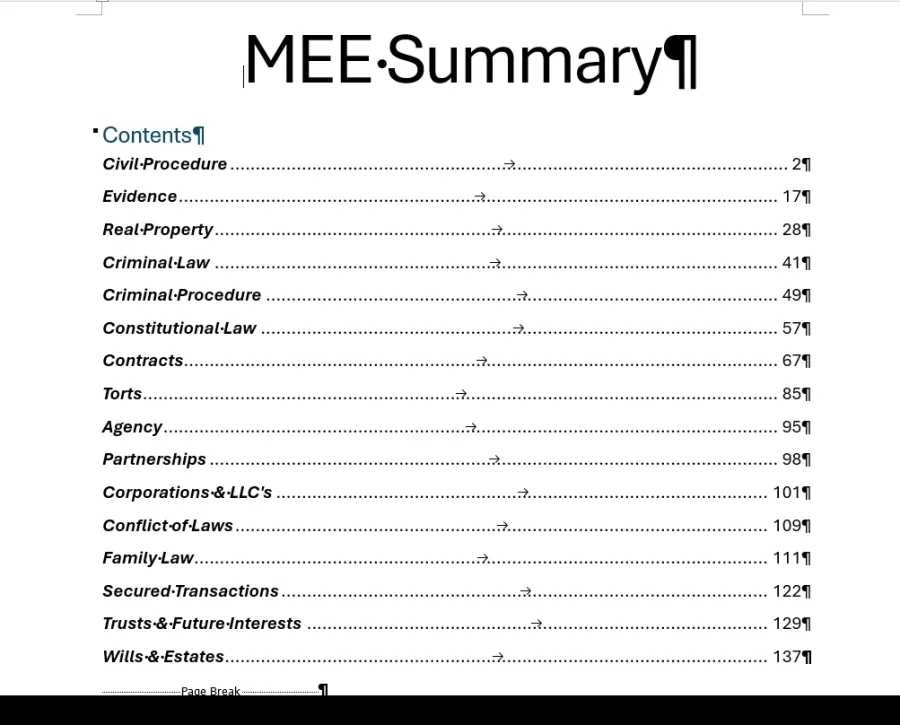
Below, I will post some images of the notes as samples, so please take a look if you are interested.
This note basically covers all the points of SmartPrep (however, points judged unnecessary for passing are omitted), and displays H, M, and L indicating the importance of SmartPrep points (I basically thought L didn't need to be memorized, and I cut out quite a bit of what I hadn't encountered in past question practice). It covers all 16 subjects of the MEE as of 2026 in about 150 pages. It is summarized in about 10 pages per subject, and since the keywords that must be memorized are highlighted, it is possible to review the important points of all subjects in about 2 hours at the shortest if you look at only the keywords at once. In fact, just before the exam, I repeatedly reviewed all subjects in about 2 hours by speed-reading only the highlighted parts of this note. Especially just before the exam, this is a considerable source of peace of mind. In the MEE, which has a very large number of subjects, I think how well you can prepare the shortest review notes makes a big difference.
It is not just a shortened version of SmartPrep's points, but for points that you cannot compete with unless you understand them deeply while doing problem practice, or parts where the meaning is not understood with SmartPrep alone, I have posted comparison tables and summaries in Japanese as appropriate. It takes a tremendous amount of time to research these from scratch using AI yourself, so I think it will be a reference for those who want to do it efficiently.
Note that this note was created for the February 2026 exam, and I do not plan to update it myself in the future. I think there will be various places that should be updated as time passes. However, my impression is that the MEE is not an exam where places with the latest case law changes are targeted, and rather than that, I think it is better to focus on thoroughly understanding and being able to write important points that have been asked many times since long ago. Even if this note becomes quite old, its usefulness itself will likely not change. Although the exam format will change significantly in the future and there will be changes in exam subjects, at least for the subjects covered as of February 2026, the important points should not change.
Multiple-Choice Preparation (Shortest Rule List)For multiple-choice study, I re-solved all the questions in Emanuel (about 500 questions) in the 3 weeks just before the actual exam after I was able to do the essay part to some extent. In the multiple-choice section, I often got the correct answer by process of elimination with ambiguous knowledge, and especially for important points, by returning after doing the essay study thoroughly, Emanuel's explanations played a role in further strengthening that understanding, and I think it had the effect of improving both multiple-choice and essays.
A particularly recommended study method for multiple-choice is to make a list that summarizes the Rules of the options you got wrong or were ambiguous about in multiple-choice practice in one line as briefly as possible. In Excel, for the questions I got wrong, I wrote down the Rules that you can't get the correct answer without knowing in Japanese concisely, and I re-memorized the essential knowledge by reading them back about 3 times just before. In fact, this was quite effective, and in my second attempt, my multiple-choice score improved even more than in the first attempt. I can't re-solve a large number of questions like 500 or 2000, but leaving them as solved is inefficient, so I think this list-making of the shortest Rules for multiple-choice is extremely useful.
Summary
The NY Bar is difficult. It is normal to fail.Moreover, the situation where everyone around you passes but you fail is quite mentally tough.
If you listen to success stories written by excellent people (including returnees) or claims of passing with high scores and underestimate it by thinking it is easier than the Japanese bar exam, (if you are not very excellent) you will fail with a high probability. The strategy often taken by Japanese people—to give up on essays because you cannot compete with native speakers—is also dangerous for some people, so if you have even the slightest anxiety about English or essay exams, I think it is better to raise your MBE score to a level where you can get 70% as soon as possible and put your full effort into essay preparation from at least one month before the actual exam. I hope this failure experience report will be of some use to future Japanese examinees.
Finally, my aforementioned MEE preparation notes (MEE summary) can be downloaded from below.
I am convinced that anyone can definitely pass if they memorize the blue-highlighted keywords in these notes while practicing past questions using MEE Testing and the like. There is no doubt that it is far more efficient than memorizing SmartPrep.
I know it will be tough for those who are going to take the exam from now on, but I really hope you do your best and grab a first-time pass.
(Postscript)
The other day, I received a personal message reporting a passing result from a July 2026 NY Bar examinee who studied using this MEE summary. It seems they passed with a very high score. It is entirely due to their own hard work, but if this article or the notes were of any help at all, there is nothing that makes me happier.