Last time, I looked into the amount of rice consumed and how it is eaten. The per capita supply of rice has dropped to less than half of what it was at its peak in fiscal year 1962.
Even so, there are rice paddies in Iwate, and there are rice paddies in my hometown of Iwaizumi as well.
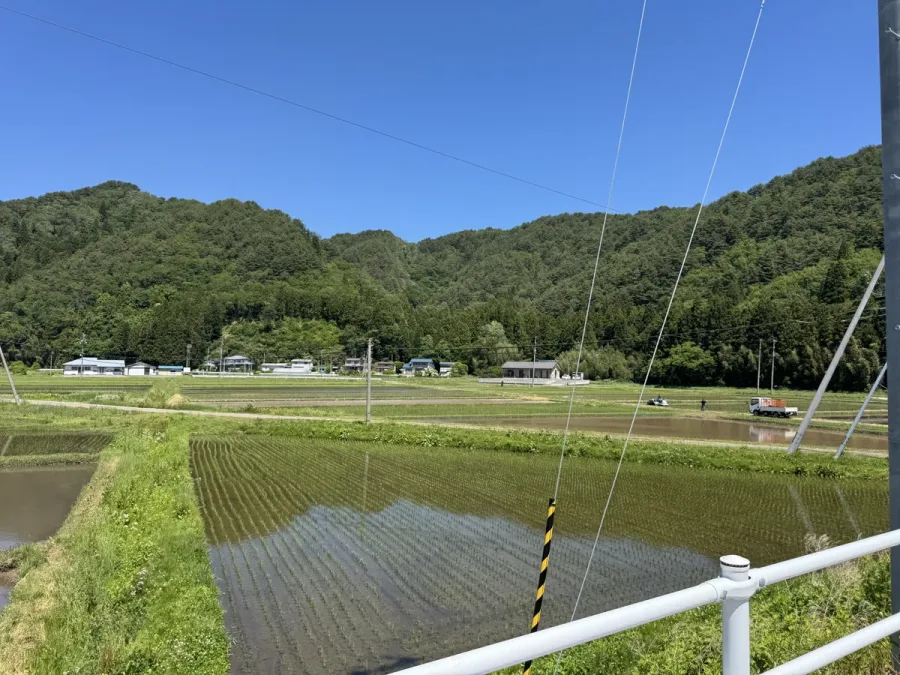
It is not just about large plains. People have drawn water into limited land nestled in the mountains, created paddies, and grown rice.
Why has Japan produced so much rice? (This reminds me of a certain gourmet manga.)
"Because it is the staple food of the Japanese people." At first, that seems like a sufficient explanation.
However, as I looked into it, it seemed necessary to distinguish between the question of whether people ate a lot of rice and the question of why rice was important in society.
Not everyone was eating enough white rice
Wet-rice cultivation was introduced to northern Kyushu and spread to various regions. However, it did not spread to every part of the archipelago at the same time or in the same way. The dates of its origin have also been revised through research.
Subsequent dietary habits also differed depending on the region and lifestyle.
There was a way of life that involved eating a combination of rice, barley, barnyard millet, foxtail millet, and vegetables, rather than just rice. A history of growing and eating millets remains in Iwaizumi as well.
On the other hand, it seems incorrect to generalize that "farmers could not eat rice." Research on the northern Kanto region during the Edo period shows that there were households in rural villages that bought rice, and that purchasing rice was linked to earnings from sources other than agriculture.
They would pay or sell the rice they produced and combine it with other foods at home. Or, they would buy rice with money earned from other work.
Producing rice and eating the rice one produced were not necessarily the same thing.
Even so, rice was at the center of society. Why is that?
Sources: National Museum of Japanese History, Exhibition Room 1, Tetsuya Hirano, "Food and Agriculture in Northern Kanto during the Edo Period", Iwaizumi Town Public Relations, October 2020 issue, p. 7. Differences in dates and regions will be supplemented in the reference section.
Both fields and the power of feudal lords were expressed in terms of rice volume
This is where the term "koku-daka" (yield in koku) comes in.
In historical discussions, we hear terms like "a daimyo of 100,000 koku." Does this mean they possessed 100,000 koku of rice, or that they had that much income every year? When I looked into it, it was not that simple.
Koku-daka is an evaluation of land productivity expressed in terms of the amount of rice. Land area and grade were examined through land surveys and converted into rice. Not only paddies where rice was actually grown, but also fields and other lands were evaluated using this scale.
Source: National Tax Agency 'Taikō Kenchi'・'Taxes on Vegetables in the Edo Period' and others. 100 koku, 40%, and 40 koku are hypothetical examples for explanation and are not actual village tax rates.
In other words, the koku (yield) is different from the actual amount of rice harvested that year, and also different from the lord's net income.
If the productivity of land can be expressed with a common measure, it can indicate the scale of a territory and serve as the basis for determining the burden of the land tax.
Rice was not only food, but also a standard for expressing the power of land and territory.
Thinking about it this way, we can see that rice held significant meaning, separate from how much white rice was actually eaten.
Collected rice became money and circulated through society
The rice collected as land tax was not just for eating.
Lords sold the collected rice in the market and used the proceeds for expenditures. Rice was also a link between finance and commerce.
Source: National Tax Agency 'Land Tax and Taxes', Bank of Japan Currency Museum 'History of Japanese Currency' and others. This is a simplified diagram of typical routes.
Gold, silver, and copper coins were also in circulation during the Edo period. Land taxes were not all paid in rice; there were systems for paying in cash as well.
Supporting society with rice and doing business with money were connected.
In Dojima, Osaka, transactions involving rice certificates and futures trading for rice delivery also developed. How to transport rice, sell it, and prepare for price fluctuations—a market and credit system grew around these activities.
I believe the importance of rice could not be measured just by what was in the rice bowl.
Source: Japan Exchange Group, History of the Dojima Rice Exchange. See the reference section for detailed explanations of rice certificates and the futures market.
Even when taxes became money, the price of rice affected daily life
With the Land Tax Reform of 1873, the system changed to one where landowners paid taxes in cash based on the value of the land.
This significantly changed the mechanism of collecting rice as tax. However, this does not mean that rice became unimportant to society.
Rice is a commodity that provides income for farmers, and for those buying it, it is a daily food. If its price rises, it impacts daily life.
In 1918, against the backdrop of rising rice prices, the Rice Riots spread from Toyama across the country.
After that, the government strengthened its involvement in the price and supply-demand of rice. However, it is not a history of constant shortages. In the 1930s, dealing with an oversupply of rice also became a problem.
The price reaching the consumer and the income of the producer. And, how much rice to secure. The issues surrounding rice change their form with the times.
Source: National Archives of Japan, Land Tax Reform Ordinance, National Diet Library, Rice Riots, Nobuhisa Namimatsu, 'Food Policy and Issues of Control and Management Under the Wartime Regime'.
There was a compelling reason to produce more
During wartime, the mechanisms for collecting rice from farmers and distributing it to consumers were strengthened. The Food Control Act was enacted in 1942.
However, even with a management system in place, it did not mean that food itself was sufficient. As the war progressed, not only production but also transportation and supply from overseas became difficult.
In 1945, the year of defeat, the national paddy rice harvest was approximately 5.82 million tons. By 1955, it had recovered to approximately 12.07 million tons. Along with rebuilding distribution and receiving imports and aid, increasing production was a major challenge.
Ensuring stable water usage. Improving rice fields. Developing varieties and cultivation techniques suited to the region. Improving fertilizers and pest control. Price systems also supported production.
On the Toyosawa River in Iwate, projects were carried out against a backdrop of water shortages and water disputes, and the Toyosawa Dam was completed in 1961. Rice cultivation cannot be continued just by sowing seeds in the land. It required long-term efforts to draw water, distribute it, and maintain facilities. When looking back on these projects, the burden on people who were forced to relocate cannot be forgotten.
Knowing about the later 'rice surplus,' one is tempted to read this as a story of overproduction. But for a society that had experienced shortages, there must have been a compelling reason to deliver sufficient rice in a stable manner.
Source: Japan Center for Asian Historical Records, Systems of Collection and Distribution, Ministry of Agriculture, Forestry and Fisheries, Annual Statistics of National Paddy Rice, Ministry of Agriculture, Forestry and Fisheries, Looking Back on Postwar Agricultural Policy, Tohoku Regional Agricultural Administration Office, History of the Toyosawa River. Harvest figures are for paddy rice, brown rice, and grain. National figures at the time do not include Okinawa.
The dining table had changed by the time productivity increased
Here, this connects to the figures from the previous installment.
The annual per capita supply of rice peaked at 118.3 kg in fiscal year 1962 and then began to decline. On the other hand, the production capacity of the producers was increasing.
Source: Ministry of Agriculture, Forestry and Fisheries, Annual Statistics of National Paddy Rice and Food Balance Sheet. The top row is the net food supply per person, not the actual intake. The bottom two rows are production statistics for paddy rice and brown rice. Because the subjects and units are different, the difference in the graph cannot be calculated as a surplus amount.
The national paddy rice harvest in 1967 reached approximately 14.26 million tons.
While efforts to ensure sufficient rice production progressed, people began to combine various foods such as meat, dairy products, bread, and noodles.
By the time the power to produce increased, the eating side had already begun to change.
The increase in government stockpiles became a problem, and production adjustment began in earnest in 1971. A society that had focused its energy on 'producing more' now had to face the challenge of adjusting production to meet demand.
Source: Ministry of Agriculture, Forestry and Fisheries, 'Looking Back on 100 Years of Showa'. Detailed progress on stockpiles and systems is summarized in the data section.
Multiple reasons are layered in the landscape of the rice fields
Why has Japan produced so much rice?
After researching this for this installment, I have come to believe that in addition to rice being important as food, it has been deeply intertwined with systems that support land valuation, taxation, commerce, and people's livelihoods.
Of course, it was not produced for the same reasons in every era. The relationship with rice also differed by region.
The history of eating a combination of grains in Iwaizumi, and the history of developing irrigation and facing cold-weather damage in Iwate, are parts of those differences.
I would like to look at the rice paddies before us not just as scenery that has always been there, but as the accumulation of the people and society that have created, supported, and continued them.
So, how has production been adjusted as the amount of rice consumed has decreased? How is that mechanism linked to rice paddies and the lives of farmers?
Next time, I would like to consider rice production adjustment and policy changes.
I have compiled the sources and charts for this installment.
I have summarized the differences between koku-daka (crop yield) and nengu (land tax), the flow of rice and currency, the Land Tax Reform, postwar production increases, and cold-weather damage in Iwate in the "Part 2: Reference Materials." Please take a look when you want to check the details mentioned in the main text.
→ Part 2: Reference Materials | Verifying the Relationship Between Rice and Society Through History and Charts
The charts were created independently based on published statistics and materials. References, statistical targets/units, and notes on interpretation are included in the reference materials. The verification date is September 27, 2026.