As the title suggests, this article is a guide to all classes in Baldur's Gate 3.
I explain the roles, strengths at various level ranges, and growth strategies for each class, so please use this if you are struggling with character builds, leveling up, or multiclassing.
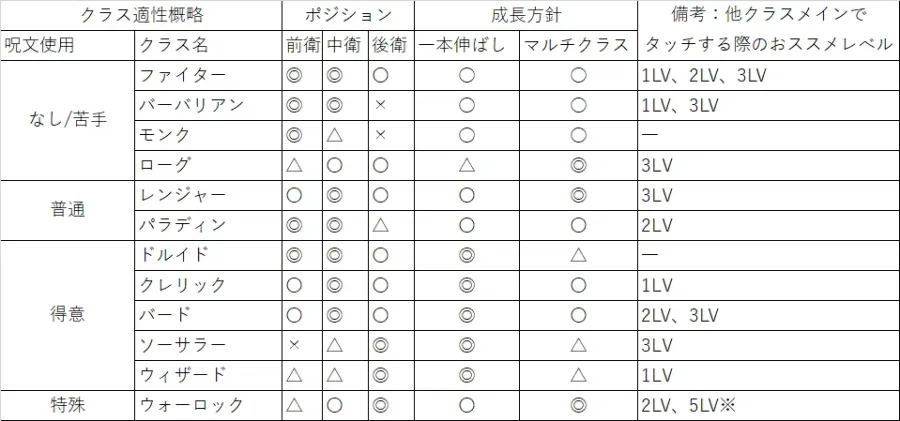
First, I have provided a rough table of the roles and aptitudes for each class.
I hope this serves as a reference for filling out your party composition or when looking at the class guides that follow. (Roughly speaking, the higher up they are, the more focused they are on weapon combat.)
No/Poor Spellcasting
The most basic weapon combat class, with high combat power in a simple way.
Second Wind's self-healing is subtle but useful. It is a versatile physical class that can move to the backline to fire a bow, or conversely, equip heavy armor and a shield for tanking.
Levels 1-2
Because you can choose a Fighting Style at level 1, your combat ability in the early game is a cut above the rest.
(Such as Archery, which adds +2 to hit via passive, or Two-Weapon Fighting, which can deal significant damage)
Action Surge at level 2 is also powerful as it simply increases the number of actions you can take.
Levels 3-4
If you choose Battle Master as your subclass at level 3, you can gain forced movement attacks and counter-maneuvers, improving your annihilation power. There is a limit to the number of uses, but they recover on a short rest, so you don't need to worry too much.
Champion is for looking toward the future. It is lackluster at this stage.
Eldritch Knight's magic is just a bonus, but since your thrown weapons won't disappear, you can create a unique throwing build if you take the 'Tavern Brawler' feat at level 4, which makes throwing strong.
Level 5-
The Extra Attack at level 5 is basic for weapon-based classes but powerful. From level 6 onwards, there is nothing particularly noteworthy until the enhanced Extra Attack at level 11, but Battle Master, which sees its superiority dice enhanced, is excellent even if you stick with it.
Multiclassing is recommended for Champion and Eldritch Knight.
Recommended multiclasses for Fighter
Battle Master: Multiclassing with Cleric (War Domain) is useful as it increases attacks via bonus actions. Since sticking with one class is strong, there is little need to force a multiclass.
Champion: It is recommended to take 2 levels of Barbarian to get Reckless Attack (always having advantage on attacks). Alternatively, since the style involves enhancing critical hits, you could take 3 levels of Rogue (Assassin) to utilize the guaranteed critical hit of Assassinate: Ambush.
Eldritch Knight: It is recommended to take 3 levels of Barbarian to get Frenzied Throw and increase the number of throws. After that, taking 3 levels of Rogue (Thief) to increase bonus actions will increase your number of attacks, making it powerful.
Recommended levels to take Fighter in other classes
Level 1: You can get a Fighting Style and Second Wind, so it is powerful at a low cost. It is easy to reinforce your build when you have 1 level left over.
Level 2: Action enhancement via Action Surge is powerful. The effect of increasing actions is rare, and even magic-focused classes should consider it.
Level 3: The main use is to go for Champion to increase critical hit rate, or to get maneuvers from Battle Master while taking Action Surge.
If you are unsure about multiclassing as a combat class, taking 3 levels of Fighter is a very solid choice.
A class characterized by Rage, boasting toughness beyond its HP due to halving physical damage taken. Note that Rage ends if you have a turn where you neither take nor deal damage. Basically, the playstyle involves charging forward, but it is also possible to fight at mid-range by making full use of throwing.
Since it is tough when you run out of Rage charges, your sustainability is low.
Levels 1-2
You can use Rage from level 1, and halving damage taken is powerful.
Reckless Attack from level 2 stabilizes your hit rate, contributing significantly to early-game stability.
Levels 3-4
If you choose Berserker as your subclass at level 3, you can acquire Frenzied Throw, allowing for throwing as a bonus action, which is an exceptional number of attacks at this stage. If you take the 'Tavern Brawler' feat at level 4, which makes throwing strong, you will have quite high damage output.
For Wildheart, I recommend the Tiger heart for area-of-effect attacks or the Bear heart, which allows you to tank by halving damage other than psychic.
Wild Magic is honestly subtle in terms of strength, and multiclassing is difficult. You can fight thanks to the Barbarian's base performance, so use it if you like randomness.
Level 5-
It is stable, but you get an Extra Attack at level 5, so this is basically where you start thinking about multiclassing. Barbarians increase their number of Rage charges by level, and the level 9 Brutal Critical is excellent for critical-hit builds, so sticking with one class is not bad.
Recommended multiclasses for Barbarian
In common, Barbarians cannot take a Fighting Style, so they are compatible with multiclasses that allow you to take one, such as Fighter levels 1-3, Paladin level 2, or Ranger level 3.
Berserker: 3 levels of Rogue (Thief), which can increase bonus actions, is optimal. Also, Eldritch Knight (3 levels) from the Fighter class, which has Weapon Bond, is compatible.
Wildheart: If you want to increase attack performance with Tiger, it is compatible with taking Colossus Slayer from Ranger or Champion from Fighter to increase critical hit rate. If you want to increase tank performance with Bear, you could utilize Paladin's Oath of the Ancients to prepare self-healing.
Wild Magic: Multiclassing with at least 2 levels of Paladin is relatively compatible because you can utilize spell slot recovery and take a Fighting Style.
Recommended levels to take Barbarian in other classes
Level 1: It is basically the same as saying, 'Please just give me Rage.' That said, it is undoubtedly powerful, so if you can manage your bonus actions, there are many situations where it is worth it.
Level 3: The main purpose is to take Berserker to perform throws as a bonus action, or to take Wildheart to gain resistance with Bear and improve tank performance.
Essentially an expert in unarmed combat. Regardless of your growth direction, the 'Tavern Brawler' feat is practically essential, so you will likely learn it at level 4. Since there are many items in the game that fix Strength, you can also build around utilizing those.
Although it is a frontline class, its defensive capabilities are fragile, so you want to fight while being mindful of your positioning.
Levels 1-2
From level 1, you have a high number of attacks due to Martial Arts, and by using Flurry of Blows, you can attack up to three times, so your attack count is unrivaled.
At level 2, you gain defensive maneuvers like Patient Defense and Step of the Wind for disengaging, so you should maneuver carefully to avoid being focused down.
Levels 3-4
If you take 'Way of the Open Hand' at level 3, Flurry of Blows is enhanced, allowing you to adapt your playstyle to the opponent's characteristics. In particular, it is important that if you seal their reaction, you won't receive opportunity attacks even if you disengage.
'Way of Shadow' is primarily focused on enhancing exploration. It excels at stealth, so it's for those who want to play that way.
'Way of the Four Elements' allows you to use various elemental spells in conjunction with unarmed attacks, making it easier to attack according to the enemy, but its raw damage output tends to be inferior to 'Way of the Open Hand'.
For the level 4 feat, you generally want to enhance your unarmed strikes and increase damage with 'Tavern Brawler'.
Level 5-
You get an Extra Attack at level 5, and you can learn Stunning Strike, which is powerful for targeting an opponent's stun. Also, at level 6, your unarmed attacks count as magical, allowing you to ignore some resistances (and 'Way of the Open Hand' also adds extra damage), so these levels are particularly strong. After that, there isn't much to note, but since your Ki point limit and unarmed strike damage depend on your Monk level, sticking with this class is not a bad idea.
Recommended multiclasses for Monk
There are more common issues for Monks than subclass-specific ones, so the recommended classes are similar.
Since there is Flurry of Blows, which allows two unarmed attacks as a bonus action, Rogue level 3 'Thief' is a strong candidate as it increases the number of times you can use it.
Also, because there is anxiety regarding durability, it has good synergy with Barbarian for Rage, or Wizard 'Abjuration' for Shield and Arcane Ward.
'Way of Shadow': Ranger 'Gloom Stalker' or Rogue 'Assassin', which mesh well with stealth play, are strong candidates.
Recommended levels for taking Monk in other classes
Basically, it is not suitable for taking in other classes.
Since it is a class that utilizes unarmed attacks, you would need to find a very unique composition.
A class that places more weight on exploration than combat, and it is not well-suited for sticking with just this class. It is a class often raised as a candidate for multiclassing from other classes.
For main combat, bows that are easy to use for stealth are standard, so mid-to-rear guard is best.
Note that, as described later, its combat power is actually high in the early game. It becomes difficult from levels 5-6 when other classes gain Extra Attack.
Levels 1-2
At level 1, when everyone's damage is low, the benefit of Sneak Attack is significant, making your damage relatively high.
With Cunning Action at level 2, it becomes easier to position yourself and use stealth, so you can act as a stable damage dealer.
Levels 3-4
Since Sneak Attack damage increases at level 3, you remain a solid damage dealer.
Increasing bonus actions with 'Thief' makes maneuvering even easier. You will likely fight while utilizing things that are usually difficult to use, such as weapon coatings or shoving.
'Assassin's' Assassinate: The guaranteed critical on surprise attacks and the additional action at the start of combat from Alacrity make it the top-tier attacker at this point.
'Arcane Trickster' is quite difficult to utilize. I would like to say it's a time of lying low until you get a powerful feat at level 9, but... if you are looking for strength, I cannot recommend it.
Level 5-
The lack of an Extra Attack is a major drawback. Depending on the class, many gain an Extra Attack from levels 5-6, which creates a clear difference.
At level 6, skill checks become stronger, and at level 11, you gain the unique trait of not fumbling on skill checks, so if you are going to stick with this class, you should build your character as an exploration specialist who treats combat as a bonus.
Recommended multiclasses for Rogue
It is difficult and troublesome to raise Rogue as your main class.
Since Sneak Attack can be activated with a normal action, perhaps it is best to raise Thief to level 7 to learn Uncanny Dodge and increase Sneak Attack damage to 4d6, then go for Fighter level 5 to get Extra Attack, Fighting Style, and Action Surge.
Basically, you want to take it as a multiclass, so you might want to consider rebuilding once you reach levels 5-6.
Recommended levels for taking Rogue in other classes
Level 3: Taking 'Thief' to increase bonus actions is extremely powerful. For many classes, it becomes a top multiclass candidate. Also, 'Assassin' is excellent for some classes that utilize stealth.
Spellcasting/Normal
You can use spells, but it is a class where they are just a bonus.
Basically, they are often used for out-of-combat healing or exploration.
Compared to the aforementioned Rogue, it is a bit more combat-oriented, but it is also quite good at exploration. Highly recommended is choosing Beast Tamer at level 1 to acquire a Familiar, which helps with exploration and also acts as a decoy (target) that can be summoned every short rest in combat.
Since you will often be increasing Dexterity, it is best suited for flexible maneuvering as a mid-guard while utilizing ranged weapons.
Levels 1-2
At level 1, the Familiar can also be a combatant of sorts. Do your best with your starting bow.
For level 2, Archery or Two-Weapon Fighting is recommended. Since dual-wielding hand crossbows is possible in the future, it is not essential to move to the front just because you have two-weapon fighting.
Spells are a bonus, but in the early game, just having increased healing ability is appreciated. In exploration, having Speak with Animals is great.
Levels 3-4
'Beast Master' is powerful because you gain one additional unit, and it is excellent as a combatant in the early game. It becomes harder to keep up in battle gradually, but numbers are still strength.
'Hunter' is a safe choice because you can take Horde Breaker, which allows for multiple attacks without a limit on the number of uses.
'Gloom Stalker' is a class that excels in stealth combat and contributes to exploration by granting superior darkvision.
Level 5-
Since you get an Extra Attack at level 5, you won't fall behind as a combatant. By the way, this is often where the strength balance reverses with the aforementioned Rogue.
On the other hand, there are few powerful skills from here on, so it is better to multiclass with 'Hunter' and 'Gloom Stalker'.
For 'Beast Master', the performance of the beast companion is linked to your Ranger level, so sticking with this class is better.
Recommended multiclasses for Ranger
'Hunter': If dual-wielding, you want to get bonus actions from Rogue level 3 'Thief'. After that, Fighter levels 1-3 to get Archery from Fighting Style, or Barbarian (Bear) to increase durability would be good. If you are bow-focused, Cleric 'War Domain' to increase attack frequency or 'Knowledge Domain' to strengthen skill aspects would be good.
<Gloom Stalker>: You want to enhance your surprise attacks with the Rogue level 3 <Assassin> subclass. After that, you could take 2-3 levels of Fighter to gain Action Surge, or continue leveling Rogue to boost your Sneak Attack damage.
Recommended levels for taking Ranger in other classes
Level 3: It is standard to either take a Fighting Style and pick up the <Hunter>'s 2-target attack, or take <Gloom Stalker> for initiative bonuses and stealth capabilities.
PaladinBy learning healing magic and wearing heavy armor, they can become a stable tank. Additionally, their Divine Smite, which uses spell slots to boost damage, is powerful and provides strong offensive output.
However, since both the special ability Lay on Hands and spell slots recover only on a Long Rest, their sustainability is somewhat low, so you should fight while keeping that in mind.
Levels 1-2
You gain your subclass starting at level 1. Oaths affect not only performance but also roleplay (dialogue options), so consider them along with the flavor.
At this point, <Oath of Vengeance>, which allows weapon enhancement via the bonus action Inquisitor's Might, or <Oath of the Ancients>, which allows healing via Healing Radiance, are excellent.
At level 2, you gain a Fighting Style and Divine Smite for increased damage output.
Levels 3-4
The weapon consecration enhancement gained at level 3 for <Oath of Devotion> lasts for 10 turns, making it particularly strong when combat is anticipated.
<Oath of Vengeance> is strong because the level 3 Vow of Enmity easily grants Advantage against a single enemy, stabilizing hit rates. (As of 2023/12/31, there is a bug where targeting yourself grants Advantage against all enemies.)
<Oath of the Ancients> doesn't have anything noteworthy at this point, but since the bonus action heal usable from level 1 is powerful, it is optimal as a tank.
Note that by intentionally breaking your oath, you can become an <Oathbreaker> class. It will be a while before it becomes truly powerful.
Level 5-
You gain Extra Attack. The level 6 Aura of Protection is powerful; for <Oathbreaker>, the level 7 Aura of Hate adds damage, and for <Oath of Vengeance>, the Haste spell learned at level 9 is powerful.
Since both spell slots and the number of uses of Lay on Hands increase with level, there is no problem with sticking to this class.
Recommended multiclasses for Paladin
Regardless of subclass, multiclassing with Warlock, which also utilizes Charisma, is powerful, and taking Extra Attack via Pact of the Blade is a strong option.
However, be aware that it is impossible on the highest difficulty(the Extra Attack from Pact of the Blade does not stack with the standard Extra Attack).
<Oath of Vengeance>: Taking 3 levels of Sorcerer to get Metamagic and twin Haste is also an option.
<Oath of the Ancients>: Multiclassing with Wizard's <Abjuration> is recommended to increase tank performance. The strength is that you won't regret using spell slots for Counterspell.
<Oathbreaker>: Taking 3 levels of Fighter to get <Battle Master> and gaining extra attacks through ripostes is recommended. 3 levels of Ranger <Hunter> is also good as it does not degrade spellcasting capabilities.
Recommended levels for taking Paladin in other classes
Level 2: You gain Divine Smite and a Fighting Style, which boosts your frontline capabilities. It is also worth noting that you gain spell slots.
Spellcasting/Proficiency
This category is primarily for classes that focus on casting spells.
Remember that as long as you multiclass within this category, the number of spell slots will not decrease (note: the level of spells you can learn depends on each individual class), which makes multiclassing easier.
A spellcasting class that can also fight on the front lines by transforming into a Wild Shape.
Even if defeated in Wild Shape, you simply revert to your original form, making this a class with excellent durability. Wild Shape recovers on a Short Rest, so it also has high sustainability.
Note that due to the performance of Wild Shape and the requirements for spell levels and slots, this class is not well-suited for multiclassing.
Levels 1-2
Level 1 has no particular strengths. Since it is not a long period, just do your best as a simple healer.
At level 2, you gain Wild Shape and choose a subclass.
Regardless of the subclass, Wild Shape is extremely powerful at this point.
<Circle of the Moon> allows you to use Wild Shape as a bonus action. As long as you have charges left, you can transform as many times as you want, and you can even heal as a bonus action using Lunar Mend, making it the best tank in the game.
<Circle of the Land> improves sustainability further with Natural Recovery, which restores spell slots on a Short Rest. It is also powerful because you can learn useful spells like Hold Person and Haste in the future.
<Circle of the Spores> is very difficult to handle. Although you can counterattack with a reaction, it is underwhelming at this point.
Levels 3-4
Taking the "Tavern Brawler" feat at level 4 also improves the unarmed attack power of Wild Shape.
Also, at level 4, your transformation options increase.
Level 5-
There is no Extra Attack, but you gain Primal Strike, which allows Wild Shape to make extra attacks, so you won't fall behind. The Owlbear, which you can transform into at level 6, is powerful as it can also attack as a bonus action. Note that while <Circle of the Spores> can mass-produce zombies here and is fun, it is questionable whether it is powerful.
Since Wild Shape's extra attacks increase further at level 10, sticking to this class is stable until then.
*Unknown if bug or feature (12/31): If you take a Short Rest while in Wild Shape, your Wild Shape charges fully recover while remaining in the transformed state.
(If you fight as is, you can transform a total of 3 times.)
Recommended multiclasses for Druid
As mentioned above, it is not very suitable for multiclassing. Taking 1 level of Barbarian to increase durability with Rage, or taking Wizard to increase spell options, would be effective. You could also receive the benefits of various Cleric domains.
Recommended levels for taking Druid in other classes
Because many effects depend on Druid level, it is not very suitable for multiclassing.
If forced to choose, if you have leftover bonus actions and are worried about durability, it might be worth taking Circle of the Moon Druid to transform and use it like temporary HP.
This class can handle basic healing spells, but its nature changes depending on the subclass: domain you choose. Regardless, they tend to be on the tougher side for a spellcaster, so you should aim to act as a mid-line defender to stop enemies who have slipped past your front line.
1-2LV
Powerful because you can heal from LV1 and utilize the features of your domain.
Since there are no concerns about combat capability up to 2LV, you should choose your domain with the future in mind.
<Life Domain>: Healing amount increases with Disciple of Life, and you also gain area healing via Channel Divinity. Optimal as a healer.
<Light Domain>: Warding Flare, which provides infinite evasion buffs, is reliably strong. You also have area attacks via Channel Divinity.
<Trickery Domain>: Unfortunately, its performance is lackluster. Not recommended. At low levels, the hit bonus from Channel Divinity's Invoke Duplicity can sometimes be useful.
<Knowledge Domain>: Mediocre in combat. If your party needs it, it can enhance exploration through skill proficiencies and Channel Divinity.
<Nature Domain>: Can be considered if you want Speak with Animals and no one else in the party is responsible for it. It has no strengths beyond that.
<Tempest Domain>: Besides being able to deal damage with reactions, the lightning damage boost from Channel Divinity is also powerful.
<War Domain>: Especially strong in the early game because the bonus action extra attacks increase based on Cleric level. The damage boost from Channel Divinity works the same way.
3-4LV
Because there are no significant enhancements, it tends to pale in comparison to other classes relatively.
However, since the need for a healer is high, you can continue to use it without worry.
5LV-
Since there is no extra attack, your offensive capability will fall behind, so you will likely end up focusing on healing or support via spells. In that sense, <War Domain> might be a difficult period.
The 10LV Divine Intervention has impact, but it is a very rare once-per-game ability, so it is debatable whether you should aim for it.
Classes like <Light Domain>, which can grant evasion buffs to others at 6LV, or <Life Domain>, where healing enhancement becomes stronger based on level, are particularly suited for single-class progression.
Recommended multiclasses for Clerics to take
If you are focusing on healing, you don't necessarily need high-level spells, so it is worth considering mixing in Wizard or Sorcerer to get Counterspell.
Both are adept at spells, and you won't be inferior in spell slots compared to single-class progression.
<Knowledge Domain>: By taking 3LV of Bard <College of Lore> to get additional proficiencies, you can enhance your role without reducing your spellcasting ability much.
Recommended levels for taking Cleric in other classes
1LV: Powerful because you can get domain features. <Light> for reaction buffs, <Knowledge> for proficiency buffs, and <War> for attack, martial weapon, and heavy armor proficiency are strong candidates. Exceptionally, you might go for <Tempest> at 2LV to get maximum lightning damage.
BardBecause they have abundant skill proficiencies and can provide support with Bardic Inspiration, they are particularly strong in exploration among spellcasting classes. They can handle weapon combat, but since there is some anxiety about durability, it is recommended to act as a mid-line unit. A highly versatile class that can also use healing spells.
1-2LV
At 1LV, where all abilities are unstable, the 1d6 from Bardic Inspiration is quite effective. In the early game, this alone fulfills a role. Of course, healing is also excellent.
Increasing short rests from 2LV is excellent because it also improves the sustainability of other classes.
3-4LV
In addition to learning a subclass, exploration aspects become even stronger with Expertise.
<College of Lore> specializes further in exploration, and Cutting Words, which can lower an opponent's saving throw, is also excellent.
<College of Swords> learns two-weapon fighting and gains medium armor proficiency. Combined with combat styles, you gain combat power that can keep up as a member of the front line.
<College of Valour> is recommended if you mainly use bow attacks, as you can enhance Bardic Inspiration while gaining proficiency in martial weapons and medium armor.
5LV-
Bardic Inspiration recovers on short rests, greatly improving support capability.
Extra attack is only available from 6LV with <Swords> and <Valour>. College of Lore will increase the number of spells. Since spells increase and inspiration becomes stronger, single-class progression is strong, but since it is somewhat complete by 6LV, you can also multiclass.
Recommended multiclasses for Bards to take
<College of Lore>: It is recommended to take 1LV of <Knowledge Domain> for further enhancement of exploration aspects. Your magical ability will drop, but you could also take 1LV of Rogue to aim for even greater heights. If you want to extend your combat side, get Eldritch Blast with 2LV of Warlock.
<College of Swords> / <College of Valour>: Similar to Paladin, taking 5LV of Warlock to gain further extra attacks and weapon attacks using Charisma is excellent.
Other than that, taking 1-3LV of Fighter, which can take a combat style, will be a stable boost.
Regarding <Swords>, if you are dual-wielding, Rogue (Thief) is also good.
Recommended levels for taking Bard in other classes
2LV: Increasing short rests is excellent. Bardic Inspiration is also consistently strong, so it is useful.
3LV: In addition to the benefits of 2LV, it is powerful to take the combat style addition and Flourishes of <Swords>, or the skill proficiencies and Cutting Words of <Lore>.
The biggest feature is being able to cast spells as a bonus action using a unique resource called Sorcery Points. Sustainability becomes low, but in the short term, they become a spellcaster with top-class output. Regardless of subclass, they can cast Haste on two targets, so their support capability is also powerful.
1-2LV
Choose a subclass from 1LV. <Draconic Bloodline> is excellent because it gives decent AC (evasion) in the early game. <Storm Sorcery> is excellent for positioning because you can fly. <Wild Magic> is for those who like randomness. Its strength is mediocre.
3-4LV
Metamagic: Quickened Spell is powerful. Although it uses 3 Sorcery Points, you can cast spells as a bonus action, so your instantaneous output is higher compared to other spellcasters.
5LV-
Because you learn Haste at 5LV, there is a high possibility that your combat power will improve dramatically, coinciding with the timing when other front-line units get extra attacks. At 6LV, <Draconic Bloodline> improves spell damage.
There is no notable growth in the future, but simply increasing spell levels and slots is powerful.
Recommended multiclasses for Sorcerers to take
Since they generally lack sustainability, taking 2LV of Warlock to be able to fight with Eldritch Blast is quite a strong candidate. Also, taking <Tempest Domain> with 2LV of Cleric to reinforce damage is good.
Recommended levels for taking Sorcerer in other classes
3LV: There is a need to twin Haste, but in that case, you need 3LV to get 3 Sorcery Points. You can also take Quickened Spell to use as needed, or take Subtle Spell or Careful Spell for emergency needs.
WizardThe point that you can learn magic from spellbooks is important and excellent. Since you can learn them regardless of Wizard level as long as you have spell slots, it is also suitable for multiclassing.
They do have Arcane Recovery, but since they are still dependent on spell slots, their sustainability is on the lower side.
1-2LV
At 1LV, you lack strength and healing, so it might be particularly tough even for spellcaster types. From 2LV, you choose a subclass school.
<Abjuration>: Reduces damage taken. At this stage, you aren't quite ready to be on the front lines.
<Conjuration>: You can only create water. Not great.
<Divination>: You can support or hinder by swapping enemy or ally rolls with dice held via Portent (2 per Long Rest). Quite powerful.
<Enchantment>: You can charm enemies, but the drawback is that your ability score (Charisma-dependent) doesn't align with the Wizard's. The number of uses is also low.
<Evocation>: Your Evocation area spells do not affect allies. Always useful.
<Illusion>: Not great.
<Necromancy>: You recover a small amount of HP, so it's not a waste.
<Transmutation>: Increases the number of items created via alchemy. Low frequency of use.
3-4LV
You just get more 2LV spells. You might envy the growth of weapon-attacking classes, but be patient.
5LV-
Basically, your spells simply get stronger. <Abjuration> requires a unique build, but because you become extremely sturdy, you can act as a tank or use your reaction from 6LV to protect allies. From 6LV, the characteristics of each class begin to emerge, such as <Necromancy> which enhances undead control, and <Divination> which makes Portent even stronger.
<Enchantment> and <Evocation> (and to some extent <Illusion> and <Conjuration>) reach their full potential from 10LV, so it is better to stick with one class.
Recommended multiclasses for a Wizard to take
3LV of Sorcerer is quite excellent for spreading Haste to two targets or using Metamagic. Also, taking <Tempest Domain> with 2LV of Cleric is good for damage reinforcement.
<Abjuration>: A special subclass that can become a tank. If you want a front-liner or a sturdy mid-liner, you can raise it in that direction. Because of the excellent defensive spell Armor of Agathys, a multiclass with 1LV of Sorcerer (Draconic Bloodline: White) or Warlock is recommended.
Recommended levels for taking Wizard in other classes
1LV: In most cases, you multiclass just to learn spells from a spellbook. Exceptionally, <Divination>'s Portent is powerful, making it worth multiclassing at 2LV.
Spell Usage/Special
WarlockWarlock uses a unique system, so it is separated. Simply put, you get fewer slots, but they recover on Short Rests.
Also, the effectively exclusive cantrip Eldritch Blast is powerful, and its sustained combat capability is outstanding. You can swing weapons on the front lines, but there is some anxiety regarding defense. You should operate from the mid to back lines.
1-2LV
There is also additional damage from Hex, so at 1LV, your offensive capability is excellent. For the subclass, the temporary HP gain from <The Fiend> is relatively powerful at this point.
The 2LV Invocation "Agonizing Blast" is effectively mandatory. It adds your Charisma bonus, resulting in significant damage for a cantrip.
3-4LV
At 3LV, you choose from Pact of the Blade to enhance weapons, Pact of the Chain to gain a familiar, or Pact of the Tome to increase spell variety.
If you are attacking with weapons, choose Pact of the Blade. If you are playing in the back line, Pact of the Chain is strong at this level, and the invisible Imp is useful for exploration. On the other hand, if you are looking ahead to 5LV and beyond, Pact of the Tome is stronger.
5LV-
Eldritch Blast becomes two beams, making you a decent combat force in any build.
Pact of the Blade gains an extra attack, and Pact of the Tome gains free spells, so the enhancement range is large. However, the growth after 6LV is lackluster, and it is fatal that there is nothing specifically suited for weapon attacks up to 12LV.
If you are Pact of the Blade, you should multiclass. The magic itself is not bad, so if you are Pact of the Tome, sticking with one class is also fine.
Recommended multiclasses for a Warlock to take
If you are Pact of the Blade, any class with an extra attack is valuable. Fighter, which allows you to take a fighting style and can be acquired at low levels, or Paladin, which can utilize Charisma modifiers, are good.
For Pact of the Tome, you can multiclass into 1LV of Wizard to increase spell variety or 3LV of Sorcerer for Metamagic. Eldritch Blast x2 is powerful. You could even take 2LV of Fighter to get Action Surge.
Recommended levels for taking Warlock in other classes
2LV: By taking Eldritch Blast and adding Charisma to damage, you can utilize it as a powerful, unlimited ranged attack. Since it is a cantrip, it is significant that the number of attacks increases depending on character level.
5LV: By taking an extra attack with Pact of the Blade, you can improve the offensive performance of weapon-attacking classes. Note that you attack using your Charisma modifier.
However, be aware that it is impossible on the highest difficulty(the extra attack from Pact of the Blade does not stack with a normal extra attack).
Afterword
This information is as of 2023/12/31 (first draft).
There is little information in Japanese, and translated articles were hard to read, so I made this myself as much as I could.
Since the main game has finally been localized into Japanese, I plan to play BG3 to the fullest during the year-end and New Year holidays.
Well then, have a happy new year.