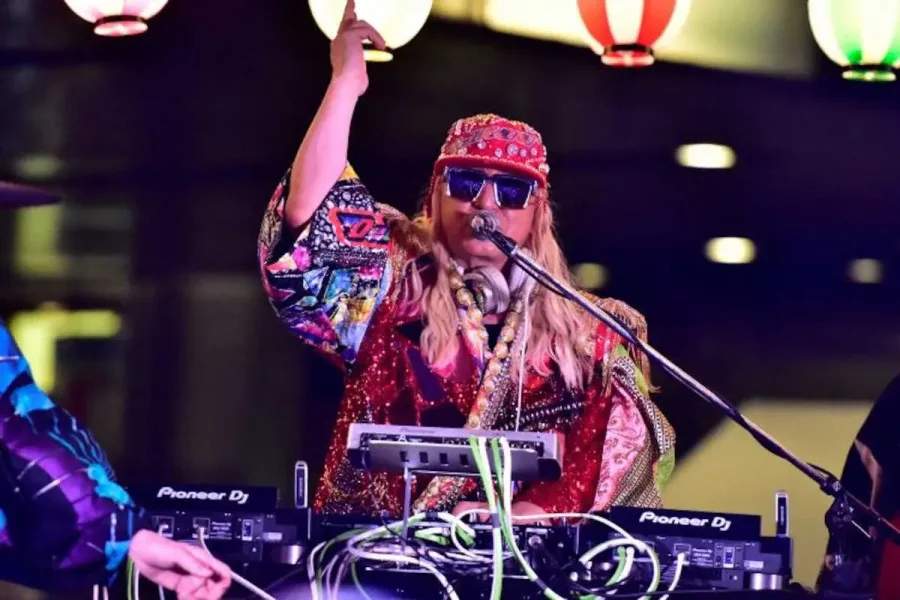
In July 2026, Sorajima conducted a 6-day, 4-night business trip to the United States with 52 employees.
This was not just a site visit for the management team. Almost every employee participated, including manga editors, corporate staff, and even new hires who had only been with the company for a month.
One editorial department set a goal to "talk to 500 American readers on-site," and the recruitment team personally made appointments with local universities.
Why did they go to such lengths and incur such costs to take everyone? And what did they gain? We spoke with Co-CEO Hagiwara, Second Editorial Department Editor-in-Chief Ikeda, and HR Department's Harada.
“A U.S. business trip if we hit our goal”
──First, could you tell us the background behind the decision to carry out this U.S. business trip?
Hagiwara:It is because Sorajima is a company that seriously strives to achieve big dreams that everyone else might mock.
I have visited the U.S. several times myself. During those trips, I attended 'Anime Expo' in Los Angeles and was shocked by the intensity of the passion there.
The atmosphere where Japanese manga and anime culture is deeply accepted by society, the scale of the event, the passion of the fans—these things can never be conveyed through management's impressions or online articles.That is why I wanted all employees to experience it someday and dream of the scene where Sorajima's works create a frenzy at 'Anime Expo'.
However, since it would be a significant investment, I set a goal: 'There is only a 20% chance of success, but if we achieve this company goal, let's go on a business trip to the U.S.' It wasn't an easy goal, but we actually achieved it.
Once the employees responded to the flag raised by management, we had no choice but to execute it. Co-CEO Maeda and I decided, 'If we are going to do it someday, let's do it soon,' and launched the U.S. business trip project in April.
Initially, 30% were cautious. From there, how it reached about 90% deciding to 'go'
──What was the internal reaction to the idea of everyone going abroad?
Hagiwara:There were various opinions and discussions. In a survey before the implementation, while about 50% were positively in favor, about 30% expressed cautious opinions, such as doubts or opposition.
Initially, I had a strong desire to have all employees participate. But seeing employees seriously raising questions, considering the meaning of doing it at this timing and the company's investment judgment, changed my thinking. I thought, 'Since they are thinking with the company as the subject, I shouldn't force participation, but trust them and leave it to their own judgment.' I believed, 'If it's them, they will surely respond in the end.'
Therefore, after conveying my desire for everyone to go together with all my might, I decided to let each person choose based on their own will in the end.
After that, teams were formed by department, and they each planned how to spend their time in the U.S. As a result, the employees themselves set the 'WHY' for why they were going, and in the end, almost everyone participated.
Including the corporate department staff, it was over 90% of the company. Many employees made adjustments despite having families, and I cannot thank their families enough for their support.
—It is quite rare for corporate department staff to participate in an overseas business trip, isn't it?
Hagiwara: That may be true. But I believe that when a company aims to move forward toward something, everyone, regardless of their job role, should have the same perspective and view the publishing business and the organization with the same level of clarity.
I see the corporate department not just as an administrative function, but as an essential partner in truly achieving the big dreams that everyone else might mock. When the business department actually takes action, the cooperation of the corporate department to support that realization is indispensable.
If a gap in passion or perception arises between the business department and the corporate department at a critical juncture, the organization cannot move in the same direction as a single team.
That is precisely why I wanted the corporate department staff to join this U.S. business trip as well, so that everyone's perspective could be aligned.
“Will it really pay off?” Employees' internal conflicts and the reasons they found for going
—When you first heard about the plan for the U.S. business trip, what did you honestly think?
Harada: While I felt it was very 'Sorajima-like,' honestly, it took me some time to find the significance of us going, given my position in the HR department.
However, in daily company information sessions and similar settings, as I spoke about the goals Sorajima has set as an HR representative, I was often asked by job seekers and students, 'What does it specifically mean to create works with a global perspective?'
Through those repeated interactions, I began to want to see with my own eyes what it truly means to 'transcend the world' and to be able to talk about it.
Ikeda: For me, confusion came first. With significant costs and man-hours involved for both the individual and the company, I wondered if it would really be worth it or if we could get a return on that investment.
I had never been to the U.S. before, so honestly, I was looking forward to the trip itself, but still.
—With that confusion and anxiety, how did you determine your objectives and goals for the trip once you decided to participate?
Ikeda: Precisely because I was anxious about whether it would be worth the cost, I thought I should first decide 'what I need to bring back to make it pay off.'So, I worked backward to organize what milestones the Second Editorial Department needs to clear to achieve its goals over the next 10 years.
Our ultimate goal is to create works with authors that will thrill the world in 10 years. To achieve that, it is important to have our original works adapted into anime and for that anime adaptation to generate great excitement. Currently, we are in an environment where we can deliver works to the world with the help of platforms. If we can maximize this environment to make our works a hit, trust in the original work will be born, and an anime adaptation will be within reach.
In other words, how widely and deeply we can deliver our works to American readers will determine our future 10 years from now.
So, how much do we actually know about those American readers? That is where I got stuck. I can read sales data and market reports. But the faces of the people behind those numbers, and the passion with which they read our works—that is something I cannot understand at all from the documents.
There is no other way than to meet them in person and talk to them on the ground. 'There are things you can only gain through experience' is certainly a cliché. But for me at that time, it was the only answer that made sense for us to go. That is why I made meeting readers in person our primary goal.
Above all, I believed that by deepening our resolution of the global market as editors, we could work with creators at a higher level to produce works with an eye toward international expansion.
Talking to 390 people, and the faces of readers that began to emerge
—So, Ikeda-san, how did you spend your time in America?
Ikeda:As the Second Editorial Department, we went there with the goal of talking to 500 people in America. We split into five teams, with the expectation of talking to 100 people per team.
Specifically, we visited large American bookstores like Barnes & Noble and Kinokuniya, as well as local merchandise shops, and we spent our time at the 'Anime Expo' venue constantly engaging in dialogue with the locals.
Initially, I thought about fixing the questions in advance and statistically aggregating and analyzing the information obtained. However, as we actually talked to people, I felt that knowing the enthusiasm of the person in front of me was more important than collecting data, so halfway through, I stopped sticking to fixed questions and shifted to a style of just talking to the person in front of me.
As a result, we were able to talk to 390 people.
Through this action, I felt the 'heat' of the people we spoke with, and not only did I burn it into my memory, but I was also able to touch upon trends in what kind of worldviews and tastes in works are easily accepted by American readers, as well as the reality of how much and how often current readers consume manga works.
—Could you also tell us about the specific lessons learned from that?
Ikeda:First of all, I became able to vividly imagine the faces and enthusiasm of the fans of our works in America.
In my head right now, many faces of local people who talked to me about their favorite anime and manga come to mind. Thanks to this feeling, when thinking about the details of a work, I can now imagine the actual faces of the other party, asking myself, 'Will this work reach those people in America?' or 'Will it be talked about with such passion?' I think this created a starting point for my thinking when creating works, and the resolution of the thinking itself has increased.
Furthermore, after returning to Japan, there were moves to review the organizational structure of the Second Editorial Department, and we became able to have deeper dialogues in the actual production process, especially in discussions about character design and world-building.
The content of our serialization meetings has also changed. Having witnessed people cosplaying and fans buying large amounts of merchandise on-site,the importance of character design and the work's worldview has taken deep root not just as information, but as a shared experience among employees.
A 20-year yardstick acquired on the Walk of Fame
—What other lessons did you learn?
Ikeda:I think I have come to think from a more long-term perspective about how and to what extent works reach people.
For example, I have developed the habit of having the perspective of, 'Will these characters be lined up sparkling in that American merchandise shop 20 years from now?' or 'What kind of sensational impact will this work have on the era?' every time I look at a work.
In America, I toured Hollywood, Santa Monica, and other places, and visited numerous merchandise shops. Among them, while walking around the shops near the Walk of Fame, where star-shaped plates with the names of famous people are lined up, I witnessed the sight of characters from Japanese works that have built the history of global entertainment lined up there.
Works that once flew overseas are still rooted in the daily lives of local people and continue to be loved. When I faced that reality, I realized how much sensational emotion these works had brought to the world in the past.
The overwhelming visceral experience I gained at that time is still etched into my body even now.
—It seems you took some action right there on the spot.
Ikeda:While walking along the Walk of Fame, various thoughts raced through my mind, and I impulsively posted a long message to the company's Slack right there.
Until now, both as an individual and as an editorial department, while valuing uniqueness and novelty in the direction of our work editing, there has been a strong underlying market-in philosophy of first firmly grasping domestic sales and trends. I still believe that is one important way of thinking when it comes to delivering works to the world with responsibility as an editor.
Of course, among the works created by firmly grasping what sells, there are many that hold the potential to thrill the world in the future. However, beyond that, as an editorial department, we want to pour more effort into creating works that pursue sensationalism, novelty, buzz, and uniqueness in the era.
By experiencing firsthand in America the power of legendary works that have actually moved the history of entertainment, that thought has become stronger.
HR made an appointment at UCLA. The reason why the recruitment staff took action locally
—Harada-san, please tell us how you were operating in America.
Harada:I mainly visited companies conducting global recruitment, companies handling Webtoon editing, and educational institutions to hear their stories directly.
Also, taking advantage of the "Anime Expo 2026" venue, I proceeded with consultations for tie-ups with local bookstores and held individual appointments to exchange opinions with people who are working hard to spread anime locally.
—Is there anything that left a particularly strong impression on you during that time?
Harada:It was visiting UCLA (University of California, Los Angeles).
I originally had the conviction that age, position, and nationality do not matter for creators who produce hits. In fact, there are manga editors at Sorajima who graduated from American universities. So, I wanted to use this business trip as an opportunity to create a partnership with a local university.
The goal was to connect with the future recruitment of students who have the desire to jump into entertainment companies and create something new with their own hands.
So, I made an appointment with UCLA's career support team specializing in the entertainment industry and was given the opportunity to directly convey Sorajima's vision and passion.The career center staff, who also had a desire to actively send students out into the world, gave us a positive reaction and warm words regarding Sorajima's visit.
—Based on these encounters locally, please tell us what kind of learning or changes you experienced through this business trip to America.
Harada: I think there were two main reasons.
The first is how we convey our message to job candidates. We are now able to deliver the company's determination to truly aim for the global market to candidates with much greater passion and clarity than ever before, rather than just as a slogan. I feel that Sorajima's seriousness about delivering our works to the world is being conveyed to candidates more effectively than ever.
The second is recruitment and collaboration at a practical level by utilizing local networks. Concrete actions have already begun, such as speaking at a UCLA panel discussion, coordinating job openings, and receiving invitations to events from the other party. I hope to continue utilizing these local connections as a weapon for our future recruitment activities.
Because we visited the US in person like this, we could see a concrete path toward achieving Sorajima's goals, and our passion and resolve to promote global expansion have increased. As a member of the corporate department, I also feel that my perspective has broadened significantly to run with the same passion as the business side, and I am truly glad I participated in this US business trip.
──That sounds like a very fruitful business trip. In general overseas visits, employees often accompany appointments set by management. Why do you think Sorajima employees, including you, were able to set their own goals and design their own actions locally this time?
Harada: I think it is because we have the strength as an organization where each person has the attitude to act to maximize results and can turn the opportunities given to them into results.
I feel that we were able to act autonomously precisely because that attitude is established among all employees, including myself. In fact, during the US trip, I personally contacted about 100 people via LinkedIn and secured local appointments. That is why I was able to contact universities and companies myself without hesitation during the subsequent trip to South Korea, and take actions to maximize results within the limited stay.
Even in overseas countries where the language is difficult to understand, I think about what is necessary and execute it myself. If I am anxious about the language, I take the initiative to arrange a local interpreter. I believe that this individual autonomous action and the environment that supports it are what characterize Sorajima.
Sorajima's winning strategy is the "Infinity Model"
──Finally, please tell us how you feel looking back on this US business trip.
Hagiwara: Looking back, I think the US trip was a measure that symbolized Sorajima's organizational development cycle.
We have a concept we call the "Infinity Model." It is a cycle of how Sorajima employees exist: increasing capability density, "truly" achieving goals, and uniting as expectations rise. As expectations for the editorial department rise, outstanding talent gathers, leading to hit works, which in turn raises expectations for Sorajima. It is a structure where the two cycles push each other up.
This trip also fits perfectly into this Sorajima cycle.
We accumulated daily actions to increase capability density and "truly" achieved a goal with a 20% probability of success. We all went to the US to align our perspectives and unite. And that unity becomes the power to achieve the next goal.
The value in terms of the publishing business is also already beginning to appear. For example, we all visited business partners together to propose new initiatives, and the development of new sales channels for overseas publishing is progressing. There is no doubt that the fact that almost everyone went together made them more willing to cooperate.
Back in 2023, when Sorajima was still an organization of about 30 people, we went on a 3-day, 2-night business trip to South Korea. The knowledge, perspective, and frustration from that time are connected to the current Sorajima, so I feel that the cycle has been turning many times.
However, there is a condition for continuing to turn this model. It is to maintain the capability density as an organization that is worth this scale of investment. If there are employees who think, "I'm lucky to have been taken along," it will just be a waste.
To keep this model turning, we will set the next flag, and the one after that, in the same way and go to achieve them in the same way.
I want us to be a company that seriously achieves big dreams that everyone else mocks.