Hello, I'm Kayabuki.
For this commander introduction, I'll be covering Anne Bonny and Mary Read!
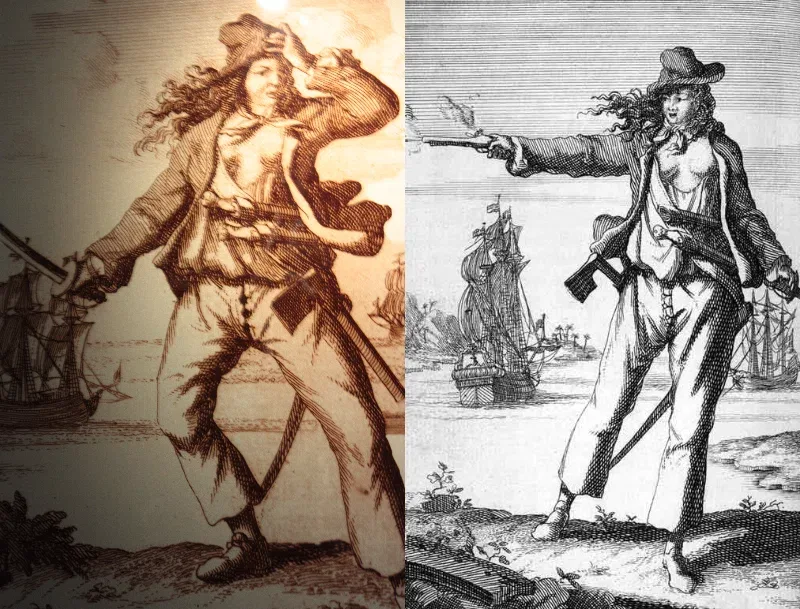
Anne Bonny and Mary Read were both real people who were active during the early 18th century, the "Golden Age of Piracy," and were members of the so-called "Pirates of the Caribbean."
They are famous for being very rare female pirates at a time when many pirate ships had rules forbidding women on board, but they didn't play any particularly important historical roles, so you won't find them in school textbooks.
In Japan, it seems more people think of the characters from Fate/Grand Order.
In MTG, they were included as characters from Assassin's Creed, and their contemporaries include Leonardo da Vinci, Socrates, Athenian Teacher, and Cleopatra, Exiled Pharaoh.
Hmm, the other three are just too strong (in terms of name recognition).
As for their in-game abilities, you can create a Treasure when you discard a card that is an Island, a Pirate, or a Vehicle from your hand. The "Island" here refers not only to the basic land Island, but also any card that has Island as a land type.
You can use their built-in looting ability, but it triggers just fine if you discard through other means. In fact, since you're using them as your commander, you shouldn't be satisfied with just one Treasure per round; you should be actively looking to discard.
Using the act of "discarding," which can be approached in various ways, as a trigger—without any mana requirements or usage limits, and being able to create Treasures even if they enter tapped—is quite alarming.
There are definitely dedicated combos for them, and there is no doubt that they are a commander with combo potential.
Of course, there is no problem with building them in a combo-oriented way, but this article will not focus on that; instead, I will mainly introduce a build with the concept of winning by collecting lots of Treasures.
I will also explain the combos in the latter half of the article, so please take a look if you are interested.
Basic Strategy
As mentioned earlier, the path to victory is creating a massive amount of Treasure.
You build your board with Pirates and Vehicles, and discard what you don't need for the current situation to turn them into Treasures.
Since you can choose between casting or discarding depending on the situation, it can be said to be a unique tribal deck that can adopt many cards that are "strong when they hit" even if they lack some versatility.
……Or so I would like to say.
If you think about it with the premise of discarding and only playing them on the battlefield when they can be used effectively, actually,an "Island" is stronger than most Pirates.I already spoiled that in the article title, though.
I will now discuss the basis for that reasoning and the construction policy derived from it.
The Real Basic Strategy
In terms of MTG gameplay, if you pass your turn without being able to play a land (especially in the early game), you suffer a significant tempo advantage loss.
On the other hand, having too many lands isn't good either, because there's a limit to how many you can play at once, and the number of spells you can play decreases by the number of lands you have.
Yes, I'm talking about everyone's favorite: mana screw and mana flood.
However, Mary Read and Anne Bonny are different.
You can swap out unwanted cards in your hand through looting, and there is even a bonus if that 'unwanted card' is an Island.
Therefore, a build that adopts a large number of Islands and keeps swapping out the ones you can't play is permissible. The risk of mana screw is extremely low, and if you have enough looting methods, you can also prevent mana flood.
In contrast, if you try to actively adopt Pirates (and Vehicles).
It is natural that mana screw is more likely to occur than if you just put in Islands, but building with that in mind is the same as what you do with other decks, so that is fine.
The problem is that Mary and Anne do not provide any effects to Pirates on the battlefield, and you cannot both cast them to put them on the battlefield and discard them to convert them into Treasures at the same time.
If you assume you are going to cast them, it doesn't matter whether the creature type is Pirate or not. It is better for the deck to simply adopt cards with high card power or strong synergy.
And when you are trying to balance both discarding and casting, it becomes extremely difficult to decide which one to choose.
If you draw a 'card that is only effective in specific situations that don't occur often, but you can't create that situation yourself (with cycling)' during a game, how long do you hold onto it?
In Commander, it is an everyday occurrence that the situation is completely different by the time your turn comes back around. It might not be useful now, but it might be usable on your next turn. Or the one after that? Maybe it will be useless until the end of the game.
Should I keep holding onto this, or should I discard it?
A card rotting in your hand is effectively the same as not having one at all. If you think of it as losing value for the duration you hold it, it's better to discard it sooner if you're going to discard it anyway. But are you really sure you should discard it?
…Isn't it difficult to decide?
And what if you have 10 or 20 of those in your deck?
Wouldn't it be better to just give up on Pirates, put in Islands, draw, and looting effects instead, and commit to hitting your own strong plays while reliably growing your lands every turn?
In short, in a Mary Read and Anne Bonny deck, being a Pirate or a Vehicle is merely one factor for adding points.
The priority is far lower compared to that of other tribal support commanders.
Despite appearances, this is actually a commander that is not suited for a Pirate deck in the first place.Well, the historical Mary and Anne never became captains either, I suppose
The win conditions are X-burn spells using big mana from Treasures, or alternative win conditions.
Basically, since you need to prepare a large amount of Treasure, the danger is easy for opponents to see, so I think it is less likely to be perceived as unfair even if used at a casual table. Though I still think it would be a level 6, or a 7 depending on how you think about it.
Since it is tough to take 40 life with an X-spell that isn't even infinite mana, I prepare a reasonable number of creatures that excel in combat, both to chip away at life beforehand and to protect my own life.
Explanation of adopted (candidate) cards
LandsThis is likely the most distinctive part of this commander's deck.
As mentioned earlier, a large number of Islands are adopted, and in the author's list at the time of this article's posting, there are 33 Islands, for a total of 49 lands.
With this many Islands, you will almost never have trouble with blue mana, but supplying red mana is a point of concern.
Even though you can do anything with Treasure once the commander is out, not being able to secure the red mana to cast that commander is naturally a reason to mulligan.
This makes dual lands with the Island type important. They are perfect cards that supply red mana in the early game and can be converted into Treasure from the mid-game onwards, but the blue-red combination has a poor lineup with no battle lands or cycling lands.
Aside from the overly expensive Volcanic Island, the candidates are the shock land Steam Vents and the surveil land Thundering Falls. When lined up with Volcanic Island, your senses become numbed, but these are also sufficiently expensive cards. (They are still cards I want, though.)
Therefore, I would like to recommend Molten Tributary and Shifting Fjords.
While entering the battlefield tapped is certainly a non-negligible drawback, it doesn't matter if you are discarding them, and this isn't the type of deck that will struggle if it doesn't get off to a rocket start. Since they contribute to the deck's stability, I think you should actively include them.
On the other hand, for non-Island lands, while they can clog up your hand from the mid-game onwards if you include too many, you can handle them without issue as long as you play one per turn as your land drop.
Therefore, it is not a good idea to be overly restrictive, and it is best to choose mainly those that can enter untapped, especially from the mid-game onwards.
Specifically, Command Tower, Training Center, Shivan Reef, Cascade Bluffs, and Sunken Hollow, which are almost guaranteed to enter untapped, and Stormcarved Coast and Sulfur Falls, which enter untapped from the mid-game onwards, are high priority.
I mentioned that the concept of this deck is to discard lots of surplus Islands and go treasure hunting.
However, to do that, a sufficient amount of looting means is essential. While Islands can certainly be converted into treasures,Islands that you cannot discard are just dead cards.If you increase the number of Islands, you also need to include more looting means.
And while looting is a broad term, there are many types, which I will classify into three main categories here.
1. Swap part of your hand
These are spells like Thrill of Possibility, where drawing a few cards and discarding a few cards come as a set.
They can be further classified by whether you draw or discard first, or whether the number of cards in your hand after resolution is the same as before casting or one less, but I will group them together here.
2. Swap your entire hand
Although it is a bit minor to call it representative, Tolarian Winds is an example of this type.
It is a type of spell that swaps every single card regardless of the current number of cards in your hand, and despite its flashy image, the mana cost tends to be relatively light.
3. Reset your hand to 7 cards
Originating from the famous Wheel of Fortune, this is the type where everyone discards their current hand and resets to 7 cards (with exceptions). Considering price and other factors, Wheel of Misfortune and Windfall are likely candidates.
Now, which of the above three patterns is suitable for Mary Read and Anne Bonny?
Of course, it depends on how you build it, but the correct answer when building along the lines of this article is 1, the partial swap type.
To put it simply, the reason for this is that "the cards you want to discard and the cards you don't want to discard are clearly defined."
The X spells that serve as finishers are the primary cards you don't want to discard, and since you can't include many of them and can't play them early, you need to hold onto them if you draw them before you are ready. In this situation, the full-swap spells in categories 2 and 3 lose significant value.
Furthermore, the type 2 full-swap spells have another reason for being difficult to use. That is, the more cards you have in your hand when you cast them, the more cards you can dig through, making them more effective.
Since Mary and Anne only perform looting, they cannot increase the number of cards on their own. Contrary to the impression of cycling through your hand in a flashy way, your hand tends to run dry until you draw and activate a draw engine, so even if you cast a full-swap spell, you will only draw about 2 or 3 cards.
Based on the above, I concluded that full-swap spells are too limited in the situations where they can be used effectively, making them difficult to include. You might include one of the type 3 spells, though.
So, at the end of this section, I will list a few particularly useful looting spells of the partial swap type.
Magmatic Insight
This is a Tormenting Voice at half the mana cost.
The restriction that you must discard a land is actually something I welcome.
Trade Routes
This is also high-performance, despite the restriction that you must discard a land.
Since it's a repeatable looting effect for only one mana, you can cycle through your deck at high speed.
Collector's Vault
The activation cost is slightly heavy and it requires tapping, but this also allows for continuous looting.
Since the whole point of looting is to create Treasures, the fact that it reliably provides one extra is fantastic. For the same reason, cards that generate Treasures while looting, such as Big Score, Pirate's Pillage, Unexpected Windfall, and Prismari Command, are also highly valuable.
Demand Answers
This is a strictly better version of Thrill of Possibility, as you can now use an artifact as an additional cost instead of discarding a card.
It was already quite excellent as a spell, but gaining the option to convert Treasures into cards adds even more flexibility. When you don't have many cards you want to discard, using Treasures to maintain your hand size makes it easier to keep moving.
Fomori Vault
It's a bit unconventional, but since you discard one and draw one, I've classified it as looting.
If you have five Treasures, you're filtering from five cards; if you have ten, you're filtering from ten, so the expected value is very high.
Looting while Mary and Anne are on the battlefield increases your mana, but it doesn't increase your hand size. In fact, many effects cause it to decrease.
Therefore, you need ways to draw cards, but deciding how many to include in the deck is quite a dilemma. I understand that you can reduce the count slightly because you naturally dig through the deck during the looting process, but then the question becomes: what is the right number?
The balance between Islands, looting, and drawing—isn't that the most difficult part of building this deck?
Idol of Oblivion
A go-to draw source for token decks.
The pace of drawing is slow, at most one card per round, but it's cheap and reliable enough to be used without issue.
Rielle, the Everwise
It only triggers once per turn, but it compensates for the cards you discard.
The key point is that it also triggers during your opponent's turn.
Teferi's Ageless Insight
Alhammarret's Archive
These double any draw that isn't a normal draw. Looting effects are usually low-cost because they don't increase your hand size, but with these, simply activating Mary and Anne's ability allows you to draw two cards and discard one, resulting in a net gain of one card in hand.These are essential cards.
Once Rielle or these types of cards are established, your hand will usually overflow, but I don't think it's necessary to force in cards like Reliquary Tower that ignore hand size limits. After all, you can still create Treasures by discarding cards during the cleanup step.
Treasure Cruise
Dig Through Time
Since I use looting frequently, my graveyard naturally fills up. I might as well make good use of it with delve.
Glint-Horn Buccaneer
It draws one card per cycle for every two treasures. It also has hexproof, so its draw efficiency is excellent.
It has a size appropriate for its cost, so it can also be expected to serve as a combatant.
Most pirates have a lower priority than an Island.
I certainly said that, but there are pirates that are stronger than an Island in most cases.
Those are Impulsive Pilferer and Deep-Cavern Bat.
They can be reused via the encore ability after being discarded, and that meshes well with Mary and Anne's strategy. Impulsive Pilferer creates three treasures for four mana, and Deep-Cavern Bat can even serve as a finisher with direct damage equal to the number of treasures.
I think it's a matter of preference how many other pirates to include, but Captain Storm, Cosmium Raider, which can directly convert treasure generation into board strengthening, Siren Stormtamer, which has a built-in counterspell, and Kitesail Freebooter, which has a pseudo-removal effect, are likely strong candidates.
Mana Acceleration
In this deck, I don't use any mana artifacts other than Sol Ring, so I barely do any mana acceleration in the traditional sense. Since I can play the commander on turn 3 and immediately create treasures, and continue to produce them thereafter, there is little need to dedicate deck slots to it.Well, Sol Ring is just strong enough to overpower any synergy issues, you know...
Mana acceleration here refers to getting more mana out of treasures and using treasures repeatedly.
Goldspan Dragon
Treasures produce double mana. There are cases where you can't get double red symbols from lands, but the good thing is that even if you use treasures to cast spells, you can recover them immediately by attacking.
Xorn
Grim Hireling
Roaming Throne
The number of treasures produced is doubled. Although the approach is different from Goldspan, this is also effectively doubling your mana.
It has an aspect as a combo piece, but it's definitely worth including on its own merits.
It's no longer a tribal deck, but Roaming Throne is worth considering just for the ability to increase commander triggers. There are many cases where it's hard to decide whether to name Pirate or Human.
Alchemist's Talent
This provides acceleration equivalent to Goldspan Dragon at level 2, and direct damage at level 3.
At level 3, the damage from X-spells is effectively doubled, so if you combine it with the mana doubling from level 2, it's no exaggeration to call this a 4x damage boost from a single card.
It can even be a finishing move with an X-draw spell.
It's not easy since you need to invest a total of 11 mana by then, but if the reward is victory, that seems fair enough.
Galazeth Prismari
The following are cards that allow you to use Treasures continuously rather than as disposable items.
Galazeth Prismari makes this possible with limited usage. Since this build tends to include a high number of instants and sorceries, this card is quite useful as it allows you to hold up counterspells and the like without fearing the consumption of your Treasures.
Urza, Lord High Artificer
I think it's safe to call this a strictly better version of Galazeth Prismari.
If I had to force a criticism, perhaps the only downside is that it doesn't produce red mana.
The Construct token that comes along as a bonus is also reliable; everything about this card is strong.
Treasure Map
You don't get many opportunities to deal combat damage, so the front side doesn't really matter; the real prize is the back side. The transformation condition is not an obstacle.
The performance of the back side, Treasure Cove, is almost equivalent to the famous Tolarian Academy.
Since it produces mana equal to the number of artifacts you control, it yields a result similar to producing mana without consuming Treasures, so I have categorized it here.
Since the deck includes X-cost draw spells and X-cost burn spells, if you also include Mind Over Matter, it is possible to partially recreate "MoMa," the most famous combo deck in MTG history.
Because it requires 6 mana + 4 mana without haste + alpha, it isn't particularly strong in EDH, but it certainly has a certain charm.
Affinity and Improvise in general
Affinity (for artifacts), Affinity (for tokens), and Improvise are also ways to use mana while leaving Treasures on the battlefield.
The 10 cards mentioned above are worth considering for inclusion. All of them are powerful, making it difficult to choose which ones to keep.
Conspiracy Theorist
Containment Construct
You can use discarded cards, but only for that turn.
Due to the difference between "may cast" and "may play," if you have to choose one, you should prioritize Containment Construct. After all, there are many opportunities to discard lands.
Currency Converter
With an initial investment of 1 mana, it can continuously supply Treasures or Bears, and it can even perform looting on its own.
Drake Haven
Mana is required each time, but you can create a Drake every time you discard a card.
Since they are Drakes, they naturally have flying, making them highly reliable as blockers.
If their numbers increase, you can also pressure life totals, making this a very convenient card for maintaining the board state.
Mechanized Production
You win if you can survive one turn with 8 or more Treasures.
The number of Treasures required to win is low, but since both artifact destruction and enchantment destruction are effective, it is easy to disrupt.
Hellkite Tyrant
This one requires 20. It also has an artifact theft ability, but since it's hard to include haste-granting effects in this deck, it doesn't go beyond being a romantic choice.
Crackle with Power
Jaya's Immolating Inferno
These are the best options for X-spells to use as a finisher in multiplayer games.
Crackle with Power generally needs to be cast with X=3 or more because it must deal damage to three players, but the damage output is 15 damage for 11 mana, 20 damage for 14 mana, 30 damage for 20 mana, and 50 damage for 32 mana.
It depends heavily on the remaining life totals, but you are generally in the kill range starting around 20 mana.
Routing is extremely important in this deck, but what is truly necessary is not the routing itself, but generating Treasures.
Regardless of the process,if you end up with Treasures and can cast Mechanized Production or an X-spell, that is fine.Therefore, if there is a way to generate Treasures efficiently, it is worth including even if it has nothing to do with routing.
It also serves as a countermeasure if your commander is sealed by Song of the Dryads, Kenrith's Transformation, etc.
Deadly Dispute
Magda's Galleon
Radiant Performer
These three cards also serve as removal slots. Whether to adopt them depends on how much weight you are willing to tolerate.
Discover the Impossible
It is a cost-effective spell that grants 10 mana for 7 mana.
However, it is a very heavy sorcery that leaves you vulnerable, and it has a high gambling element because there are misses like affinity and delve cards.
I will introduce other cards that might fit into the deck, including combo pieces.
Rain of Riches
This is a candidate if you prioritize Treasure synergy. However, X-spells and counterspells become misses, so you might want to remove it depending on your build balance.
Foil
It is a pitch counter, but it uses up 3 cards from your hand, including Foil itself. Although it is basically close to an inferior version of Force of Will, the alternative cost is discarding rather than exiling, so the disadvantage is mitigated to some extent in this deck. Also, it is cheap.
Aether Grid of Ghirapur
You can deal damage to any target by tapping Treasures.
It denies the presence of low-toughness creatures on the board, so it draws a lot of hate.
Mystic Sanctuary
You can recover instants and sorceries from your graveyard. The trigger condition is not at all suited for a multicolor commander, but given the nature of this deck, it is easy to achieve.
Although I keep in mind the recovery for when 'Crackle with Power' or 'Jaya's Immolating Inferno' end up in the graveyard, I think it's fine to use it flexibly without being fixated on that.
Since this itself has the Island type, discarding it to make a Treasure is even an option. (Though I wouldn't do it proactively, of course.)
Reweave
Guff Rewrites History
Indomitable Creativity
These are spells like 'Chaos Warp' that transform permanents into other spells within your library. The idea is to turn the easily generated Treasures into other high-quality cards, and for the latter two, to also remove the opponent's troublesome permanents. It is a standard feature of these types of spells that the situation can sometimes get worse instead.
The original 'Chaos Warp' itself also has a relatively high priority.
I am very bad at dealing with 'Smothering Tithe,' which is encountered frequently, but due to color constraints, that is about the only way I have to destroy enchantments.
Artificer Class
Sky-Swimming Carp
Graft Theorist
Looting triggers when a Treasure is created. If you discard an Island here, the commander creates a Treasure, which triggers looting again, and so on, allowing you to chain them.
You can dispose of Islands that have accumulated in your hand, and if you combine it with one more card, infinite Treasures can also be achieved.
Reckless Fireweaver
Ingenious Artillerist
Glint-Horn Buccaneer
These convert Treasure generation into direct damage. In this deck, Treasure generation is mostly synonymous with looting, so 'Glint-Horn Buccaneer' is treated similarly.
This is the finisher for combos.
Since 'Glint-Horn Buccaneer' also has a separate two-card combo with 'Malcolm, Keen-Eyed Navigator,' it would be good to include it as well.
From here on, I will introduce combos involving 'Mary Read and Anne Bonny,' but basically, what you can do is infinite Treasures. To actually win from there, you need another step, such as using the 'Reckless Fireweaver' type creatures mentioned just above, or shooting an X-spell after the Treasures untap, so please be careful.
The 'Library of Leng' on the right removes the maximum hand size and allows you to discard cards to the top of your library instead of the graveyard. Therefore,
Discard an Island to the top => Draw the Island on top => A Treasure is created => Looting triggers => Discard an Island to the top
The infinite loop is established.
…Or so I thought, but when discarding to the top (because the library is a hidden zone), you do not reveal the card, so it seems you cannot satisfy the 'discard an Island' requirement even if it really is an Island. Oh my.
To those who read this when the article was first published, I sincerely apologize for spreading misinformation. (Corrected 2024.12.30)
If you have support such as increased Treasure generation from 'Xorn' or increased card draw from 'Teferi's Ageless Insight,' you might be able to continue the chain. If you include 50 cards consisting of Islands, Pirates, and Vehicles, would you be able to dig through your entire library on average?
If both treasure generation and looting are doubled, I think you can generally keep things moving as long as you don't limit your Islands, so when building a combo version, naming Humans for Panharmonicon is the most stable choice.
Discard Gold-Forged Thopter => create 2 treasures => looting triggers twice => use 2 treasures to return the Thopter to hand => discard Gold-Forged Thopter with one of the looting triggers.
You can dig through your entire library with this.
If you discard Islands as needed with the remaining looting, you will also get enough treasure.
Amulet of Vigor in this deck shines brightest when you can immediately use the massive amount of treasure from Mary and Anne and Ingenious Artificer, etc., and there are surprisingly few combos where it is a required piece itself.
Therefore, I feel there is no need to force its inclusion.
The feature of Mary and Anne's combos is that while they require many pieces, most of them are replaceable.
You could also say that even if you fail with Gamble, you can still recover.
Conclusion
What did you think of the non-Pirate version of Mary Read and Anne Bonny?
Actually, I initially thought about building it with a Pirate theme.
However, when I actually tried playing it, it just wouldn't run well. When I investigated the cause, I had no choice but to conclude that Pirates weren't needed.
Even though the oracle text explicitly states that it supports Pirates, when you try to strengthen the deck, Pirates inevitably end up being cut.
I wanted to share this strange feeling and the process of understanding why it happens, so I chose it as the subject for this article.
I would like to continue talking about the parts of the commanders I use that aren't visible just by reading the cards like this.
I haven't even decided what to write about next, so I'm not sure when that will be, but I hope you'll join me again if you'd like.
Have a great New Year!
2024.12.27 Kayabuki
2024.12.30 Corrected an error in the description of the combo section
This article is unofficial Fan Content permitted under the Fan Content Policy. Not approved/endorsed by Wizards. Portions of the materials used are property of Wizards of the Coast. ©Wizards of the Coast LLC.