"Go rules are difficult," "I don't really understand how a game of Go ends," and "I don't know if this is black's territory" are common sentiments. Here, I will explain the rules of Go by focusing on what territory is.
In doing so, it is easier to understand by going through "Jungo" (pure Go), which is considered the prototype of Go.
Rules of Jungo
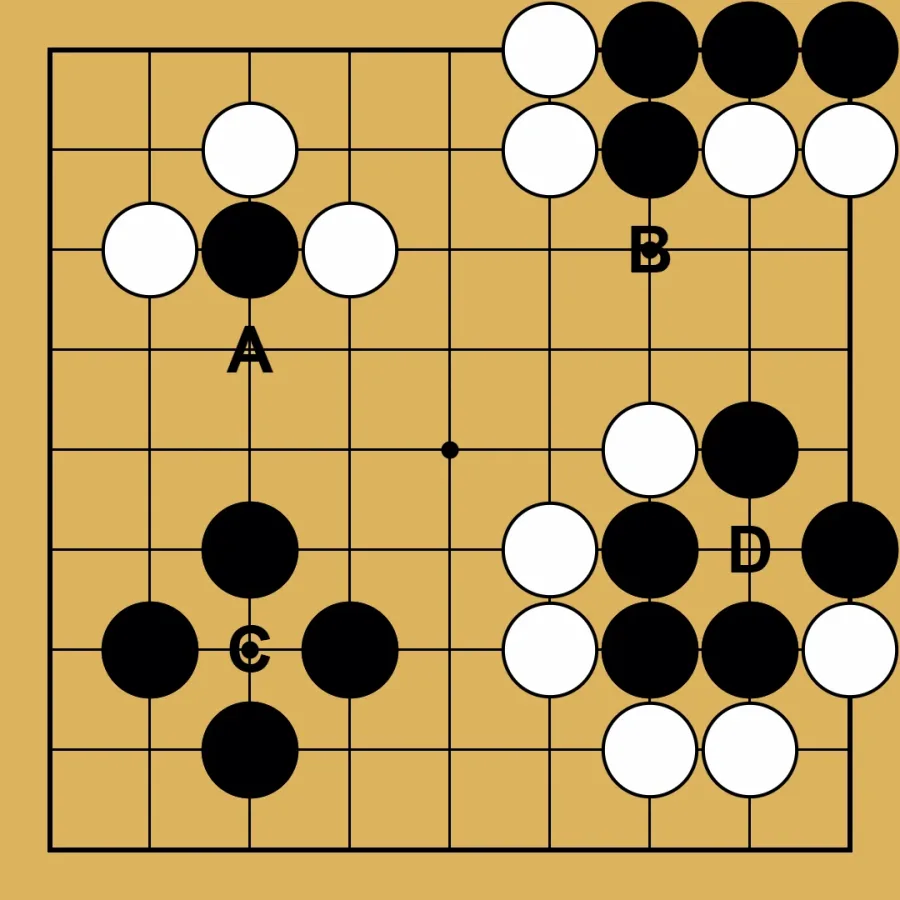
(1) Players take turns placing one stone at a time on the intersections of the vertical and horizontal lines on the board, starting with black.
(2) If a stone's vertical and horizontal adjacent points are blocked by the opponent's stones, it is captured.
For example, if white places a stone at A or B in Figure 1 below, the black stone is captured. The image is that if white blocks the lines extending vertically and horizontally from black (liberties), the black stone can no longer exist on the board.
(3) You cannot place a stone in a spot where it would be captured by the opponent the moment it is placed. However, you can place it if you can capture the opponent's stone.
For example, white cannot place a stone at C in Figure 1. This is because it would be captured the moment it is placed. However, white can place a stone at D. This is because it can capture the black stone. It is helpful to think of it as the liberties not being blocked because the black stone is captured.
(4) If there are no more places you want to put a stone, you can pass. If both players pass consecutively, the game ends.
(5) At the end of the game, the player with more stones on the board wins.
The above are the rules of Jungo. Actually, there is one more rule called "Ko," but I will omit it this time. If you are interested, please refer to the Nihon Ki-in website. Also, since black, who moves first, has an advantage, a handicap is sometimes given to white (usually 7 stones for a 9x9 board under Jungo rules).
The rule that "the one with more stones wins" is actually similar to Othello. Jungo is "a game where you place more stones than your opponent under the rule that you can capture stones by surrounding them".
Theorem derived from the rules: If you have two rooms, the stones become invincibleNow, those are the rules, but it is easier to understand the game of Go if you know the important theorem derived from these rules: "If you have two rooms, the stones become invincible".
Following rule (3), white can place a stone at E in Figure 2 to capture the black stones. Although it is a place surrounded by black, white can place a stone there because it can capture the black stones. On the other hand, white cannot place a stone at F or G. If white could place stones at F and G at the same time, it could capture the black stones, but you can only place one stone at a time. Therefore, white cannot place a stone at F or G, which are places surrounded by black. Thus, these black stones cannot be captured by white no matter what. In this way, stones with two rooms become invincible stones that the opponent cannot capture no matter what. Such a room is called an "eye," and becoming an invincible stone is called "living." Conversely, stones that cannot live no matter how hard they try are called "dead stones."
In Jungo and Go, this battle of life and death is one of the great thrills.
Strategy for winning at JungoNow, how can you win at Jungo? Figure 3 below shows a game of Jungo in progress. Black has created invincible stones with two eyes in the upper right and lower right, and these stones cannot be captured. On the other hand, white has placed stones scattered in the space on the left. At this point, the number of stones on the board is the same.
After this, black will place stones in the space on the left, but if white plays well, black will not be able to create two eyes in the space on the left to live and will be captured. Therefore, no matter how black plays, the space on the left belongs to white, and it is destined to have white stones placed there in the end. In this way, it is important to "efficiently create space that can exclude the opponent even if they enter (= your own territory)".
Disadvantages of JungoNow, after reaching a state like Figure 3, if white makes a mistake in responding, there is a possibility that black could live in the space on the left. So there is no problem with white trying to invade the space on the left. However, when players of a certain level play against each other, if a state like Figure 3 is reached, both will understand that "it's pointless for black to invade the left." Then, once each other's territory is determined, it becomes a boring task of just filling in stones within your own territory (note that you need to leave two eyes when filling in your own territory). It's not so bad if you play on a 9x9 board, but when it becomes 13x13 or 19x19, you end up doing useless work endlessly even though the result is already known.
However, if both parties can agree on where their respective territories are, the current rules of Go were created based on the idea that you can just end the game when the territory is determined and compare the size of the territories.
Current Go Rules (Japanese Rules)
Changes from Pure GoRules (1) through (4) are the same as in Pure Go; the only difference from Pure Go is (5).
(5) The player with more stones on the board at the end of the game wins.
Instead of this, the following (6) is adopted.
(6) At the end of the game, the player with more empty points within their territory wins (empty points within territory are called "territory" (ji), measured in "points" (moku)). However, the number of points is reduced by the number of stones captured by the opponent. Any of your own dead stones located within the opponent's territory are considered to have been captured by the opponent.
As mentioned earlier, the game ends when the territory is determined, and the size of the territory is compared. Once the territory is determined as shown in Figure 3, there is no point in either player placing stones, so they pass to end the game and compare the size of their territories.
The reason for subtracting the number of captured stones is to reflect the difference in the number of stones on the board. For example, if Black has had 5 stones captured and White has had none, assuming both players have placed the same number of stones, Black will have 5 fewer stones on the board. Therefore, if we consider "territory = empty points + your own stones," we can compare the size of the territories by subtracting 5 from the size of the empty points (the territory).
Territory = space that can be defended even if the opponent entersThe issue here is determining where the territory actually is. In Figure 4 below, is the large space in the bottom left White's territory?
Now, as I wrote earlier, territory is space that can be defended even if the opponent enters. If Black can live after invading the bottom left, it cannot be called White's territory. In conclusion, if there is this much space, Black can live if they play well. Therefore, this space in the bottom left cannot be called White's territory.
However, judging which space allows for an invasion and survival requires a certain level of skill. If you are unsure, you can try invading to see what happens. If you invade and survive, it's a bonus; even if you don't, as long as the number of stones you placed is the same as the number of stones the opponent placed, you won't lose anything.
Agreement is everythingThat said, suppose that in the situation in Figure 4, Black does not invade, White does not place defensive stones to prevent an invasion, and both players pass to end the game. In that case, they will likely both agree that the bottom-left space is territory. Agreement between the parties is everything, so the bottom-left space will be counted as White's territory, and White will win.
So, what should be done if, after both players pass, they cannot agree on "which stones are dead" or "where the territory is"? In that case, a referee would likely be called in a tournament. Detailed rules regarding this are defined in the Japanese Go Rules, so if you are interested, please refer to this explanation.
Are Pure Go and Go (Japanese Rules) different games?
Although Pure Go and Go (Japanese Rules) differ in how the winner is determined, there is no major difference in the gameplay. Therefore, it is easy to play Go (Japanese Rules) after getting used to Pure Go. Please just be aware that in Japanese rules, you lose points if you fill in your own territory after it has been determined. The following sites are recommended for learning and playing Pure Go.
Introduction to Go through Pure Go and Practice
Puni Go
If you are used to Pure Go and want to play Go using Japanese rules,
Igo de Asobo! (where you can learn thoroughly from the basics)
Igo Shiru (includes social game elements, a collaboration with Hikaru no Go is planned for next year )
are recommended.
Summary
The prototype of Go: "Who can place more stones?" → It is important to efficiently create "spaces that can be defended even if the opponent enters" (territory). → After territory is determined, you just place stones in your own territory. → On a large board, that task is tedious. → Current Japanese rules: The game ends when territory is determined, and the size of the territory is compared. (There is no major difference in gameplay between the two rules.)
Supplementary Notes
[Note 1] Regarding Chinese rules There are Japanese rules (Korean rules are also almost the same as Japanese rules) and Chinese rules for Go. Chinese rules adopt the following (7) instead of (6). (7) At the end of the game,
the player with the higher total of their living stones and territory wins Since you add the number of your living stones to your territory, you do not need to subtract the number of captured stones. This means that within your own territory, you count empty points and your own stones together without distinguishing between them. Unless there is a special shape, the difference between Chinese rules and Japanese rules is at most 1 point. Under Chinese rules, you do not lose anything by filling your own territory with your own stones after the territory is determined. Igo Quest adopts Chinese rules.
[Note 2] Differences in results between Pure Go and Go. The results when playing until territory is determined may differ between Pure Go and Go. This is because in Pure Go, when filling your own territory with stones after territory is determined, you must leave empty points for two eyes (2 points). For example, in Figure 3, the black territory is divided into the upper right and lower right, and it is necessary to leave 2 points of empty space in each territory, for a total of 4 points. On the other hand, white only has one block of territory, so only 2 points of empty space are needed. Therefore, there is a 2-point difference from the result when stones are placed without leaving empty points (Chinese rules).