1. The Emergence of MiMo Code and the New Trend in Autonomous Development
On June 11, 2026, the Chinese technology giant Xiaomi released "MiMo Code," an AI coding agent that runs on the terminal, as open source (MIT License). This tool was developed as a powerful alternative to Anthropic's preceding Claude Code and is forked from the open-source AI agent "OpenCode." The most significant feature of MiMo Code is its ability to autonomously perform a series of software engineering processes—such as reading and writing files, executing shell commands, managing Git, and even conducting Test-Driven Development (TDD)—without human intervention, going far beyond simple code completion.
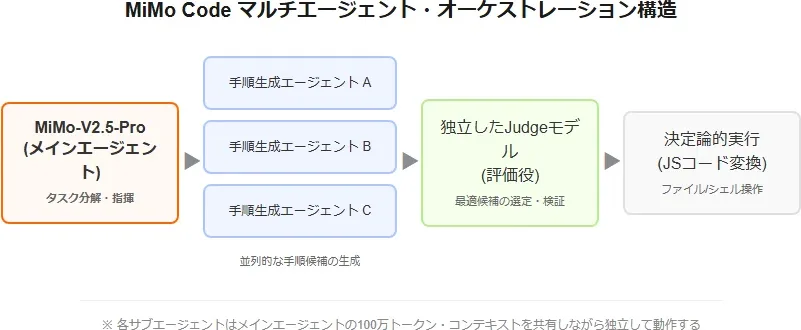
Developers can immediately introduce this agent into their workflows without complex environment setup through platform integration via "MiMo Auto" or "OAuth." It also features a migration function that inherits authentication information from existing Claude Code in one step, signaling an intent to rapidly expand its share in the developer community. This event symbolizes that AI has evolved from a "temporary consultant" into a "permanent partner" that deeply understands the context of a project. The figure below shows the structure in which MiMo Code deploys multiple sub-agents in parallel to execute tasks.
Performance Surpassing Claude Code: Results of a Blind TestThe capabilities of MiMo Code have reached a level that surpasses existing top-tier models. According to benchmark data released by Xiaomi, MiMo Code (using MiMo-V2.5-Pro) recorded scores exceeding those of Claude Code (using Claude Sonnet 4.6) under the same conditions. Particularly noteworthy are the results of a blind test conducted on 576 human developers where the type of AI was hidden. In complex tasks exceeding 200 steps, MiMo-V2.5 achieved a high win rate of 65%.
Behind this outstanding performance is the adoption of a swarm-like mechanism where "multiple AI agents generate candidates for execution procedures, and an evaluator agent selects the most promising candidate for execution." This multi-layered verification process structurally overcomes the logical failures and the "optimistic termination" problem—where the completion of a task is misidentified—that were prone to occur in conventional methods relying on a single agent. MiMo-V2.5-Pro has over 1 trillion parameters and supports a 1-million-token native context, enabling inference while grasping the structure of entire large-scale repositories.
2. Technical Innovation: Persistent Memory and Multi-Agents
AI with Memory: Persistence via SQLite FTS5The greatest innovation on the technical side is the inclusion of a "persistent memory system" with SQLite FTS5 as the backend. In conventional AI coding tools, "stateless" conversations, where the project background must be re-explained for each session, were a bottleneck for productivity. However, MiMo Code adopts a multi-layered memory management architecture based on the importance of information.
Specifically, it builds "MEMORY.md" to record architectural decisions, "checkpoint.md" to save state snapshots, and a hierarchical task log "progress.md" within the project, maintaining context across sessions by searching and referencing these files. It is worth noting that a dedicated sub-agent called "checkpoint-writer" autonomously handles the maintenance of this information. Developers can benefit from the AI deepening its understanding of the project the more it is used, without having to worry about management overhead. The figure below is an example of optimizing the attention structure to avoid computational explosion as the context length increases.
Deterministic Task Execution: Conversion from Natural Language to CodeMiMo Code introduces a "deterministic" approach to improve task execution accuracy. Normally, when an AI agent interprets and executes instructions written in natural language (such as SKILL.md), the results can vary due to the probabilistic behavior of the model. To address this issue, MiMo Code has introduced a mechanism that automatically generates JavaScript code based on the contents of SKILL.md and executes that code strictly to perform the task.
Furthermore, to handle large-scale long-horizon tasks, features such as automatically starting a new session by extracting the key points of the current session and progress management via a tree-based task system have been implemented. In the official demonstration, MiMo-V2.5-Pro continued to operate autonomously for 11.5 hours from a single prompt, and after 1,868 tool calls, succeeded in building a complete desktop video editing application of 8,192 lines from scratch. This dramatic extension of the "safe operating limit time" confirms that AI has shifted from a single-use tool to a true digital workforce.
3. Impact on Society and Development Ethics in the AI Era
The Light of 10x Development Speed and the Shadow of Vibes CodingWhile the spread of advanced agents like MiMo Code has the potential to increase development speed by more than 10 times, it is also amplifying a new security risk called "vibes coding." Vibes coding refers to an irresponsible development attitude where one gives rough instructions to an AI such as "write some good code" and uncritically deploys the generated code to the production environment simply because "it worked."
According to survey data from actual workplaces, when AI-generated code is used without appropriate human review, the vulnerability discovery rate reaches 55.3%, which is more than eight times higher than that of handwritten code (6.7%). In the breakdown of vulnerabilities, SQL injection is overwhelmingly the most common at 38%, followed by deficiencies in authentication/authorization and hard-coded sensitive information. As the autonomy of AI agents increases and situations where humans "do not write a single line of code" become possible, the risk that a lack of security awareness will lead to catastrophic incidents is rising. AI is a powerful "tool," but one must not forget that the final responsibility for its output lies with the developer.
A New Framework for Coding Agent OperationsWith the explosive adoption of agentic AI, there is a growing call for a new operational framework called "CodingAgentOps," which extends traditional LLMOps. Because agents do not just return text but exert direct "side effects" on file systems, shells, Git, and networks, stricter governance is required than ever before. CodingAgentOps proposes the following six pillars to prevent agents from running out of control.
Trajectory Observability: Recording all agent actions to ensure reproducibility when issues occur.
Quality Gates: Implementing automated code reviews and security scans via LLM-as-Judge.
Cost Governance: Setting budgets per task and detecting unnecessary exploration loops (waste).
Security: Execution in sandbox environments and defense against prompt injection.
Governance & Auditing: Maintaining audit trails of all actions and requiring Human-in-the-Loop (human approval) for high-risk operations.
Experiment Management: Scientifically optimizing agent configurations (prompts and model selection).
The key to successfully introducing autonomous tools like MiMo Code will depend less on the performance of the agent itself and more on the robustness of the operational foundation built around it.
4. Future Developments and Points of Interest
Dissolving into the Human x Car x Home EcosystemThe most notable future development is how MiMo Code will integrate with Xiaomi's vast "Human x Car x Home" smart ecosystem. The MiMo-V2.5 series, the foundation model for MiMo Code, is designed not as a mere web-based chat UI, but with the premise of native integration into Xiaomi's proprietary HyperOS 2.0 and its massive array of hardware.
Specifically, it is entering a phase where it functions as the backend for the next-generation AI assistant "miclaw," interpreting the importance of meetings from a user's calendar to adjust IoT devices throughout the home (lighting, air conditioning, routers, etc.) and autonomously controlling smart cars. This trend of AI moving out of the cloud and "dissolving" into the OS and hardware layers will become a definitive megatrend for enterprise AI from 2026 onwards. Breaking away from cloud dependency and advancing edge/on-device AI will be the driving force behind realizing a true "intelligent society."
The Future of Engineers Coexisting with AIThe rise of OSS agents like MiMo Code also holds significant implications for the AI development race between the US and China. Chinese AI companies have pursued "thorough architectural efficiency" under hardware constraints, resulting in the establishment of unique technical systems that "extract top-tier inference with extremely low computational costs." With DeepSeek-V4 at a disruptive cost of about one-sixth to one-seventh that of Western models
For engineers, the choice of "which model to use" is becoming less essential. From now on, the focus will shift to high-level system engineering capabilities: how deeply these inexpensive and powerful autonomous components can be integrated into an "orchestration framework" tailored to a company's business logic to build workflows that generate unique value. MiMo Code, which possesses memory and continues to grow autonomously, will become a "second brain" for engineers and the ultimate weapon for maximizing creativity.
#MiMoCode #AIAgent #Xiaomi #OpenSource #Engineer #DevelopmentEfficiency #Security #NextGenLLM