<Update> This article is not about YOASOBI's 'Into The Night' released on 2021/07/02. However, that one is also too interesting, so I plan to analyze it as well!!
<Update> Click here for the second installment, Pretender!
It was the end of 2020.
I opened YouTube.
Around this time, I was hooked on THE FIRST TAKE and YOASOBI's 'Yoru ni Kakeru'.
That day, I played 'Yoru ni Kakeru' again. Ah, what a great voice, so soothing, I thought while listening. Then I glanced at the related videos.
[English ver.] YOASOBI 'Yoru ni Kakeru' by Anonymouz
English Ver... What's that? I want to hear it!!
I love English lyrics, so I jumped on it immediately. Honestly, since the original is such a wonderful song, I didn't have high expectations.
My impression after listening: 'Wow, this is insane.' I listened to it over and over like a drug addict. Listening -> addiction level increases -> want to listen -> listen... the cycle repeats. I probably listened to it 30 times in a row, losing track of time.
What is this stylish song? It's just too irresistible. If I played this as background music while confessing my love, it would definitely be a success lol
I'm the type who gets excited easily and loses interest just as fast, but even after a few days, I was still in a storm of enthusiasm.
I listened to it again on my next day off. 'Wow, this is insane.' Then, I listened to other songs by Anonymouz. 'Wow, this is insane.' Listening -> addiction level increases -> want to listen -> listen... the cycle repeats. I've truly become captivated.
In the heat of the moment, I even applied for concert tickets. And I won them. What will happen when I hear it live? I'm ready for the shivers and goosebumps.
So, I thought about why I was so drawn to it. As someone who has been in bands and units, I decided to try analyzing it instead of just ending with 'Oh, that's amazing,' and I did so from a super condescending perspective lol
But I figured I could at least write down the reasons why I fell in love with it.
Part 1: A Thorough Analysis of Anonymouz's English Lyrics
What I fell in love with is, quite simply, the lyrics. Not only are the English lyrics wonderful, but the way the words are chosen and arranged without disrupting the original melody, and the rhythm, are excellent. It's addictive, really.
I wanted to savor the worldview by comparing YOASOBI's original text and Anonymouz's English text little by little. Because they are lyrics that I don't usually pay much attention to, I feel like they are packed with endless charm. Anonymouz's English pronunciation is also wonderful, so I'd like to touch on that from time to time.
From here on, it's in the realm of the super-obsessive. I think it's too geeky, so most people should probably skip it.
First, the beginning. The very first breath (the sound of inhaling) is too lovely. Really, it's wonderful. It's too beautiful. It's enough to make me a breath fetishist.
00:00
It's wonderful from the very start. 'Like...' is expressed with 'as if' + the present participle of 'sinking' and 'melting'. Truly, the feeling of sinking and melting away right now is perfectly expressed, really.Ah... melting, melting is the feeling. Even the listener feels like they're going to melt.
If you listen to the song carefully, 'sinking' and 'melting' become 'sinkin' and 'meltin'' respectively.G dropping. A common phenomenon in the world of English.
For example, McDonald's 'Ba-da-ba-ba-ba, I'm lovin' it.' That also has the g of 'I'm loving it' dropped to become 'lovin it', which then sticks together to become 'lovinit', and as a result, 'lovin-it'. The G often disappears and goes somewhere else. Also, the D and T often go away too. So 'through the night' becomes 'thru-da-nai'.
Anonymouz's pronunciation is also wonderful, so it's perfect for studying English. It's much more fun than those textbooks. If you sing along by imitating this pronunciation, you'll likely reach a native level of pronunciation in no time.
sinking down becomes 'sinkin-down', and melting in air becomes 'meltin-near'. The R sound (rolled tongue) of 'air' is also clearly present. So cool!
And the high notes in and I is spreading out high are just too beautiful. Is this falsetto? Or is it her natural voice? Honestly, my ears just melt right here. It's too wonderful. I feel like I'm going to melt. And the final V sound in 'above' (biting the lower lip) is also there. Lovely.
00:20
Ah. The low notes in 'needed' are so cool. Dropping the core (volume) of the voice to make it low and cool. And here too, the T, D, and G are all missing without exception. Seriously, they've disappeared way too much. I'm officially appointing them the 'Missing Three Brothers'. TDG. Like TDL (Tokyo Disneyland).
And the progress of the 'ing' sounds is also in top form. 'setting sun': the sunset is 'ing', so it's in the middle of setting. Plus, 'inhaling nightfall': inhaling the sunset (literal translation) -> the sun has begun to set (liberal translation), that expression is just too cool. Sigh. Here too, the G is missing without fail.
And 'they would melt in each other' is also just excellent. The Japanese phrase 'kasanatte ita' (overlapping) across the fence quickly transforms into the 'sky' and 'you' 'melting into each other'. Too sexy. I feel like I'm melting just listening to it. Actually, I didn't realize 'Yoru ni Kakeru' was a song where melting is mentioned so many times.
The 'th' sound in 'other' is also pronounced as 'ada' rather than 'aza', really bringing out that English feel. The piano's 'ta-ta-ra-ta-ra-ta-ta' also makes me go 'ooh'. I could have a drink just listening to this piano phrase on repeat.
And what's even more unbelievable is the rhyming. In the original song, all the endings are 'ta'. Ta x ta x ta x ta. This is already maximum ear candy, but the English translation is just as wonderful and doesn't fall short at all.
Bye, lie, eye, with an i x i x i. Perhaps because YOASOBI landed a 4-combo of 'ta' x 'ta' x 'ta' x 'ta', Anonymouz is returning the favor with a 3-combo of 'i' x 'i' x 'i' (bye, lie, eye). A fierce battle of artistry. If the rule is that points are added for the number of combos, I suppose YOASOBI is slightly in the lead at 4-3. I might get scolded if I played around like this, though.
00:38
What struck me here was the English translation of 'dokoka hakanai kuuki wo matou kimi wa'. It is translated as there’s something in the air around you fleeting like you’re about to fade(literal translation: the air around you is so fleeting that it seems like you might disappear). It really makes you wonder just how fleeting they are. Also, the Japanese phrase 'dokoka hakanai' is beautiful, isn't it? dokoka really captures that sense of fragility. Great lyrics!dokoka really captures that sense of fragility. Great lyrics!
YOASOBI's artistry was highlighted in this section as well. I haven't decided on a combo, but let's add points to YOASOBI. 3-5. With this finished, YOASOBI is in the lead at 3-5. I feel like I might get scolded for this, but I'm just chuckling to myself while playing around like this. Sorry.
00:56
I am blown away from this point on.
First, the rhythm of the Japanese lyrics 'chikku takku to' is so good. You can't help but hum along. I thought, 'I'm definitely adding points to YOASOBI!' but that was short-lived, because Anonymouz's English lyrics are even more brilliant. Zero points added to YOASOBI.
The 'tick' fits perfectly with the English 'tick and' as 'tikken', and 'tock' fits with 'tocking' as 'tokkin'. And the 'to' fits perfectly with 'on'. It's super satisfying to listen to. Tik-tok-on I think it sounds so good because the ①②③ below are rhyming.
①tick and ②tocking ③on
In ①, the D is dropped, ending in N, and in ②, the G is dropped, also ending in N. Since ③ also ends in N, it's a triple combo of N x N x N, rhyming perfectly. The bouncy rhythm of the Japanese 'chikku takku to' is expressed without any loss. It's irresistible. The 'missing brothers' TDG are unexpectedly peerless here. Adding 3 points to Anonymouz brings the score to 6-5. A sudden turnaround. This is getting interesting.
Still, I am amazed that she managed to express this so well in English lyrics, even though the Japanese lyrics here are very fast. Japanese is a language where subjects can be omitted, reducing the word count, but English requires subjects, which increases the word count. The technical skill to translate into English while carrying that handicap and fitting it into this melody is impressive.
In fact, if you count the number of subjects (in this case, pronouns) in Japanese and English, it's obvious.
In these lyrics, there is only one subject: 'the two of us'. In contrast, the English has,
it, we, I, I, they, I, I, we, we—that's nine of them! That's quite a lot. And she fit them perfectly into the original melody. Hats off to her.
Still, I'm amazed she could fit such English into that melody. But if you observe closely, a certain rule of English is at work. Thanks to this, it fits beautifully.
First, it's not just that the T, D, and G at the end of words are dropped and not pronounced, but also that the H is dropped.
For example, "cold hearted words." If you read it in katakana, it's ko-ru-do-ha-te-tto-wa-zu (cold-hearted words). However, in English, the cold hearted words' D and H are dropped, so it becomes colearte words, fitting three English words neatly into one beat.
This also appears frequently in daily conversation. For example, ①have him ②with us ③tell her becomes ①haveim ②witus ③teller, changing to ①havim, ②witus, and ③teller respectively. Knowing this will skyrocket your listening skills. I guess you could call them the Four Heavenly Kings of Omission, rather than the Three Brothers. Powering up from three brothers to the Four Heavenly Kings!
Also, while English grammatically requires a subject, there are many times when it's not pronounced because it's understood without it. It's whimsical. It's complicated. Whether a subject is absolutely necessary or not, it's confusing.
Particularly notable is "that I get and loud voices (I) hear when (they) well up,". You don't need to pronounce the (I) and (they) here. So, combined with the dropping of T and D, it becomes ①thaIgenlouvoices ②hear ③whenellup, which, when written in katakana, shrinks down to just three words: ①da-ra-i-gen-rau-voi-shi-zu, ②hi-a, ③we-ne-ra-ppu. It's surprising.
Well, there are various detailed rules, and natives sing songs too. So, if you know these things, it's useful for singing at karaoke or listening to Western music. Of course, daily conversation follows the same rules, so it's extremely effective for conversations with foreigners (especially natives).
A certain teacher from Study Sapuri "It's not that you can't hear it, they aren't saying it from the start!!"
Now, finally, the chorus! Currently, Anonymouz has the upper hand at 6-5. I'm excited to see what happens. The scores are completely subjective and arbitrary. To be honest, I'm biased toward Anonymouz. Sorry.
01:14
What caught my heart in this chorus is the English expression for 'Boku no te o tsukande hora', which is 'come and take my hand come on and hold it tight'. This is just my own speculation, but I think that English, which tends to be longer than Japanese, was unusually short here, and perhaps they were short on word count.
These are the four bars. If you count the number of characters when written in hiragana, they are 16, 15, 15, and 11, with only the fourth one being shorter. Moreover, a literal translation of 'Boku no te o tsukande' is 'take my hand'. That's only three words. How to translate 'hora' depends on the translator's sensibility, but even so, it's not enough to fill one measure (eight 4/4 beats).
So, Anonymouz translates it as 'come and take my hand come on and hold it tight'. The 'come on' here might be a liberal translation of 'hora', but I was captivated by the initial 'come' and the final 'hold it tight'. It's a great lyric, it fits perfectly into the measure without any awkwardness, and it balances the word count beautifully. Too skillful. Adding 1 point.
And it connects well to the next part, 'even the days' (which corresponds to 'wasurete shimaitakute' in the original song). Still, isn't the falsetto part in 'even the days' just too beautiful?
And now, the long-awaited Four Heavenly Kings of Omission T, H, D. As usual, 'warmth inside my arms,' changes to 'warmin-sai-my-arms'.
The score is currently 7-5. Anonymouz's lead remains unchanged. I feel like I'm really going to get scolded for this. I love YOASOBI too, haha.
01:50
The piano interlude is just wonderful. It wouldn't be out of place playing in a stylish jazz bar. You could enjoy some cheese with a glass of wine.
02:07
In this English version, the second verse (only you can see) through to the pre-chorus (actually, I want to say it too) are omitted, and the second chorus follows after a stylish piano interlude.
Needless to say, you can enjoy the comfort of 'tick-tock again' once more here. In the original song, ikura connects it sexily with 'ah, look, again...', but Anonymouz sings it just as sexily with 'oh and again'.
Moreover, the way the words end in ①oh and again ②tick and ③tocking ④on with ININ×AN×IN×ON sounds so pleasant to the ear. Right here. Yes, 4 more points for Anonymouz. 11-5. A big lead has opened up.
The expression I focused on in this second chorus is this one. The English translation of "When I was lured into saying it" is "I knew I was just lured by all your words".
Literally translated, it means (I knew I was tempted by your words). lured is the past tense of lure, meaning to entice or tempt, and a lure used in fishing is also called a lure because it tempts the fish.
It is very difficult to translate "tsurarete" (lured/hooked) into English, but Anonymouz's English translation "lured by all your words" is just too perfect.
I was breathless at the wordplay game of lure ⇔ lure (fishing bait) ⇔ fishing ⇔ "when I was lured into saying it." Wow, this was definitely intentional, wasn't it? Amazing!
And from there, it connects to the final phrase "on your face for the first time".
The vocal ability on the final "for the first time" is also just too amazing. The way the words seem to break down a little is irresistible. It was so broken that for a moment I wondered if she sang it with words not in the lyrics. I would love to ask her someday if she just broke them down or if she really sang different words as an ad-lib.
In any case, I thought it was playful and fun. In my next life, I want to be born as someone who is good at singing.
02:27
What I focused on in this verse is the English translation of "You look beautiful in my eyes," which is "to my eyes you are so beautiful oh you’re out of this world".
"to my eyes you are so beautiful" is enough on its own, but it is further emphasized by "oh you’re out of this world (literal translation: so much so that it feels like you're not of this world)." Even though 5 beats of the 8 beats in the measure are used for "to my eyes you are so beautiful" and 1 beat for "oh you're," the final "out of this world" is perfectly contained within 2 beats.
And now, the big chorus!
02:48
The first half of the big chorus is also truly wonderful. What caught my attention here was "in air" within the English expression "as if thinking down through the night like we are melting in air." The reason is a subtle sense of discomfort I felt while savoring the lyrics.
Wait, even though it's the same song, the expressions are a bit different... "in air" and "in the air." What changes with or without the "the"?
I didn't notice it when just listening to the song, but it's a subtle difference in the lyrics. I don't know if it's just due to grammatical constraints or if it's Anonymouz's intention, but it's quite intriguing.
So, from here on, this is Part 2, where we stray from the main topic and spend a considerable amount of time on just "the." People who write this kind of thing and people who read it are both geeks. Or, English geeks. Anyway, thank you for reading this far. This concludes Part 1.
Part 2: What is the difference between "in air" and "in the air"?
I looked it up on Weblio English-Japanese Dictionary.
Hmm, I don't get it. "In the air" means "in the air" or "floating." I know that as a matter of knowledge, but I don't know the meaning or usage of "in air." To be precise, I don't know how to distinguish between "in air" and "in the air." When do you use "in air" and when do you use "in the air"? That is the question. I also found the word "on air" (broadcasting) and the noun "in-air," but, hmm, I'm not satisfied.
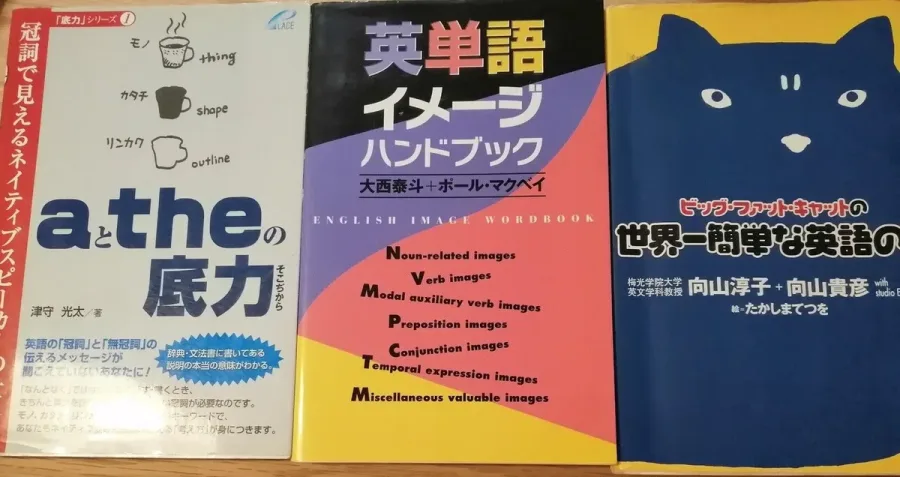
So I decided to look it up in books. I prepared three books. I thought that if I understood the difference between a and the, I would naturally understand the difference between in air and in the air, so I decided to approach it from that angle.
These three books were truly excellent. They really deepened my knowledge of English. I had intended to research English lyrics, but before I knew it, I was completely absorbed in reading them.
Now, I would love to introduce them one by one, but... I'll hold back. Regarding the crucial distinction between 'in air' and 'in the air', I decided to start by understanding the difference from 'a' to better understand 'the'.
First, from "Big Fat Cat's World's Easiest English Book". This book was quite good. It's perfect for English beginners or those who want to relearn the language. Even intermediate and advanced learners will find new discoveries.
"Big Fat Cat's World's Easiest English Book" by Junko and Takahiko Mukoyama
After this introduction, it continues as follows.
There were also easy-to-understand examples.
In other words, 'a' can be interpreted as one of many, whereas 'the' refers to something specific that cannot be replaced. Still, it's amazing how much the meaning changes.
All you Yamato Nadeshiko (ideal Japanese women) out there, please be careful when confessing your love to Westerners in English.
A representative example of using 'the' is the sun. In junior high school, we learned that the sun is 'the' sun, but if we could create a sun using plasma, it might eventually become 'a' sun.
Something like, 'We use a sun for 〇〇.' 'I heard there used to be only one sun.' 'Wow, what era was that?!'
↓Research on artificial suns↓ by University of Tsukuba, keep it up!
https://www.osi.tsukuba.ac.jp/sdgs/effort/s-16
Next up is "The Underlying Power of 'a' and 'the'." Doesn't the title alone draw you in?
Underlying power, they say. They dedicated the book's title to just two words: 'a' and 'the'. And what's more, they called it 'underlying power.' That means the whole book is dedicated to explaining it, right? It sounds like a super rewarding read.
"The Underlying Power of 'a' and 'the'" by Kota Tsumori
This book was also absolutely amazing. The title of Part 2, which starts on page 84, is "Do Americans Dream of Naked Books?" It couldn't possibly be boring. And according to Mr. Tsumori, the has tremendous underlying power.
In other words, the 'the' in the English translation of "You, who wear a somewhat fleeting air," which is "there’s something in the air around you fleeting like you’re about to fade," means that while the overall shape is invisible, it is an air that certainly exists there. Hmm, I can feel the underlying power. I'm starting to get it.air
"as if thinking down through the night like we are melting in air" refers to air whose shape is invisible. Just air. Atmosphere. Air that you don't notice, can't see, and can't feel. Air that is just everywhere around you.
Here is a shocking realization. Could it be that because the Japanese text intentionally uses the word "air" even though it would make sense without a subject, "the" appears when translated into English...? This is so profound....
Finally, let's wrap it up with a book by Mr. Katsuto Onishi. There it is. Right away. A direct hit.
It seems that what 'the' points to changes depending on the context, situation, common sense, and the connection of words, but the 'the' in the English translation of "You, who wear a somewhat fleeting air," which is "there’s something in the air around you fleeting like you’re about to fade," gives a strong limitation to 'air'.thethe
As for what kind of limitation, it means the air you are wearing that is completely different from the surrounding air. In other words, you are wearing that (this) somewhat fleeting air.
The English translation of "As if sinking, as if melting away," which is "as if thinking down through the night like we are melting in air," is,
"As if we are sinking into an air (atmosphere) that doesn't belong anywhere, as if we are melting away."
"The air you are wearing" was separated and limited from the surrounding air by "the".
"English Word Image Handbook" by Katsuto Onishi + Paul McVay
Wow, I had no idea there was such a difference. It's like the air you wear has a clear, intensely limited underlying power, and it's no longer fleeting at all. No, wait, because the fleetingness is intensely limited, is it even more fleeting? Interesting!
The atmosphere you wear has completely taken on color. Every time I listen to this song, I imagine all sorts of transience.
03:06
Now, let's pull ourselves together for the second half of the big chorus!
I got so sidetracked that I forgot to introduce the lyrics.
This is finally the end.
There are many moving points, but my favorite part in this section is "so promise me." I really love the pronunciation. Since P is a plosive, it pops first, then the R brings a trilled sound. And finally, an S comes. This combination creates an indescribable viscous feel.
Man, it's just so indescribably emotional. I like "FROM" too, but I was completely won over by this "PROMISE" at the end. That viscous feel.
To begin with, it's not in the original YOASOBI song, but whether it's to increase the word count to fit the melody or to rhyme "take me" with "promise me," I don't know, but either way, I just want to say thank you to Anonymouz. My ears are in heaven.
I got sidetracked in the wrong direction along the way, but there is only one conclusion.
[English ver.] The perfection of YOASOBI's "Yoru ni Kakeru" by Anonymouz is just too high!!
It's been a while since I've been so captivated. Of course, the original song is wonderful, but Anonymouz's sense for lyrics, vocal ability, the song's taste, and the video style—everything is art. Man, I haven't been this excited in a long time. Seriously, I want to hear it live soon. I'm looking forward to the May concert!!