It's rap, yet somehow it's so soothing it makes you sleepy. The beats are hazy, and the vocals melt deep within the reverb. When I first heard Clams Casino's "I'm God," I was confused, wondering, "Is this really hip-hop?" It wasn't aggressive or party-oriented; it was just purely floating. That is Cloud Rap.
Cloud Rap is a subgenre of hip-hop that emerged in the United States in the late 2000s, characterized by a "cloud-like, hazy sound." It combines reverb-drenched ambient samples with trap-style drums to create a soundscape that feels like the boundary between dream and reality. In fact, this genre is an important "prequel" to the currently popular styles of rage and pluggnb. In this article, I will organize everything from the definition and history of Cloud Rap to representative songs and the specific steps for creating that "cloud" sound using DTM. By the time you finish reading, the family tree of current SoundCloud-born genres should be connected by a single line.
What is Cloud Rap? Understanding the Basics of the Genre
As the name suggests, Cloud Rap is a subgenre of hip-hop with a floating sensation like a "cloud." There is an interesting anecdote about the origin of the name. It is said that it was named in 2010 by blogger Walker "Walkmasterflex" Chambliss, based on a 2009 interview where rapper Lil B showed a CG image of a castle floating on a cloud and said, "I want to make music like this." The naming was sparked by a blog post reviewing the music of Squadda B from Main Attrakionz, which I will mention later.
The characteristics of the sound are as follows.
Reverb-drenched ethereal samples: Ambient or dream-pop materials are blurred with deep reverb.
Trap-style drums: 808-style drums are placed on a grid around 130 BPM, but they feel relaxed and half-time to the listener.
Lo-fi texture: Rather than aiming for high sound quality, it intentionally retains a sense of degradation like tape or bit-crushing.
Melting vocals: Vocals are also heavily processed with reverb and delay to integrate them with the track. The use of Auto-Tune is also common.
Unexpected sample sources: Materials outside the hip-hop tradition, such as J-POP, game music, and anime soundtracks, are freely chopped up.
What is important is that Cloud Rap makes the "ambiguity of genre boundaries" its aesthetic. If you listen only to the beat, it's ambient; if you listen only to the voice, it's rap. I feel that this floating, neither-here-nor-there sensation is the genetic code inherited by all subsequent internet-born genres.
Another essence is that Cloud Rap is, through and through, "internet music." It is a soundscape intended to be heard not in clubs or on the streets, but in front of a PC late at night, through headphones or earphones. Therefore, it does not compete in sound pressure, but instead layers delicate sounds that work even at low volumes. While it is hip-hop, the assumed listening environment is closer to bedroom pop or ambient. I perceive this "music for listening alone" character as having resonated with and spread through the loneliness of the SoundCloud generation.
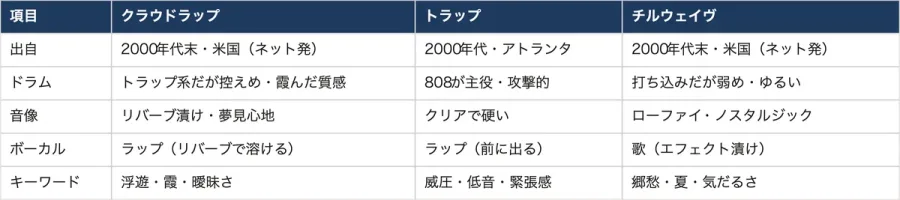
Differences from other genresComparing it with nearby genres helps bring the outline of Cloud Rap into focus.
The difference from trap is the "assertiveness of the drums." In trap, the 808 bass and hi-hats are the stars, but in Cloud Rap, the drums are merely the wind that flows through the clouds, and the star is the hazy upper layer. On the other hand, it shares the way of blurring the soundscape with chillwave, but that genre leans toward indie pop with vocals, and rap doesn't fit. I feel that explaining it as "music with rap over a chillwave beat" makes it easy to understand Cloud Rap's position in the middle of the two.
And there is one more important positional relationship. Rage and pluggnb, which I have explained in this magazine, are both descendant generations that inherited the genes of Cloud Rap. Rage was born by expanding the floating sensation into rave-like frenzy, and pluggnb by expanding the sweetness of sparkling melodies—each taking one aspect of Cloud Rap. This article is, so to speak, the "prequel" to those two articles. If you are listening by tracing back from the current scene, please read on with the understanding that this is the source.
The History of Cloud Rap: From Birth to the Present
Roots and Birth (Origins)The story of Cloud Rap begins around 2008 with the meeting of Lil B and producer Clams Casino. Lil B, from the California Bay Area, was a maverick who had been releasing an abnormal amount of music online since the MySpace era. Clams Casino, who was a student in New Jersey at the time, sent him beats, and their collaboration began.
The decisive moment was the 2009 production of "I'm God." By stretching the vocals from Imogen Heap's "Just for Now" and transforming them into a floating texture reminiscent of angelic singing, this beat was later described by multiple media outlets as the song that announced the birth of cloud rap. It was included on Lil B's mixtape "6 Kiss" (2009), and the instrumental version also gained cult popularity.
The term "cloud rap" itself began to be used in 2010 to refer to the music of Oakland duo Main Attrakionz (Squadda B and Mondre M.A.N.). The artists themselves have said, "Cloud rap was a name given to us." The fact that internet blog culture created the genre name itself symbolizes the internet-native nature of this genre.
Development and Golden AgeIn 2011, cloud rap reached the mainstream scene. Harlem newcomer A$AP Rocky released his debut single "Peso" and the mixtape "Live. Love. ASAP," skyrocketing to stardom with his languid flow over hazy beats by Clams Casino and Friendzone. The fact that a New York rapper found success with a West Coast-originated, internet-born sound also signaled the end of an era where regionality defined genres.
During the same period, Clams Casino himself established his reputation as a producer with the release of his instrumental collections, leading to the rise of beat tape culture, where beats that were once just "rap accompaniment" became objects of appreciation in their own right. The aesthetic of cloud rap has also become an undercurrent for the "listening to beats only" culture that followed lo-fi hip hop.
In 2013, an explosion occurred from an even more unexpected place. "Ginseng Strip 2002" by 16-year-old Yung Lean from Stockholm, Sweden, became a viral hit on YouTube. The music video, where Arizona Iced Tea and Pokémon coexisted, was the very aesthetic of the Tumblr generation. Two collectives formed around Yung Lean: Sad Boys and Drain Gang, consisting of Bladee, Ecco2k, Thaiboy Digital, and producer Whitearmor, and cloud rap began its own unique evolution in Northern Europe.
An American-born genre was inherited by Swedish teenagers, then re-imported to become a global standard. It was a propagation that could not have happened without SoundCloud and YouTube, making cloud rap what can be called one of the "first rap genres created by the internet."
Current Scene and TrendsSince the late 2010s, cloud rap has settled down as a standalone boom, but its genes have spread to an astonishingly wide range. Micro-genres of the 2020s like emo rap, digicore, hexD, jerk, rage, and sigilkore all take the hazy aesthetic of cloud rap as their starting point. The idea of emo rap, which puts rapping over sentimental guitar samples, is a direct descendant of the cloud rap method of blurring clean materials, and the excessive effect processing of digicore is an extension of the aesthetic of "melting vocals into the track."
As a turning point in history where the propagation path of genres changed from "region" to "platform," cloud rap is an important reference point in music history. From the Bronx to Atlanta, hip hop subgenres have always been discussed alongside the names of places, but micro-genres since cloud rap take SoundCloud or Discord communities as their "place of origin." This genre was the first success story of that.
Two lineages are particularly important. One is rage, starting with Playboi Carti's "Whole Lotta Red" (2020), which converted the floating feeling of cloud rap into a rave-like euphoria. The other is pluggnb; this genre, which combines the soft tones of plugg with R&B melodies, is infused with the glittering synth aesthetic derived from Drain Gang. Details are explained in our magazine's articles on "rage" and "pluggnb," so reading them alongside this article will complete the map of the 2010s to 2020s.
The originators are also still active. Bladee continues to update his style with "The Fool" (2021) and "Cold Visions" (2024), and in 2024, he even approached post-punk with his collaborative album with Yung Lean, "Psykos." True to a genre that makes "ambiguity of boundaries" its aesthetic, it continues to drift while changing its form even now.
Representative Cloud Rap Songs and Recommended Artists
Here are 5 songs that trace the history of cloud rap.
1. Lil B "I'm God" (prod. Clams Casino, 2009)
The origin and peak of the genre. Imogen Heap's vocal sample rings out like a heavenly choir, and Lil B's simple, honest rap floats above it. This is a song I want you to listen to by comparing both the instrumental and rap versions first.
2. A$AP Rocky "Peso" (2011)
The moment cloud rap reached the mainstream. The combination of hazy beats and A$AP Rocky's smooth flow updated the soundscape of hip hop at the time by one level. The mixtape "Live. Love. ASAP" is also a must-listen.
3. Yung Lean "Ginseng Strip 2002" (2013)
A viral hit where a Swedish teenager re-spread cloud rap to the world. The combination of an amateurish flow and sweet, hazy beats has a strange addictiveness even when listened to more than 10 years later.
4. Main Attrakionz "Dip" (from "808s & Dark Grapes III", 2015)
The culmination of the pioneers who gave the name "cloud rap" its origin. The album "808s & Dark Grapes III," fully produced by Friendzone, can be called the culmination of the early cloud rap aesthetic.
5. Bladee "Be Nice 2 Me" (from "Icedancer", 2018)
A popular song representing the Drain Gang era. The combination of Auto-Tune-melted vocals and shimmering synths captures the state of cloud rap just before it branched off into pluggnb and rage. It is recommended to listen from here into the current scene.
If you want to dig by artist, the shortcut is to start with the Clams Casino instrumental collections. If you listen to just the beats without the rap, you can understand the acoustic design of this genre with surprising clarity. Next, SpaceGhostPurrp is an artist who took the haze of cloud rap in a darker direction, connecting to later Memphis revivals and the phonk movement. Canada's Night Lovell and Bones, known for his massive amount of mixtapes, are artists who fill the middle ground between cloud rap and emo rap. Listening to these four groups will make you realize how much breadth there is within the common denominator of "haze."
How to make Cloud Rap with DTM? Production tips
Cloud rap is one of the hip-hop genres that is easiest for DTM beginners to make sound "authentic." The reason is clear: processing that "blurs" the sound is more dominant than precise mixing. Let's organize the steps using Logic Pro as an example.
Rhythm and Beat CharacteristicsSet the project BPM to around 130 (trap-style grid). The perceived speed is a relaxed half-time of around 65. The basic pattern is as follows.
There are three key points.
Only one snare on the 3rd beat: This is the core of the half-time feel. Placing it on the 2nd and 4th beats would make it sound like standard hip-hop, so placing it on the 3rd beat creates "space."
Sparse kicks: Keep the detailed 808 rolls like in trap music to a minimum, and arrange them so they don't disturb the flow of the clouds.
Thin hi-hats: Lower the volume and vary the velocity. Occasionally inserting 16th-note rolls or triplets will add vocabulary derived from trap.
Drum sounds can be 808-based, but they are too hard as they are. The cloud rap style is to apply a light low-pass filter to the entire drum bus or share a subtle reverb to place them in the same "air" as the other parts.
As for the precision of the programming, it is surprisingly fine to use strict quantization. This genre is not about creating a raw feel through the looseness found in boom-bap; rather, the groove of this genre comes from the contrast of clouds flowing irregularly over a mechanical grid. Human feel is expressed not through the drums, but through the fluctuations of the melodic elements and the vocals.
Tips for Sound MakingThe essence of this genre is not the drums, but the "clouds," or the hazy melodic elements. There is a standard procedure for creating them.
Choose your material: Choose material that is beautiful on its own, such as ambient pads, choir-style vocal samples, or music-box or game-music-style melodies. Note that directly sampling commercial songs or anime soundtracks requires rights clearance, so for songs you intend to release, it is safer to use royalty-free material like Splice or your own original phrases.
Shift the pitch: Pitch up or down by a semitone or several tones. If tape-like artifacts (degradation noise) appear, that becomes the texture itself.
Apply deep reverb: Apply hall-style reverb with a high send amount. Long reverberations with a decay of 4 seconds or more are also correct in this genre.
Round it off with a low-pass filter: Cut the high frequencies to blur the contours. A good benchmark is to make it sound like you are listening through a pane of glass.
Make it sway with sidechaining: Applying compression so that the melodic elements dip slightly in sync with the kick creates a swaying motion, as if the clouds are pulsing slowly.
Vocal processing is also distinctive. Apply deep plate reverb and delay to the rap to sink it into the track. While standard mixing textbooks teach that "vocals should be brought to the front," in cloud rap, you intentionally do the opposite. Applying heavy Auto-Tune (or Pitch Correction in Logic) to create a texture that is halfway between singing and rapping has also been a staple since Yung Lean.
In Logic Pro, you can almost finish everything with just three things: the hall-style presets in Space Designer, Tape Delay, and Bitcrusher. In this genre, the "courage to overdo it" is more important than expensive plugins.
Song Structure (Arrangement)Cloud rap compositions are loop-based and do not feature dramatic developments. A typical structure is as follows.
Intro (4-8 bars): Play only the atmospheric 'cloud' layers to establish the world-building.
Verse 1 (16 bars): The drums enter and the rapping begins.
Hook (8 bars): A repetition of melodic phrases. This is often the part that becomes a vocal track with Auto-Tune.
Verse 2 (16 bars): Create subtle changes by adding or removing atmospheric layers.
Hook (8 bars): Repeat the same hook.
Bridge (8 bars): A 'break in the clouds' section where the drums are removed, returning to just the atmospheric layers.
Hook (8 bars): The final hook.
Outro (8 bars): Fade out, leaving only the reverb tail.
The key to the structure is 'creating development through subtraction.' Instead of adding elements to build intensity, you change the scenery by subtracting elements, such as removing the drums or bass. Changes as subtle as clouds drifting and the weather shifting between sunny and cloudy are sufficient.
I will also list some points where beginners often stumble. The first is the issue of 'the low end becoming muddy due to excessive reverb.' By placing a high-pass filter before or after the reverb send, and cutting the reverberation below 200Hz, you can achieve a sound image that remains hazy without becoming muddy. The second is the issue of 'all parts becoming too hazy, losing their core.' If you keep at least the bass and kick close to dry (no effects), it creates a composition where there is a solid ground beneath the clouds. Remembering to decide on one place to blur and one place to keep clear will help you make decisions faster.
How to find samples on SpliceYou can find cloud rap-style materials by searching with the following keywords.
cloud rap: This is the direct keyword. You can find everything from beat loops to atmospheric layers.
ambient pads: Pads that serve as cloud material. Choose ones that are dreamy.
ethereal vocal: Choir-style or angelic vocal samples. These form the core of the 'I'm God' aesthetic.
dreamy melody: You can find beautiful melody loops featuring music boxes or bells.
tape texture: Tape noise or hiss noise. It can add a lo-fi atmosphere.
plugg: While it is an adjacent genre, you can repurpose soft synth-style timbres.
The criteria for selecting source material is simple: 'Does it sound beautiful on its own?' It is precisely because you are blurring beautiful material that a sense of melancholy and floating emerges. Conversely, if you blur material that is dark and muddy from the start, it tends to become just an unclear sound. If you imagine 'how will this transform if I blur it' during the audition stage, your download accuracy will improve.
Let's try it out in SunoHere is a prompt example for generating this genre with Suno AI. It turns the content of this article directly into a song.
Style of Music:
Cloud rap, hazy ethereal pads drenched in long reverb, sparse trap drums half-time feel, dreamy pitched vocal sample, melancholic auto-tuned male vocals, lo-fi tape texture, 130 BPM, floating and nostalgic
Lyrics (with meta tags):
[Intro]
[Mood: Dreamy]
[Energy: Low]
(reverb-soaked pads drift like clouds, distant vocal sample)

[Verse]
(rapping, hazy, laid-back)
リバーブの奥で 声が溶けていく
雲の上の城を 画面越しに見てた
スネアは3拍目 急がない世界
綺麗な素材を 霞ませるだけでいい

[Chorus]
[Energy: Medium]
(auto-tuned singing, floating harmonies)
クラウドラップ 夢と現実のあいだ
引き算の展開で 景色が変わっていく

[Bridge]
[Texture: Tape-Saturated]
(drums drop out, only clouds remain)

[Verse 2]
(rapping, softer)
ネットで生まれて 北欧で育った
レイジもプラグも ここから始まった

[Chorus]
[Energy: Medium]
(auto-tuned singing, floating harmonies)
クラウドラップ 夢と現実のあいだ
10年経っても まだ漂っている

[Outro]
[Fade Out]
(long reverb tail slowly dissolves into silence)
Summary: Listen to, create, and enjoy Cloud Rap
Let's organize the key points of this article.
Cloud rap is a hip-hop subgenre born in the late 2000s with a 'cloud-like, hazy sound image,' and its name originates from an anecdote about Lil B's 'Castle in the Clouds.'
The foundation was built by Lil B and Clams Casino's 'I'm God' (2009), and it went mainstream with A$AP Rocky's 'Peso' in 2011.
In 2013, Sweden's Yung Lean had a viral hit, and a unique Nordic evolution began through Sad Boys / Drain Gang.
The micro-genres of the 2020s, such as rage, pluggnb, and digicore, all carry the DNA of cloud rap.
The core of production is the process of 'blurring beautiful material,' making it a genre that is easy for beginners to replicate with deep reverb, low-pass filters, and halftime drums.
First, listen to the instrumental version of 'I'm God' and burn that hazy quality into your ears. Then, try applying too much reverb to a beautiful pad you have on hand. The clouds are born right around the point where you think, 'Is this too much?' I still remember the surprise I felt the first time I tried it, the moment a simple preset pad suddenly turned into 'something melancholy.' It was a discovery that there was such rich expression to be found in places outside the correct mix.
Cloud rap production is a genre that requires 'boldness' more than equipment. You can start making clouds tonight with just your DAW and free reverb.
In related articles, I also explain the descendant generations of 'rage' and 'pluggnb,' as well as the contemporary 'vaporwave' and 'chillwave,' and 'trap,' which became the rhythmic foundation. Please read them as a next step in tracing the family tree of internet-born genres.
#MusicGenre #CloudRap #DTM #Composition #MusicProduction #HipHop #LoFi #ConnectWithMusicLovers