From Chemical Engineer to Quantum Computing Standard-Bearer
When people hear the term "quantum computer," many may think of tech giants like Google or IBM. However, there is a small company that has emerged as a major player in the stock market as a "pure-play quantum computing company" in this field: Rigetti Computing. At the helm is Dr. Subodh Kulkarni, an engineer who earned his degrees in chemical engineering from the Indian Institute of Technology and the Massachusetts Institute of Technology.
With over 30 years of experience in the semiconductor industry and a track record of successfully leading publicly traded companies, why did he jump into a company with "technology that has yet to be commercialized" just before turning 60? And what kind of future does he envision in an environment filled with contradictions—the high barrier of fidelity, persistent financial losses, and speculative stock prices that command a multi-billion dollar market capitalization? In this edition of People Spotlight, we will decode the figure of Subodh Kulkarni, the standard-bearer of quantum computing, through his career, management philosophy, and the overall picture of the technical challenges Rigetti is taking on.
1. One of the Most Notable Executives in the Quantum Computing Industry
Subodh Kulkarni has served as President and CEO of Rigetti Computing since December 2022. Rigetti is a company that develops superconducting gate-model quantum computers and is listed on the Nasdaq market under the ticker symbol "RGTI."
In recent years, quantum computing-related stocks have become the target of investor frenzy. This is because expectations for quantum computers have risen sharply as the next "game changer" following the artificial intelligence boom. Rigetti's stock price rose more than 45 percent in 2025 and continued to climb into 2026. On the other hand, total revenue for the full year 2025 remained at only around $7 million, a 34 percent decrease from the previous year. It is a state that cannot be explained by traditional financial metrics, with a market capitalization hundreds of times higher than its revenue.
In this market environment driven by expectations, Kulkarni is quietly but steadily advancing his technology roadmap. He has stated in media interviews that he does not consider revenue to be the most important metric at this time. His philosophy is that the top priority right now is to clear technical milestones one by one. Rather than hyping the stock price with flashy earnings forecasts, he is building up "intrinsic performance" in terms of qubit count and fidelity. That is Kulkarni's consistent stance.
The reason he attracts attention in the industry is not just because he is the head of a trendy company. He is one of the few leaders who has built a long track record as both a researcher and an executive in the "hard technology" world of semiconductors and has experience successfully selling a publicly traded company. The fact that he brings a grounded perspective of technology management to the highly uncertain field of quantum computing makes him a special figure.
2. From the Indian Institute of Technology to MIT: The Origins as a Chemical Engineer
Kulkarni's career began in chemical engineering. He earned his Bachelor's degree in Chemical Engineering from the Indian Institute of Technology (IIT) Bombay (now Mumbai). IIT is known as one of the world's leading elite science and technology universities, and its graduates are active in technology companies and research institutions around the world, including Silicon Valley.
Afterward, Kulkarni moved to the United States and earned his Master's and Ph.D. in Chemical Engineering from the Massachusetts Institute of Technology (MIT). Needless to say, MIT is one of the world's top-tier institutes of technology. His background of having attended two of the world's premier science and technology educational institutions—one in the East and one in the West—speaks to how solid his foundation as an engineer is.
At first glance, the field of chemical engineering might seem far removed from quantum computing. However, chemical engineering knowledge regarding material manufacturing processes, microfabrication, and yield management is actually deeply connected to quantum computer hardware development. This is because superconducting qubits, like semiconductor chips, are made through precise manufacturing techniques. The background to Kulkarni's later conviction that "superconducting systems will be the winner" lies in his deep understanding of manufacturing processes as a chemical engineer.
A chemical engineer who knows how to build things, rather than a theoretical physicist, is at the top of a quantum computing company. This fact is an important point when considering the nature of Rigetti as a company. Rigetti is not a company that talks about "physics dreams," but a company that tries to build "mass-producible hardware."
3. IBM, 3M, Imation: Technology and Management Cultivated at Large Corporations
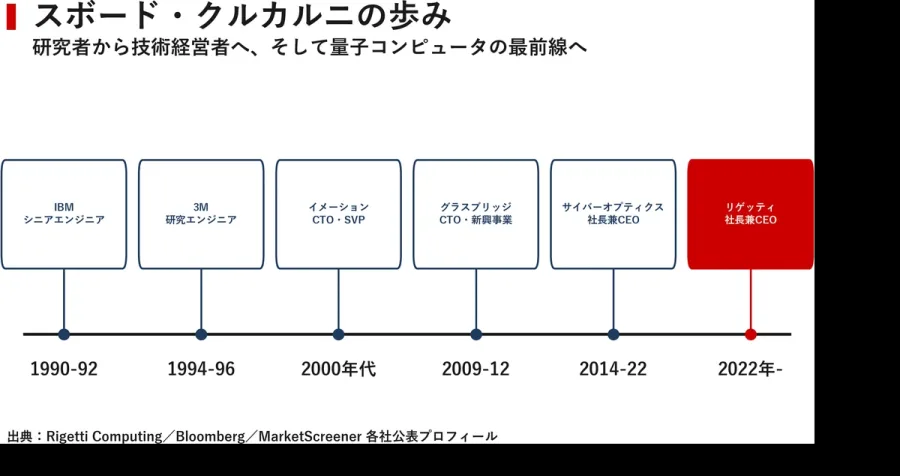
After obtaining his degree, Kulkarni began his career as a researcher at a giant technology company. From 1990 to 1992, he worked as a senior engineer at IBM (International Business Machines). At one of the world's largest computer companies, he came into contact with the front lines of computing.
Subsequently, from 1994 to 1996, he served as a senior research engineer at 3M. 3M is a company known for Post-it notes, various tapes, films, and optical materials, with strengths in materials science and productization technology. Here, Kulkarni learned the process of "commercialization," turning research results into actual products, up close.
After that, he held key positions at Imation. Imation was a global company involved in recording media, data storage, and data security. At this company, Kulkarni served as Chief Technology Officer (CTO) and Senior Vice President of OEM and Emerging Businesses, overseeing a wide range of areas from research and development to manufacturing and global commercial operations. Furthermore, he also served as CTO and Senior Vice President (Emerging Businesses) at GlassBridge Enterprises, which inherited the legacy of Imation, from 2009 to 2012.
Research at a giant corporation like IBM, materials and commercialization at 3M, and technology oversight and business operations at Imation. Through this series of experiences, Kulkarni steadily shifted his focus from "researcher" to "technology executive." In addition to pure research ability, he acquired the perspective of how to make technology viable as a business and how to deliver it to the market. This "ambidexterity in technology and management" is his greatest strength.
4. CEO Experience at CyberOptics: Leading a Publicly Traded Company
Kulkarni's most significant achievement as an executive was during his time at CyberOptics Corporation. From 2014, he served as the company's President, CEO, and Director.
CyberOptics is a company that handles high-precision inspection and measurement equipment used in the manufacturing processes of semiconductors and electronic devices. With 3D sensor technology at its core, it was a company that acted as an 'unsung hero,' protecting the quality of micro-manufacturing processes. Here, Kulkarni would demonstrate his skills as a top executive in the field of semiconductors and precision measurement, which is precisely his area of expertise.
Then, in November 2022, CyberOptics was acquired by Nordson Corporation, a global leader in industrial equipment. Leading a publicly traded company, increasing its corporate value, and rewarding shareholders through a sale to a major corporation—this is one clear form of success as an executive. Kulkarni proved that he is not only someone who understands technology but also an executive who can create and realize corporate value.
This success at CyberOptics served as a run-up to his next career move. Almost at the same time as the completion of the CyberOptics acquisition, he was appointed CEO of Rigetti. It was the moment an executive who had achieved success in an 'established market' of semiconductors and precision measurement made a major turn toward the 'domain where a market does not even exist yet' of quantum computing.
Furthermore, Kulkarni also serves as an outside director for several companies and is on the board of directors of Key Tronic (ticker: KTCC), an electronic manufacturing services company. A deep understanding of public company governance is also one of the elements that colors his career.
5. To CEO of Rigetti: The Transition in December 2022
In December 2022, Subodh Kulkarni was appointed President and CEO of Rigetti Computing. It was the appointment of a veteran executive who has built a career of over 30 years in the semiconductor industry and has a track record of scaling and commercializing cutting-edge technology.
Rigetti is a quantum computing company founded in 2013 by Chad Rigetti. The founder was a physicist who started the company with a background in superconducting qubit research. However, as it embarked on the long and arduous path of commercializing quantum computers, the company needed to transition from a 'research and development phase' to a 'phase of establishing it as a business.'
This is why Kulkarni, a professional in semiconductor commercialization and public company management, was invited. This appointment was a sign that Rigetti was seriously trying to transition from the 'dream-telling stage' to the 'stage of making and selling things.' Translating the founder's physical vision into mass-producible hardware and a sustainable business—that is the role entrusted to Kulkarni.
After taking office, Kulkarni clearly organized Rigetti's technology strategy. Instead of spreading himself thin, he focused on one point: 'gate-based quantum computers using the superconducting method.' And he steadily raised the two core performance indicators—the number of qubits and fidelity—along the roadmap. It is an extremely engineering-oriented and solid approach, even if it lacks flashiness.
Like a chemical engineer, he repeatedly emphasizes the importance of manufacturing processes. Superconducting qubits have the advantages of high compatibility with existing semiconductor manufacturing infrastructure and fast gate speeds. Kulkarni is convinced that these two points are what will make the superconducting method the 'winning method.' He prioritizes practical perspectives such as ease of mass production and speed of operation over theoretical beauty. His consistent philosophy as a technology executive is evident here as well.
6. Who is Rigetti? The Bet on the Superconducting Method
To understand the person Kulkarni, one must know what the company he leads, Rigetti, is 'betting on.'
There are several ways to realize quantum computers. These include the ion trap method, superconducting method, photonic method, neutral atom method, and silicon quantum dot method. Each has its pros and cons, and no one yet knows which method will ultimately become mainstream. This 'proliferation of methods' is the most significant characteristic of the dawn of quantum computing.
The method Rigetti chose is the superconducting method. This is a leading method also adopted by Google and IBM, which uses superconducting circuits cooled to cryogenic temperatures as qubits. The strengths of this method that Kulkarni repeatedly cites are 'fast gate speed' and 'established manufacturing processes.'
Gate speed is the speed at which quantum operations are executed. Superconducting qubits perform operations faster than other methods and can execute more calculations per unit of time. Also, because superconducting circuits can be made by applying existing semiconductor manufacturing technology, they are suitable for future mass production. For Kulkarni, who is a chemical engineer and knows the world of semiconductor manufacturing inside and out, this 'ease of manufacturing' is a critically important point.
On the other hand, the superconducting method also has weaknesses. That is the problem of 'fidelity.' Fidelity is an indicator of how accurately quantum operations are executed; if this is low, errors occur in calculations. As we will see in detail in a later chapter, the superconducting method lags behind some competing methods in this fidelity. Kulkarni acknowledges this challenge head-on and is taking a strategy of raising fidelity through improvements in the manufacturing process.
In addition to having a platform called 'Rigetti QCS' that provides its own quantum computers via the cloud, Rigetti also provides systems to major quantum cloud services such as Amazon Braket, Microsoft Azure Quantum, and qBraid. Furthermore, it is focusing on 'on-premises' sales, where the quantum computer itself is installed at the customer's facility. This is to meet the needs of research institutions and governments that want to own the hardware directly.
7. Roadmap: From 36 Qubits to 1000 Qubits
What symbolizes Kulkarni's management is a clearly quantified roadmap. He takes a style of setting specific goals and timelines for the number of qubits and fidelity, and achieving them one by one.
Rigetti first developed the 84-qubit 'Ankaa-3' system. This system aimed to achieve a median 2-qubit gate fidelity of 99 percent or higher by the end of 2024. Kulkarni states that the performance of Ankaa-3 confirms Rigetti's leadership in superconducting quantum computing.
Subsequently, Rigetti introduced a new modular (combinable like building blocks) system architecture. They planned to launch a 36-qubit system by mid-2025 and a system exceeding 100 qubits by the end of 2025. This approach, called "quantum chiplets," which involves combining small chips to scale up, is precisely the application of semiconductor industry concepts to quantum computers.
Then, in 2026, Rigetti began general availability of its 108-qubit "Cepheus-1-108Q" system. This system achieves a median two-qubit gate fidelity of 99.5 percent. Cepheus-1 became available through Amazon Braket, Microsoft Azure Quantum, and qBraid, in addition to Rigetti's own cloud QCS.
Looking further ahead, Rigetti plans to launch its next-generation machine, "Lyra," in the latter half of 2026. Lyra is expected to have a configuration exceeding 100 qubits and aims for higher fidelity. Furthermore, they have announced plans to deploy systems exceeding 1,000 qubits in the UK over the next three to four years.
From 36 qubits to 108 qubits, and then to 1,000 qubits. This roadmap of climbing the numerical staircase one step at a time is the essence of Kulkarni's technology management. It is not a fantasy; he promises specific numbers and timelines and proceeds while fulfilling accountability to the market. His experience in driving product roadmaps in the semiconductor industry is being applied directly to the world of quantum computing.
8. The Wall of Fidelity: What the Difference Between 99.5% and 99.99% Means
The biggest technical challenge Rigetti faces is fidelity. Kulkarni himself speaks about this point without hiding it.
The two-qubit gate fidelity that Rigetti is achieving is 99.5 percent. At first glance, this seems like extremely high precision. However, in the world of quantum computing, this 0.5 percent error has significant meaning. Their competitor, IonQ, has achieved a fidelity of 99.99 percent using the ion trap method. While it may look like a small difference in numbers, when compared by error rate, 99.5 percent is a 0.5 percent error, while 99.99 percent is a 0.01 percent error, which is a 50-fold difference.
Why is fidelity so important? Quantum computers inevitably generate errors during the calculation process. A technology called "quantum error correction" to fix these errors is essential for realizing practical quantum computers. And, to effectively begin error correction with software, it is generally considered that a fidelity of 99.9 percent or higher is required.
In other words, Rigetti's 99.5 percent level has not yet reached this "line where error correction can begin." This fact is a point that investors cannot overlook when evaluating Rigetti. This is because true competitiveness is determined not just by the "number" of qubits, but by their "quality"—that is, the coherence time of individual qubits (the time they can maintain a quantum state), two-qubit fidelity, and error correction methods.
Kulkarni is trying to overcome this challenge by improving the manufacturing process. The quality of superconducting qubits depends heavily on manufacturing precision. For him, with his knowledge of semiconductor manufacturing, this is a "solvable problem." Raising fidelity from 99.5 percent to 99.9 percent, and then further beyond. This steady improvement is Rigetti's technical lifeline and the area Kulkarni is focusing on most.
Chasing quantity while also improving quality. The difficulty of quantum computer development lies in having to pursue these two goals. And Kulkarni is a manager who faces this difficult challenge with the honesty of a chemical engineer.
9. Rigetti's Current Position in Numbers
Let's look at Kulkarni's management from the perspective of financial figures. Here, a unique structure characteristic of quantum computer companies is revealed.
First is revenue. Revenue for the full year 2025 was approximately $7 million, a 34 percent decrease from the previous year. However, in the first quarter of 2026, revenue surged to $4.4 million, a 193 percent increase year-over-year. This rapid growth is mainly due to the shipment of on-premises systems. Specifically, the delivery of the Novera QPU to the University of Saskatchewan in Canada contributed to this. The fact that the numbers fluctuate significantly each quarter shows that quantum computers are still at the stage of "delivering each unit individually."
Turning to profit and loss, the operating loss for the first quarter of 2026 was $26 million. On the other hand, net income on a GAAP basis was a profit of $33.1 million. This is seen as being mainly due to accounting factors unrelated to the core business, such as the revaluation of warrants (stock acquisition rights). On a non-GAAP basis, which shows the true strength of the core business, there was a net loss of $14.7 million. In other words, the reality is that the business is still running at a loss.
However, what is noteworthy about Rigetti's finances is the abundance of their cash on hand. As of the end of the first quarter of 2026, Rigetti held $569 million in cash, cash equivalents, and available-for-sale investments, and maintains a debt-free operation. Quantum computer development requires a long time and a large amount of capital, but Rigetti has secured sufficient funds to continue development by riding the tailwinds of the stock market.
Revenue is small, and the core business is in the red. Yet, they have abundant funds and a high stock price. This seemingly contradictory state is the typical profile of a current quantum computer company. Kulkarni is using this abundant capital as fuel, adopting a strategy that prioritizes achieving technical milestones over profitability. The background to his statement that "revenue is not the most important metric right now" lies in this financial structure.
10. Quanta Computer, C-DAC, and the UK: Global Partnership Strategy
Another pillar of Kulkarni's management is the construction of global partnerships and sales networks. He is trying to accelerate development by connecting Rigetti's technology with companies, research institutions, and governments around the world.
Symbolic of this is the collaboration with Taiwan's Quanta Computer. Quanta is one of the world's largest contract manufacturers of laptops and servers. In 2025, Rigetti accepted a $35 million investment from Quanta. The shares were acquired at approximately $11.59 per share. Furthermore, both companies agreed to jointly invest over $100 million in superconducting quantum computing technology over the next five years. Combining Quanta's powerful hardware manufacturing capabilities with Rigetti's superconducting quantum technology. This partnership aligns perfectly with Kulkarni's strategy of aiming for "mass-producible quantum computers."
Sales to government and research institutions are also yielding results. The Centre for Development of Advanced Computing (C-DAC) in India placed an order with Rigetti for an on-premises 108-qubit superconducting quantum computer, valued at approximately $8.4 million. This system is scheduled to be installed in late 2026. There is a growing global trend of nations seeking to possess quantum computer hardware domestically, and Rigetti is accurately capturing these needs.
Furthermore, Rigetti has announced its intention to invest up to $100 million in the UK. This investment is aimed at deploying a quantum computer system exceeding 1,000 qubits within the UK over the next three to four years. The UK is prioritizing quantum technology as a national strategy, and Rigetti is looking to leverage that momentum to increase its local presence.
In addition to these partnership strategies, Kulkarni also emphasizes "external collaboration" on the technical front. He states that by teaming up with companies that have strengths in quantum error correction and control technology, such as Riverlane and Q-CTRL, Rigetti can accelerate innovation on top of its foundational technology. Rather than keeping everything in-house, he aims to evolve technology across the entire ecosystem. This open stance is also a hallmark of his management style.
A Taiwanese manufacturing giant, an Indian national research institution, and the British government. Kulkarni is working to elevate Rigetti from a mere US startup to a global player in quantum computing.
11. Kulkarni's Management Philosophy: The Vision of a "Quantum Society"
Behind the technical roadmap and partnerships, Kulkarni holds a grand vision: the concept of a "Quantum Society."
In a keynote speech, he addressed the theme of "How should we embrace a quantum society?" and envisioned a society that leverages the power of quantum technology to realize things that are practically impossible today. He views quantum computers not just as high-speed calculators, but as foundational technology that will change the very nature of society. This grand perspective lies at the root of his management.
At the same time, his vision is never limited to abstract idealism. Rather, his tone is extremely practical. Kulkarni repeatedly emphasizes that Rigetti is "not at the stage of chasing revenue, but at the stage of chasing technical development." This is a clear statement of management judgment: prioritizing the achievement of long-term technical milestones over satisfying shareholders with short-term profits. Not being swayed by short-term performance pressure and focusing on essential technological progress—this discipline is the core of Kulkarni's management philosophy.
Another point he emphasizes is the idea of "enabling external innovation." As mentioned in the previous chapter, through collaborations with companies like Riverlane and Q-CTRL, he is trying to create an environment where other companies can innovate on top of Rigetti's foundational technology. By opening up the platform and fostering an ecosystem, he is advancing innovation at a speed that the company could not achieve alone. This can be said to be the application of the "platform strategy" that has succeeded in the semiconductor and cloud industries to quantum computing.
Furthermore, Kulkarni has high expectations for the fusion of quantum computers and artificial intelligence. He sees a continuous convergence between quantum computing and artificial intelligence in the future. In an era where artificial intelligence demands vast computational resources, quantum computers will take on a portion of those calculations. A massive new market will be born at the intersection of these two cutting-edge technologies. Kulkarni is positioning Rigetti at that intersection.
A grand vision combined with grounded technical management. The ability to balance these two is what makes Kulkarni an extraordinary executive. He is neither a founder who only talks about dreams nor a financier who only chases numbers. He possesses the coolness to make technology a viable business while believing in its potential.
12. "3 to 5 Years to Quantum Advantage": Cautious Optimism
In discussions surrounding quantum computers, the question of "when will it be put to practical use?" is always the focus. On this point, Kulkarni consistently takes a position that could be called "cautious optimism."
He states that it will be three to five years before Rigetti reaches "Quantum Advantage." Quantum advantage refers to the point where a quantum computer clearly outperforms the performance of a conventional computer in a specific task. In one interview, he mentioned "three to four years," and in any case, he views it on a timeline of "within a few years."
This "3 to 5 year" outlook is noteworthy. This is because, regarding quantum computers, extreme views are flying around, from pessimism that "it will take decades" to excessive optimism that "we will be able to do anything soon." Amidst this, Kulkarni presents a grounded view: "It is close, but we are not there yet." These are remarks made after calmly assessing what can and cannot be done as an engineer.
This caution is also a form of honesty toward investors. If he were to fuel excessive expectations, the stock price might rise in the short term. However, the backlash when those expectations are not met would be significant, and trust would be lost in the long term. By honestly admitting that quantum advantage is still a few years away, Kulkarni is positioning Rigetti as a "company that makes achievable promises."
At the same time, he believes that the superconducting approach will be the ultimate winner. High gate speeds and established manufacturing processes—this is his conviction that these two strengths will lead the superconducting approach to superiority in the long run. While acknowledging the immediate challenge of fidelity, he believes it can be overcome through improvements in manufacturing technology. This coexistence of "honesty in acknowledging challenges" and "conviction that they can win" is a characteristic of Kulkarni's way of speaking.
The 3 to 5-year timeline might feel long to investors. However, a foundational technology capable of changing society cannot be completed so easily. Kulkarni's cautious optimism may be the most accurate description of where the technology of quantum computing stands today.
13. Risks and Expectations for Investors to Consider
Let's look at Subodh Kulkarni and Rigetti calmly from an investor's perspective. Here, great expectations and risks that cannot be ignored coexist.
First, let's look at the expectations. Rigetti is one of the few publicly traded companies dedicated exclusively to quantum computing. For many investors, it represents a rare option to invest directly in the next-generation technology of quantum computing. Investments from Quanta Computer, partnerships with India and the UK, and a steadily advancing roadmap demonstrate that this company possesses genuine technical capabilities and global reach. With over $500 million in cash on hand and no debt, the company faces no immediate concerns regarding development funding. Having an experienced executive like Kulkarni at the helm is also a major source of reassurance.
On the other hand, the risks are also clear. The biggest concern is the stock price level itself. While revenue is only in the $7 million range, the market capitalization has reached billions of dollars, resulting in an exceptionally high price-to-sales ratio (PSR) of several hundred times. This can be described as an 'expectation bubble' where the stock price is formed solely by future expectations. Some analysts warn that the surge in Rigetti's stock price is excessive and that a significant correction could occur in late 2026.
Technical risks also remain. As mentioned earlier, Rigetti's 99.5 percent fidelity lags behind competitor IonQ's 99.99 percent and has not yet reached the 99.9 percent threshold required to begin error correction. Whether this technical gap can be bridged is not yet guaranteed. Furthermore, the fact that the realization of quantum advantage is '3 to 5 years away' means that the company must continue development without full-scale monetization until then.
What is important for investors is not to be swayed by short-term fluctuations in the stock price, but to determine whether the technical milestones set by Kulkarni are actually being achieved. The number of qubits, and above all, the improvement in fidelity. These essential metrics are the yardstick by which Rigetti's true value should be measured. As Kulkarni himself says, 'I want you to look at the technology, not the sales,' the company is at a stage where it should be evaluated based on its technical progress.
Quantum computing stocks are a battleground of intense expectations and risks. Whether Rigetti can survive and emerge as a winner depends entirely on whether Kulkarni's technology management can deliver on its promises.
14. Lessons from the person Subodh Kulkarni
Finally, let's summarize what we as business professionals can learn from the person Subodh Kulkarni.
First is the value of being 'ambidextrous in technology and management.' Kulkarni is a technologist at heart with a PhD in chemical engineering, yet he also possesses the management acumen to successfully sell off a publicly traded company. Because he deeply understands technology, he can devise feasible strategies, and because he understands management, he can turn that technology into a viable business. His career teaches us the strength of balancing expertise with a management perspective.
Second is the 'courage to dive into uncertain domains.' Kulkarni had already achieved success in the established markets of semiconductors and precision measurement. He could have continued on a stable career path. However, he made a major pivot into the world of quantum computing, where a market did not even exist yet. He did not settle for his accumulated achievements but threw himself into a new challenge. This choice provides courage to many business professionals approaching the latter half of their careers.
Third is the 'strategy of honesty.' Kulkarni does not hide or deny that he is lagging behind competitors in fidelity or that quantum advantage is still several years away. Speaking honestly about inconvenient facts might seem disadvantageous in the short term. However, it builds long-term trust. He accumulates achievable promises rather than exaggerations. This integrity is a quality required of leaders in an uncertain age.
Fourth is the 'discipline of focusing on the essence.' Even while the stock price is in a frenzy, Kulkarni does not abandon his stance that 'it is about the technology, not the sales right now.' He does not get swept away by the expectations or pressures of those around him, but continues to focus on the essential metrics he believes in. This strength of discipline becomes the foundation for long-term success.
A chemical engineer who studied at the Indian Institute of Technology and MIT, conducted research at IBM and 3M, and learned management at Imation and CyberOptics. As the culmination of this, he is now challenging the next frontier of humanity: quantum computing. The story of Subodh Kulkarni is still halfway through. Whether he can turn his vision of a 'quantum society' into reality, or whether it will end as a page in an expectation bubble, the answer will become clear over the next few years.
Chasing the grand dream of quantum computing with grounded engineering and management. We cannot take our eyes off the challenge of this technologist.
Summary
Subodh Kulkarni is a rare leader who possesses both deep expertise as a chemical engineer and a track record as an executive who has led a publicly traded company. Rigetti Computing, which he leads, has taken a bet on the superconducting approach and is steadily advancing a roadmap to increase the number of qubits and fidelity step by step.
While facing challenges such as the technical barrier of fidelity, ongoing financial losses, and a stock price driven by expectations, Kulkarni does not break the discipline of 'following technical milestones.' While promoting global partnerships with Quanta Computer, India, and the UK, and holding up a grand vision of a 'quantum society,' he speaks with cautious optimism that quantum advantage is 3 to 5 years away.
He is neither a founder who only talks about dreams nor a financier who only chases numbers. He has the composure to believe in the potential of technology while making it a viable business. The person Subodh Kulkarni may represent an ideal image of technology management in an era of uncertainty.
References and Sources
Rigetti Computing Official Website 'Dr. Subodh Kulkarni (Leadership Team)' https://www.rigetti.com/leadership-team/dr-subodh-kulkarni
Rigetti Computing Official Website 'Dr. Subodh Kulkarni (Board of Directors)' https://www.rigetti.com/board-of-directors/dr-subodh-kulkarni
Bloomberg Markets "Subodh K Kulkarni, Rigetti Computing Inc: Profile and Biography" https://www.bloomberg.com/profile/person/15225840
MarketScreener "Subodh Kulkarni: Positions, Relations and Network" https://www.marketscreener.com/insider/SUBODH-KULKARNI-A0DNR5/
Quantum Zeitgeist "Rigetti CEO: Quantum Computing, AI Key To Future Growth" https://quantumzeitgeist.com/rigetti-ai-quantum-computing-future-growth/
Quantum Zeitgeist "Rigetti Computing Unveils Roadmap For Scalable Quantum Systems" https://quantumzeitgeist.com/rigetti-computing-unveils-roadmap-for-scalable-quantum-systems-and-goal-for-100-qubits-by-end-of-2025/
Rigetti & Co, LLC "Rigetti Computing Reports First Quarter 2026 Financial Results" https://investors.rigetti.com/news-releases/news-release-details/rigetti-computing-reports-first-quarter-2026-financial-results
Quantum Computing Report "Rigetti Computing Reports Q1 2026 Financial Results: 108-Qubit System Availability and $100M UK Investment" https://quantumcomputingreport.com/rigetti-computing-reports-q1-2026-financial-results-108-qubit-system-availability-and-100m-uk-investment/
The Quantum Insider "Rigetti Finalizes $35 Million Investment as Quanta Partnership Moves Forward" https://thequantuminsider.com/2025/04/30/rigetti-finalizes-35-million-investment-as-quanta-partnership-moves-forward/
Rigetti & Co, LLC "Rigetti Computing Announces Strategic Collaboration Agreement with Quanta Computer" https://investors.rigetti.com/news-releases/news-release-details/rigetti-computing-announces-strategic-collaboration-agreement
Constellation Research "Rigetti Computing CEO: Quantum advantage 4 years away" https://www.constellationr.com/blog-news/insights/rigetti-computing-ceo-quantum-advantage-4-years-away
CNBC "Rigetti Computing CEO: We are about 3-4 years away from demonstrating quantum advantage" https://www.cnbc.com/video/2025/11/11/rigetti-computing-ceo-we-are-about-3-4-years-away-from-demonstrating-quantum-advantage.html
Castle Growth "Interview with CEO of Rigetti Computing: The key information" https://castlegrowth.co.uk/2025/01/16/quantum-computing-future-rigetti-ceo-interview/
The Quantum Insider "Rigetti's Vision for the Future of Quantum Computing" https://thequantuminsider.com/2026/01/27/rigettis-vision-for-the-future-of-quantum-computing-what-makes-this-company-so-special/
stockanalysis.com"Rigetti Computing (RGTI) Stock Price & Overview" https://stockanalysis.com/stocks/rgti/
The Motley Fool "This Quantum Computing Stock Is Poised for a Sharp Selloff in the Second Half of 2026" https://www.fool.com/investing/2026/07/09/this-quantum-computing-stock-is-poised-for-a-sharp/