As always, beware of spoilers.
Please be aware that this includes mentions of Part 2, Chapter 6, the Mahoyo event, the Hibichika event, and the Scathach trial quest.
Pseudo-Servants that have exuded presence since the very beginning
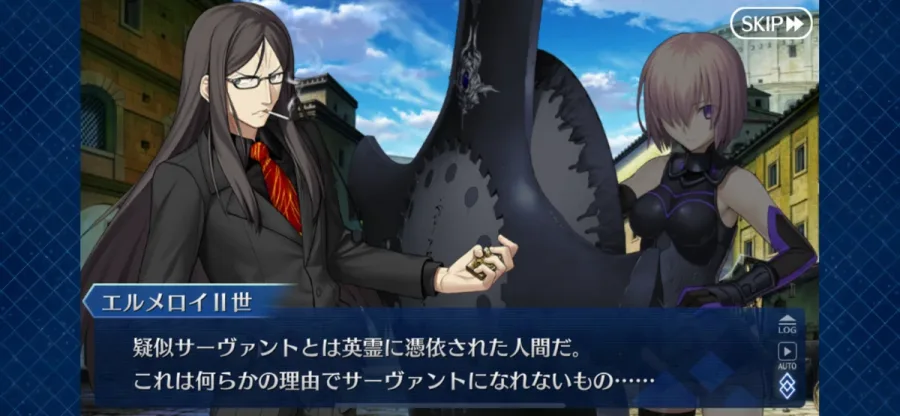
A Pseudo-Servant is a Servant created by having a Heroic Spirit possess a human.
The most prominent Pseudo-Servant in FGO is likely Lord El-Melloi II, who has been implemented since the very beginning.
Other Pseudo-Servants of Fate main story characters and other Type-Moon characters, such as Rin Tohsaka, Sakura Matou, and Illya, have also appeared one after another.
However, it is actually not very clear why Pseudo-Servants can be summoned as Pseudo-Servants.
If you think it's just fan service, they didn't implement any other Pseudo-Servants besides El-Melloi II until the end of the first part, so it's hard to see it as just fan service.
I would like to analyze the mysteries surrounding these suspicious Pseudo-Servants.
Premise 1: Catalysts are the key to Heroic Spirit summoning
Before that, let's confirm the importance of catalysts in Heroic Spirit summoning.
If you're thinking, 'I already know that,' please skip this.
In FGO, it was only briefly explained at the beginning, so you might not remember it, but catalysts are important in Heroic Spirit summoning.
To use an analogy, they are like tickets that allow you to specify the type of Heroic Spirit to be summoned.
A fragment of the Argo would be treated like a ticket exclusively for Argonauts, which is why secret battles are sometimes fought over catalysts throughout the Fate series.
In FGO, Mash's shield is used as a catalyst for Heroic Spirit summoning, but as a result of the incineration of human history making human history unstable, something incredible happened.
It became a catalyst for every Heroic Spirit encountered.
Well, normally there's no way to form bonds with such a large number of Heroic Spirits, so for now, please assume that in FGO, the encounter itself acts as a catalyst.
Premise 2: Heroic Spirits are the dead
And one more essential element for this analysis.
That is that all Heroic Spirits are dead.
Even though there are immortal Heroic Spirits, they are summoned by pretending to be dead, and if they don't reach the Throne of Heroes by dying, they cannot be summoned in the first place.
You cannot reach the Throne of Heroes during the Incineration/Bleaching of Human History
Based on that premise, the most plausible hypothesis for why Pseudo-Servants can be summoned is the possibility that they reached the Throne of Heroes because they died during the Incineration of Human History.
However, I honestly think that theory is suspicious.
As depicted in the Scathach trial quest, the Incineration of Human History did not just kill people, it incinerated death itself.
Because of that, the dead could not finish dying and ended up piling up inside the protagonist's waste hole.
What that means is simple: if you don't die, you can't become a Heroic Spirit.
In other words, since you cannot finish dying due to the Incineration of Human History, there is no way they could become Heroic Spirits.
The same applies to the Bleaching of Human History.
They are causing them simultaneously to make it complicated on purpose, but I believe that the destabilization of human history and the ability to summon Pseudo-Servants are unrelated.
It acts as a catalyst, including the catalyst's world line
You might think that since Pseudo-Servants have memories of parallel worlds, they were summoned from parallel worlds, but it has been clearly stated that it is difficult to summon Heroic Spirits from the future or parallel worlds.
The reason for this is not depicted, but I believe it is because it acts as a catalyst, including the catalyst's world line.
As proof of this, even in the Lostbelts, the Crypters do not summon Lostbelt Heroic Spirits but instead summon Heroic Spirits of Proper Human History.
This is likely because they couldn't summon Lostbelt Heroic Spirits even if they wanted to.
In particular, Hinako Akuta would surely summon Xiang Yu even if he were the Lostbelt version, and the fact that she couldn't might be because she belongs to Proper Human History and was too far removed from the Lostbelt Xiang Yu.
It is clear that this is not a problem with the Chaldea-style Heroic Spirit summoning system, as the true identities of the fairies in Lostbelt Britain are Servants summoned using the Chaldea-style Heroic Spirit summoning system that Morgan plagiarized.
If so, why were the Pseudo-Servants, especially El-Melloi II, summoned?
He is a Heroic Spirit from a future and parallel world who even has memories of the Sixth Singularity, and despite not having a catalyst with a connection to the FGO world line, he is an initially implemented Servant who can be summoned from the start.
※2024/12/16 Chaldeas was bright red before the Rayshift.
Moreover, if the Incineration of Human History occurred when Chaldeas turned bright red, why is it possible to summon him when the summoning circle was set up at the epicenter before that?
An existence that turns everything upside down
Unless the premises established so far are completely overturned, summoning a Pseudo-Servant is inherently impossible.
However, the key to solving the mystery of these Pseudo-Servants appeared suddenly.
Sojuro Shizuki.
He is the only modern Heroic Spirit whose path to reaching the Throne of Heroes has been depicted.
To summarize, it started when a supernatural entity that had lived in Kumano Hot Springs for a long time stole Alice's magic item, Shiny Star, and fused with it.
It then activated as a monster that discards all wishes except for one, forming a Singularity, but Aoko stood in its way.
However, Aoko struggled against the very nature of the monster that discards wishes, and in a pinch, she tried to erase the Singularity, but she didn't have enough time.
That was when Sojuro Shizuki made a suicide attack on Shiny Star.
Sojuro died, but he created a tiny opening in Shiny Star, which allowed Aoko to successfully erase the Singularity.
For that achievement, Sojuro Shizuki reached the Throne of Heroes.
That is the story of how Sojuro Shizuki became a Heroic Spirit.
At first glance, he seems different from a Pseudo-Servant, but if we assume he is also a Pseudo-Servant—given that Shiki and Asagami, who did not fuse with anything, called themselves Pseudo-Servants—the true nature of Pseudo-Servants begins to narrow down.
The Pseudo-Servants died in the Singularity.
The Pseudo-Servants all claim they have no memory of their deaths.
However, a hypothesis can be formed based on Sojuro's case.
If one dies within a Singularity and becomes a Heroic Spirit, perhaps the memories of the original timeline take precedence, causing the memories of death in the Singularity to be lost.
But it would be premature to assume they died in a Singularity just because they lack memories of their deaths.
I want to focus on the Pseudo-Servants Ishtar and Ereshkigal.
They were originally much crueler and colder goddesses, but they were neutralized by the goodness of their vessel, Rin Tohsaka.
And since the experience of losing her father early is essential for Rin Tohsaka to acquire that goodness, she is an existence from the Fate/stay night timeline.
Now, a question.
In the Fifth Holy Grail War of Fate/stay night, Rin Tohsaka summoned a Heroic Spirit without a catalyst; was the summoned Heroic Spirit the mysterious red archer, or the Pseudo-Servants Ishtar or Ereshkigal?
The answer is the mysterious red archer, but don't you feel a contradiction somewhere in that?
If there is no concept of time in the Throne of Heroes, one should be able to summon oneself using oneself as a catalyst. In fact, there have been cases in other series where one summoned oneself.
However, just as the protagonist and the Crypters were not allowed to summon Heroic Spirits from Lostbelts, which are different timelines, they were not allowed to summon themselves from the same timeline possessed by a Divine Spirit.
To conclude, the twist is likely that the latter were not humans from the same timeline.
Even if the original timeline was the same, the compiled events before the Singularity and the Lostbelts after were treated as separate timelines, and it was a matter of course that those who became Heroic Spirits in the Lostbelt after the Singularity could not be summoned in the compiled events before the Singularity.
In other words, the Pseudo-Servants died in the Singularity and reached the Throne of Heroes.
That is why they have no memories of their deaths and cannot be summoned in the compiled events.
Why can Pseudo-Servants be summoned?
Then why are we able to summon Heroic Spirits who died in the Singularity?
That, too, can be understood by comparing it to Sojuro Shizuki's case.
As can be seen from Bazett's investigation data, the 2001 Singularity of Kumano Hot Springs was on top of a Lostbelt created by the erasure of the 1999 Singularity.
Furthermore, the truth of the matter is likely that Alice, who actually lived through that timeline, was at the summoning site and acted as a catalyst, leading to the successful summoning of the Servant Sojuro Shizuki.
In other words, if you have a catalyst from that timeline, you can summon any Heroic Spirit from a Lostbelt without exception.
I've talked for a long time, so let's check the answers.
What served as the catalyst to summon the Pseudo-Servants as Heroic Spirits?
Why was Waver able to summon Heroic Spirits before meeting them in person?
Why did only people with connections to Fuyuki City become Pseudo-Servants?
There is only one answer.
Because the FGO timeline was a Lostbelt that grew from the Singularity where the Pseudo-Servants died and became Heroic Spirits, the protagonist and Mash Kyrielight themselves, who lived through that timeline, acted as catalysts to summon the Pseudo-Servants.
However, there are parts that cannot be fully explained by that.
If you ask what that is, it's simply that the FGO timeline is not a Lostbelt that branched and grew from the Fate/stay night Singularity.
If that were the case, the number of Holy Grail Wars held shouldn't be different, so it's an inexplicable situation where the Pseudo-Servants from the Fate/stay night Singularity can somehow be summoned in the FGO timeline.
And the fact that Servant Sojuro has no memory of his death might be because Aoko erased the anecdote of his death.
Regarding that, it's the same as Servant Iori Miyamoto having no memory of his death, so that doesn't carry much weight and is currently on hold.
In summary.
You cannot become a Heroic Spirit during the Incineration of Humanity.
People who died in a Singularity can become Heroic Spirits.
The world line itself acts as a catalyst.
Because of that, it is difficult to summon Heroic Spirits from parallel worlds.Pseudo-Servants are Heroic Spirits from Lostbelts that grew out of singularities in the SN world line.
The above is my deduction.
AfterwordI actually wanted to prove that there was a Fantasy Tree in Singularity F, but with the current information, I can only deduce that the FGO world line was a Lostbelt, which is a bit frustrating.
Since there are many foreshadowings approaching the core of FGO in in-house collaborations, I want to make sure I don't miss the next swimsuit event.