Apollo is perhaps one of the gods in Greek mythology who appears "perfect." With his radiant beauty, artistic talent for playing the lyre, and the prophetic power to foresee the future, he has long left the impression of an ideal god.
However, if we look closely at the original accounts of Apollo, we can see shadows behind his perfection—the flip side of his light. He fires arrows that bring plague, and he repeatedly fails in love. I would like to take a closer look at Apollo, a god who is never short of such episodes.
1. The Basics of the God Apollo
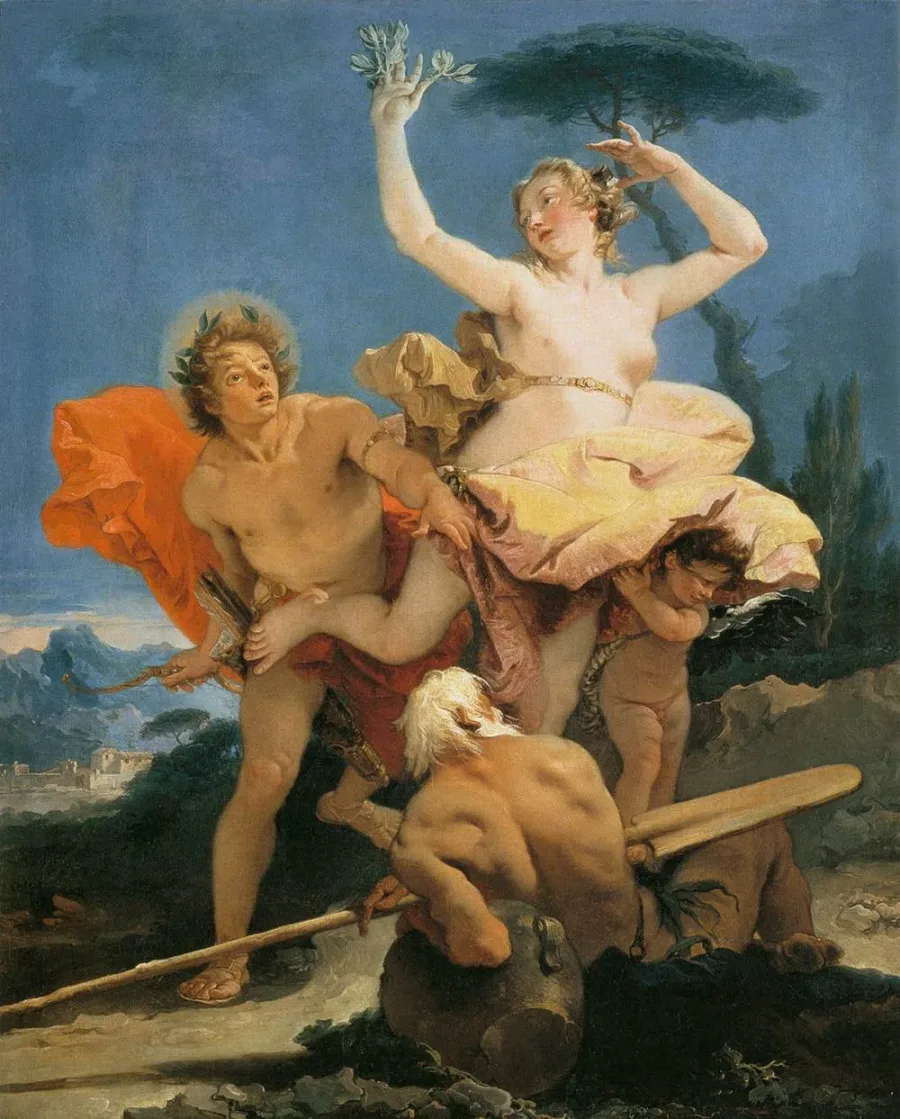
The etymology of the name Apollōn has been debated since ancient times and remains undetermined today. Several theories have been proposed, such as "the destroyer," "the perfect one," or "the leader of the herd."
Apollo was inherited in Roman mythology under the name Apollo, remaining almost entirely unchanged. While many other Greek gods had their names changed in Roman mythology, Apollo retained nearly the same name and divinity in both Greek and Roman traditions.
Apollo was born to Zeus and the goddess Leto. Subjected to Hera's jealousy, Leto wandered the world in search of a place to give birth. The earth, fearing Hera, would not accept Leto, but the island of Delos, floating on the sea, took her in, and there the twins Apollo and Artemis were born.
Upon his birth, Apollo immediately demonstrated his divine power and took up his silver bow. In his youth (or as a young man), he slew the great serpent Python and made Delphi his own sacred site.
2. What are Apollo's "Powers"?
Apollo is known as a god who governs various powers. Let us look at them one by one.
2.1. Light and the SunAs a god of light, Apollo is often associated with the sun. Strictly speaking, the original "sun god" was Helios, and they were clearly distinguished as separate deities until the time of Homer and Hesiod. However, they began to be gradually identified as one starting with the works of Euripides in the 5th century BC. As time passed, they became unified as "Apollo Helios" during the Hellenistic period.
When Apollo is spoken of as the "god of light," it carries more of a nuance of "knowledge" or the "light of revelation" rather than the physical light of the sun. It is a light that illuminates the darkness of ignorance and reveals the truth. In that sense, his connection to prophecy and poetry is understandable.
One of Apollo's most important powers is prophecy. The Temple of Apollo at Delphi was the largest oracle in the ancient Greek world. It was a sanctuary where every Greek city-state, and even kings from afar, would seek guidance before making important decisions.
The phrase "Know thyself" was said to be inscribed at the entrance to Delphi, and this saying is deeply linked to Apollo's aspect as a god of prophecy.
Apollo is also the patron god of music, poetry, and art. The lyre (kithara) is Apollo's symbolic attribute, and he holds the title "Musagetes" (leader of the Muses).
Poetry was a medium for conveying the words of the gods to humans, and music was a way to express the unseen world. The reason prophecy, poetry, and music are all tied to the single god Apollo is that in ancient times, "speaking," "singing," and "conveying the words of the gods" were inextricably linked.
Apollo is also a god who carries a silver bow. As a god who shoots arrows from afar, he was also spoken of as a being who rains arrows of plague (punishment) upon humans. The Iliad begins with a scene where Apollo shoots arrows of plague at the Greek army.
The fact that the god who brings plague is also the father of Asclepius, the god of medicine, is an interesting point.
3. Famous Episodes, Paintings, and Source Works of Apollo
3.1. The Story of Apollo and DaphneThis story begins with Apollo insulting the god of love, Eros. An angry Eros shot a golden arrow of love at Apollo and a leaden arrow of rejection at the nymph Daphne. Apollo fell madly in love with Daphne and chased her, but Daphne refused him at all costs. Just as she was about to collapse from running, she prayed to her father, the river god Peneus, to "change this form," and she transformed into a laurel tree. Apollo embraced the tree and vowed to honor the laurel forever as his sacred tree, to be used as a crown for victors and poets.
This story is described in detail in Book I of Ovid's Metamorphoses.
We introduce this story in detail in #11.
Apollo, who fell in love with Cassandra, daughter of King Priam of Troy, sought her love in exchange for granting her the gift of prophecy. However, once Cassandra gained the ability, she broke her promise and rejected Apollo. Angry, but unable to take back the power, Apollo instead cursed her so that 'no one would ever believe her prophecies.' Cassandra prophesied the fall of Troy, the trap of the Trojan Horse, and the death of Agamemnon, but not a single person would listen to her words. She became a prophet burdened with the unique suffering of speaking the truth while never being heard.
This episode is briefly mentioned in Homer's Iliad, and Aeschylus's Agamemnon and Euripides's The Trojan Women are cited as important sources. In painting, it has been depicted repeatedly as the tragedy of a prophet rejected by a god, such as in Evelyn De Morgan's 'Cassandra' (1898, The De Morgan Foundation, London).
3.3. The Musical Contest Between Apollo and MarsyasThe satyr Marsyas picked up the aulos flute discarded by the goddess Athena and practiced until he boasted, 'I can even beat Apollo, the god of music.' Apollo accepted the challenge, and the contest began with the condition that the winner could do whatever they pleased with the loser. Marsyas played the flute, and Apollo played the lyre. When the contest remained undecided, Apollo played his lyre upside down and challenged Marsyas to do the same with his flute. Marsyas could not do so, and his defeat was sealed. Apollo gave him the cruel punishment of hanging Marsyas from a pine tree and flaying him alive. It is said that Apollo later regretted his actions and did not play the strings of his lyre for some time.
This story is told in Book VI of Ovid's Metamorphoses and Apollodorus's The Library of Greek Mythology.
3.4. The Battle Between Apollo and PythonThe great serpent Python, a child of Gaia (the Earth), once guarded the oracle at Delphi. It is also said to have tormented Apollo's mother, Leto. Apollo slew this great serpent with his golden bow and arrows and established Delphi as his own sacred site. This is considered the origin of the Delphic Oracle. It is often depicted as Apollo's first great act and is also the story that establishes his authority as the god of prophecy. However, depending on the tradition, it is said that Apollo slew it while he was still an infant, or that he did so after he had become a young man. It is also said that after the slaying, Apollo went into exile to purify himself for shedding blood, and upon his return, he founded the Pythian Games.
This story is described in the Homeric Hymn to Apollo (Hymn 3) and Book I of Ovid's Metamorphoses.
3.5. Apollo and Asclepius (Coronis)Apollo loved the Thessalian princess Coronis, and she became pregnant. However, while Apollo was away, she fell in love with a human youth named Ischys. When a white crow (or Apollo's own prophetic ability) that had been watching Coronis reported this, Apollo was filled with intense rage and had his sister Artemis shoot Coronis, or it is said that Apollo shot her himself with an arrow. Just before Coronis was cremated, Apollo rescued the child from her womb and entrusted him to the wise centaur Chiron. This child was the future god of medicine, Asclepius. Furthermore, it is said that the crow that brought the news had its white feathers scorched black by Apollo's anger, and that all crows have been black ever since.
The main sources for this story are Pindar's Pythian Ode 3 and Book II of Ovid's Metamorphoses.
4. A Deeper Look at Apollo's Complex Divinity
4.1. Apollo as the 'God of Order'Apollo is often spoken of as a god of order, harmony, and balance. As symbolized by the phrase 'Know thyself,' knowing moderation and keeping within one's limits were considered Apollonian wisdom.
In later times, Nietzsche contrasted the Apollonian and the Dionysian in 'The Birth of Tragedy.' The Apollonian represents order, form, reason, and the clarity of the individual, while the Dionysian represents chaos, intoxication, emotion, and the dissolution of the individual. This contrast had a major influence on the study of Greek mythology, but it is also pointed out that it is a 19th-century German philosophical interpretation and does not always overlap with the image of Apollo in the original texts.
Apollo has many romantic episodes, but most of them end in sadness for both parties.
Daphne escaped Apollo by transforming into a laurel tree, and Cassandra, after being granted the gift of prophecy, rejected Apollo's love and was cursed so that "no one would believe her prophecies." Furthermore, Hyacinthus met his end when a discus thrown during a game struck his head due to the jealousy of Zephyrus, the god of the west wind; it is said that the hyacinth flower was born from his blood.
Even Apollo, who shines brightly and appears perfect, seems to have a series of fruitless results in love.
While Apollo is the "God of Light," he also brings plague, and although he is the "God of Beauty," he is not blessed in love. Moreover, while Apollo is the "God of Prophecy," his prophecies were often misinterpreted by humans. For example, King Croesus of Lydia interpreted the Delphic oracle, "If you attack Persia, you will destroy a great empire," as a promise of his own victory and marched to war, but it was his own kingdom that was actually destroyed. When Croesus later complained that "the god betrayed me," the reply from Delphi was, "The god spoke only the truth. It was human interpretation that was mistaken." Apollo's prophecies have repeatedly shown that while the words of the gods themselves are correct, humans tend to interpret them in ways that suit their own convenience. Similarly, Oedipus, who received the oracle at Delphi that he would "kill his father and marry his mother," also ended up fulfilling the prophecy while trying to avoid the tragedy.
5. Conclusion
Apollo is one of the most multifaceted gods in Greek mythology, embodying light, prophecy, music, and plague all at once.
These conflicting structures within Apollo—perfect beauty and unreachable love, the guardian of order and the arrows of plague—suggest that myths are not just simple stories, but carry profound messages.
Next time, the theme will be the "Trojan War," one of the events where the gods are deeply involved in the human world. Apollo also plays an important role in that ten-year war. We will take a close look at how the greatest battle in Greek mythology began and what it brought about.
References
・Homeric Hymn to Apollo (Translated by Yoshihiko Kutsukake, included in "Homeric Hymns," Chikuma Shobo)
・Homer, "Iliad" (Translated by Chiaki Matsudaira, Iwanami Bunko)
・Apollodorus, "The Library of Greek Mythology" (Translated by Harushige Kōzu, Iwanami Bunko)
・Friedrich Nietzsche, "The Birth of Tragedy" (Translated by Hideo Akiyama, Iwanami Bunko)