Hello, this is q_ru. This time, I've put together an article for the Pokémon series to help those who aren't very familiar with games enjoy my videos even more.
I'm writing this for those who don't own the game or are absolute beginners, so I'll start from the very basics.
I've also included my own way of thinking, so it might sometimes serve as a hint for improvement for those who play games regularly but aren't very good at them and want to get better.
Type Matchups
To begin with, do you all perfectly understand Pokémon type matchups?
You don't, right? Neither do I.
Actually, Pokémon type matchups are very complicated.
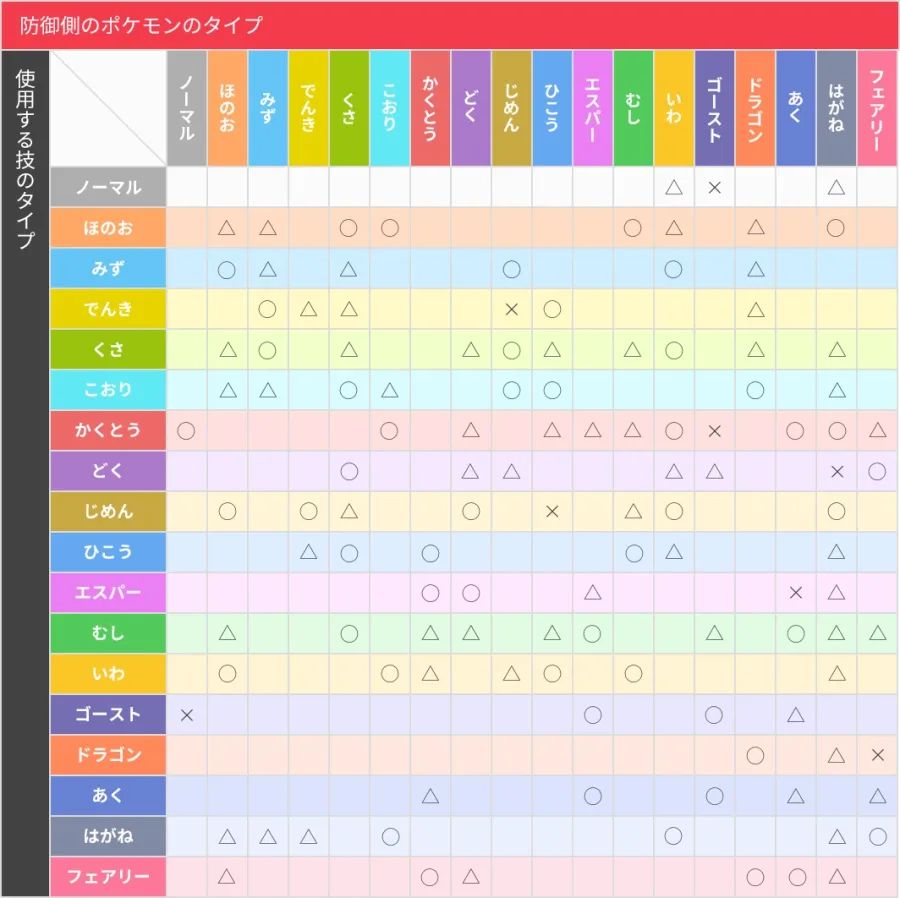
First, please take a look at this chart.
Cited from the official Pokémon website
: https://www.pokemon.co.jp/ex/sun_moon/fight/161215_01.html
Some of you may have noticed while looking at the chart, but it's not always the case that if something is super effective, the reverse is not very effective.
(In the chart, ○ is super effective, △ is not very effective, and × is ineffective. Blank spaces are normal (neutral) damage.)
For example, Grass is not very effective against Dragon, but Dragon is not super effective against Grass.
It's confusing.
And it's not the case that every Pokémon has only one type (from here on, I'll call this a single type); there are Pokémon that have two types (from here on, I'll call this a dual type).
When that happens, the confusion simply doubles.
It's too much.
Also, type matchups have changed in the past, and types have even been added.
Not only the Fairy type, but actually the Dark and Steel types were also added later.
Even if you go to the trouble of memorizing them, there might come a time when they change again.
I've been rambling for a while, but since Pokémon Sun and Moon, the game started showing you the matchups, so honestly, you don't need to memorize them. It's a godsend.
Generations
I sometimes refer to 'Generation 5 Pokémon,' but this indicates which game the Pokémon first appeared in. I'll list them along with the starter Pokémon (the first three Pokémon).
Generation 1(Red, Green: Charmander, Squirtle, Bulbasaur)
Generation 2(Gold, Silver: Cyndaquil, Totodile, Chikorita)
Generation 3(Ruby, Sapphire: Torchic, Mudkip, Treecko)
Generation 4(Diamond, Pearl: Chimchar, Piplup, Turtwig)
Generation 5(Black, White: Tepig, Oshawott, Snivy)
Generation 6(X, Y: Fennekin, Froakie, Chespin)
Generation 7(Sun, Moon: Litten, Popplio, Rowlet)
Generation 8(Sword, Shield: Scorbunny, Sobble, Grookey)
Generation 9(Scarlet, Violet: Fuecoco, Quaxly, Sprigatito)
Mysterious Alphabet
You might hear me say things in my videos like 'this Pokémon has high S' or 'low C', but these letters are associated with each of the Pokémon's stats.
H (Health, HP)
A (Attack)
B (Defense)
C (Special Attack)
D (Special Defense)
S (Speed)
Move Damage Multipliers
To get a rough idea of a move's damage, you need to know how much of a multiplier is added to the move's power and what the final power will be. So, I'll explain just five of the main multipliers that apply to moves. (There are others, but I'll skip them this time.)
As mentioned before, super effective gets a 2x multiplier, and not very effective gets a 0.5x multiplier.
In the case of dual types, the multipliers for both types are calculated, so for example, if you use a Fighting-type move on a Rock/Ice-type Pokémon, the power becomes 4x, and if you use a Grass-type move on a Dragon/Fire-type Pokémon, the power becomes 0.25x.
This is surprisingly not well known, but if you use a move of the same type as the Pokémon using it, the power increases by 1.5x. This is called STAB (Same Type Attack Bonus), and while dual-type Pokémon may have more weaknesses than single-type Pokémon, they also have the advantage of having a wider variety of STAB moves.
Pokémon have moves and abilities that can change the field.
The types of fields are Electric Terrain, Grassy Terrain, Psychic Terrain, and Misty Terrain.
In Electric, Electric-type moves get a 1.3x power boost; in Grassy, Grass-type moves get 1.3x; in Psychic, Psychic-type moves get 1.3x; and in Misty, Dragon-type moves have their power reduced to 0.5x.
Each field also has other effects, such as preventing confusion or blocking priority moves, but I'll skip those for now.
The power of a Pokémon's moves can be increased by having them hold items.
Major items include the Choice Band (increases move power by 1.5x but locks you into the same move) and the Life Orb (increases move power by 1.3x but you take damage every turn).
This is a bit different from the others because it's purely luck-based, but if a move lands a critical hit, its power is 1.5x. Critical hits happen with a 1/24 probability, so you generally don't need to consider them when calculating power.
(Some abilities and moves can increase this probability, so be careful when facing Pokémon that have them.)
Based on these, if a Pokémon holding a
Life Orb uses a STAB move with 70 power that is super effective against the opponent, it becomes
1.3 × 1.5 × 70 × 2 = 273
as you can see.
By roughly calculating this during battle, you'll be able to tell which move has the most power in the current situation.
Since moves of the same power deal the same damage to the same Pokémon (strictly speaking, it's different because of a factor called random numbers), you can also grasp roughly how much damage you'll deal even if you switch to a different Pokémon.
Convenient, right?
Types of moves
There are three types of moves.
Physical moves, Special moves, and Status moves.
(Honestly, you don't need to memorize which is which. They are written in the subtitles in the videos anyway.)
Physical moves are moves that seem to hit the opponent directly. The attacker refers to their Attack stat, and the receiver refers to their Defense stat. There are exceptions like Foul Play (where the attacker refers to the opponent's Attack stat).
Special moves are moves like, 'Hey! That's magic!' The attacker refers to their Special Attack stat, and the receiver refers to their Special Defense stat. There are exceptions like Psyshock (which is a special move but refers to the opponent's Defense instead of Special Defense).
Status moves basically do not deal damage to the opponent when used, often affect stats, and many of them are guaranteed to hit.
※As an aside, there was a time in the past when physical and special moves were categorized by move type. Since base stats haven't fundamentally changed from what they are now, it seems Pokémon whose base stats and types didn't match were treated quite poorly... (like Sceptile).
The Three Values
Now, it is no exaggeration to say that this is the most important part, so I will touch upon the element called the 'Three Values.' The Three Values refer to Individual Values, Effort Values, and Base Stats.
In the flow of the conversation, I think it will be easier to understand if we assume base stats first, so I will explain from base stats.
Base StatsThese are hidden stats assigned to the HABCDS of each Pokémon. (Because of this, the official sources have never explicitly stated these numbers.)
To explain it very simply and roughly, even in the real world, certain abilities are determined by the organism. For example, cheetahs are fast runners, gorillas are strong, and rhinoceros skin is hard and difficult to damage.
This idea that 'this organism is basically good at this ability' is what base stats are.
Since not all Pokémon have unique base stats, Pokémon with the same numbers are sometimes called a 'tribe' or 'group'.
For example, Charizard, Zapdos, and Volcarona, which all have a base Speed stat of 100, are sometimes called the 'Base 100 Speed group'.
Individual ValuesThis is exactly as the name suggests. If I talk about the difficult stuff, it becomes a conversation about how there are 32 different values for each of HABCDS, so I will explain this roughly as well.
I think there are slow people and fast people among humans as well.
That is what is happening with each stat in the Pokémon world.
Basically, it is better to have higher stats, so hardcore players will carefully select these. (I will omit the explanation of detailed adjustments for now.)
Individual values can be checked using the Judge feature.
In recent Pokémon games, you can use it in your Pokémon Boxes after talking to a specific person, usually after clearing the game.
In the game, they are expressed in words rather than numbers.
From lowest to highest:
No Good
↓
Decent
↓
Pretty Good
↓
Very Good
↓
Fantastic
↓
Best
.
The best stats are often called 'V'.
I'm sure some of you have heard of 6V Pokémon.
In recent Pokémon series, you can use Bottle Caps and Gold Bottle Caps to bring stats to their maximum state. A god-tier system.
Because IV breeding in the days before this was hell.
This might be the one people are least familiar with.
By the way, effort values are referred to as 'base points' in the game.
To explain it roughly, it's like saying even if someone is born slow, if they keep putting in the effort to run, they can eventually beat someone who was born fast.
Since I have to talk about numbers here, a lot of them will come up, but please bear with me.
You can invest up to 510 effort values into one Pokémon, and up to 252 into a single stat.
There are mainly two ways to invest effort values into a Pokémon: defeating wild Pokémon, and administering vitamins. (There are others, but I'll omit them this time.)
Defeating a wild Pokémon generally gives you 1 point. (Though some first-evolution Pokémon give 2, and there are items that can increase the effort values you receive.)
Which effort value you receive is determined by the Pokémon, and basically, you get the effort value for that Pokémon's highest base stat.
Among those who played Pokémon as children, haven't you ever thought, 'Aren't the Pokémon I traveled with stronger than the ones I just caught in the wild?' That is caused by this system.
Vitamins (like Protein or HP Up) can be administered to add 10 effort values.
In recent Pokémon games, these can also be bought with money, so this is basically the method used to invest effort values. It's a level of training convenience unthinkable in the old days when you had to keep hunting wild Pokémon endlessly. It's the best.
Even in the world of Pokémon, money is everything.
For those of you who are frustrated and wondering, 'How much stronger does it actually get when you invest effort values?', wait no longer. I will explain that from here.
From here on, I will refer to the numerical values of Pokémon stats as actual values.
For effort values, the first 4 points invested in each stat increase the actual value by 1, and from there, every 8 points increase the actual value by 1.
(For the actual values of a level 50 Pokémon. The calculation method is different for other levels, but you don't need to memorize it.)
In other words, you can increase the actual value of each stat by 32 from its base state. Simple, right?
※ As an aside, since investing 252 into two stats leaves 6 remaining, it is often the case that investing 508 instead of the full 510 will result in the maximum possible stats.
If the individual value is 'Best', the actual value of a level 50 Pokémon is the base stat + 75 for HP, and for stats other than HP, it is the base stat + 20 to get the base actual value.
Stat Ranks
Stat ranks are stats that change along with notifications like '—'s Attack rose!' or '—'s Defense fell!' (HP does not have stat ranks.)
They mainly change due to status moves, abilities, or move effects, and can change up to 6 stages in either the positive or negative direction. (Counting the normal state as 0, there are 13 stages in total.)
When these change, the multiplier applied to the Pokémon's stats changes.
The way multipliers change differs between accuracy and evasion and other stats.
Accuracy and evasion have a 1x multiplier at 3/3 in their normal state. The numerator increases by 1 for each stat rank increase (can change from 3/3 to 9/3). The denominator increases by 1 for each stat rank decrease (can change from 3/3 to 3/9).
Other stats have a 1x multiplier at 2/2 in their normal state, but the mechanism for how they change is the same.
Essential helpful websites
Pokémon Tettei Kouryaku: https://yakkun.com
A god-tier site where you can check detailed Pokémon data for each series. If you are a Pokémon beginner, you can just copy the Pokémon builds here and you will be fine. It also has great features like searching for moves they can learn.
Damage Calculation Tool SV by PokeSol
: https://sv.pokesol.com/calc
A damage calculation tool created by the people at Pokémon Soldier, also known as PokeSol. It is my personal favorite damage calculator because it can calculate damage additions, Stealth Rock, and berry recovery. PokeSol also has a YouTube channel where they post interesting videos every day.
Pokémon Wiki:https://wiki.ポケモン.com/wiki/メインページ
An amazing site that contains almost all of Pokémon history. It is fun to learn things you didn't know, like "That character existed!?" or "That move had that kind of mechanic..."
How to think about battles
From here on, I will basically write about what I think about during Pokémon battles and my approach to them. First, as a premise, I believe that it is harder to improve rapidly in Pokémon than in other games. It would be helpful if you read this not as a way to become the strongest, but as a way to improve little by little.
First, if you have started playing Pokémon, I think it is important not to be too attached to your own ideas. I think you should just try to imitate skilled players. Let go of your ego. You are robots. What is important when imitating is not to use a team based on defense, but a team based on high-firepower offense. Defensive teams make you feel like "no one can defeat this Pokémon, so it's the best," but most people have countermeasures for that. Because of that, you have to engage in mind games like switching to another Pokémon in the back to counter the opponent's counter-Pokémon, and beginners who haven't gained experience yet often lose due to that gap. Considering that, it is easier to win and feel the joy of winning by using an offensive team that can defeat the opponent even if you use moves somewhat randomly, which makes it easier to keep playing.
This is what is commonly called reducing the rock-paper-scissors element.
There is talk that skilled players are good at reading the opponent, but in the extreme, reading is just a game of luck.(Although it cannot be called a game of luck unconditionally, as the reads of skilled players also come from intuition and experience gained from a vast number of battles.) I understand the admiration and I think it is good to have your own ideas, but that kind of thing won't be stable while you are a beginner, and your switch-read Swords Dance as a beginner is nothing more than a lucky play. For now,
let go of your admiration
and try playing straightforward Pokémon.
Pokémon has a strong element of luck, but that is because it is fun to have mind games that take that luck element into account after you have gained a certain level of skill; just playing it as a game of luck means you aren't truly experiencing the fun of Pokémon, which I feel is a waste. (This is entirely my own philosophy.) If you only want to play a game of luck, I think you should try using one-hit KO moves forever.
If you find training tedious but want to try Pokémon battles first, I recommend using rental teams with almost fixed selections. You can learn the basics first, build a foundation for your thinking, and then create your own ideas later. If you have established your own ideas, such as "looking at the current trends, I should change this Pokémon to another one" for the rental team you were using, then you are a full-fledged trainer.
"This Pokémon is strong! Then let's put a Pokémon that can counter (meta) it in our party!" If you are serious about winning, I think it is better to have the mindset of building a passive team that counters the opponent rather than building a team based on yourself.
Let's put aside your love for specific characters for now.
Just play as many matches as you can.Compared to other games, Pokémon has a much wider range of team-building options, so the competitive environment changes rapidly.
Because of that aspect, I think it's better to approach Pokémon online battles with a card game mindset.
Just to explain, the 'environment' refers to the current trends in the game.
To read that environment, you need to rack up as many battles as possible and see the teams that various people are using.
This is essential for grasping which Pokémon are strong, as mentioned in the team-building section earlier.
You can also develop a sense for damage in Pokémon, and since Pokémon is ultimately a game of information, the number of attempts you make really counts.
Quantity over quality.
Also, Pokémon moves, items, and abilities have such detailed mechanics that you won't understand them just by looking them up briefly, so I think it's important to have the experience of getting tripped up by them at least once.
Pokémon is a game that requires a lot of knowledge, both about the environment and about the Pokémon themselves.
In other words, it means that anyone has the potential to become the strongest trainer if they gain experience while thinking for themselves.
What did you think?
If this article helps you enjoy my Pokémon videos even more, and if I dare say, if it makes you even slightly more interested in the Pokémon franchise, then I feel it was worth writing this article.
Thank you for reading until the end! Have a great Pokémon life!