9:00 AM at Gifu-Hashima Station. Looking from the Shinkansen platform, you can see the Meitetsu platform. I pass through the ticket gate and head to the Meitetsu Shin-Hashima Station.
It is raining. There are surprisingly many passengers on the two-car, red Meitetsu-colored train. It proceeds while stopping at each station, as is typical for a local line. The number of passengers increases along the way, and by the time we reach the final stop, Kasamatsu, there are even people standing. There seem to be many students; perhaps there is a university nearby.
It is not yet 9:30 AM. Today I am going to Kasamatsu Racecourse in the southern part of Gifu Prefecture, but the gates don't open until 10:00, so there is still plenty of time. After going through the underpass and crossing the road, I reach the embankment of the Kiso River. The road on the embankment has heavy traffic, but there is a staff member at the small pedestrian crossing who stops the cars when I appear. I think to myself, as expected of a place in front of a racecourse.
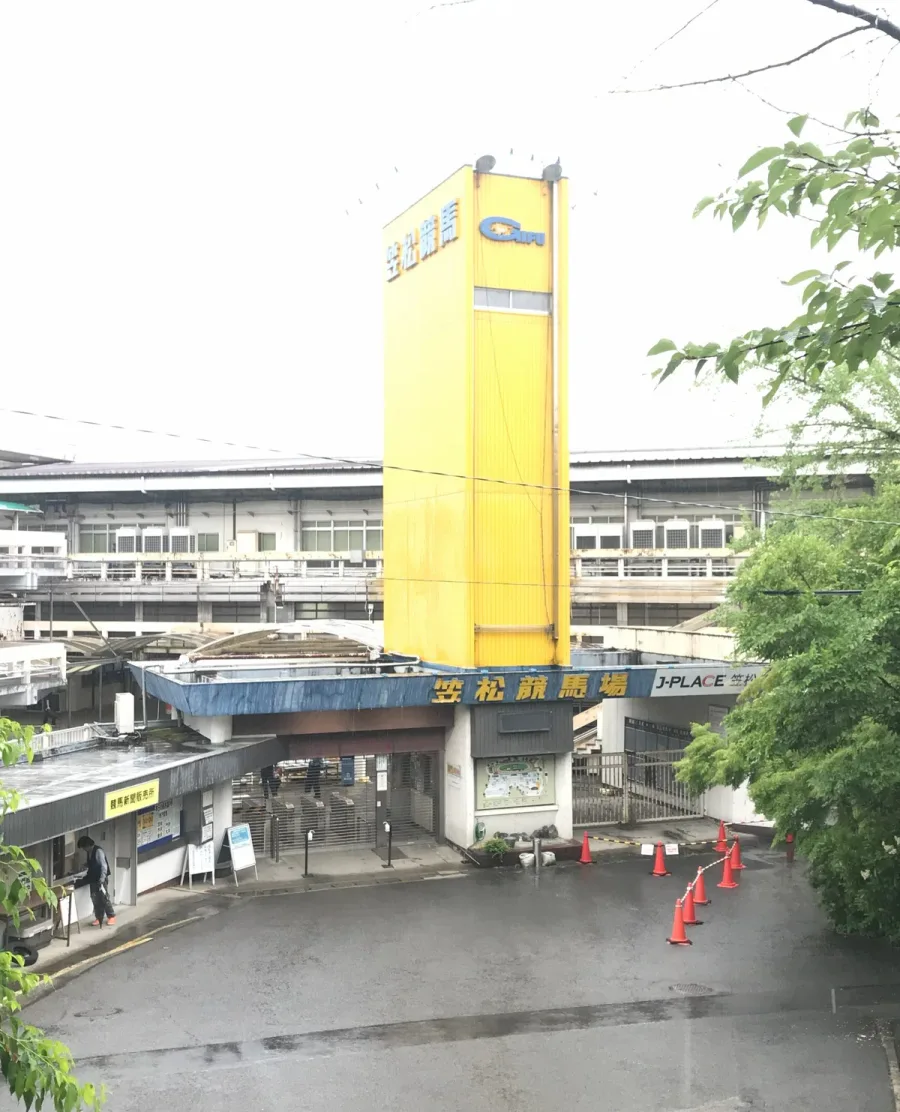
Kasamatsu Racecourse is located inside the embankment of the Kiso River. From the top of the embankment, I can see the entrance gate with a yellow tower-like structure. The cut-out letters for "Kasamatsu Racecourse" are also yellow. Actually, this was my second time coming here. I visited two months ago when there were no races. At that time, they were selling tickets for other local racecourses, so I was able to go inside. I walked around the track and the stands, bought a small bet for Sonoda, drank a beer with some kushikatsu, and went home. It was deserted, but I thought I would come back on a race day because of its unique atmosphere.
I go down the stairs and approach the entrance gate. There are only two people ahead of me. That makes sense, as it is still 30 minutes before opening. A man is talking enthusiastically to the woman at the racing newspaper stand. I decide to take shelter from the rain under the eaves a little way off.
Then, the man who spotted me started talking to me. He was probably in his 40s, with a bearded face and messy hair. He said he works transporting fresh fish by truck, but since he came to a nearby market today, he rode his bicycle from there to the racecourse. After that, he told me endless tales of his horse racing history—stories about hitting a "manshu" and winning 2 million yen in one race, or winning 28 million yen in four races and buying a used Mercedes. By the way, "manshu" is originally a boat racing term referring to a "man-shu" ticket. It means a winning horse racing ticket where a 100-yen bet turns into 10,000 yen. Later, a local man also used the word "manshu," so perhaps that is what they call a winning ticket around here.
The long story continued for about 20 minutes, and when it was finally time for the gates to open, he said he had forgotten his wallet at his lodging—no, no, I thought, you are buying a racing newspaper—but according to him, he just happened to have 600 yen in his pocket. I parted ways with the man there.
The gates opened exactly at 10:00. About 50 customers had already gathered. Unlike the JRA (Central Horse Racing), admission is free. The rain has intensified, but you can move around inside the track without getting wet.
Kasamatsu Racecourse has three stands: West, Central, and East. Perhaps because it wasn't a race day when I visited the other day, only the West Stand, which is closest to the main gate, was in use. Today, on the contrary, all stands are open.Among them, the Central Stand is the oldest. It has a cantilever roof like the silver canopy at Koshien Stadium, and benches are set up on concrete tiers. I went up the inner stairs while avoiding the rain. The lights in the hallway were not on, and it was dim. A glass-enclosed room labeled "Cafe Section" was closed. There was a counter where they might have served drinks, and an old cash register was left behind.
When I went outside, it was a tasteful stand. However, there was an "X" mark on the seats of the benches. It seems that this stand is not to be used. No wonder there were no customers. But I was satisfied to be able to enter such a wonderfully antique stand.
I went to the East Stand at the very back. There are ticket machines here too, and customers are sitting in the stands. This stand is located close to the paddock (viewing area), which is very convenient.I think it is hard for racing fans who have never been to Kasamatsu to understand, but at this racecourse, the paddock is inside the track. At first, I also thought that to go see the paddock, you would have to go through an underground passage under the track. But in reality, you cannot get close to the paddock and have to view it from a distance from the stands. This can be said to be a feature not found at other racecourses. Still, it is a small racecourse. You can see the horses reasonably well.
The first race starts at 10:35 AM. The horses walk from the left inside the track to the paddock. And in the rain, they circle the narrow paddock.
The distance for the first race was 800m. When I first saw it, I was surprised: 800m?! Isn't that too short even for local horse racing? However, the Kasamatsu course is about 1100m per lap, and the straight from the 4th corner to the finish line is only about 200m. In other words, there is only one furlong of straight here, and the furlong poles (distance markers) that are placed every 200m in central horse racing are placed every 100m here. This naturally leads to the rule that horses in the lead have an advantage (although actual races are not that simple). In any case, 800m means they don't even do a full lap, so the starting point was set near the 2nd corner.
Kasamatsu, which was called the "poorest racecourse" by the writer I admire, TDC Fujiki, has a large screen, even if it is small. When the starter is shown on it, it is time for the race to start. When the 10-horse race starts, it is surprisingly worth watching, even if it is only 800m. The track is in poor condition due to the rain since yesterday, and you can see water spray rising near the 4th corner. The horses came rushing into the straight in a group. The sound of hooves hitting the ground jumped into my ears, and the large horse bodies passed in front of me, kicking up sand. The result of the first race was 7-10-8. I had bought 4 combinations of quinella (predicting 1st and 2nd place in any order) with number 9 as the axis, but I missed it completely.
Local horse racing often ends with the favorites winning compared to central horse racing. However, it is not that easy to win. I have over 30 years of horse racing experience, but the result is always a loss, and it is rare for me to hit a winner. First, let me get used to Kasamatsu slowly.
After missing the second race as expected, I reached the third race. It was a 1400m race, the standard distance for Kasamatsu, with 10 horses.Looking at the racing newspaper, horse number 5 was the overwhelming favorite with "◎" marks lined up. In central horse racing, I tend to get ambitious and bet on longshots, but today I had switched to a policy of trusting the favorite. Without hesitation, I bought 9 quinella combinations, betting on number 5 across the board.
The gate is placed behind the 4th corner to the right of the stands. The horses that started passed in front of the stands once, went around the track, and returned to the straight. In the rain, the first one to cross the finish line was the longshot number 10, but the favorite I used as my axis caught up and finished 2nd, so I was able to win successfully.This is the real thrill of horse racing. If you don't win, it's endlessly lonely and miserable, but when you do win, you start to feel like you've become something amazing. Having won for the first time at Kasamatsu, I felt a bit emboldened and decided to skip the 4th race and drink a beer.
Today, all the food stalls in the track were open. Simple snacks like kushikatsu, doteyaki, and yakitori were lined up. When I ordered two kushikatsu, the woman at the shop asked, "Miso? Or sauce?" I ordered miso without hesitation and had her pour me a draft beer. The small refund and the cost of food and drink were about the same amount.
As I sit in the grandstand watching the paddock, I can hear the conversations of the regulars gathered in one corner. The man in glasses, in particular, talks a lot. When the field size reaches 12 horses, he says in the Nagoya dialect, "There's no way to win with this." Fans like this do a lot of "grumbling," but it seemed like the man was winning his fair share of bets.
In the 5th and 6th races, I had a hard time because the favorites didn't come through, but in the 7th race, my anchor, number 6, pulled away from a good position to take 1st place. Since I had also bought a win ticket and the 2nd place horse was a long shot, it paid out reasonably well. While cheering in my heart, I walked down from the stand with a very bored look on my face. I decided to skip the next race and go to the shop I mentioned earlier.
This time I went inside and sat at a table. I ordered a bottled beer and, as is local custom, a "dote-don." It was a simple dish of dote-yaki served over a bowl of rice, but it tasted exceptional. As I drank my beer and looked around the small shop, I saw posters and photos of Oguri Cap displayed.
The gray horse Oguri Cap, who would later become a star in the JRA, made his debut here in Kasamatsu in 1987. He moved from local racing to the central circuit, won four G1 races, and became an idol horse. A bronze statue of Oguri Cap stands beside the main gate of Kasamatsu, showing that he was the pride of this rustic racecourse.
Thirty-five years have passed since then. Time has flowed, and a rainy Kasamatsu felt lonely. Most of the customers seemed to be locals, and there were few people there to watch the horses sprinting through the dirt, kicking up spray. To me, the grandstand and facilities, which seem absolutely wonderful, and the slowly passing time, would likely just look shabby and sluggish to the average person. The windows at Kasamatsu are cloudy and you can't see the scenery beyond, but I feel like I want to keep watching the horses run here forever.
Today there are 12 races. However, the final race starts at 16:55, so if I stay until the end, it will be late. So, I decided to finish after the 9th race, the Neo River Prize. The reason I stopped at the 9th race was because there was a very solid favorite in that race.
The number 9 horse had "double circles" (top pick) across the board. It hadn't finished outside the top two in its last four races. Without hesitation, I made it my anchor and bought 11 combinations. Number 9 pushed up from a good position and rounded the 4th corner; although it was passed by the rival number 5 at the end, it safely finished in 2nd place. When I put the winning ticket into the payout machine, coins came clattering out. I won, but the odds were low, so my balance ended up in the negative.
It was still raining. I went to the restroom and returned to the main gate. I walked out of the gate, gazing aimlessly at the bronze statue of Oguri Cap. The window of the racing paper stand, which had been open in the morning, was already closed. I crossed the pedestrian bridge on the embankment and headed down, and the station was right there. Six hours passed in the blink of an eye. A paradise on earth existed in Kasamatsu.