The Rio de Janeiro Carnival, the sound of countless drums echoing in the night sky, a parade of thousands filling the streets—this is undoubtedly the sound of Samba. The low "thud" of the surdo, the crisp "shing" of the pandeiro, the sharp "kin" of the tamborim. These layers combine to create the world's most cheerful, precise, and large-scale rhythmic music.
Samba is Brazil's national music. Since "Pelo Telefone" was released as the first official samba recording in 1916, it has remained at the heart of Brazilian music. Both Bossa Nova and MPB were born from samba, and almost all roots of modern Brazilian music can be traced back to it. In 2005, UNESCO recognized its cultural value globally by registering "Samba de Roda," a form of samba from Rio, as an Intangible Cultural Heritage.
In this article, we will summarize the characteristics, history, representative songs, and even how to create samba using DTM. Why are there three types of surdos? What is the difference between a tamborim and a pandeiro? How is a samba-enredo (samba for carnival) structured? By the time you finish reading, you will surely want to program the roar of a Rio night into your DAW.
What is Samba? Let's Understand the Basics of the Genre
Samba is a traditional Brazilian music that was established in Rio de Janeiro in the early 20th century. It developed through the fusion of Afro-Brazilian culture (musical traditions of African people with roots in Bahia) and Rio's urban culture.
Let's organize the characteristics of the sound.
2/4 time rhythm
Samba is traditionally notated in 2/4 time. At first glance, it looks like a simple duple meter, but in reality, it is packed with numerous syncopations, creating a complex tapestry of rhythm behind its apparent simplicity.
Samba Batucada
The foundation of samba rhythm is called "Samba Batucada" or simply "Batucada." It is a structure where multiple percussion instruments play different patterns, forming one large groove as a whole, which is the essence of samba.
Rhythmically speaking, the foundation of samba is 16th-note syncopation. Accents are placed on the downbeat of the first beat, the last 16th note of the first beat ("e of 1"), and the middle of the second beat ("and of 2"), which creates the "bouncing" feel of samba.
Main Percussion Instruments (Bateria)
The percussion group that supports samba is called the "Bateria." Especially in samba schools for the carnival (described later), a bateria of hundreds of people marches through the streets. Representative instruments are as follows.
Surdo: A large bass drum-like percussion instrument. It carries the low-frequency pulse. There are three sizes: the 1st (Marcação) falls on the second beat, and the 2nd (Resposta) falls on the first beat with a "thud." The 3rd (Cortador, or "Fly" in "Samba Reggae" terminology) is responsible for fills.
Pandeiro: A skin-headed circular percussion instrument similar to Jamaican or Middle Eastern frame drums. It has a shape close to a tambourine and is equipped with five sets of cymbal jingles. It is a versatile instrument played with the fingers to produce low, medium, and high tones, and is the foundation of samba and choro.
Tamborim: A small percussion instrument about 15cm in diameter. It is played with a plastic stick. It handles the "melodic" elements of the samba rhythm and plays complex syncopations.
Cuíca: A drum that produces sound through friction. When you rub the central stick with a damp cloth, it produces a unique "squeaky" sound like a dog barking. It is the "singing" decorative tone of samba.
Agogô: A percussion instrument consisting of two connected metal bells of different pitches. It marks the rhythm with a dry metallic sound.
Ganzá: A cylindrical shaker. It contains sand or metal beads, and when shaken, it produces a "shaka-shaka" sound.
Reco-reco: A metal/wooden instrument with jagged grooves carved into it. It is played by scraping it with a stick to produce a "scratchy" sound.
These overlap simultaneously to create a unique samba groove.
Vocals
Samba vocals are sung in Portuguese. There is often a call-and-response between the lead and the chorus, and it is a tradition in live performances for the audience to join in the chorus. The themes of the lyrics are diverse, ranging from love and life philosophy to hymns of Brazil and carnival anthems, blending street sensibilities with poetic sensitivity.
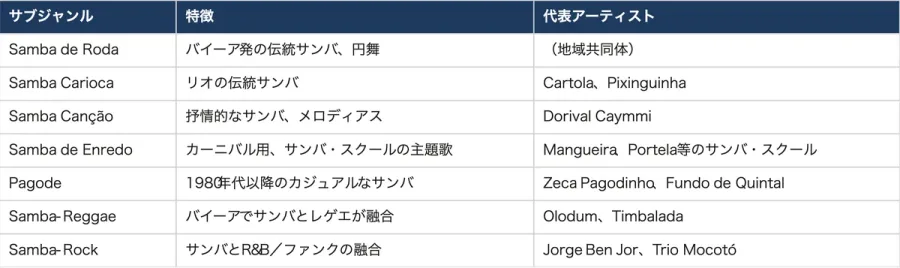
Samba is not just a single genre, but is composed of many subgenres.
Differences from Other GenresBossa Nova is a genre established by João Gilberto in 1958 with "Chega de Saudade," which significantly simplified samba. While samba features large ensembles and powerful rhythms, Bossa Nova differs in scale, characterized by small ensembles, whispered vocals, and jazz-influenced harmonies. The relationship between the two is covered in detail in the map of Brazilian music as a whole.
History of Samba: From Birth to the Present
Roots and Birth (1900s–1930s)The roots of samba lie in the state of Bahia in northeastern Brazil. In the 19th century, people brought from Africa through the slave trade fused their own musical traditions (especially West African rhythms) with the music of European settlers (such as marches and polkas).
From the late 19th to the early 20th century, amidst the abolition of slavery in Bahia (1888) and the trend of urbanization, many Black communities migrated to Rio de Janeiro. The district around "Praça Onze" in the center of Rio—especially the home of a woman from Bahia named Tia Ciata—is considered the birthplace of samba. In the 1910s, musicians who gathered here created a new urban musical style called "Samba Carioca".
The first official recording of samba is considered to be "Pelo Telefone" (1916, written by Donga). It became an explosive hit at the 1917 Rio Carnival, pushing samba to the center of national music.
In the 1930s, samba was officially recognized as Brazil's national music and became known to the world through Carmen Miranda (a Brazilian singer who later became famous in Hollywood). Ary Barroso, Noel Rosa, and Pixinguinga pushed samba to a high level of musical perfection.
Samba Schools and Carnival (1930s–Present)Indispensable to the history of samba is the "Samba School" (Escola de Samba). In 1928, the first samba school, called "Estação Primeira de Mangueira", was formed in the Mangueira district of Rio. A samba school is a massive group consisting of musicians, dancers, costume designers, and choreographers who parade in the annual carnival.
The Rio Carnival (held every year in February or March, a few days before Lent) is known for the massive performances of samba schools. In a dedicated facility called the Sambadrome, each samba school parades with thousands of people, featuring their Samba de Enredo (the theme song for that year). Mangueira, Portela, Beija-Flor, Salgueiro, and Imperatriz Leopoldinense are representative samba schools.
The bateria (percussion section) of a samba school consists of hundreds of people who keep the rhythm while marching through the streets. This is the most "large-scale" expression of samba and is the star of the Rio Carnival.
1950s–1970s: Relationship with MPB and Bossa NovaIn 1958, João Gilberto teamed up with Antonio Carlos Jobim and Vinicius de Moraes to release "Chega de Saudade." This song, which significantly simplified samba and introduced jazz harmonies, became the starting point for later Bossa Nova. Samba and Bossa Nova have a "parent and child" relationship.
In the late 1960s, MPB (Música Popular Brasileira = Brazilian Popular Music) emerged, with artists like Chico Buarque, Gilberto Gil, and Caetano Veloso developing modern pop music based on samba. Samba of this era is also known for lyrics that included social criticism under the military regime.
1980s–1990s: The Pagode RevolutionIn the 1980s, a smaller, more casual style of samba called Cacique de Ramos emerged in the Pagode district of Rio. It is an intimate form of samba sung in bars and at home parties, with Beth Carvalho and Fundo de Quintal as pioneers. Zeca Pagodinho is the biggest star of Pagode and continues to be active today.
In the 1990s, Samba-reggae, centered around Olodum, also emerged from Bahia and became known globally after Paul Simon featured Olodum on "The Rhythm of the Saints" (1990).
The current samba sceneAlthough the frequency of new monthly releases in contemporary samba has decreased, it remains alive as the central music of Brazil through the Rio Carnival culture, the Pagode live scene, and the activities of samba schools. Diverse artists such as Diogo Nogueira, Maria Rita, Teresa Cristina, and Marcelo D2 (who leans toward hip-hop samba) are active.
Internationally, Sergio Mendes, Bebel Gilberto (daughter of João Gilberto), and Seu Jorge continue to convey the charm of Brazilian music to English-speaking listeners.
Representative Samba Songs and Recommended Artists
I have selected 5 songs as an entry point to samba.
1. Francisco Alves "Aquarela do Brasil" (1939, composed by Ary Barroso)
A national anthem titled "Watercolor of Brazil." It was composed by Ary Barroso in 1939 and released through early recordings by Francisco Alves and others (premiered on stage by Aracy Cortes in June of the same year). It later spread through the singing of Carmen Miranda, who went to Hollywood, and became an external icon of Brazilian music. It is a representative song packed with the splendor of samba, the beauty of its melody, and national identity.
2. Cartola "O Mundo é um Moinho" (1976)
A signature song by Cartola (Angenor de Oliveira), known as the "poet" of samba. Singing that "the world is a windmill," it is a philosophical samba that weaves together the suffering and beauty of life. Cartola, who was also a founding member of the Mangueira samba school, left behind two solo albums in his later years, in 1974 and 1976, which condensed the spirituality of samba.
3. João Gilberto "Aguas de Março" (1974, featuring Antonio Carlos Jobim)
Although it leans toward Bossa Nova, it is a historically important song as a simplified form of samba. Composed by Tom Jobim, the version featuring João Gilberto is a classic. It is one of the pinnacles of Brazilian music, where jazz harmonic sensibilities and samba rhythms fuse.
4. Beth Carvalho "Vou Festejar" (1978)
A signature song by Beth Carvalho, known as the mother of Pagode. She popularized the new samba style of Cacique de Ramos and paved the way for the emergence of artists like Zeca Pagodinho. It is the essence of bright, celebratory samba.
5. Marcelo D2 "Loadeando" (2003, from "A Procura Da Batida Perfeita")
A contemporary representative example of fusing samba and hip-hop. A revolutionary work by former Planet Hemp rapper Marcelo D2, who layered rap over traditional samba. It is a song that proves the samba gene continues to live on in the younger generation today.
How to make samba with DTM? Production tips
Since samba is music centered on live instruments, live performance is ideally the best. However, even with DTM, if you have the right sound sources and an understanding of the patterns, you can assemble a sound that is authentic.
Characteristics of rhythm and beatBPM Setting
Traditional Samba Carioca is 100–120 BPM. Samba-enredo (for Carnival) is even faster at 130–150 BPM. Pagode is slightly slower, mainly 90–110 BPM. It is best to start building around 110 BPM.
Time Signature and Basic Pattern
Samba is in 2/4 time, but in DAWs, it is often programmed in 4/4 for convenience, treating two bars as one "Samba bar." In this article, we will show a typical Samba pattern in one 4/4 bar (16 steps).
Surdo Pattern
There are three sizes of surdo, each with a different role.
スルド1(マルカソン、低音): |....|X...|....|X...|(2拍目・4拍目で「ドン」)
スルド2(レスポスタ、中音): |X...|....|X...|....|(1拍目・3拍目で「ドン」)
スルド3(コルタード、高音): |..X.|.X..|..X.|.X..|(フィルとシンコペーション)
The relationship where Surdo 1 (Marcacao) drops heavily with a "don" and Surdo 2 (Resposta) "answers" it by sounding diagonally creates the pulse of the Samba bass. Surdo 3 (Cortado) handles decorative fills and adds movement to the track.
Tamborim Pattern
The typical "telecoteco pattern" for the tamborim is as follows.
タンボリン: |X.X.|X.XX|X.X.|X.XX|
It plays syncopation in 16th notes and handles the "melodic" rhythmic elements of Samba.
Pandeiro
The pandeiro is also called the "smallest unit of Samba" and is a versatile instrument that can express the entire rhythm of a song on its own.
パンデイロ(サムタッチ+オープンハット):
  低音:|X...|X...|X...|X...|
  高音:|..X.|..X.|..X.|..X.|
  シャラ:|X.X.|X.X.|X.X.|X.X.|
In actual performance, these are played simultaneously by one person, so using sample loops is practical.
Other Percussion Instruments
Agogo: Striking the high and low bells alternately with a "kan-kan, con-con" sound
Ganza: 8th note shaker
Cuica: Inserted as an accent with a "quee" or "kyuru" sound
Reco-reco: Adds a rustling, shaker-like texture
Selection of Percussion Samples
When creating Samba via programming, high-quality percussion samples determine success or failure. Native Instruments' "Cuba", Spitfire Audio's "Discovery: Latin Percussion", and loop & one-shot collections like Splice's "Brazilian Percussion" and "Samba" are standard.
Humanize
Since Samba percussion is played by multiple people simultaneously, perfect quantization sounds unnatural. By randomly shifting the timing of each percussion instrument by about 5–15ms and subtly varying the velocity (volume), a live-performance groove is created.
Vocals
Lead vocals in Samba are sung in Portuguese. In programming, vocal chops (short shout samples) are often used as a substitute. Vowel-centered shouts like "Ô," "Ah," and "Eh" are standard.
Horns/Strings
In Samba-canção (lyrical Samba) and Samba-jazz, horn sections and strings add color. Trumpets, flutes, and violins participate modestly and handle the melody lines.
Guitar (Cavaquinho/Violão Brasileiro)
Supporting the harmony of Samba are the cavaquinho (a small 4-string guitar) and the violão (a standard classical guitar). The cavaquinho strums chords on the 2nd and 4th beats, functioning also as a rhythm instrument. You can find materials by searching for "cavaquinho" on Splice.
List of Recommended Plugins
Song Structure (Arrangement)This is the typical structure for Samba-Canção (Carnival Samba-Enredo is more complex).
Intro (4-8 bars): Starts gently with a percussion solo or guitar arpeggio
Verse 1 (16 bars): Full bateria and vocals enter
Chorus (8-16 bars): Chorus (choir) responds
Verse 2 (16 bars): Different lyrics, continues
Instrumental Part / Horn Solo (8-16 bars): Solo instrument comes to the front
Chorus (8-16 bars): Second time, thicker arrangement
Outro (8-16 bars): Fade out or abrupt ending
These are useful keywords for Samba production.
"samba": Direct genre search
"brazilian percussion": General Brazilian percussion instruments
"surdo": Surdo alone
"pandeiro": Pandeiro alone
"tamborim": Tamborim alone
"cavaquinho": Cavaquinho material
"cuíca": Cuíca material
"pagode": Pagode style
"samba enredo": Samba for Carnival
Here are some prompt examples for those who want to try the feel of samba using Suno AI.
Style of Music:
Traditional Brazilian samba, samba carioca, 110 bpm, 2/4 time, full bateria with surdos, pandeiro, tamborim, cuíca, cavaquinho, Portuguese vocals, joyful Carnival energy, Cartola-influenced
Lyrics (with metatags):
[Intro]
[Tempo: Mid (110 bpm)]
[Key: D major]
[Mood: Joyful Carnival]
[Energy: Mid]
(pandeiro starts, then surdos enter, tamborim joins with telecoteco pattern)

[Verse 1]
[Energy: Mid→High]
"Vai começar a festa, samba no pé
Bateria tocando, vamos ver
Surdo bate forte, pandeiro a cantar
Esta é a noite que ninguém vai parar"

[Chorus]
[Energy: High]
[Mood: Festive]
(call and response with backing vocals, cavaquinho strumming)
"Olha o samba, olha a festa
Vamos juntos, mão na cintura
Da Mangueira pra Portela
A bateria nunca fica dura"

[Verse 2]
[Energy: High]
"Cuíca canta como um choro distante
Tamborim corta, agogô vibrante
Beijaflor de cores, asas a voar
Essa é a magia da carnaval do mar"

[Instrumental Break]
[Energy: High]
(surdo solos, tamborim rolls, pandeiro virtuosic playing)

[Final Chorus]
[Energy: Maximum]
(repeat with full layered vocals, all percussion)

[Outro]
[Energy: High→Mid]
[Fade Out]
(percussion thins out, pandeiro carries the rhythm to the end)
Pro Tip
Using the keywords "samba," "Portuguese," and "bateria" together in Suno makes it easier to get results closer to samba. As you listen to the generated song, try to follow with your ears how the bass of the surdo, the intricate rhythms of the tamborim, and the shimmering timbre of the pandeiro intertwine; this will help you internalize the structure of a samba bateria.
Summary: Listen to, create, and enjoy samba
In this article, we have covered the basics of samba. Let's review the key points.
What is Samba: Brazil's national music, born in Rio de Janeiro in the early 20th century, which fuses Afro-Brazilian culture with urban culture
Bateria: A percussion ensemble including surdos (3 types), pandeiro, tamborim, cuíca, agogô, ganzá, etc.
History: "Pelo Telefone" was the first official recording in 1916. The first samba school was formed in Mangueira in 1928.
Diverse Subgenres: Samba de Roda, Samba Carioca, Samba-Canção, Samba-Enredo, Pagode, Samba-Reggae, etc.
How to create it in DTM: Basic elements include 110 BPM, the "dialogue" of the 3 types of surdos, the "telecoteco" of the tamborim, the versatility of the pandeiro, and the harmonic support of the cavaquinho.
First, try listening to Cartola's "O Mundo é um Moinho." If you feel something from those conversational vocals, delicate percussion, and guitar harmonies, open your DAW, grab a "pandeiro" loop from Splice, and start by layering bass and vocals over it. "Listening to the dialogue of the percussion" is the starting point for samba production.
Check out related articles too
A map of Brazilian music as a whole -> Brazilian Music Edition
Difference from Brazilian Funk → Brazilian Funk Edition
The World of Salsa → Salsa Edition
#MusicGenre #Samba #Samba #DTM #Composition #MusicProduction #DTMBeginner #Brazil #BrazilianMusic #WantToConnectWithMusicLovers