(*) This post is an English translation of the following post, which was originally written in Japanese. The original post was mainly aimed at Japanese licensed lawyers who will complete an LL.M. in the U.S.
Introduction
I took the Texas Bar Exam in July 2024. In this post, I’ll outline the application process related to taking the exam.
To provide some context, I was working for a Japanese law firm while pursuing an LL.M. degree at the University of Texas at Austin, sponsored by my firm. After completing my LL.M., I stayed in Austin to take the Texas Bar Exam. Thanks to the support of my firm (particularly my secretary), I was able to gather the necessary documents in Japan while I am physically present in the U.S.
Why I Recommend the Texas Bar ExamSince 2021, the Texas Bar Exam has adopted the Uniform Bar Exam (UBE), making its study methods largely consistent with other UBE states like New York. [1][2] However, the application process and post-exam admission procedures have state-specific requirements.
This post targets a niche audience: Japanese speakers planning to take the Texas Bar Exam. With the increasing prominence of Texas in the U.S. economy and the adoption of the UBE (the hurdles for taking the Texas Bar Exam have been lowered), I anticipate more Japanese examinees in the future. I decided to write this post to share my experience.
The application process is designed to proceed quickly and efficiently, making Texas a viable choice for those pursuing an LL.M. and considering bar admission after graduation.
When choosing which state’s bar exam to take, one must also consider post-admission requirements, such as maintaining membership in the state bar. I plan to address these aspects in a separate post.
DisclaimerThis post is based on my experience applying for the July 2024 Texas Bar Exam. I strongly recommend consulting the latest rules before starting your own application. [3]
Timeline from Application to Exam
Preparing and Completing the ApplicationThe Texas Bar Exam is administered by the Texas Board of Law Examiners (TXBLE). The application process opened on December 4, 2023, via the TXBLE website. Compared to states like New York, where applications start much earlier and preparations often begin before arriving in the U.S., Texas’s timeline felt relatively relaxed. Since I had decided to focus solely on the Texas Bar Exam upon being admitted to the University of Texas, I didn’t take any action before moving to the U.S.
The first step is creating an account on the TXBLE system, ATLAS. You’ll answer a series of questions, fill out the application form, upload the required documents, and pay the application fee ($1,140).
The official application deadline was February 1, 2024, but late applications were accepted with an additional late fee. I completed my application on January 21. One key point to note when planning your schedule is that certain documents, like the Certificate of Good Standing from your local bar association in Japan, must be issued within 30 days of the application date. Thus, it’s essential to decide on your target submission date and prepare the documents accordingly.
After Submitting the ApplicationEven after submitting your initial application, you’ll need to upload additional documents, such as your LL.M. degree transcript, once they become available (e.g., after graduation).
After submitting the required documents, you’ll wait for approval to take the exam. You can monitor the status on ATLAS, where updates are posted. In my case, I received approval in early July and received my admission ticket on July 3.
Although ATLAS generally sends automated email notifications for updates, it didn’t notify me of the approval status. I had to check the system manually, so I recommend monitoring it regularly.
Additionally, during this period, you’ll need to complete tasks like fingerprinting and address inquiries related to Character & Fitness. While these are technically requirements for admission to the state bar, not for taking the exam, they are typically completed between the application deadline and the bar exam (end of July). For convenience, I’ll cover these steps in this post.
Completing the Application Form
Filling out the application form in ATLAS involves answering questions in the following categories. Most questions are straightforward, requiring simple, factual responses:
1. Personal Information
2. Educational Information
3. Bar Admissions and Applications
4. Other Professional or Occupational Licenses
5. Employment
6. Military Service
7. Criminal History Information
8. Fitness Information
9. Civil Litigation
10. Legal and Financial Responsibility
11. Requirements (Supreme Court of Texas Rules Governing Admission to the Bar of Texas ("Rule") §2(a)(5))
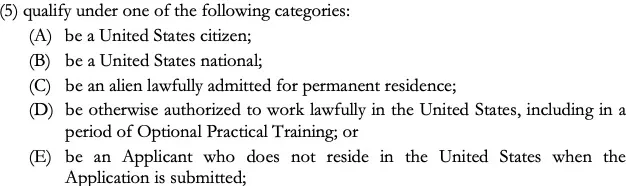
The final category, Rule 2(a)(5), asks about your legal basis for residing in the United States. This is a requirement for bar admission, not for taking the exam.
Most LL.M. graduates meet this requirement through OPT (Optional Practical Training) authorization. However, if your OPT has not yet been approved at the time of application (which was my case, and likely true for many), your response to TXBLE at the time of application would indicate that you currently lack the necessary legal status to satisfy this requirement.
For those not applying for OPT, submitting the appropriate documents under §2(a)(5)(E) should suffice for bar admission. Some graduates from the University of Texas LL.M. program have successfully followed this alternative route.
Submitting Supporting Documents
Documents ListTo complete your application, you must upload the following documents to ATLAS:
Relevant Rules and ReferencesThe checklist for the above documents is based on the following rules and guidelines:
• Rule 2(a): General Eligibility Requirements for Admission to the Bar
• Rule 13 §5: Exemption from Law Study Requirement for Foreign Applicants Without a Common-Law Legal Education
• Rule 13 §9: LL.M. Curriculum Criteria [4]
For more details, consult the TXBLE Rulebook:
https://ble.texas.gov/txrulebook
Additionally, TXBLE has published a checklist for foreign-educated lawyers, available here:
The University of Texas website also offers guidance for international lawyers:
Document Preparation Details
Certificate of Good Standing / Statement of DisciplineFor Japanese lawyers, certificates must be obtained from both the JFBA and your local bar association (e.g., Tokyo Bar Association). Templates for the application forms are available, and the costs were as follows:
• JFBA: ¥1,050
• Tokyo Bar Association: ¥550
Both organizations issued the certificates within about a week of application. Once obtained, you can upload scanned PDFs to ATLAS. However, in rare cases, TXBLE may request the original documents during the review process, so it’s a good idea to have the originals available.
This refers to your transcript and graduation certificate from your Japanese law school. If you submitted these documents to LSAC during your LL.M. application, you can reuse them. I requested the University of Texas LL.M. office to send them directly to TXBLE on January 25, 2024, after completing my ATLAS application.
LL.M. Degree TranscriptThis is your official LL.M. transcript and graduation certificate. You can only obtain this after graduating (e.g., in May).
At the University of Texas, transcripts can be requested via the Texas One Stop system:
You’ll need an official transcript for TXBLE, which may only be available after final grades are processed. In my case, I obtained and submitted the transcript on June 8, 2024.
The submission process involves asking the university to send the transcript directly to TXBLE via email (PDF format is sufficient). Provide TXBLE’s email address: information@ble.texas.gov.
Character & Fitness
While it is a requirement for admission, not for taking the bar exam, this section illustrates Character & Fitness.
FingerprintingAs part of the Character & Fitness review, you must complete fingerprinting within 30 days of submitting your application. I completed this step on February 1, 2024.
The process is outlined on the following page:
You’ll need to schedule an appointment with Identogo, visit the location, and complete the fingerprinting process, which takes about 10 minutes. The fee was $10.
Employer Reference CheckTXBLE may contact your current employer as part of the Character & Fitness review. In my case, my law firm received such an inquiry on February 2, 2024, but no inquiries were sent to past employers. [5]
This process is specific to Character & Fitness requirements as a part of admission and is separate from the exam itself. TXBLE indicates that the review can take up to 270 days, meaning it may continue even after the bar exam.
Below is an excerpt from the reference request TXBLE sent to my employer:
This inquiry focuses on negative checks and does not place a significant burden on the responder.
Final Thoughts
The above overview covers the Texas Bar Exam application process (and related admission procedures where relevant). Overall, the process was straightforward, with almost everything completed online. There was no need to coordinate the delivery of original documents, which was convenient.
Additionally, if you have any questions about the process, you can contact the reviewers directly via ATLAS. I found them highly responsive, providing prompt answers to my inquiries.
I hope this post serves as a helpful reference for anyone considering taking the Texas Bar Exam in the future.
Footnotes
[1] The Texas Bar Exam underwent a significant reform in February 2021. See Supreme Court of Texas Rules Governing Admission to the Bar of Texas §11(d)(e): TXBLE Rulebook.
Notable changes included replacing the “Texas Essay Questions” (which likely included Texas-specific topics like Oil and Gas Law) with the UBE’s “Multistate Essay Examination.” Similarly, the “Procedure and Evidence Questions,” previously unique to Texas, were also eliminated.
Prior to these reforms, applicants relied on Texas-specific materials and tackled around 20 years of past questions for preparation.
[2] For study methods, see my separate post on bar exam preparation:
[3] The NCBE announced the rollout of the NextGen Bar Exam starting in 2026, with implementation in Texas expected by 2028. Learn more: Supreme Court of Texas - NextGen Bar Exam Implementation.
[4] Rule §9 pertains to which courses you must take during your LL.M. program to be eligible to sit for the bar exam. This should be considered when planning your LL.M. curriculum. I’ve written a separate post about this topic:
[5] At my law firm, many attorneys study abroad in the U.S. and take bar exams (mostly in New York or California). However, the attorney in charge of study-abroad coordination at my firm was unaware of any prior cases where a reference check had been conducted. This process may be unique to Texas, likely because Texas has far fewer examinees compared to New York or California. For the July 2024 exam, Texas had 3,299 examinees.
[6] I once wrote a character reference for a friend applying for admission to the New York Bar. The questions were more open-ended, requiring more detailed, narrative responses. Compared to that, Texas’s process imposes a lighter burden on referees.