The time when the sunset melts into the horizon, a terrace by the sea, ice in a glass quietly melting away. What you hear is music where only the house kick drum gently marks the time, layered with the sounds of seabirds, Spanish guitar arpeggios, and elegant synth pads. That is Chillout.
It is synonymous with the sunset music popularized worldwide by the famous 'Café del Mar' bar on the island of Ibiza, Spain, and is also the 'music after the floor' born from the club culture of the 1990s. Music that plays during the time when you start to quietly prepare to head home, still holding the lingering echoes of the celebration while cooling down your heated body after dancing intensely—that is the place where Chillout belongs.
In this article, we will explain everything from the basic characteristics of Chillout to its history, representative songs, and how to create it using DTM. By the time you finish reading, you will surely want to try creating your own background music for your evening work.
What is Chillout? Let's understand the basics of the genre
Chillout (Chill-out / Chillout) is a general term for downtempo electronic music intended for relaxation. With a slow BPM of around 60 to 100, it developed mainly in the UK and Spain in the 1990s as music played during 'after-hours' (after the intense dancing on the main club floor) of house and techno.
The term 'Chill-out' originally began to be used almost synonymously with 'ambient house.' In 1989, a space called 'The White Room' was set up inside the London nightclub 'Heaven,' with Jimmy Cauty (later of KLF) and Alex Paterson (later of The Orb) serving as DJs. They played ambient mixes using material from Brian Eno, Pink Floyd, Eagles, Mike Oldfield, 10cc, War, and others. This is considered the cultural starting point of Chillout music.
Let's organize the sound characteristics by element.
Rhythm
The BPM is 60 to 100. While based on a gentle four-on-the-floor kick, there is a wide range from almost no beat (leaning towards ambient) to having a light house groove (leaning towards Balearic house). Percussion with a live feel, such as shakers, congas, and bongos, is frequently used, and a human-like swing is preferred over mechanical quantization.
Tone
The tone of Chillout is the very image of 'sunset and the sea.'
Warm synth pads (the open resonance of the Roland Juno series)
Nylon guitar, flamenco-style Spanish slide guitar
Electric piano (Rhodes, Wurlitzer)
Wind instruments such as flute, saxophone, and trumpet
Field recordings of waves, seabirds, children's voices, rain, etc.
Atmosphere
If there are lyrics, they often feature open, optimistic, or spiritual themes such as 'sun,' 'sea,' 'dreams,' and 'eternity,' with little darkness or introspection. Even when there are vocals, they are often whispered female vocals or short, phrase-chopped fragments.
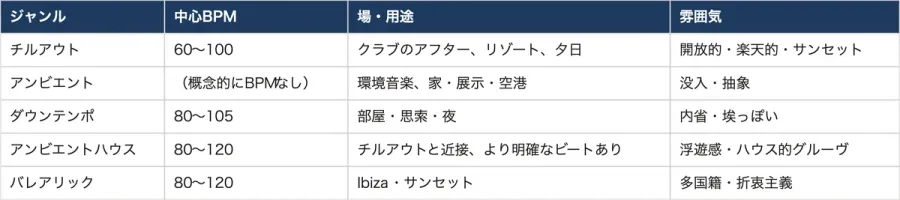
Differences from other genresSince Chillout has many adjacent genres, I will organize them here.
The difference from Ambient lies in two points: the "setting" and the "presence of a beat." Ambient is beatless, immersive music created as environmental music for the home, or for specific spaces like exhibitions or airports. Chillout is music tied to specific settings, such as a club's "sub-room," "after-hours," or a sunset at a resort, and it differs in that it often features a light beat.
The difference from Downtempo is the "mood." While Downtempo takes on an introspective darkness as music for rooms, contemplation, and the night, Chillout carries an optimistic and open atmosphere associated with sunsets, resorts, and holidays. Even within the same BPM range, the moods are significantly different.
The relationship with Ambient House is inclusive and historically close. Around 1990 in the UK, Chillout and Ambient House were used almost synonymously. Today, "Ambient House" is used as a more specialized music genre name, while "Chillout" remains as a broader lifestyle-oriented term.
The relationship with Balearic is also almost synonymous. Balearic is a term derived from the Balearic Islands, which include Ibiza, and refers to the multinational eclecticism played at Ibiza's sunset sessions. The musical core of Chillout almost completely overlaps with Balearic.
History of Chillout: From Birth to the Present
Roots and Birth (1989–1991)The most frequently cited starting point for Chillout is "The White Room," established in 1989 inside the London nightclub "Heaven." Jimmy Cauty and Alex Paterson served as the DJs, playing ambient-leaning mixes for guests tired of dancing on the main floor. The selection, which crossed over from authentic ambient by artists like Brian Eno to rock and pop material by Pink Floyd, Eagles, Mike Oldfield, 10cc, and War, became the prototype for the later Chillout aesthetic.
In February 1990, the unit "The KLF," led by Jimmy Cauty and Bill Drummond, released the ambient concept album "Chill Out." Depicting a fictional train journey through the American South through sound, this work was an innovative piece that mixed train travel sounds, Pink Floyd-esque synths, and post-punk dub sampling, and was described by critic Bob Stanley as a "pioneer of ambient house." The fact that the album itself was titled "Chill Out" contributed significantly to the establishment of the genre name.
At the same time, at "Café del Mar" on the island of Ibiza, Spain, DJ José Padilla began his tenure as a sunset DJ in 1991. His selection was a multinational eclecticism that mixed ambient, new age, world music, and loose house, which became the musical blueprint for "Balearic" and "Ibiza Chillout."
The Golden Age (1994–early 2000s)In 1994, Café del Mar launched its own label and released the first installment of the "Café del Mar" compilation series curated by José Padilla. This became a global hit, commercially establishing the genre name Chillout and the image of "Ibiza sunset music." José Padilla curated volumes 1 through 6 between 1994 and 1999.
In the UK, major Chillout compilations were released one after another, such as the "Chillout Sessions" series (1998–) by Ministry of Sound and the "Beach House" series by Hed Kandi.
In terms of artists, works representing the golden age of Chillout were released in succession, including Air's "Moon Safari" (1998) from France, and UK releases such as Zero 7's "Simple Things" (2001), Goldfrapp's "Felt Mountain" (2000), Chicane's "Behind the Sun" (2000), and Röyksopp's "Melody A.M." (2001).
The sunset hour in Ibiza became a holy land that electronic music fans around the world aspired to visit, and sunset bars like Café del Mar, Mambo, and Savannah became established as cultural icons.
The Current Scene (late 2000s–2020s)The commercial label "Chillout" saw a slight decline in usage after the mid-2000s due to market saturation and the differentiation of subgenres such as "Lounge," "Chillstep," and "Chillwave." However, its cultural role continues to this day.
Chillout tents at festivals: Almost all large dance music festivals have a "Chillout Stage," which functions as a resting place for guests who have danced on the main stage.
Spotify "Chill Beats" and "Chillout" playlists: Numerous playlists with millions of listeners are currently active.
Modern labels like Bedrock and Anjunadeep: Continuing while creating a boundary between deeper, meditative Chillout and Deep House.
Burning Man Sunrise Set: The 5 a.m. sunrise DJ set at the American art festival "Burning Man" carries on the spirit of chillout.
Balearic Revival: Since the 2010s, there has been a growing movement to re-evaluate the legacy of chillout under the term "Balearic."
Representative Chillout Songs and Recommended Artists
For those starting to listen to chillout, here are 5 songs you should check out first.
1. The KLF "3 a.m. Somewhere Out of Beaumont" (1990)
The opening track of the ambient concept album "Chill Out." It is a 6-minute dreamlike road movie featuring the sounds of Elvis and fiddles from a Texas radio station, synth drones, and train whistles. As the beginning of the work that gave birth to the genre name "chillout" itself, this track allows you to experience the origin of the genre.
2. José Padilla "Adios Ayer" (Representative song from Café del Mar Volumen Seis / Vol. 6)
The Café del Mar series, curated by the synonymous Ibiza sunset DJ José Padilla himself, contains a diverse range of music from around the world, such as A Man Called Adam's "Estelle" (1990), "Mas Que Nada" (Sergio Mendes cover), and Sade's "Smooth Operator." Among José Padilla's own tracks, "Adios Ayer" is iconic, representing the ideal form of "Balearic" by fusing flamenco guitar, laid-back house beats, and bossa nova rhythms.
3. Chicane "Saltwater" (1999)
A track by the British project Chicane, led by Nick Bracegirdle. It is an epic song over 8 minutes long that combines the vocals of Máire Brennan from the Irish group Clannad (an arrangement of the song "Theme from Harry's Game") with trance-like arpeggios and a laid-back house kick. It is still frequently played in Ibiza chillout sets as a representative work of "sunset trance."
4. Air "Playground Love" (2000)
A song produced by the French duo Air for the soundtrack of Sofia Coppola's film "The Virgin Suicides." Featuring guest vocals by Thomas Mars of Phoenix, this elegant 4-minute track combines saxophone solos, Rhodes electric piano, and synth pads, reminiscent of 1970s film music. It is a work that symbolizes the "cinematic" aspect of chillout.
5. Zero 7 "Destiny" (2001)
A track from the debut album "Simple Things" by the British duo Zero 7, led by Sam Hardaker. With a structure featuring alternating vocals by Sia Furler and Sophie Barker, it is a comfortable 7 minutes of intertwining strings, drums, electric piano, and bass. The "Simple Things" album was nominated for the 2001 Mercury Prize and became a representative work of 2000s chillout.
How to make chillout with DTM? Production tips
Here are some specific tips for actually making chillout music using DTM.
Rhythm and Beat CharacteristicsBPM Setting
70–100 BPM is an easy range to work with. Starting between 85–90 BPM functions as a midpoint between laid-back house and downtempo. If you want to create ambient-leaning chillout with sparse beats, 60–80 BPM is also fine.
Drum Patterns
Chillout drums generally follow one of two directions: 'a softer version of house kicks' or 'a focus on live-sounding percussion'.
Example of a House-leaning pattern (90 BPM):
Based on a four-on-the-floor house kick, with hi-hats placed softly on the off-beat eighth notes. Shakers and congas are used to add a 'resort' feel. The key is to choose a round, non-harsh kick sound.
Example of a sparse beat pattern (70 BPM):
The kick is reduced to about once every two beats, with shakers and congas supporting the groove of the track. This is suitable for ambient-leaning chillout.
Tips for Sound DesignChillout sound design is the process of painting 'sunsets and the sea' with sound.
1. Open Synth Pads
Warm, expansive synth pads create the background for the track.
Warm pad sounds from the Roland Juno series (Juno-60, Juno-106)
Use sawtooth or square waves as the base, and cut some high frequencies with a low-pass filter
Apply deep chorus effects to create width
Set long attack and release times (500ms to 2000ms) for a 'soft' swell
Maximize the stereo width
Logic Pro's Retro Synth Analog mode, ES2, or TAL-U-NO-LX (Juno-60 emulation) are standard choices.
2. Nylon Guitar / Spanish Guitar
The guitar plays a major role in the 'resort feel' of chillout.
Nylon-string classical guitar (a Balearic staple)
Flamenco-style slides/bends
Spanish-style phrases (Phrygian, Phrygian Dominant scales)
If you are recording with real instruments, a light compressor and reverb are sufficient. For programmed tracks, you can use Native Instruments Session Guitarist 'Strummed Acoustic' and 'Picked Acoustic,' Spectrasonics Omnisphere, or nylon guitar libraries for Kontakt.
3. Electric Pianos and Acoustic Instruments
The live, organic tones of Rhodes, Wurlitzer, and Hammond organs create that 'lounge' feel characteristic of chillout. Native Instruments Scarbee Mark I, Arturia Stage-73, and Logic Pro's Vintage Electric Piano are standard choices.
Using wind instruments like saxophones, flutes, trumpets, and trombones as one-shot phrase chops adds a jazz-cafe vibe.
4. Field Recordings
Ambient sounds such as waves, seagulls, human chatter, children laughing, wind, and fire are frequently used in chillout. Layering them thinly over the entire track at a modest volume of around -25 to -35dB helps evoke the atmosphere of a specific place.
You can find a wealth of material by searching for 'ocean,' 'seagull,' 'beach,' 'sunset,' and 'crowd' on Freesound.org or in the Field Recording category on Splice.
5. Reverb and Delay (Spaciousness)
A hallmark of chillout is its 'spacious' sound.
Set hall-type reverbs to a longer decay (3–6 seconds).
Apply generous amounts of reverb to pads, vocals, and guitars to push them further back in the mix.
Use a shallower reverb for drums (Decay 0.8–1.2 seconds).
Use quarter-note delays to create horizontal width.
Valhalla VintageVerb (Concert Hall/Plate) and Eventide Blackhole are industry standards.
6. Tape Saturation
While chillout doesn't necessarily need the 'dusty' feel of downtempo, applying a subtle tape saturation to the master bus helps unify the sound image.
Plugin List
Chord Progressions and MelodiesChillout is fundamentally based on the open, airy sound of major keys.
Representative progression examples:
Major progression: Cmaj7 → Am7 → Fmaj7 → G7 (bright and elegant)
Sus4 heavy: Csus4 → C → Fsus4 → F (sense of openness)
Modal: Dmaj7 → A7sus4 → Bm7 → F#m7 (New Age style)
Constructing melodies with long notes and fewer notes, and effectively using tension notes like the 2nd, 5th, and 7th of the major scale, creates a lingering resonance like a sunset.
For Spanish guitar styles, you can create a flamenco-like passion using the Phrygian Dominant scale.
Song Structure (Arrangement)Chillout tracks are long, ranging from 6 to 8 minutes, and use long fade-ins and fade-outs.
Intro (16–32 bars): Starts with only field recordings (sound of waves, seagulls) and pads. A long section of over a minute to establish the atmosphere.
Beat-in (16 bars): A loose kick and shaker are introduced.
Main A (32 bars): Bass, guitar, and electric piano are added, presenting the song's theme. If there are vocals, this is the first verse.
Breakdown (16 bars): Remove the drums and return to just guitar and pads. The sound of waves is heard again.
Main B (32 bars): The drums return, and additional layers (wind instruments, strings) are added, making the track at its thickest.
Outro (32 bars): Remove elements one by one, leaving only pads and field recordings at the end, and slowly fade out.
The key is 'not to create flashy drops.' The aesthetic of chillout is to carry through 7 to 8 minutes with gentle undulations, without dragging in the conventions of House or EDM.
To find samples on SpliceHere is a collection of keywords useful for chillout production.
'chillout', 'chill out': Direct keywords
'balearic': Balearic sunset style
'ibiza sunset': Ibiza sunset style
"nylon guitar", "spanish guitar": Nylon/Spanish guitar
"rhodes loop": Electric piano
"ocean field recording", "seagull", "beach ambience": Ocean/beach ambient sounds
"conga loop", "shaker": Percussion
"ambient pad", "dreamy pad": Open synth pads
"saxophone phrase": Saxophone phrases
For those who want to experience the chillout atmosphere using AI, we have prepared some Suno prompt examples.
Style of Music:
Chillout, balearic sunset, soft house groove 88bpm, nylon spanish guitar, electric piano rhodes, breathy female vocal, ocean field recording, seagulls, warm analog pad, Cafe del Mar aesthetic, sun-soaked relaxed mood
Lyrics (with metatags):
[Intro]
[Tempo: Slow-Mid]
[Key: D major]
[Mood: Sunlit Open]
[Energy: Low]
[Texture: Warm Spacious]
(ocean waves, seagulls, soft Rhodes chord, distant chatter)

[Verse]
[Energy: Low→Medium]
Sun goes down and the bar lights up
Glasses clink against the breeze
Don't ask where we're going next
Just stay here for a while

[Pre-Chorus]
[Mood: Drifting]
(nylon guitar fingerstyle pattern enters, light shaker begins)
Time forgets the clock
Sea forgets the shore

[Chorus]
[Energy: Medium]
[Mood: Open Sky]
(soft house kick enters, lush pad widens, vocal layers)
Chill the night, let the orange dissolve
Chill the night, let the salt taste sweet
Where the day forgets to end
And the music holds the sea

[Verse 2]
[Energy: Medium]
[Texture: Brighter]
(spanish guitar slide, sax phrase floats by)
Stranger smiles across the table
Speaking some forgotten tongue
Waves keep rolling like a memory
Of a summer not yet gone

[Bridge]
[Energy: Low]
(drums drop, only Rhodes, ocean, distant guitar)
Stay here for a while
Just stay here

[Chorus]
[Energy: Medium]
(full arrangement returns, slightly brighter)
Chill the night, let the orange dissolve
Chill the night, let the salt taste sweet

[Outro]
[Energy: Low]
[Texture: Filtered Down]
(drums fade, pad sustains, ocean returns, seagulls)
[Fade Out]
Pro Tip:
Suno responds relatively well to environmental keywords like "resort," "sunset," and "ocean." By analyzing the field recordings, the thickness of the synth pads, and the positioning of the guitars in the generated tracks, you can gain hints for your own DAW work.
Summary: Listen to, create, and enjoy chillout
In this article, we explained the basics of chillout. Let's review the key points.
What is Chillout?: Downtempo electronica at 60-100 BPM, played in clubs after hours or during sunset at resorts.
Differences from adjacent genres: Distinguished from ambient (home, beatless, immersive), downtempo (room, contemplative), and ambient house (closer to chillout, but with clearer beats).
History: Originated from the White Room at London's "Heaven" in 1989 and the 1990 KLF album "Chill Out"; José Padilla (1991-) of Café del Mar established the Ibiza sunset culture, which went global through compilation series starting in 1994.
Keys to DTM: 85-90 BPM, loose house kick + shaker + conga, nylon guitar, Rhodes electric piano, warm synth pads, field recordings of the ocean and seagulls, and long reverb.
Structure: Long tracks of 6-8 minutes, long fades, and no flashy drops.
Start by listening to the Café del Mar Vol. 1 compilation or the song "Destiny" by Zero 7. Once your body gets used to the warmth of that sunset, you can open your DAW and start with an 88 BPM, Cmaj7 loop, and field recordings of ocean waves. If you keep the motto "sunset, not the dance floor" and "spacious, not flashy" in mind, the chillout vibe will begin to emerge.
Check out related articles too
Deep dive into the differences from ambient → Ambient Edition
Differences from downtempo → Downtempo Edition
The world of Balearic deep house → Deep House Edition
#MusicGenre #Chillout #Chillout #DTM #Composition #MusicProduction #DTMBeginner