Items have been offered to the gods from ancient times to the present day. By examining their significance, we can learn about the history of these offerings and the true nature of traditional Japanese culture.
In this final installment, the third in the series, we trace the roots and evolution of the 'Gohei'.
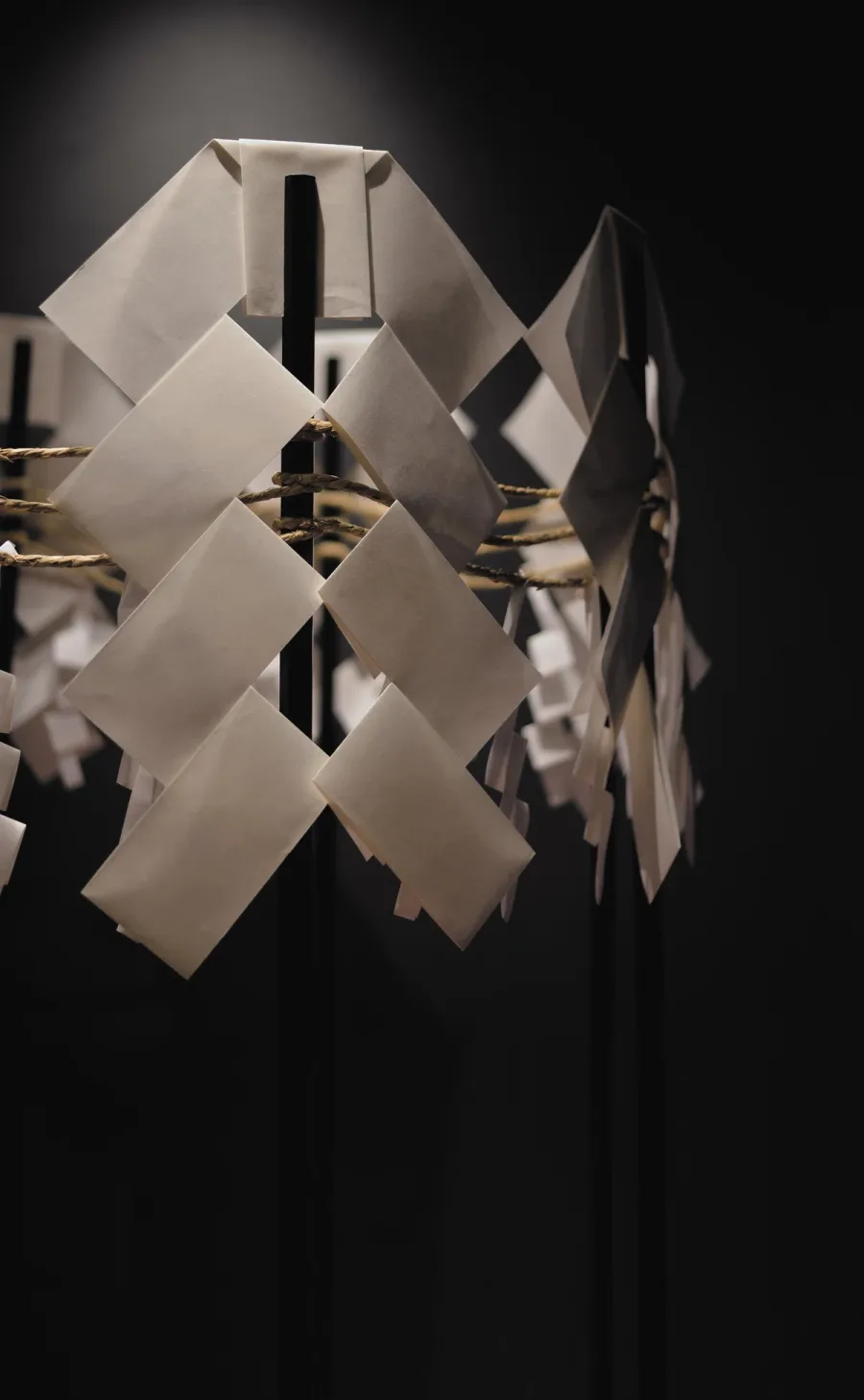
The 'Gohei' (or mitegura) is a common sight in modern shrines and rituals. Many people likely associate it with its structure of long, folded strips hanging down on both sides. However, the center of the Gohei as an 'offering' is not in the hanging parts, but in the part held by the skewer itself.
To uncover the truth, let's unravel the roots of the Gohei. 'The Gohei refers to an offering to the gods, and the word itself combines 'hei,' which denotes a valuable item, with the honorific 'go',' says Mamoru Saso, a professor in the Faculty of Shinto Studies at Kokugakuin University and director of the Kokugakuin University Museum, who studies the history of rituals from ancient ruins.
'From the Kofun period, people offered valuable items to the gods in rituals as 'heihaku.' These were often symbols of the innovations and cutting-edge technology of the time, and items such as iron weapons, agricultural tools, beads, and mirrors have been excavated from ritual-related sites. Furthermore, these cutting-edge technologies included the art of weaving cloth, so textiles were also offered.'
Later, from the latter half of the Nara period to the early Heian period, the term 'heihaku' came to 'specifically refer to textiles,' Saso explains. The methods of offering also diversified, and a format emerged where folded cloth was inserted into a skewer. This is recorded in historical documents as 'heihasamuki' (inserted offerings).
In fact, this 'heihasamuki' is said to lead to the Gohei seen in shrines today. The key points are the 'yu' (bast fiber) and 'asa' (hemp) attached to the heihasamuki.
'Yu is the fiber of tree bark that was inserted into the skewer along with the heihaku to indicate that the heihasamuki was an offering to the gods. These served to express sacredness.'
The cloth offering inserted into the skewer, and the yu and hemp indicating its sacredness. As time passed, 'paper' also came to be used to prepare Gohei in place of cloth. 'Paper' was also a valuable item at the time, just like cloth. In this case, too, yu and hemp were hung, but depictions of long, thin folded paper hanging on both sides instead are also recognized. This is called 'shide.'
From the Muromachi period to the Edo period, the practice of offering Gohei at the altar, in addition to sakaki (tamagushi/masakaki), became widespread and established. The evolution of the Gohei as we see it today became visible.
Hiroaki Yoshinaga, an assistant professor at the Research and Development Institute at Kokugakuin University, explains the subsequent evolution as follows:
'The Gohei from the medieval period onwards generally has a structure consisting of 'heishi' (the paper part) and 'shide' (the paper strips) that indicate sacredness. Since then, while the basic structure of the Gohei has not changed, the heishi and shide parts were renewed for every festival, and the style of making larger shide also spread. The shide, which were thin like yu and hemp, gradually became thicker and larger, and cases where they were inserted at the top became more common. Furthermore, a format where the heishi and shide are integrated also appeared.'
Perhaps because of its characteristic form, the shide part was gradually highlighted. 'In addition to white paper, dyed paper and metal Gohei also appeared, and the impression conveyed by the shide became even stronger,' Yoshinaga continues.
Thus, the Gohei is something that has been offered from mythology to the present day. Although shide may be recognized as its image today, what inherits the original character as an offering is the heihaku part at its center. And for that, the finest items of each era were used.
We have looked at offerings to the gods over the course of three articles. We feel 'tradition' in them, but Saso says, 'When you unravel history, you find that offerings were symbols of the latest technology of the time.'
'One of the interesting aspects of Japanese culture is that tradition and innovation coexist. Whether you look at swords, performing arts, or Gohei, it can be said that the history of offerings is packed with this. In fact, the roots of Japanese culture, which is the coexistence of tradition and innovation, may lie in offerings to the gods.'
While inheriting tradition, new things are also incorporated. The 'essence' of Japanese culture may be condensed in things offered to the gods.