'pre-' means 'before', 'sub-' means 'under', and 'trans-' means 'across'. English prefixes are etched with how humans have organized and perceived the world. In this magazine, we will systematically explain English prefixes from their etymological roots, aiming to understand English words not through 'rote memorization' but as a 'network of meanings'. We will learn knowledge that connects to Latin and Greek, academic vocabulary, medical and scientific terms, and English texts at the University of Tokyo, Kyoto University, and medical school levels, along with example sentences.
This time, we will cover ex- / e- 'out, to the outside'.
The basic image of ex- / e-
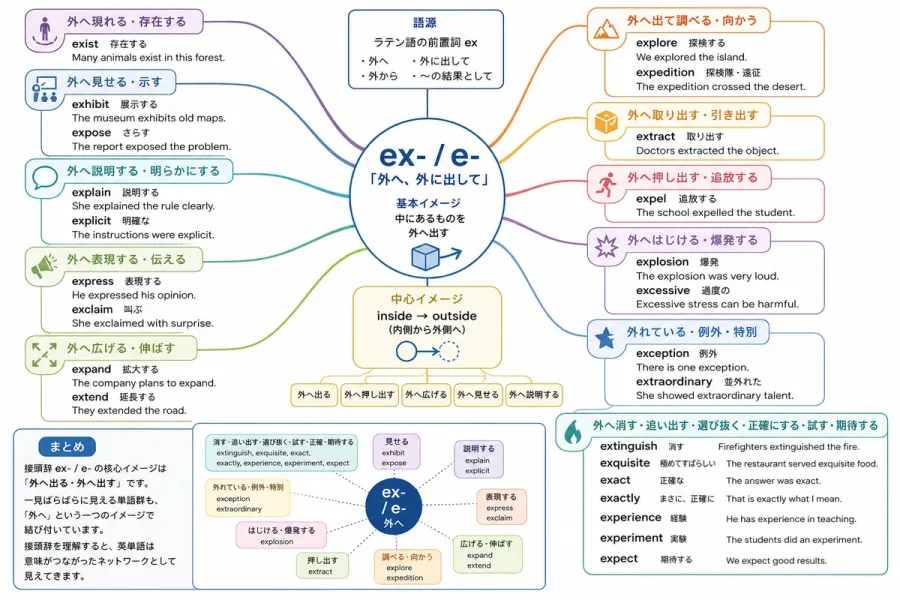
ex- derives from the Latin preposition 'ex', meaning 'out', 'to the outside', 'from the outside', or 'as a result of'. Even in Japanese, there is the concept of 'from inside to outside', such as in 'exit' (deguchi), 'discharge' (haishutsu), or 'escape' (dasshutsu). In English, when 'ex-' is attached, it creates the image of 'taking something that is inside and bringing it out'.
The network of meanings created by ex-
The central image is inside → outside. From this, meanings such as 'go out', 'push out', 'spread out', 'show to the outside', and 'explain to the outside' have developed.
exist
'exist' was born from 'ex' (out) and 'sistere' (to stand). Originally, it meant 'to appear and stand'. The current meaning of 'to exist' comes from the idea of 'appearing in the outside world'.
Many animals exist in this forest.
exhibit
'exhibit' has its etymological roots in 'ex' (out) and 'habit' (to have/hold). Originally, it meant 'to bring out and show before people'.
The museum exhibits old maps.
explain
'explain' has its etymological roots in 'ex' (out) and 'plain' (flat). Originally, it meant 'to spread out something complex until it is flat'. To explain is to spread out the thoughts in one's head to the outside so that the other person can understand them.
She explained the rule clearly.
explicit
'explicit' shares the same etymological root as 'explain'. 'pli' and 'ply' mean 'to fold' or 'to hide', so 'explicit' originally meant 'that which was folded has been completely spread out'. From there, it came to mean 'not hidden' or 'clearly shown'. Its antonym is 'implicit', meaning 'folded inside' or 'tacit'.
The instructions were explicit.
There was an implicit understanding between the two.
express
'express' was born from 'ex' (out) and 'press' (to push). Originally, it meant 'to push out'. Because it involves pushing emotions or thoughts to the outside, it came to mean 'to express'. It also has meanings like 'express train' or 'special delivery' for mail.
He expressed his opinion.
The express runs every ten minutes to Kyoto.
I'd like to send this letter by express, please.
exclaim
'exclaim' is made of 'ex' (out) and 'claim' (to shout). It carries the image of releasing emotions to the outside.
She exclaimed with surprise.
expand
'expand' has its etymological roots in 'ex' (out) and 'pandere' (to spread). It represents spreading out toward the outside.
The company plans to expand.
extend
The word 'extend' comes from 'ex' (out) and 'tendere' (to stretch). It carries the image of stretching something outward.
They extended the road.
(They extended the road.)
explore
The word 'explore' is said to come from 'ex' (out) and 'plorare' (to call out loudly). It is thought to originate from ancient hunters or soldiers calling out to confirm their surroundings while investigating. Today, it means 'to go out to an unknown place and investigate'.
We explored the island.
(We explored the island.)
expedition
The word 'expedition' comes from 'ex' (out) and 'ped' (foot). It literally means 'to set foot outside'.
The expedition crossed the desert.
(The expedition crossed the desert.)
extract
The word 'extract' was born from 'ex' (out) and 'tract' (to pull). It means to pull something from the inside to the outside. In the same form, it also has the noun meaning of 'an extract'.
Doctors extracted the object.
(The doctors extracted the object.)
This soup contains a lot of vegetable extract.
(This soup contains a lot of vegetable extract.)
expel
The word 'expel' comes from 'ex' (out) and 'pellere' (to push). Because it means to push something out, it came to mean 'to banish' or 'to expel'.
The school expelled the student.
(The school expelled the student.)
expose
The word 'expose' was born from 'ex' (out) and 'pose' (to place). It means to take something that was hidden and place it out in the open.
The workers were exposed to radioactivity.
(The workers were exposed to radioactivity.)
The report exposed the problem.
(The report exposed the problem.)
The scandal was exposed by two journalists.
(The scandal was exposed by two journalists.)
explosion
The word 'explosion' comes from 'ex' (out) and 'plodere' (to strike or burst). Originally, it meant 'to burst out with force'.
The explosion was very loud.
(The explosion was very loud.)
exception
The word 'exception' was born from 'ex' (out) and 'capere' (to take). Something taken out from the whole group is an 'exception'.
There is one exception.
(There is one exception.)
excessive
The word 'excessive' has the same etymology as 'exceed'. 'Exceed' is made from 'ex' (out) and 'cedere' (to go), meaning 'to go beyond the limit'. From there, 'excessive' came to mean 'beyond the limit'.
Excessive stress can be harmful.
(Excessive stress can be harmful.)
extraordinary
'Extra' means 'outside'. Something that is outside of 'ordinary' is 'extraordinary'.
She showed extraordinary talent.
(She showed extraordinary talent.)
extinguish
The word 'extinguish' originates from the Latin meaning 'to put out a fire and drive it away.'
Firefighters extinguished the fire.
(The firefighters put out the fire.)
exquisite (extremely beautiful/excellent)
'Exquisite' was born from 'ex' (completely) and 'quaerere' (to seek). Originally, it meant 'carefully selected.' From there, it came to mean 'extremely refined' or 'extremely excellent.'
The restaurant served exquisite food.
(The restaurant served extremely excellent food.)
exact and exactly
'Exact' has its roots in 'ex' (completely) and 'agere' (to move). Originally, it meant 'to push out to the end.' From there, it came to mean 'accurate.'
The answer was exact.
(The answer was accurate.)
That is exactly what I mean.
(That is exactly what I mean.)
experience and experiment
Both originate from the Latin 'periri' (to try). The root meaning is 'to try completely'; when an individual tries something completely, it means 'to experience,' and when a scholar tries something completely, it means 'to experiment.'
experienceThis is an experience gained by an individual actually trying something in the outside world.
He has experience in teaching.
(He has experience in teaching.)
This is something a scholar tries in order to gain knowledge.
The students did an experiment.
(The students conducted an experiment.)
expect
'Expect' was born from 'ex' (out) and 'spect' (to look). Because it means looking toward the future, it came to mean 'to anticipate' or 'to expect.'
I never expected such a question.
(I never expected such a question.)
We expect good results.
(We expect good results.)
Summary
The core image of the prefix ex- / e- is 'going out / putting out'.
exist = to appear outside and exist
exhibit = to bring out and show
explain = to spread out and explain
express = to push out and express
expand = to spread out
explore = to go out and search
extract = to pull out
expel = to push out
expose = to lay out
extraordinary = outside of the ordinary
extinguish = to drive the fire out
Words that seem unrelated at first glance are connected by the single image of "out." When you understand prefixes, English words are no longer isolated items to be memorized, but appear as a vast network of connected meanings.