by Masakazu Urabe
August 12, 2025
Cloudflare is a prominent unicorn company, yet its co-founder and CEO, Matthew Prince, remains a relatively unknown figure. Born and raised in a small town of 7,000 in rural Utah, his background presents a stark contrast to the typical image of a Harvard graduate. This article delves into his life from birth to the company's IPO.
Prologue: At the Crossroads of the AI EraFrom a quiet study at 2,000 meters above sea level in Park City, Utah, Matthew Prince murmured, "The internet isn't just a place. It's a promise."
The company he founded, Cloudflare, has become a massive infrastructure company that now handles 20% of the world's internet traffic. It protects the web, makes it faster, and is now working to create new rules for the AI era.
On July 1, 2025, Cloudflare made a global declaration:
"We will stop unauthorized data scraping by AI crawlers."
In addition, the company has proposed "Pay per crawl," a system where AI companies pay content providers for the data they collect. Prince's goal was to ensure a future for the web where information is not just "stolen" but is "created, nurtured, and protected."
"If things continue as they are, there will be no point in being a creator of information," he said.
This statement is deeply rooted in his own life journey—growing up in a snowy mountain town, studying both code and law, and working with his team to create a "shield" to protect the internet.
Chapter 1: A Boy Raised with Snow and Code (1974–1992)Matthew Browning Prince was born on November 13, 1974, in Salt Lake City, Utah. He grew up in the small mountain resort town of Park City, with a population of just about 7,000 people. It was a secluded town, snowed in during the winter and quiet even in the spring. His great-grandfather was a Mormon pioneer, and his son was the firearms designer John Browning.
His father, who transitioned from being a newspaper reporter to a stockbroker and restaurant owner, faced continuous struggles. The house was always filled with bills, and the atmosphere was often tense.
His mother, on the other hand, ran a gift shop and taught him how to read the seasons and trends, as well as the power of observation.
A fateful gift arrived on Christmas when he was seven. An Apple II Plus (worth about $1,200 at the time), given to him by his grandmother, introduced Matthew to the world of programming.
As a high school student, at his mother's suggestion, Matthew began to audit computer science lectures at the University of Utah. He would get lost in writing code in an empty classroom, feeling like a "lone monk." To him, programming was "magic" that allowed him to shape his own world with his own hands.
And so, in that quiet, snowy mountain town, young Matthew became fascinated with the "world of orderly code."
Chapter 2: The Common Ground Between Law and Code (1992–2003)At Trinity College in Connecticut, Matthew Prince double-majored in literature and computer science. He found common ground between these two seemingly different fields.
Literature is the world of "structure" and "meaning." Programming is the world of "structure" and "commands." Both, he realized, deal with "logic and worldview," requiring both "comprehension" and "design."
After graduation, he entered the prestigious University of Chicago Law School, where he encountered another "language": law.
In one of his law school classes, a young Barack Obama—who would later become president—spoke about the workings of law while also teaching the power of stories and persuasive language.
At that moment, Matthew took a sober look at himself.
"I could write code. I could tell stories. But I hadn't yet reached the 'language of the law' that could move people's hearts," he said.
In 2000, he earned his J.D. However, after his first day at a law firm, he left his resignation letter on his desk and walked away the next morning.
He then teamed up with an old acquaintance, the brilliant engineer Lee Holloway, to launch Unspam Technologies. Although it was a niche field, spam prevention, they were tackling the dark side of the internet.
In 2004, they started "Project Honey Pot" to track online spam. They created a system of "deliberate traps" on the web to lure bots, which would then record their IP addresses and attack patterns. This Honey Pot method was later imitated by many security companies.
This very philosophy would later lead to the creation of Cloudflare, a "distributed guardian" that protects the healthy order of the entire internet.
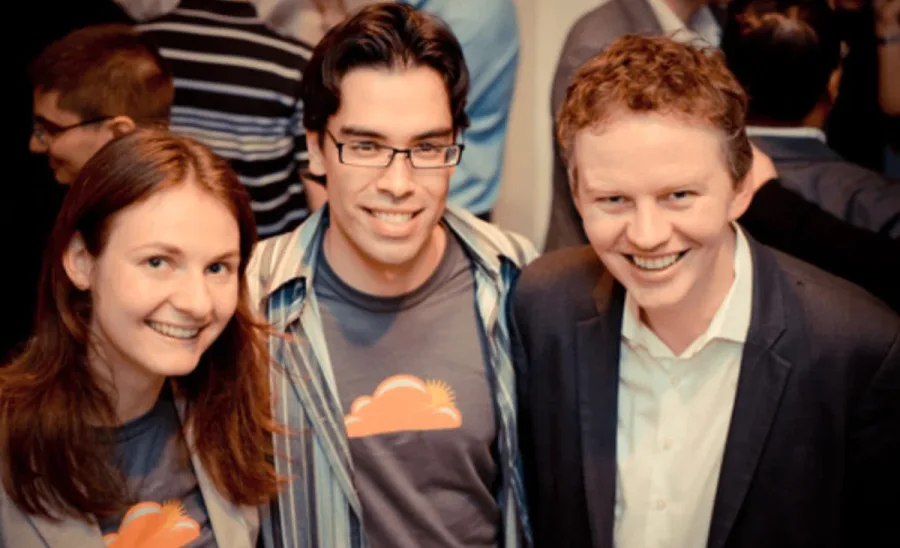
Chapter 3: Three People Create a "Shield" (2009–2010)In 2009, Matthew began pursuing an MBA at Harvard Business School. While learning the logic of business, his passion remained with "Project Honey Pot."
One day, as he was talking about the project, a woman listened intently.
That woman was Michelle Zatlyn, a Canadian strategist known for her strong analytical skills, action-oriented approach, and calm focus on numbers.
Michelle instinctively felt that Project Honey Pot could evolve from a "database for defense" into a "real-time, global protective infrastructure."
Matthew and Michelle later renamed the project from "WebWall" to "Cloudflare." Matthew also brought back his old friend, Lee Holloway.
Holloway was a man of few words who spoke through his code. His source code was described as "beautiful, like poetry."
The three of them were an ideal team, sharing a clear mission and possessing complementary skills.
In the fall of 2009, they raised $2.1 million from venture capitalists Venrock and Pelion. In 2010, they took the stage at the global startup event "TechCrunch Disrupt" and officially launched Cloudflare to the world.
Their slogan was: "To make the Internet more secure, more reliable, and faster for everyone."
By the time of its IPO in 2019, Cloudflare had raised over $320 million in six funding rounds.
Funding Rounds
Series A (2009): $2.1 million
Lead Investors: Venrock, Pelion Venture Partners
Series B (2011): $20 million
Lead Investor: New Enterprise Associates
Series C (2014): $50 million
Lead Investor: Fidelity Investments
Series D (2015): $110 million
Lead Investors: Fidelity Investments, Google Capital, Microsoft, Qualcomm, Baidu
Series E (2019): $150 million
Lead Investor: Franklin Templeton
Cloudflare was not just another startup. It was a revolutionary entity aiming to be the "public transport of the internet."
Chapter 4: The Philosophy Behind Rapid Growth (2010–2019)Cloudflare's start was exceptionally unique. They offered a suite of features—DDoS protection, bot mitigation, and web acceleration (WAF)—for free to anyone.
This single phrase encapsulates his entire philosophy.
He believed it was unfair to have a "paywall" at the entrance to the internet for vulnerable people in society—small bloggers, NGOs, and developers in developing countries—for whom the internet is both a tool and a platform for expression.
While this ideal seems beautiful, it was also a "dangerous gamble" from a business perspective.
Competitors like Akamai and Imperva all said the same thing: "Offering protection for free will destroy the industry's pricing."
Questions arose from investors and within the company.
"How will we generate revenue?"
"Why not charge from the beginning?"
Caught between an ideal and reality, the two co-founders debated this issue many times.
But Matthew was convinced.
Cloudflare's business model appeared to be "freemium" on the surface. But its true essence was completely different.
What was the "real value" of the free plan?
Prince focused on the vast traffic data and attack patterns generated by the massive number of free users. The user behavior collected by Cloudflare from millions of users was a microcosm of the global web and a real-world testing ground for understanding attack patterns.
This information served as the "learning material" for Cloudflare's defense AI and algorithms.
This idea marked a major turning point in 2015.
Cloudflare's analysis of its network data clearly showed that the massive traffic and threat patterns from the free tier dramatically contributed to improving the overall network's defense accuracy and speed.
Free Users: Provide real-world data to train the defense AI.
Paid Users: Purchase advanced features and SLAs (Service Level Agreements).
Cloudflare as a whole: The increase in users improves AI accuracy and network optimization.
This was an entirely new infrastructure model that aimed to achieve "a balance between public good and profitability."
On September 13, 2019, Cloudflare went public on the New York Stock Exchange (NYSE).
For him, the IPO was not just a symbol of success, but a way to secure the funding necessary to ensure the continuity of their mission.
From that moment on, Cloudflare truly became a "private public infrastructure for the web."
(To be continued in Part 2)
Matthew Browning Prince
Basic Information
Date of Birth: November 1974
Place of Birth: Salt Lake City, Utah, USA
Family: Wife Tatiana Ringos-Webb, one child
Current Position: CEO and Co-founder, Cloudflare, Inc.
Key Achievements
Shortly after its founding, Cloudflare became a frontline defense against cyberattacks worldwide. Matthew successfully protected against numerous massive DDoS attacks, growing the company into what is now known as the "shield of the internet." He also implemented a freemium model with both free services and plans for large corporations, leading to explosive customer growth. In 2019, the company was listed on the New York Stock Exchange, attracting global attention.
His name became even more widely known for his social decisions, such as blocking "The Daily Stormer" in 2017 and "8chan" in 2019. These decisions, made at the intersection of free speech and public safety, sparked controversy but left a powerful impact.
Personal Profile and Present Life
Matthew is often described as a "visionary who connects technology with society," yet he is also a down-to-earth person from Utah. Unlike the typical Silicon Valley elite from Stanford or Harvard, he has an unusual background as a rural native who went through law school.
On weekends, he values spending time with his wife, Tatiana, and his son in the mountains of Utah, enjoying nature.
Today, as CEO of Cloudflare, he continues to focus on building the next-generation internet infrastructure, including "Zero Trust" and "Workers AI." In conferences and lectures, he repeatedly talks about the theme of "balancing the freedom and security of the internet." His interest is not just in business growth, but in how to protect society and people's lives.
This manuscript was originally written in Japanese and has been translated into English. Please point out any errors or awkward expressions.