Hello everyone! This is Hitoshi.
Starting with this post, I will be providing information on "arboreal geckos"!
When you hear "tree-climbing reptiles," many people might think of chameleons first. But in fact, there are many fascinating species in the gecko world that are specialized for life in the trees.
Slinking up tree trunks, leaping from branch to branch, and hunting prey in the night forest—this "aerial stroll" is the daily routine for arboreal geckos.
In this article, I will take up 7 representative species from among arboreal geckos and compare them thoroughly, from their classification and distribution to their ecology, difficulty of care, price range, and even legal regulations.
I have also prepared a flowchart for beginners to answer the question, "Which species should I choose so I won't have any regrets?" So, whether you are just starting out or are a veteran who has already decided on your "favorite gecko," please stay with me until the end.
A Thorough Comparison of 7 Representative Arboreal Geckos
[Classification and Distribution]
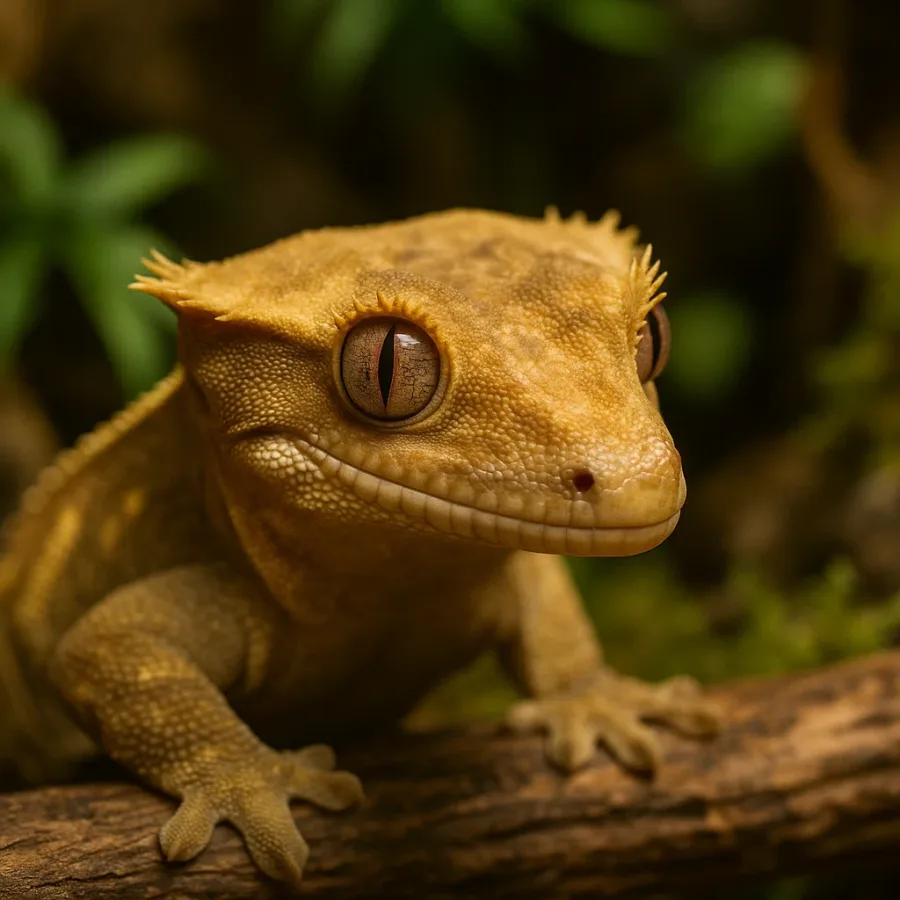
The crested gecko is a medium-sized gecko that inhabits the southern part of New Caledonia.It was previously classified in the genus Rhacodactylus, but it now belongs to the genus Correlophus.
After being discovered in 1866, records in the wild were lost for a long time, and it was once thought to be extinct, but it is truly a "resurrected gecko" that was miraculously rediscovered in the forests of New Caledonia in 1994.
[Ecology]
They are nocturnal and live high in the trees of the forest.The thorn-like protrusions above their eyes, which look like "eyelashes" and are the origin of their name, are characteristic.
They rest in tree hollows or in the shade of leaves during the day and begin their activities at night. Their tails are semi-arboreal and have some gripping power, but they may drop them if they feel threatened (unfortunately, they do not regenerate).
Their diet is very unique; they are omnivorous and enjoy not only insects but also ripe fruit and nectar. This is why their ease of care using commercially available artificial food (fruit-flavored gecko food) is one of the reasons for their popularity.
[Difficulty of Care]
They are very easy to keep and are at the top of the list as an introductory species for arboreal geckos.
They have a gentle temperament and are relatively easy to get used to handling. As long as you are careful about the fact that their tails do not regenerate if dropped, there are so many examples of breeding that even beginners can try their hand at it. They have a wide range of suitable temperatures and humidity, and they have a depth of character that allows them to adapt even if the environment fluctuates slightly.
[Price Range]
They are now actively bred all over the world and can be obtained relatively cheaply in Japan as well.The market price is around 10,000 to 20,000 yen for normal varieties, and about 30,000 to 50,000 yen for morph individuals with excellent color and patterns. It is surprising how widespread they are, considering they were once on the verge of extinction.
[Legal Regulations]
In international endangered species assessments, they are classified as "Vulnerable" by the IUCN.Because they are native to New Caledonia, the export of wild individuals is restricted, but the crested gecko itself is not listed under CITES (Washington Convention).
However, the possibility of them becoming subject to regulations depending on future trade volume is being considered, and in some countries and regions, permission may be required for import. Although many of the individuals currently in circulation are captive-bred, moderate use is desired from the perspective of wildlife conservation.
[Classification and Distribution]
The gargoyle gecko is a medium-sized gecko endemic to the southern part of the main island of New Caledonia, and it also goes by the Japanese name "Tsunomikado-yamori" (horned gecko).Even within New Caledonia, they inhabit a different region (limited forest areas in the southern part of the main island) than the crested gecko. Taxonomically, they were previously in the same genus Rhacodactylus as the crested gecko, but in recent reclassifications, they are also considered to be in the genus Bavayia (some literature may still use the old genus name).
As the name "gargoyle" suggests, they have a unique appearance with horn-like protrusions above their eyes.
[Ecology]
They are nocturnal arboreal geckos that live on tree trunks and thick branches.
Their body color is based on gray or brown with red or black stripes, and they often sit still, camouflaged like tree bark. However, when they sense the presence of prey, they move agilely to catch insects.
Their nature is relatively calm, and many individuals become accustomed to people, but they are known to have a strong sense of territory, and cannibalism or tail-biting can occur between individuals of the same species. Their tails regenerate if dropped, but the regenerated tail is smooth and loses its pattern, so it is safer to keep them individually if you want to preserve their tails.
[Difficulty of Care]
They are the next easiest arboreal gecko to keep after the crested gecko.
You can maintain their health by keeping the temperature around 25°C and the humidity between 50% and 70%. They also eat artificial food, so they are suitable for keepers who are not good with feeder insects. However, some individuals are a bit more aggressive than crested geckos, and there are cases where they run off or bite during handling (though since they have small teeth, it does not cause serious injury).
If keeping them in pairs, be careful of fighting between males or excessive courtship toward females, and it is desirable to have an environment where they can be separated if necessary.
[Price Range]
The export of wild individuals from New Caledonia is prohibited, and almost all those in the market are captive-bred.The price is slightly higher than that of the crested gecko, ranging from 20,000 to 30,000 yen for a normal individual, and individuals with good coloration, such as the "red line" with strong red tones, can cost over 50,000 yen. However, as captive breeding has gotten on track, they have become easier to obtain in recent years.
[Legal Regulations]
The gargoyle gecko itself is not listed under CITES but because the country of origin, New Caledonia, strictly restricts the import and export of wild animals, those in Japan are CB (captive-bred) individuals from populations introduced long ago.
Although they are not currently an international endangered species, they are recognized as a species that requires protection due to the destruction of their habitat forests. While no special registration is required for sale, please be aware that no wild-derived individuals are in circulation.
[Classification/Distribution]
As the name suggests, the Leach's Giant Gecko is one of the world's largest geckos, bearing the name of an 'Emperor' (Mikado).They are distributed throughout the main island of New Caledonia and surrounding islands, with subspecies and local forms existing that vary in body size and pattern depending on the regional population.
Taxonomically, they belong to the genus Rhacodactylus, the same as the Gargoyle Gecko, and are also known by the English name New Caledonian Giant Gecko. With a total length of around 35 cm and some individuals weighing over 300 grams, they truly possess the aura of a 'giant'.
[Ecology]
They are nocturnal and inhabit tree hollows and thick branches in high forest trees.They have massive jaws, said to be capable of preying on other geckos, and while it is believed that in the wild they feed on large insects, other lizards, small rodents, and bird chicks, they are also omnivores that enjoy ripe fruit.
When keeping them as pets, it is best to provide commercial gecko food or large dubia roaches. Their temperament varies greatly by individual; some are accustomed to handling and are calm, while others are defensive and may bite. Their lifespan is said to be over 15 years, and if cared for properly, you can enjoy their impressive presence for a long time.
[Difficulty of Care]
It can be said that they are for intermediate to advanced keepers. Above all, because the adult physique is large, a cage with height and widthis necessary. As a guide, a cage about 60 cm wide and deep and 90 cm high is recommended, and it is necessary to arrange large, thick branches or wooden shelters.
Also, since males show strong fighting spirit toward each other, keeping them individually is the standard. Temperature and humidity management itself follows that of other New Caledonian geckos, but care must be taken because they are susceptible to stuffiness, so good ventilation is required, and if the environment is unsanitary, they are prone to infections of the fingertips. Although they have a difficult side, their presence is special to keepers, and it is a species that many enthusiasts become fascinated with once they keep one.
[Price Range]
They are extremely expensive. Even now that breeding has progressed both domestically and internationally, a baby costs at least 100,000 yen or more, and it is not rare for sub-adults to adults to reach several hundred thousand yen per pair.
In particular, large strains with beautiful patterns (such as the local form from the southern part of the main island called 'Yate') are traded at high prices even in the overseas market. It can be said that they are truly premium geckos worthy of the name 'Emperor'.
[Legal Regulations]
This species is also endemic to New Caledonia, and international trade of wild individuals is strictly restricted. However, the species itself is not listed in the CITES Appendices. This is thought to be because there is almost no trade originating from the wild.
However, in their habitat, capture and export are prohibited by law for the conservation of the unique ecosystem, and all populations in Japan are bred from a small number of bloodlines brought in long ago. Therefore, the individuals in circulation are very limited, making it a species with a high barrier to entry.
[Classification/Distribution]
The Chahoua Gecko is a medium-sized gecko that inhabits the southeastern part of the main island of New Caledonia and outlying islands.It was once included in the genus Rhacodactylus, but is now independent as the genus Mniarogekko.
It is called the Mossy Prehensile-tailed Gecko in English, and its Japanese name is sometimes written as 'Mamono Mikado Gecko'. It is about 25 cm in length and is characterized by a grayish-green, mossy, bark-like body color. Unlike other New Caledonian geckos, its tail has a very strong gripping power, allowing it to firmly wrap around branches to support its body.
[Ecology]
They are nocturnal and arboreal, living by clinging to thick branches and trunks high in the trees.Like other New Caledonian geckos, they are omnivorous and eat fruit and nectar in addition to insects and other small animals.
A major feature of the Chahoua is that it has been pointed out that males and females may raise their young together. There have been cases observed in captivity where a pair after egg-laying acted together to guard the eggs, and it is thought that in the wild, the male may remain in the nest to protect the eggs. Such ecology is very rare for geckos and is an interesting point unique to the Chahoua.
[Difficulty of Care]
Compared to Crested or Gargoyle Geckos, availability is lower and information is limited, so it is for intermediate keepers and above.Keeping them is not much different from other New Caledonian species, but they tend to prefer slightly lower temperatures, so care must be taken as they are weak against heat. Measures against high temperatures in summer and ensuring ventilation are particularly important.
Also, since their tail strength is very strong, be careful not to pull the tail forcibly when handling them (they will autotomize, but you want to avoid this as much as possible). As mentioned above, they also show cooperative behavior in pairs, so pair keeping is recommended if you are aiming for breeding, but since they may fight if they do not get along, it is essential to observe the individuals closely.
[Price Range]
There are few captive-bred individuals, and they are very expensive. In Japan, even a baby costs from the high 100,000s to 200,000 yen, and a grown pair can reach the scale of several hundred thousand yen. Individuals imported from overseas are also rare, and they are so scarce that reservations among breeders fill up immediately. It can be said that they are in a category that is even more difficult to obtain than Crested or Gargoyle Geckos, even though they are from the same New Caledonia.
[Legal Regulations]
Like other New Caledonian geckos, the export of wild-caught individuals is prohibited.They are not listed in CITES, but collection and possession themselves are illegal in protected areas of their habitat. As a result, the individuals currently in circulation are only closed-bred individuals from bloodlines obtained long ago. Because the number of individuals is small, inbreeding is likely to progress, and it is a species where bloodline management is also an issue.
[Classification/Distribution]
The Tokay Gecko is a large gecko widely distributed throughout Southeast Asia (from northeastern India to all of Southeast Asia, southern China, the Philippines, Indonesia, etc.).They belong to the genus Gekko and are taxonomically close to groups like the Japanese house gecko, but they stand out due to their massive size (30-35 cm in total length) and vivid body color of orange polka dots on a grayish-blue body.
They often inhabit human dwellings and are known for their loud 'Tokay!' call, from which their Japanese name is derived.
[Ecology]
They are nocturnal and have a strong territorial nature, and males call loudly to defend their territory. The volume of their voice has an impact that you will never forget once you hear it.
In their native regions, they are seen not only in forests but also inside and outside houses, and while they are liked for helping with pest control,they have a fierce temperament and will not easily let go if they bite, so caution is required.Their diet is entirely carnivorous, and they prey on large insects, small mice, and even other geckos. There have even been cases where they have eaten live mice when kept as pets.
[Difficulty of Care]
It is not highly recommended for beginners. First of all, because many individuals have a fierce and violenttemperament, handling is strictly prohibited. They have jaw strength that can cause bleeding if bitten, and they are easily stressed, so basically, you should stick to observation.
Also, keeping them requires a large cage (at least 60 cm in height and width) and a sturdy shelter. Their suction power is strong, and you must be careful when opening and closing the lid, or they will escape. They prefer a high-temperature, high-humidity environment with a temperature of 25-30°C and humidity of 70% or more, but if ventilation is poor, they can develop skin diseases.
Furthermore, males and females may bite each other violently, and pairing can sometimes be difficult. Despite these rough aspects, the Tokay is a species that continues to attract enthusiasts who want to 'try to master keeping them,' captivated by their bold calls and beautiful body colors.
[Price Range]
In the past, large numbers of wild individuals were exported cheaply from Southeast Asia, and they were sold in Japan for around several thousand yen. However, in recent years, due to concerns about the decline of local populations caused by overfishing, they became subject to trade regulations under CITES in 2019, which has reduced the volume in circulation.
Currently, the market price in Japan is on a slight upward trend, with around 10,000 yen for juveniles and 20,000 to 30,000 yen for adult sizes being common. Although they are easy to obtain due to their low price, sufficient preparation is required for keeping them as mentioned above.
[Legal Regulations]
Listed in Appendix II at the 2019 CITES Conference of the Parties (COP18), and since then, international trade in Tokay geckos requires a permit issued by the exporting country.In Asia, vast numbers are traded for traditional medicine and as pets, and export quotas (annual export limits) have been set by various countries to prevent over-exploitation. Furthermore, in Japan, although they are not classified as 'specified animals' since 2020,importation by businesses other than for pet purposes has been prohibitedNo permit is required for individuals to keep them as pets, but since the number of newly imported individuals is limited, there is a possibility that they will become even rarer in the future.
[Classification/Distribution]
A large day gecko native to northern Madagascar.It is a very beautiful gecko with red spotted patterns that stand out against its emerald green body color, and it is also called theMadagascar Day GeckoThere are about 50 known species in the genus Phelsuma, which are also distributed on islands in the Indian Ocean such as Mauritius and Reunion, but the Giant Day Gecko is one of the largest species (25-30 cm in total length) and is a representative species that has been loved around the world for a long time.
[Ecology]
The defining characteristic of the genus Phelsuma is that they are diurnal.They move actively during the bright hours of the day, licking flower nectar and preying on insects. Since the Giant Day Gecko is no exception and loves to bask in the sun, ultraviolet irradiation using a UVB light is important even in captivity.
In the forest, they are often seen on banana trees and palm trees, and they also appear in gardens near human settlements. Unlike many other geckos, they do not have eyelids that blink, but they adapt to strong light by constricting their pupils even during the day. Their movements are agile, and watching them run around walls is very rewarding. However, if you startle them, not only their tails but alsotheir skin can peel offso you must be careful with their defensive instinct where their scales peel off if you try to grab them roughly (a phenomenon called 'self-peeling' rather than autotomy).
[Difficulty of Care]
It is for intermediate keepers. Because they require the strong light, ultraviolet rays, and high temperatures characteristic of diurnal geckos, they require more equipment investment than other nocturnal geckos.Simply put, it is necessary to irradiate them with a UVB fluorescent lamp or metal halide lamp for reptiles and keep the daytime temperature in the cage at around 28-32°C. On the other hand, there is no problem if the temperature drops to around 20°C at night, and it is healthier to keep a temperature difference between day and night. It is good to maintain a slightly higher humidity of around 60%, plant houseplants in the cage so that the animal can lick water directly, and mist in the morning and evening.
Their personality is nervous but not aggressive. However, they rarely get used to people, so it is better tobasically treat them as display-onlyand avoid touching them unnecessarily. They are hardy and easy to breed in an appropriate environment, making them the perfect species for those who want to observe brightly colored geckos during the day.
[Price Range]
They are relatively easy to obtain, costing around 15,000 yen for babies to young individuals, and about 20,000 to 30,000 yen for adults. While there used to be wild-caught imports from Madagascar, they are now mainly captive-bred. Prices can vary depending on color variations (such as individuals with many red spots on their backs), but they are an inexpensive introductory species among the genus Phelsuma.
[Legal Regulations]
Like many reptiles from Madagascar, the Giant Day Gecko is listed in CITES Appendix IIThis means that unauthorized international trade is prohibited. However, individuals bred over generations in the West and Japan are in circulation and have been imported through appropriate procedures.
No special permit is required for keeping or selling them domestically, but keepers must handle them responsibly, such as by preventing escapes, keeping in mind that they are a species at risk of extinction in the wild in the future.
[Classification/Distribution]
The genus Uroplatus is a genus of arboreal geckos endemic to Madagascar, and nearly 20 species are currently known.They range from large species reaching 30 cm in length to small species of about 10 cm, but all are famous for their extreme bark mimicry. The Japanese name 'Herao' comes from 'spatula tail,' meaning a flat, leaf-like tail, and they are collectively called Leaf-tailed Geckos in English.
Representative species include:
- TheMossy Leaf-tailed Gecko(U. sikorae), which mimics mossy bark
- TheHenkel's Leaf-tailed Gecko(U. henkeli), whose tail is split like the edge of a dead leaf
- TheLined Leaf-tailed Gecko(U. lineatus), which mimics a tree branch with an incredibly thin body.
[Ecology]
All species are nocturnal and rest by clinging to tree trunks and branches during the day.Their protective coloration and mimicry ability are phenomenal, and they blend into the surrounding environment by utilizing their leaf-vein patterned tails and jagged body contours, making them difficult to find with the naked eye.
They are carnivorous, feeding mainly on insects and spiders. Their movements are surprisingly quick, and they pounce agilely when they find prey. They have also been observed using defensive measures such as opening their mouths wide to threaten, or dangling their tails and shaking their bodies to act exactly like a dead leaf.
[Difficulty of Care]
They are very delicate and for advanced keepers.
They prefer a cool environment with an appropriate temperature that is slightly lower, depending on the species, 22-26°C during the day and 18-22°C at nightRather than a hot and humid tropical rainforest, you need to approximate the environment of a cool, humid mountain forest. Therefore, measures against high temperatures in the Japanese summer (such as room temperature management with an air conditioner) are essential. You also need to maintain humidity at 70-80% or higher at all times, install a misting device in the cage, and devise ways to keep it from drying out while ensuring ventilation.
The cage should emphasize height, and you should create plenty of hiding places with large houseplants and bark panels.They are very susceptible to stress, and you should avoid peeking at or touching them frequently.Care requires delicate attention and extensive experience, as they may fall into anorexia immediately after transport or suffer from necrosis of the fingertips and tail tips due to incomplete shedding.
Even so, being able to observe their artistic mimicry at home is an incomparable joy, and some enthusiasts become addicted once they succeed in keeping them.
[Price Range]
They are rare and expensive.
Depending on the species, they cost 50,000 to 80,000 yen per individual for small species (e.g., Satanic Leaf-tailed Gecko U. phantasticus), and over 100,000 yen for large species (e.g., Giant Leaf-tailed Gecko U. fimbriatus). Selling them as a pair is even more expensive. Because the export quota from Madagascar is limited and they are difficult to breed, relying on imported individuals, they inevitably carry a premium price.
[Legal Regulations]
All species of the genus Uroplatus are listed in CITES Appendix IIand international trade requires a permit. The Malagasy government has set strict annual quotas for the export of wild individuals, and in recent years, measures have been taken to stop exports themselves.
In addition, individuals sold in Japan are required to presentlegal import documentsand trading in unauthorized or smuggled individuals is punishable. When purchasing, it is important to obtain them from a reliable shop to ensure they have been legally imported.
Flowchart for Choosing an Arboreal Gecko for Beginners
For those considering keeping an arboreal gecko for the first time, I have created a simple flowchart to help you find the species that suits you. Let's think through a few questions.
Question 1: 'Do you want a gecko that you can hold and interact with?'
Yes → I recommend a Crested Gecko or a Gargoyle Gecko because they have gentle temperaments and are suitable for handling. Both are hardy, easy to manage, and great for beginners.
No → So, you prefer to keep geckos primarily for observation. Let's move on to the next question.
Question 2: "Do you want to see geckos that are active during the day?"
Yes → If you want to enjoy watching them during the day, Giant Day Geckos or other species in the Phelsuma genus are excellent choices. Their vibrant green bodies stand out, and they are diurnal and active. However, they cannot be handled, so keep them for observation only.
No → Then nocturnal species are fine for you. Let's proceed.
Question 3: "Do you admire large, impressive geckos, or do you prioritize ease of care?"
I want an impressive large species → Assuming you have experience and adequate equipment, New Caledonian Giant Geckos (Leachianus) or Tokay Geckos are candidates. The former is expensive but relatively handleable, while the Tokay is inexpensive but requires caution due to its aggressive temperament. Both require large enclosures.
I want to prioritize ease of care → Large species are difficult to maintain, so avoid them. The Crested and Gargoyle geckos, which are medium-sized and easy to keep, are the better choice here. These two species are generally easier for beginners to handle.
Question 4: "Do you want to keep a rare species with a truly unique appearance?"
Yes → If you are confident in your husbandry skills and want to welcome a rare species, the Uroplatus genus (Leaf-tailed geckos) is a candidate. Their appearance, which makes them look just like tree leaves, is one-of-a-kind, but environmental management is extremely strict. Don't forget that these are for advanced keepers.
No → You don't need to force yourself to try rare species. Start by gaining experience with beginner-friendly species, and once you feel comfortable, you can gradually step up.
How was it? Please use these questions as a reference to help you choose a gecko that fits you best.
That said, for your first pet, easy-to-keep species like the Crested Gecko are a safe bet. Once you get used to them, you will surely want to try other geckos... when that time comes, why not reach out for the "forest jewels" introduced here?
Summary
Arboreal geckos are rich in personality depending on the species, and their care difficulty and required equipment vary widely. When comparing these 7 representative species across the board, the gap between "sturdy, beginner-friendly species" and "rare species for experts that are breathtaking just to look at" might have been larger than you expected.
Optimized for the three-dimensional field of the forest, these creatures are prone to stress if even one element—height, humidity, or hiding spots—is missing. While sturdy and docile species like the Crested Gecko or Gargoyle Gecko are suitable for beginners, you can challenge yourself with larger and more attractive species as you gain experience. However, since rare and nervous species require specialized care, please be sure to thoroughly research the ecology and requirements of each species before bringing them home.
In the next article, we will explain "How to Create and Maintain a Terrarium"!
The sight of geckos moving along branches in a tall cage is exceptional, offering a beauty and dynamism different from terrestrial geckos.
Please enjoy life with a "tree-climbing gecko" that suits you!
<<References>>
Hozuryo Nakai (2020) "Illustrated Guide to Geckos: Explaining Classification, Improved Varieties, Ecology, Breeding, and Care." Seibundo Shinkosha.
Philippe de Vosjoli, Frank Fast & Allen Repashy (2003) Rhacodactylus: The Complete Guide to their Selection and Care. Advanced Visions.
Aaron M. Bauer (2013) Geckos: The Animal Answer Guide. Johns Hopkins University Press.
Friedrich-Wilhelm Henkel & Wolfgang Schmidt (1995) Geckos: Biology, Husbandry and Reproduction. Krieger Publishing.
Other husbandry guidebooks and blog articles