Hello, I'm the composer Toydra.
The topic I'm taking up this time is as maniacal as a research paper, so I'm sure you'll all be equally baffled.
Titled, The Mystery of the "Double Treble Clef".
While making a video featuring clefs, I discovered some interesting new facts during the research process, so I decided to write an article about it.
……That said, it's an incredibly niche topic, so I would be happy if you could just look at it and think,
"Wow, they've been researching all sorts of things, that looks like a lot of work."
.
Also, you can read the whole thing for free.
If by any chance there is a peculiar person who thinks it's interesting (!?), I would be moved to tears if you could toss a small tip at the end.
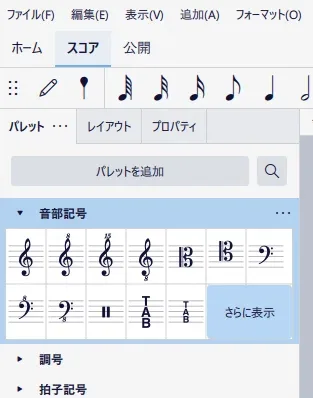
Have you ever taken a close look at the clef list in music notation software?
Treble clef, bass clef, alto clef, tenor clef... these are symbols we often use.
However, if you search further down, there are symbols mixed in that make you want to retort,
"Who uses this?"
.
The prime example is this.
One is a symbol that looks like two treble clefs stacked on top of each other.
The other is a symbol with a mysterious claw attached to a treble clef.
They both look like they've glitched out, don't they...
That said, of course, they are not nonsense symbols.
They have been used properly throughout history and are strictly included in music industry standards.
Such as the font standard "SMuFL" and the data standard "MEI".
............However.
Have you ever seen such symbols in an actual musical score???
Even if you were to conduct a survey right in front of a music college, I guarantee that 99% of people would answer NO.
If that's the case, who, when, and for what purpose were such super-minor symbols used?
So, I started my investigation right away, but...
As I dug into actual musical scores, some quite interesting behind-the-scenes stories of music history began to emerge.
So this time, while chasing the identity of this double treble clef, I would like to look at the "standardization race" of choral scores that was happening in the 19th century.
Tenor and Treble Clef
First, let's organize the premises.
The two mystery symbols I introduced earlier were actually both used for the tenor part in choral music.
Furthermore, they share the same meaning, both indicating
"this treble clef means to sing one octave lower than the written notes"
.
In other words, both have the exact same role as the current "treble clef + 8"!
If you are involved in choral music, you often see the symbol with an "8" written below the treble clef, don't you?
So, why was it necessary to prepare such a special symbol just for the tenor in the first place?
Other parts don't have special symbols.
Actually, the tenor was not originally written with the treble clef as it is today.
A while ago, it was common to write it with the C clef.
This is what is known as the tenor clef, a clef that is still occasionally used for trombones and cellos today.
However, as we moved into the modern era, vocal music also progressed toward using the more common treble clef.
It's easier to read if the symbols are standardized, after all.
Now, a problem arose here.
Naturally, the tenor is a part sung by men.
Since their voices are lower than women's, writing it in the treble clef makes the notes too high.
In fact, in modern notation, we write an "8" below the treble clef to indicate singing one octave lower, right?
This allows it to perfectly match the tenor's vocal range.
However, before this notation became established, there was no fixed answer to the problem of
"how to distinguish a tenor part one octave lower from a normal treble clef?"
One of the solutions born from this was the double treble clef, which is the protagonist of this story.
Double treble clef, double the meaning
First, let's verify if this symbol was really for the tenor.
Looking at the 19th-century music dictionary "Grove," the double treble clef is described as being used for the tenor part in choral music and as a symbol to sing one octave lower than the written notes.
In other words, at least in the 19th century, it was recognized as
Double G Clef = G clef for tenor, sounding one octave lower
.
"I see. So back then, instead of writing an '8', they just wrote two G clefs."
…If that were all, it would be a simple story.
However, when looking into the digital music notation standard MEI, a strange note appears.
It turns out that the double G clef also has
“a completely different meaning”
—that is, “two voices sharing one staff.” (!!!) What on earth does this mean?
It means this.
This is the score from the first edition of Mozart's "Requiem in D minor," where the clarinet part is written with a double G clef.
So, two clarinets are written together on one staff.
…I see, it makes sense if you think that because there are two of them, they wrote two G clefs.
However, this usage has a completely different function from the
“G clef for tenor, sounding one octave lower”
mentioned earlier, which is incredibly confusing.
Why would they give one symbol two meanings…?
…But the really complicated part starts here.
When you examine actual scores, the story becomes even more intricate.
Unsettled Usage
So, let's take a look at where the double G clef was actually used.
This is where the 19th-century British musician Otto Goldschmidt comes in.
He was a music editor who was involved in the creation of numerous scores and left behind many examples of the double G clef.
For example, this one.
Oh, that is definitely a double G clef!
It is clearly written in the tenor part of the choir.
In fact, when you look up the double G clef in 2025 Unicode-related materials, Goldschmidt's usage examples are centrally featured, and furthermore,
It is even written that.
Reading just this,
I see, the double treble clef for tenor usage was devised by Goldschmidt!
The double treble clef for "two-part" usage is a symbol that was used in a completely different context!
It starts to feel like that.
…However, when you actually open "The Bach Choir Magazine," the situation was not that simple.
Surprisingly, Goldschmidt was using this symbol in both senses, mixing them up. (!)
Here is the actual sheet music.
In this example, the double treble clef is written to combine two parts, "tenor & contralto," onto one staff.
This example, isn't it quite ambiguous?
Certainly, it includes a tenor, so it also looks like it means "one octave lower."
However, at the same time, it is also combining two parts onto one staff.
In other words, from this alone, it is unclear whether Goldschmidt himself strictly distinguished between these two meanings.
…Could it be that the double treble clef was originally a symbol meaning
"there are two parts on this staff"
, meaning the "two-part" usage was the mainstream?
And perhaps Goldschmidt just appropriated it for the tenor "one octave lower" meaning as well…?
Furthermore, the following is written in Unicode-related materials.
That is quite a blunt statement...
This symbol, which is now completely obsolete, seems to have already been obsolete 100 years ago.
Looking at it this far, the double treble clef looks like
a minor symbol that Goldschmidt used on his own and never really caught on
.
In fact, even when searching online, nothing comes up other than Goldschmidt's examples....
However, if you check all of "The Bach Choir Magazine," this view becomes impossible to explain.
To conclude, this symbol (in this usage) was not something Goldschmidt thought of at all, and there were multiple people using it besides Goldschmidt.
Music research is tough!!!
Important material: "The Bach Choir Magazine"
First, let's briefly explain what this "The Bach Choir Magazine" actually is.
In reality, it is a continuously published sheet music series containing choral works to be performed by "The Bach Choir," a choir in 19th-century London.
It seems Goldschmidt served as the first music director of "The Bach Choir," and it was a sheet music series edited by Goldschmidt assuming use by such a choir, and published by the publisher Novello.
In other words, this is not
a document like a single surviving score where Goldschmidt happened to use a strange symbol personally
. It is
a fairly substantial collection of sheet music that was published by a publisher over many years for a choir that was actually active.
If that is the case, by examining this entire series, I should be able to tell whether the double treble clef was really a local symbol used only by Goldschmidt personally, or if it was used more generally.
............And so.
I tried my absolute best to get my hands on "The Bach Choir Magazine" and examined all 435 pages.
Is music research really this tough after all!?!!
Now, when I tallied up how many times the double treble clef was used throughout the entire collection, there were 48 scores containing tenor parts, and the double treble clef was used in 39 of them.
In other words, about 80 percent.
Moreover, many double treble clefs were also seen in scores edited by people other than Goldschmidt. This is a major discovery!
Because of that, it was definitely not
"a strange symbol that Goldschmidt just used every now and then"
.
At the very least, within "The Bach Choir Magazine," the double treble clef is commonly used by various people.
Well, that said, the series "The Bach Choir Magazine" itself was edited by Goldschmidt and published with the intention of being used by The Bach Choir.
Therefore, based on this alone, I cannot go so far as to say
"All of these people independently adopted the double treble clef!"
.
However, at the very least,
we can see that it was not a symbol that Goldschmidt tried out in just one song and then abandoned, but rather one used as the notation method for this entire series of scores
.
The Origin of the Double Treble Clef
So, it seems this symbol was not just Goldschmidt's.
Now, let's talk about another question:
"In the first place, was it Goldschmidt who thought of this symbol?"
As I mentioned earlier, the Unicode documentation is written as if Goldschmidt were the inventor.
However, the 19th-century music dictionary "Grove" contained the following information.
W-who is that!?!
The number of characters has suddenly increased, but here the name of the French composer André Grétry has appeared.
In other words, at least according to the description in "Grove," the tenor usage of the double treble clef existed before Goldschmidt...
I cannot go so far as to conclude that "Grétry invented the double treble clef," but it seems that at least
Grétry proposed it
↓
Oliphant used it
↓
Used in British choral publications, and also put into practical use by Goldschmidt
It seems there was a progression like that.
This means that the theory I was suspecting along the way,
“Was it originally a symbol for combining two parts onto one staff, which Goldschmidt then repurposed for the tenor?”
becomes quite difficult to believe.
This is because there are traces suggesting that a double treble clef indicating a tenor one octave lower had already been proposed and used even before Goldschmidt.
Ultimately, it doesn't seem like the tenor usage and the two-part usage can be simply explained by saying "one was born from the other."
Perhaps they were created separately, and Goldschmidt just happened to know both ways of using them...??
It feels a bit unsatisfying, but... this is what real historical research is like.
Meanwhile, in Italy
Now then.
Up until now, we have been following the history of music in England.
However, interestingly enough, for the same problem—that is,
“I want to write the tenor in treble clef, but I want to distinguish it from the regular treble clef!”
—a completely different answer was being used in Italy.
Here, please recall the other mystery symbol that appeared at the beginning.
The one with a mysterious claw growing out of the side of the treble clef.
Its role is also the same as the double treble clef,
used as a “treble clef for tenor one octave lower.”
However, the place where it was used is different.
The one using this symbol was the Italian publisher Ricordi.
In other words, just as the double treble clef was used by choral publishers in England, in Italy, a publisher called Ricordi was using a different symbol.
Isn't that interesting?
Both were trying to solve the same problem.
Yet, different symbols were used in England and Italy.
This means that in the 19th century, before the current way of writing "8 under the treble clef for tenor" became completely standardized, multiple methods coexisted depending on the publisher or publishing culture.
The two mystery symbols we saw at the beginning were remnants of that.
Ultimately, neither symbol became common, and today, the method of adding an "8" under the treble clef is widely used.
Both the double treble clef and the other symbol used by Ricordi disappeared from general sheet music.
...Nevertheless.
For some reason, both still remain in modern music notation software.
Summary
And so, we finally return to the initial question.
Why is such a symbol that almost no one uses included in standard software???
What is the reason it is properly registered in standards like SMuFL or MEI and can be typed in most software?
The reason is simple.
In other words, “to reproduce 'old sheet music' on a computer.”
There is nothing more to it, and you can consider them symbols that are not used at all today.
In other words,
being included in a standard does not mean it is a symbol still in use today.
So, when I dug deep into the two mystery symbols lurking in the corner of music notation software, I ended up finding a standardization race surrounding 19th-century tenor notation at the end of an incredible investigation.
How was it??!??
Once I get into dedicated research, it results in this amount of investigation, so I seriously get dizzy every time.
Still, it's fun to understand things that were previously unknown.
That's all for this article.
Thank you for reading until the end!
If you sympathize (?) with this overly difficult investigation, I would be happy if you could purchase this article as a tip.
A collection of links to all the materials introduced in the article will be included in the paid section!